


The Islamic State: How Viable Is It? | INSS
go to header go to content go to footer go to search
INSS logo The Institute for National Security Studies, Strategic, Innovative, Policy-Oriented Research, go to the home page
INSS
Tel Aviv University logo - beyond an external website, opens on a new page
  • Campus
  • Contact
  • עברית
  • Support Us
  • Research
    • Topics
      • Israel and the Global Powers
        • Israel-United States Relations
        • Glazer Israel-China Policy Center
        • Russia
        • Europe
        • Antisemitism and Delegitimization
      • Iran and the Shi'ite Axis
        • The Campaign Against Iran and the Shiite Axis
        • Iran
        • Lebanon and Hezbollah
        • Syria
        • Yemen and the Houthi Movement
        • Iraq and the Iraqi Shiite Militias
      • Conflict to Agreements
        • Israeli-Palestinian Relations
        • Hamas and the Gaza Strip
        • Peace Agreements and Normalization in the Middle East
        • Saudi Arabia and the Gulf States
        • Turkey
        • Egypt
        • Jordan
      • Israel’s National Security Policy
        • Military and Strategic Affairs
        • Societal Resilience and the Israeli Society
        • Jewish-Arab Relations in Israel
        • Climate, Infrastructure and Energy
        • Terrorism and Low Intensity Conflict
      • Cross-Arena Research
        • Data Analytics Center
        • Law and National Security
        • Advanced Technologies and National Security
        • Foreign Information Manipulation and Interference
        • Economics and National Security
    • Projects
      • Preventing the Slide into a One-State Reality
      • India-Middle East-Europe Economic Corridor (IMEC)
  • Publications
    • -
      • All Publications
      • INSS Insight
      • Policy Research and Papers
      • Special Publication
      • Strategic Assessment
      • Technology Platform
      • Memoranda
      • Posts
      • Books
      • Archive
  • Database
    • Surveys
    • Spotlight
    • Maps
    • Dashboards
  • Events
  • Team
  • About
    • Vision and Mission
    • History
    • Research Disciplines
    • Chairman of the Board
    • Board of Directors
    • Fellowship and Prizes
    • Annual Reports
    • Internships
  • Media
    • Communications
    • Video gallery
    • Press Releases
  • Podcast
  • Newsletter
  • Campus
Search in site
  • Research
    • Topics
    • Israel and the Global Powers
    • Israel-United States Relations
    • Glazer Israel-China Policy Center
    • Russia
    • Europe
    • Antisemitism and Delegitimization
    • Iran and the Shi'ite Axis
    • The Campaign Against Iran and the Shiite Axis
    • Iran
    • Lebanon and Hezbollah
    • Syria
    • Yemen and the Houthi Movement
    • Iraq and the Iraqi Shiite Militias
    • Conflict to Agreements
    • Israeli-Palestinian Relations
    • Hamas and the Gaza Strip
    • Peace Agreements and Normalization in the Middle East
    • Saudi Arabia and the Gulf States
    • Turkey
    • Egypt
    • Jordan
    • Israel’s National Security Policy
    • Military and Strategic Affairs
    • Societal Resilience and the Israeli Society
    • Jewish-Arab Relations in Israel
    • Climate, Infrastructure and Energy
    • Terrorism and Low Intensity Conflict
    • Cross-Arena Research
    • Data Analytics Center
    • Law and National Security
    • Advanced Technologies and National Security
    • Foreign Information Manipulation and Interference
    • Economics and National Security
    • Projects
    • Preventing the Slide into a One-State Reality
    • India-Middle East-Europe Economic Corridor (IMEC)
  • Publications
    • All Publications
    • INSS Insight
    • Policy Research and Papers
    • Special Publication
    • Strategic Assessment
    • Technology Platform
    • Memoranda
    • Posts
    • Books
    • Archive
  • Database
    • Surveys
    • Spotlight
    • Maps
    • Dashboards
  • Events
  • Team
  • About
    • Vision and Mission
    • History
    • Research Disciplines
    • Chairman of the Board
    • Board of Directors
    • Fellowship and Prizes
    • Internships
    • Annual Reports
    • Privacy Policy and Terms of Use
  • Media
    • Communications
    • Video gallery
    • Press Releases
  • Podcast
  • Newsletter
  • Campus
  • Contact
  • עברית
  • Support Us
bool(false)

Publications

Home Publications Books The Islamic State: How Viable Is It?

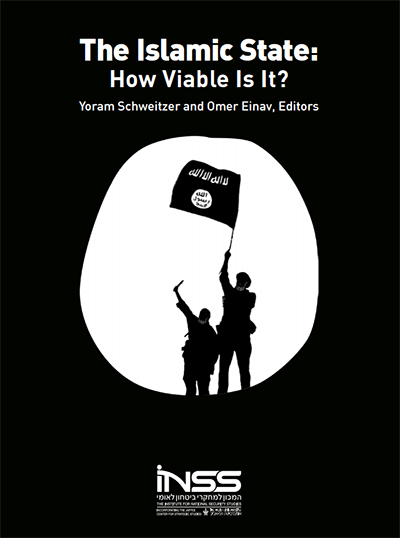
The Islamic State: How Viable Is It?

Tel Aviv: Institute for National Security Studies, 2016

Follow us on Google
עברית
Yoram Schweitzer
Omer Einav
The Islamic State burst onto the Middle East scene as an entity whose conduct and very essence challenge the existing regional order. With its military conquests in Iraq and Syria, its establishment of branches elsewhere in the Middle East and beyond, its state-like governance in the areas under its control, and the cruelty it typically exhibits, the Islamic State has become the focus of regional and international interest and concern. The articles compiled in this volume examine ways of dealing with one of the most salient military, sociopolitical, cultural, and intellectual challenges on today’s global agenda.

The Islamic State burst onto the Middle East scene as an entity whose conduct and very essence challenge the existing regional order. With its military conquests in Iraq and Syria, its establishment of branches elsewhere in the Middle East and beyond, its state-like governance in the areas under its control, and the cruelty it typically exhibits, the Islamic State has become the focus of regional and international interest and concern. The articles compiled in this volume examine ways of dealing with one of the most salient military, sociopolitical, cultural, and intellectual challenges on today’s global agenda.

There are many question marks surrounding the future of the Islamic State. Relating to historical, religious, military, economic, social, cultural, and geopolitical aspects, the articles in this volume address many of the questions prompted by the dramatic emergence of the Islamic State and examine ideas on how to grapple with this phenomenon. Taken together, they paint a portrait of the complex reality that has evolved in the Middle East in recent years, and attempt to outline future trends. In addition to this multi-disciplinary interpretation of the Islamic State and its related challenges, the collection presents insights that can assist in formulating policies to cope with this challenging situation.
________________________________________________________
Contents

Preface
Part I Background
A State Is Born: What Lies behind the Establishment of the Islamic State / Kobi Michael
The Islamic Caliphate: A Controversial Consensus / Ofir Winter
Radicalism and Islamic Terror: Historical Background / Meir Litvak 
The Internal Conflict in the Global Jihad Camp / Yoram Schweitzer Part II The Sum of Its Parts
The Islamic State as an Intelligence Challenge / David Siman-Tov and Yotam Hacohen
The Military Power of the Islamic State / Gabi Siboni
The Islamic State: Rich Organization, Poor State / Shmuel Even and Carmit Valensi
The Islamic State: Governance and Civilian Consolidation / Carmit Valensi
Fighting against the Islamic State: The Legal Challenges / Keren Aviram
The Islamic State’s Use of Social Media: Terrorism’s Siren Song in the Digital Age / Adam Hoffman
A Hitchhiker’s Guide to the Islamic State Galaxy / Orit Perlov

Part III From Where It Sprang, and the Nearby Environment
The Islamic State and the Iraqi State: A Guide to the Perplexed / Ronen Zeidel
The Islamic State Kingdom in Syria / Eyal Zisser
Kurdistan, the Islamic State, and Paradigm Shifts in the Middle East / Ofra Bengio
Lebanon and the Rise of the Islamic State / Benedetta Berti
Jordan and the Islamic State Challenge / Asher Susser
The Influence of the Islamic State on Israel’s Arab Citizens and on Palestinians in Gaza and the West Bank/ Aviad Mandelbaum and Yoram Schweitzer

Part IV Regional Forces
Iran vs. the Islamic State: The Enemy of My Enemy is also My Enemy / Ephraim Kam
The Islamic State vs. the Saudi State / Yoel Guzansky
Turkey in Face of the Threat from the Islamic State: Finally in Sync with its NATO Allies? / Gallia Lindenstrauss
Israel and the Islamic State / Shlomo Brom

Part V The Sphere of Influence
Wilayat Sinai: The Islamic State’s Egyptian Affiliate / Zack Gold
The Islamic State in Libya: Challenge and Response / Shaul Shay and Av Baras
The Islamic State and its Intentions for Africa / Smadar Shaul and Yoram Schweitzer
The Spread of the Islamic State in Southern Asia: Between Vision and Reality / Meirav Mishali-Ram

Part VI The World Powers
The United States vs. the Islamic State / Oded Eran and Afik Barak
Russia and the Islamic State Challenge / Zvi Magen, Sarah Fainberg, and Ilan Shklarsky
The European Union and the Rise of the Islamic State / Shimon Stein
The Islamic State: The Danger that China Would Rather Not Name / Eyal Propper

Part VII Threat Assessment and Strategic Confrontation

The Strategic Challenge: Contending with the Islamic State / Udi Dekel
The Islamic State Challenge: How Severe Is It? / Amos Yadlin

Conclusion
Above and Below the Surface of the Islamic State / Yoram Schweitzer and Omer Einav
Contributors

Click here for the complete text.

The opinions expressed in INSS publications are the authors’ alone.
Publication Series Books
TopicsAdvanced Technologies and National SecurityEuropeIranIraq and the Iraqi Shiite MilitiasIslamic StateIsrael-China Policy Center - The Diane and Guilford Glazer FoundationIsrael-United States RelationsJewish-Arab Relations in IsraelJordanRussiaSyriaTerrorism and Low Intensity ConflictTurkey
עברית

Events

All events
Israel’s National Security Conference
27 July, 2026
10:00 - 14:00

Related Publications

All publications
Generated with AI
From Red to Blue-and-White: The Strategic Necessity of Developing the Israeli Drone Industry
Chinese-made drones pose a range of security, technological, and geopolitical challenges for Israel. What measures should Israel take to mitigate the risks involved?
07/07/26
Shutterstock
The Battle over Access to Artificial Intelligence: Israel’s Next Strategic Challenge
The restrictions recently imposed on Anthropic — including the U.S. administration’s directive to limit access to certain models for users and entities outside the United States on national security grounds[1] — constitute a significant milestone in the evolving relationship between technology, national security, and foreign policy. Whereas over the past decade, the discourse surrounding digital sovereignty has focused on issues such as privacy, data localization, regulation, and cloud infrastructure, recent developments point to a transition to a new phase in which access to advanced artificial intelligence capabilities is becoming a strategic asset in itself. In this reality, not only data or chips are becoming objects of government policy, but also the models themselves. This article argues that the Anthropic case is not an isolated incident but rather a manifestation of a broader trend, in which artificial intelligence is becoming a central component of national power. As a result, access to advanced models may in the future become a policy tool, a mechanism of geopolitical influence, and a means of advancing strategic interests. For Israel, this development necessitates a reassessment of its approach to technological sovereignty and its policies in the fields of artificial intelligence, computing, and infrastructure, as well as a rethinking of its broader security paradigm. [1] The directive conveyed to Anthropic on June 12 by the Trump administration required the company to terminate access to its Fable 5 and Mythos 5 models for all foreign users, including the company’s foreign employees, users outside the United States, and international clients. According to reports, the company was given a very short timeline to implement the directive, under the threat of civil and criminal sanctions in the event of non-compliance. At a later stage, a limited exemption was granted, allowing the use of Mythos 5 for a small number of critical infrastructure organizations within the United States, while Fable 5 remained restricted.  
01/07/26
Shutterstock
The Pentagon’s AI-First Doctrine and Its Implications for Modern Warfare: Lessons from the Conflict with Iran
How has the new US policy—under which AI is positioned as a foundational component in the chain of command, intelligence gathering, and the planning of complex operations—been reflected on the battlefield, and what conclusions should be drawn in Israel?
19/03/26

Stay up to date

Registration was successful! Thanks.
  • Research

    • Topics
      • Israel and the Global Powers
      • Israel-United States Relations
      • Glazer Israel-China Policy Center
      • Russia
      • Europe
      • Antisemitism and Delegitimization
      • Iran and the Shi'ite Axis
      • The Campaign Against Iran and the Shiite Axis
      • Iran
      • Lebanon and Hezbollah
      • Syria
      • Yemen and the Houthi Movement
      • Iraq and the Iraqi Shiite Militias
      • Conflict to Agreements
      • Israeli-Palestinian Relations
      • Hamas and the Gaza Strip
      • Peace Agreements and Normalization in the Middle East
      • Saudi Arabia and the Gulf States
      • Turkey
      • Egypt
      • Jordan
      • Israel’s National Security Policy
      • Military and Strategic Affairs
      • Societal Resilience and the Israeli Society
      • Jewish-Arab Relations in Israel
      • Climate, Infrastructure and Energy
      • Terrorism and Low Intensity Conflict
      • Cross-Arena Research
      • Data Analytics Center
      • Law and National Security
      • Advanced Technologies and National Security
      • Foreign Information Manipulation and Interference
      • Economics and National Security
    • Projects
      • Preventing the Slide into a One-State Reality
      • India-Middle East-Europe Economic Corridor (IMEC)
  • Publications

    • All Publications
    • INSS Insight
    • Policy Research and Papers
    • Special Publication
    • Strategic Assessment
    • Technology Platform
    • Memoranda
    • Database
    • Posts
    • Books
    • Archive
  • About

    • Vision and Mission
    • History
    • Research Disciplines
    • Chairman of the Board
    • Board of Directors
    • Fellowship and Prizes
    • Internships
    • Annual Reports
    • Support
    • Privacy Policy and Terms of Use
  • Media

    • Communications
    • Video Gallery
    • Press Release
    • Podcast
  • Home

  • Events

  • Database

  • Team

  • Contact

  • Newsletter

  • עברית

INSS logo The Institute for National Security Studies, Strategic, Innovative, Policy-Oriented Research, go to the home page
40 Haim Levanon St. Tel Aviv, 6997556 Israel | Tel 03-640-0400 | Fax 03-744-7590 |
Developed by Daat ,Yael Group.
Accessibility Statement
This site is protected by reCAPTCHA and the Google Privacy Policy and Terms of Service apply.