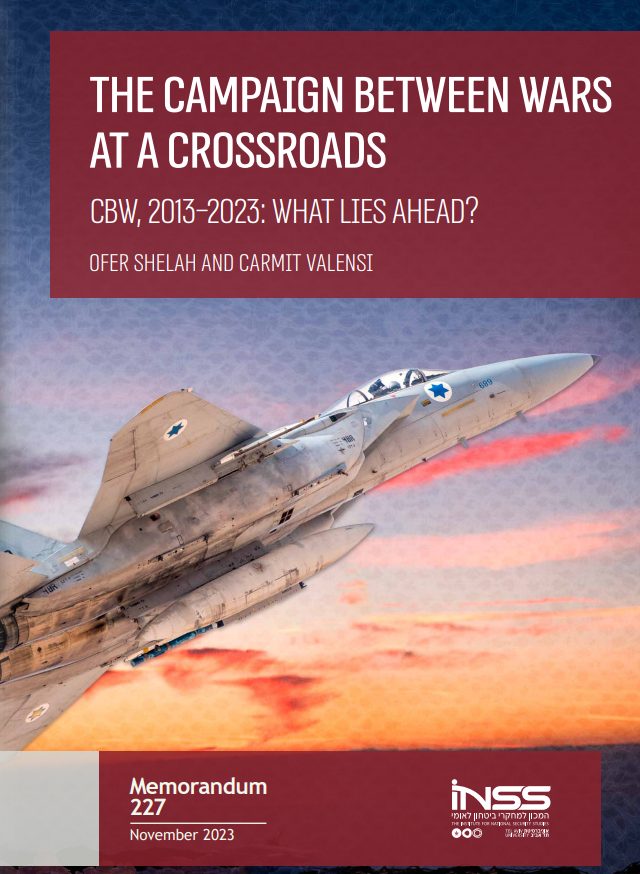
The Campaign between Wars at a Crossroads - CBW, 2013-2023: What Lies Ahead? | INSS
go to header go to content go to footer go to search
INSS logo The Institute for National Security Studies, Strategic, Innovative, Policy-Oriented Research, go to the home page
INSS
Tel Aviv University logo - beyond an external website, opens on a new page
  • Campus
  • Contact
  • עברית
  • Support Us
  • Research
    • Topics
      • Israel and the Global Powers
        • Israel-United States Relations
        • Glazer Israel-China Policy Center
        • Russia
        • Europe
        • Antisemitism and Delegitimization
      • Iran and the Shi'ite Axis
        • Operation Roaring Lion
        • Iran
        • Lebanon and Hezbollah
        • Syria
        • Yemen and the Houthi Movement
        • Iraq and the Iraqi Shiite Militias
      • Conflict to Agreements
        • Israeli-Palestinian Relations
        • Hamas and the Gaza Strip
        • Peace Agreements and Normalization in the Middle East
        • Saudi Arabia and the Gulf States
        • Turkey
        • Egypt
        • Jordan
      • Israel’s National Security Policy
        • Military and Strategic Affairs
        • Societal Resilience and the Israeli Society
        • Jewish-Arab Relations in Israel
        • Climate, Infrastructure and Energy
        • Terrorism and Low Intensity Conflict
      • Cross-Arena Research
        • Data Analytics Center
        • Law and National Security
        • Advanced Technologies and National Security
        • Foreign Information Manipulation and Interference
        • Economics and National Security
    • Projects
      • Preventing the Slide into a One-State Reality
      • India-Middle East-Europe Economic Corridor (IMEC)
  • Publications
    • -
      • All Publications
      • INSS Insight
      • Policy Papers
      • Special Publication
      • Strategic Assessment
      • Technology Platform
      • Memoranda
      • Posts
      • Books
      • Archive
  • Database
    • Surveys
    • Spotlight
    • Maps
    • Dashboards
  • Events
  • Team
  • About
    • Vision and Mission
    • History
    • Research Disciplines
    • Chairman of the Board
    • Board of Directors
    • Fellowship and Prizes
    • Internships
  • Media
    • Communications
    • Video gallery
    • Press Releases
  • Podcast
  • Newsletter
  • Campus
Search in site
  • Research
    • Topics
    • Israel and the Global Powers
    • Israel-United States Relations
    • Glazer Israel-China Policy Center
    • Russia
    • Europe
    • Antisemitism and Delegitimization
    • Iran and the Shi'ite Axis
    • Operation Roaring Lion
    • Iran
    • Lebanon and Hezbollah
    • Syria
    • Yemen and the Houthi Movement
    • Iraq and the Iraqi Shiite Militias
    • Conflict to Agreements
    • Israeli-Palestinian Relations
    • Hamas and the Gaza Strip
    • Peace Agreements and Normalization in the Middle East
    • Saudi Arabia and the Gulf States
    • Turkey
    • Egypt
    • Jordan
    • Israel’s National Security Policy
    • Military and Strategic Affairs
    • Societal Resilience and the Israeli Society
    • Jewish-Arab Relations in Israel
    • Climate, Infrastructure and Energy
    • Terrorism and Low Intensity Conflict
    • Cross-Arena Research
    • Data Analytics Center
    • Law and National Security
    • Advanced Technologies and National Security
    • Foreign Information Manipulation and Interference
    • Economics and National Security
    • Projects
    • Preventing the Slide into a One-State Reality
    • India-Middle East-Europe Economic Corridor (IMEC)
  • Publications
    • All Publications
    • INSS Insight
    • Policy Papers
    • Special Publication
    • Strategic Assessment
    • Technology Platform
    • Memoranda
    • Posts
    • Books
    • Archive
  • Database
    • Surveys
    • Spotlight
    • Maps
    • Dashboards
  • Events
  • Team
  • About
    • Vision and Mission
    • History
    • Research Disciplines
    • Chairman of the Board
    • Board of Directors
    • Fellowship and Prizes
    • Internships
    • Privacy Policy and Terms of Use
  • Media
    • Communications
    • Video gallery
    • Press Releases
  • Podcast
  • Newsletter
  • Campus
  • Contact
  • עברית
  • Support Us
bool(false)

Publications

Home Publications Memoranda The Campaign between Wars at a Crossroads - CBW, 2013-2023: What Lies Ahead?

The Campaign between Wars at a Crossroads - CBW, 2013-2023: What Lies Ahead?

Memorandum 227, November 2023

עברית
Ofer Shelah
Carmit Valensi

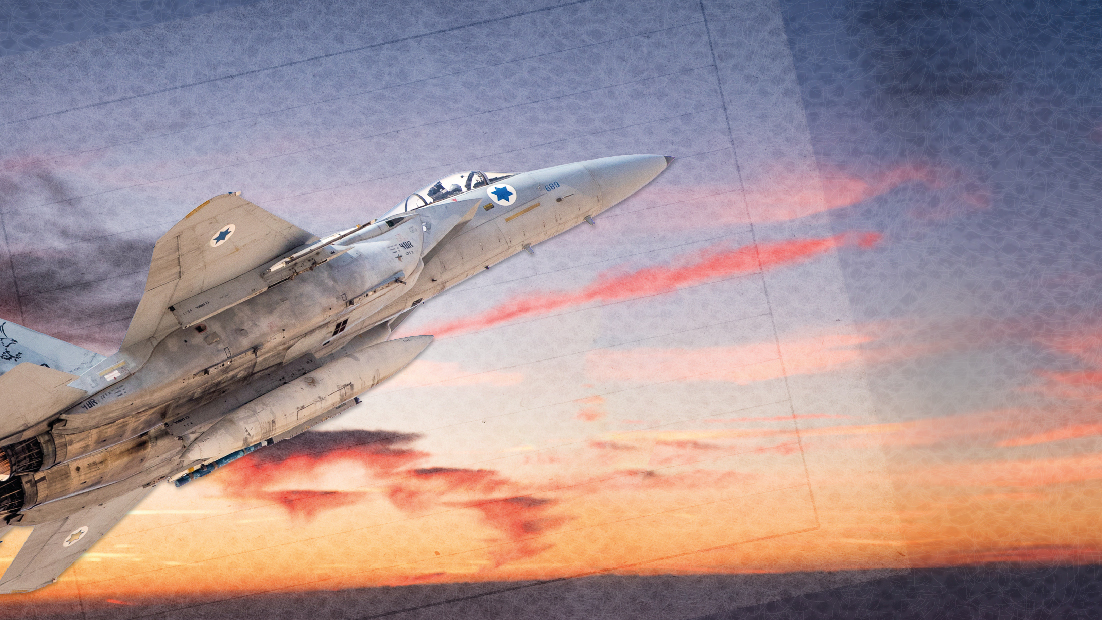
The Campaign Between Wars (CBW) is the term given to the IDF’s significant offensive activity over the past decade. What began in 2013 as specific, targeted actions with limited objectives, developed into an extensive campaign in physical and geographical terms and was anchored in the IDF operations approach, with far-reaching strategic ramifications.


CBW did indeed demonstrate advanced capabilities in intelligence and aerial action. But at the end of a decade and in view of significant changes in the region, there is a need to review and update the campaign’s benefits and its influence on Israel’s regional situation, the danger of a multi-front conflict, and IDF readiness for such a conflict.


This memorandum examines CBW’s roots in the IDF operational concept, its development, and its achievements and limitations, and considers how it has been perceived by Israel’s various enemies during different phases over the past decade. It also examines recent significant changes in the arena and in the world. The study concludes that the current policy provides only a partial response to the the “axis of resistance” led by Iran, and even reinforces the willingness of the enemies to take risks that could lead to escalation; on the other hand, CBW does not necessarily contribute to the IDF’s preparedness to meet these risks.


Consequently, a change in the operational concept is recommended, with the following action items: sharpen the kinetic activity and develop other ways of operating in order to achieve Israel’s objectives in Syria and in Lebanon; prepare the IDF for a multi-front conflict and underscore through preparations and actions that Israel is not afraid of such a conflict; work on creating regional and global coalitions that can act as a counterweight to the growing power of Iran, the axis of resistance, and the increasing closeness to Russia and China. In this way Israeli activity can reduce the chances of escalation while improving readiness if it does occur.


Click here to download the full Memorandum

Table of Contents:

This memorandum was written and published in Hebrew before the attack by Hamas on Israel on October 7, 2023 and the outbreak of the Swords of Iron war in Gaza, which is still ongoing as of the writing of this note. In the first weeks of the war there were daily exchanges of fire between Israel and Hezbollah, and while both sides have seemed reluctant to engage in a full scale war, the possibility of a far more serious escalation clearly exists. There is also increased awareness in Israel that the pre-war status quo in the north is no longer tenable, and the Hezbollah threat will have to be addressed sooner or later.

Israel is making an effort to amend the pre-war situation in at least one important aspect: the distancing of Hezbollah’s Radwan elite units from its border, and the reestablishment of the situation on the ground predicated in UN Resolution 1701, reached with the conclusion of the Second Lebanon War in 2006: no Hezbollah military presence south of the Litani River. It has yet to be seen whether that is achievable without larger scale military operations. All of this will obviously have a considerable effect on the future objectives and methods of Israel’s “campaign between wars” (CBW). Our conclusion in the memorandum, namely, that there is an urgent need to examine in depth the objectives, achievements, and future operational directions of the campaign between wars, as perhaps it had exhausted its usefulness, may seem obvious at this stage.

On the other hand, within the Israeli military establishment there is a growing understanding of some of the conclusions drawn in the memorandum, for example, that CBW helped Israel’s enemies develop their “axis of resistance” strategy. The tragic events of October 7 also brought home all too painfully the effects of ignoring the impact of the emphasis on CBW on Israel's readiness for war, and in particular, multi-front war. Some will argue that under the current circumstances Israel is already facing a multi-front war, both in terms THE CAMPAIGN BETWEEN WARS AT A CROSSROADS THE CAMPAIGN BETWEEN WARS AT A CROSSROADS 8 of the readiness of the force and in terms of the enemy's belief that Israel is averse to conflict. This too is discussed in this study.

CBW will be different after the war is over. We believe that a study of its origins, developments, and effects on both sides, like the one presented here, is essential for future decisions about Israel’s future security policy, as well as the IDF’s force buildup and concept of operation.

The “campaign between wars” (CBW) is the official term in the Israeli security establishment for the series of offensive actions that Israel has launched, primarily in Syrian territory, over the past decade. What began as individual pinpoint actions aimed at preventing the transfer of advanced weapons from a disintegrating Syria to the Hezbollah organization in Lebanon developed into a physically and geographically large-scale campaign that has been anchored in Israel’s military operational concept, including in the IDF Strategy documents....
Read more

Early 2023 marked 10 years since the first strike in Syrian territory attributed to Israel, in the framework of what came to be known as the “campaign between wars” (CBW). What began as a small number of individual strikes, intended to prevent the transfer of advanced weapons to Hezbollah, developed over the years into an ongoing and intensifying campaign in Syria and elsewhere that has become a central focus of IDF activity and attention...
Read more

The campaign between wars has preoccupied the IDF command increasingly over the past decade, and has occupied an arena in which the IDF – which has been hard pressed to achieve unequivocal success in the conflict with Hamas in the Gaza Strip or with Hezbollah in Lebanon – has felt a sense of significant achievement. Lt. Gen. (ret.) Gadi Eisenkot, who as Chief of Staff (2015-2019) oversaw a large number of strikes by the IDF outside of Israel, especially in Syria, noted this in an interview with the New York Times at the end of his tenure...
Read more

Israel’s first strike in Syria attributed to the CBW period occurred in January 2013, nearly two years after the civil war erupted. The target, according to foreign sources, was a convoy transporting SA-17 anti-aircraft missiles from Syria to Lebanon – a claim the Syrians denied, although they admitted that an Israeli attack was carried out within their territory.20 A few days later, then Minister of Defense Ehud Barak hinted that it was indeed an Israeli attack, and stated: “We said that we believe advanced weapons should not be allowed to be transferred to Hezbollah…When we say something, we mean it.”...
Read more

On September 30, 2015, Russians forces entered Syria and deployed at the Khmeimim Air Base and the Port of Tartous. At the peak of its military presence, Russia’s order of battle included about 70 fighter aircraft (Sukhoi 24, 25, 30, 34, and 35), transport aircraft, and attack helicopters, hundreds of drones, advanced air defense systems (SA-22, S-400, and electronic warfare), T-90 tanks, ships, submarines, and about 4,000 soldiers, including commando units...
Read more

Toward the end of Chief of Staff Eisenkot’s term, some in Israel began to see the campaign between wars as no longer directed primarily at enemy capabilities – game-changing weapons in the hands of Hezbollah or Iranian proxies in Syria – but rather a campaign against Iran itself, and specifically against the Quds Force and the Revolutionary Guards. Eisenkot himself stated in an interview with the New York Times at the end of his term in 2019 that Qasem Soleimani (killed by the United States about a year later) erred in “choosing a playground where he is relatively weak,” given Israel’s complete intelligence and air superiority in the Syrian arena and the international justification for Israel’s action against Iranian entrenchment...
Read more

The campaign between wars is the most evident expression of Israel’s advanced capabilities – those of the IDF and the intelligence organizations – in acquiring precise intelligence and turning it into surgical action. In the past decade, according to reports, targets varying from weapons convoys to suitcases at the Damascus International Airport were attacked, all while impressively limiting the damage to the target itself and refraining, if so decided, from human casualties – in part in order to observe the red lines set by the sides over time...
Read more

The operational success of CBW, the satisfaction at the unprecedented level of intelligence behind them, the precise execution in the vast majority of the operations, and the almost total prevention of casualties on the Israeli side have created trends in Israel that are familiar from routine security operations during the days of the major wars...
Read more

The opinions expressed in INSS publications are the authors’ alone.
Publication Series Memoranda
TopicsLebanon and HezbollahMilitary and Strategic AffairsSyria
עברית

Events

All events
Iran, US, Israel, and the Global Jewish Community
10 March, 2026
12:00 - 13:00
Shutterstock

Related Publications

All publications
Interactive Live Map: Lebanon Following Operation Roaring Lion (Epic Fury)
The interactive map herein provides a situational overview of the Lebanese arena during Operation Roaring Lion (Epic Fury) and following the ceasefire agreement that came into effect on April 16, 2026. The map displays the Israeli security zone, IDF strikes in the vicinity, as well as IDF outposts and UN bases. The map is updated continuously with the highest possible precision, based on open-source intelligence (OSINT) and media reports.
05/05/26
Hezbollah’s Global Financial Network as a Target in the War Against the Organization
How can Hezbollah’s financial resilience—based on a complex and sprawling global system that enables it to withstand IDF infrastructure strikes in Lebanon—be undermined?
03/05/26
Marwan Naamani/dpa via Reuters Connect
The Long Road to Disarming Hezbollah—A DDR Model for Lebanon
Assuming that Operation Roaring Lion does not end in the complete defeat of Hezbollah, the issue of disarming Hezbollah will remain on the agenda at its conclusion—an interest shared by both Israel and the Lebanese state. This article proposes adopting the DDR model—Disarmament, Demobilization, and Reintegration—and advancing an L(ebanon)DDR process as an orderly framework for disarming Hezbollah and integrating it into Lebanon, alongside repairing, rebuilding, and strengthening the Lebanese state. This framework offers an alternative to disarming Hezbollah through military force, which would require Israel to occupy all of Lebanon. Although it is clear that Hezbollah will not relinquish its weapons easily, the current circumstances present an opportunity to force this outcome through combined Lebanese–Israeli, regional, and international efforts. These circumstances include the willingness of Israel and Lebanon to enter into direct political negotiations; the military weakening of Hezbollah (and Iran) following the war; the IDF’s presence in southern Lebanon; and the growing support within Lebanon for disarming Hezbollah. On April 9, Israel agreed to President Aoun’s proposal to open direct negotiations with Lebanon to promote a peace arrangement and disarm Hezbollah. This objective is the central challenge on the path to an agreement between the two states, which would establish the Lebanese government’s monopoly over the use of military force. Experience from DDR processes suggests that this model can help, as it offers a long-term, supervised, and gradual process that combines disarmament with civil, social, and economic rehabilitation, alongside international support and reciprocal incentives for all parties involved.
15/04/26

Stay up to date

Registration was successful! Thanks.
  • Research

    • Topics
      • Israel and the Global Powers
      • Israel-United States Relations
      • Glazer Israel-China Policy Center
      • Russia
      • Europe
      • Antisemitism and Delegitimization
      • Iran and the Shi'ite Axis
      • Operation Roaring Lion
      • Iran
      • Lebanon and Hezbollah
      • Syria
      • Yemen and the Houthi Movement
      • Iraq and the Iraqi Shiite Militias
      • Conflict to Agreements
      • Israeli-Palestinian Relations
      • Hamas and the Gaza Strip
      • Peace Agreements and Normalization in the Middle East
      • Saudi Arabia and the Gulf States
      • Turkey
      • Egypt
      • Jordan
      • Israel’s National Security Policy
      • Military and Strategic Affairs
      • Societal Resilience and the Israeli Society
      • Jewish-Arab Relations in Israel
      • Climate, Infrastructure and Energy
      • Terrorism and Low Intensity Conflict
      • Cross-Arena Research
      • Data Analytics Center
      • Law and National Security
      • Advanced Technologies and National Security
      • Foreign Information Manipulation and Interference
      • Economics and National Security
    • Projects
      • Preventing the Slide into a One-State Reality
      • India-Middle East-Europe Economic Corridor (IMEC)
  • Publications

    • All Publications
    • INSS Insight
    • Policy Papers
    • Special Publication
    • Strategic Assessment
    • Technology Platform
    • Memoranda
    • Database
    • Posts
    • Books
    • Archive
  • About

    • Vision and Mission
    • History
    • Research Disciplines
    • Chairman of the Board
    • Board of Directors
    • Fellowship and Prizes
    • Internships
    • Support
    • Privacy Policy and Terms of Use
  • Media

    • Communications
    • Video Gallery
    • Press Release
    • Podcast
  • Home

  • Events

  • Database

  • Team

  • Contact

  • Newsletter

  • עברית

INSS logo The Institute for National Security Studies, Strategic, Innovative, Policy-Oriented Research, go to the home page
40 Haim Levanon St. Tel Aviv, 6997556 Israel | Tel: 03-640-0400 | Fax: 03-744-7590 | Email: info@inss.org.il
Developed by Daat ,Yael Group.
Accessibility Statement
This site is protected by reCAPTCHA and the Google Privacy Policy and Terms of Service apply.