


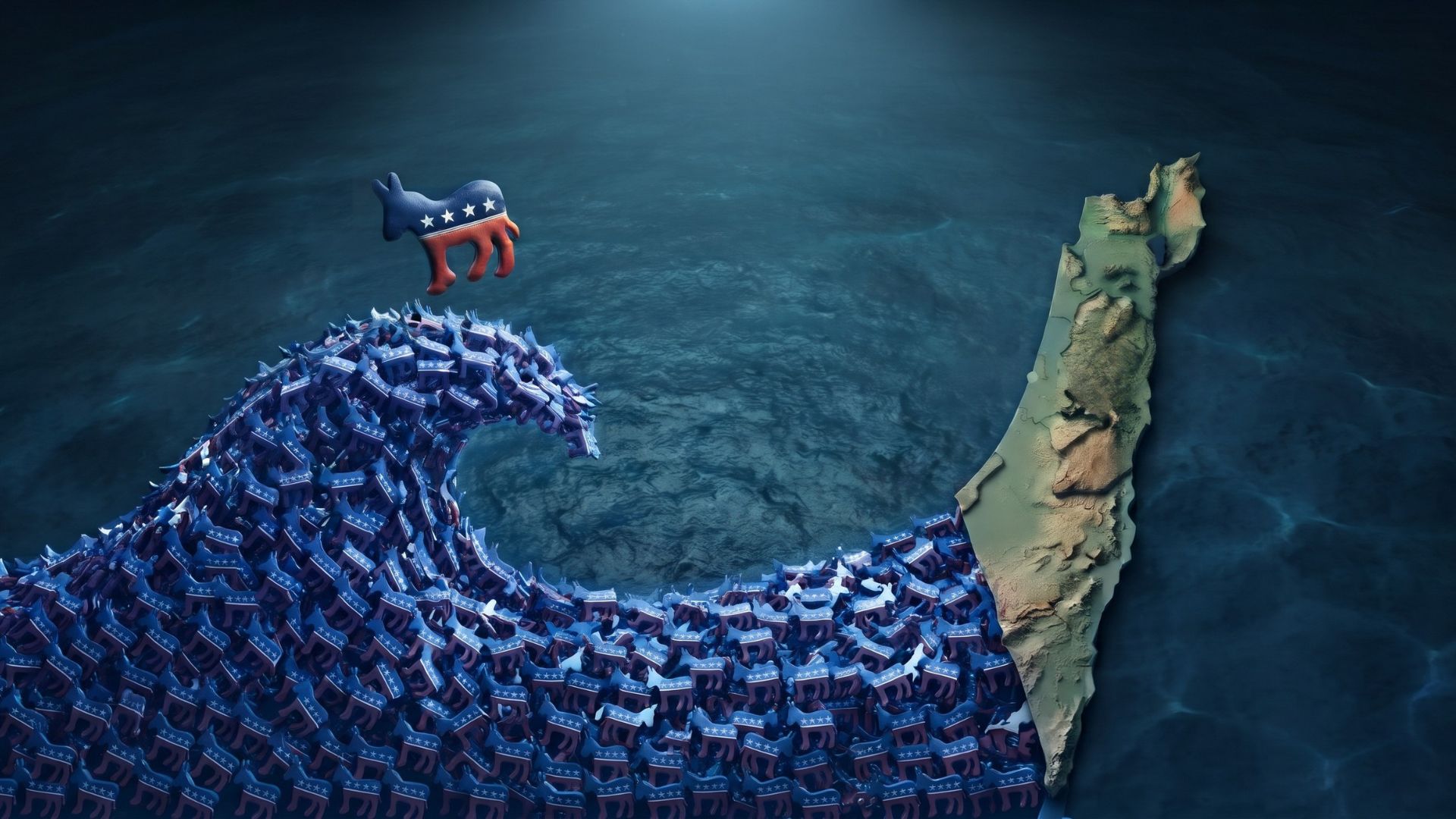
What the Democratic Tidal Wave Means for Israel | INSS
go to header go to content go to footer go to search
INSS logo The Institute for National Security Studies, Strategic, Innovative, Policy-Oriented Research, go to the home page
INSS
Tel Aviv University logo - beyond an external website, opens on a new page
  • Campus
  • Contact
  • עברית
  • Support Us
  • Research
    • Topics
      • Israel and the Global Powers
        • Israel-United States Relations
        • Glazer Israel-China Policy Center
        • Russia
        • Europe
        • Antisemitism and Delegitimization
      • Iran and the Shi'ite Axis
        • The Campaign Against Iran and the Shiite Axis
        • Iran
        • Lebanon and Hezbollah
        • Syria
        • Yemen and the Houthi Movement
        • Iraq and the Iraqi Shiite Militias
      • Conflict to Agreements
        • Israeli-Palestinian Relations
        • Hamas and the Gaza Strip
        • Peace Agreements and Normalization in the Middle East
        • Saudi Arabia and the Gulf States
        • Turkey
        • Egypt
        • Jordan
      • Israel’s National Security Policy
        • Military and Strategic Affairs
        • Israel's Security Strategy
        • Societal Resilience and the Israeli Society
        • Jewish-Arab Relations in Israel
        • Climate, Infrastructure and Energy
        • Terrorism and Low Intensity Conflict
      • Cross-Arena Research
        • Data Analytics Center
        • Law and National Security
        • Advanced Technologies and National Security
        • Foreign Information Manipulation and Interference
        • Economics and National Security
    • Projects
      • Preventing the Slide into a One-State Reality
      • India-Middle East-Europe Economic Corridor (IMEC)
  • Publications
    • -
      • All Publications
      • INSS Insight
      • Policy Research and Papers
      • Special Publication
      • Strategic Assessment
      • Technology Platform
      • Memoranda
      • Posts
      • Books
      • Archive
  • Database
    • Surveys
    • Spotlight
    • Maps
    • Dashboards
  • Events
  • Team
  • About
    • Vision and Mission
    • History
    • Research Disciplines
    • Chairman of the Board
    • Board of Directors
    • Fellowship and Prizes
    • Annual Reports
    • Internships
  • Media
    • Communications
    • Video gallery
    • Press Releases
  • Podcast
  • Newsletter
  • Campus
Search in site
  • Research
    • Topics
    • Israel and the Global Powers
    • Israel-United States Relations
    • Glazer Israel-China Policy Center
    • Russia
    • Europe
    • Antisemitism and Delegitimization
    • Iran and the Shi'ite Axis
    • The Campaign Against Iran and the Shiite Axis
    • Iran
    • Lebanon and Hezbollah
    • Syria
    • Yemen and the Houthi Movement
    • Iraq and the Iraqi Shiite Militias
    • Conflict to Agreements
    • Israeli-Palestinian Relations
    • Hamas and the Gaza Strip
    • Peace Agreements and Normalization in the Middle East
    • Saudi Arabia and the Gulf States
    • Turkey
    • Egypt
    • Jordan
    • Israel’s National Security Policy
    • Military and Strategic Affairs
    • Israel's Security Strategy
    • Societal Resilience and the Israeli Society
    • Jewish-Arab Relations in Israel
    • Climate, Infrastructure and Energy
    • Terrorism and Low Intensity Conflict
    • Cross-Arena Research
    • Data Analytics Center
    • Law and National Security
    • Advanced Technologies and National Security
    • Foreign Information Manipulation and Interference
    • Economics and National Security
    • Projects
    • Preventing the Slide into a One-State Reality
    • India-Middle East-Europe Economic Corridor (IMEC)
  • Publications
    • All Publications
    • INSS Insight
    • Policy Research and Papers
    • Special Publication
    • Strategic Assessment
    • Technology Platform
    • Memoranda
    • Posts
    • Books
    • Archive
  • Database
    • Surveys
    • Spotlight
    • Maps
    • Dashboards
  • Events
  • Team
  • About
    • Vision and Mission
    • History
    • Research Disciplines
    • Chairman of the Board
    • Board of Directors
    • Fellowship and Prizes
    • Internships
    • Annual Reports
    • Privacy Policy and Terms of Use
  • Media
    • Communications
    • Video gallery
    • Press Releases
  • Podcast
  • Newsletter
  • Campus
  • Contact
  • עברית
  • Support Us
bool(false)

Publications

Home Publications INSS Insight What the Democratic Tidal Wave Means for Israel

What the Democratic Tidal Wave Means for Israel

How will the Democrats’ sweeping midterm victory affect Israel, and how should it respond?

INSS Insight No. 2213, November 5, 2026

Follow us on Google
עברית
Theodore Sasson
Avishay Ben Sasson-Gordis

The Democrats’ sweeping victory in the U.S. midterm elections is likely to reshape the U.S.-Israel relationship. With President Trump moving to end military assistance two years before the current Memorandum of Understanding expires, and Vice President Vance attributing the Republican defeat to the Iran war and support for Israel, the $3.3 billion annual commitment can no longer be taken for granted, and a successor agreement faces steeper odds. Democrats will set the agenda, and sanctions over settler violence and new settlement construction, along with conditions on arms sales, may advance quickly. Their fate, however, turns on a divided caucus. While most Democrats back punitive measures against settler violence, fewer support limits on arms sales, meaning pro-Israel Democrats and Republicans may still block some bills. Israel is not powerless: its own elections create an opening to shift the terms of debate. Seizing that opportunity, however, will require forming a new government and acting swiftly on Democrats’ central concerns: settler violence, new settlement construction, and implementation of the 20-Point Plan for Gaza.


In this week’s U.S. midterm elections, Democrats have won sweeping victories in both houses of Congress, securing majorities that exceed all forecasts.

All 435 House seats were in play, and Democrats are on track to win about 260 seats, and possibly more. The Senate turns over more slowly, with only one-third of seats up this cycle. Even so, Democrats won every race in the so-called “blue” and “purple” states, as well as in some Republican strongholds such as Kansas, Iowa, Texas, and possibly Mississippi.

Midterm elections typically favor the party opposed to the president, but the scope of this shift is historic. It is a sweeping repudiation of the Trump administration in an election that focused on cost of living, the Iran war, allegations of corruption, and concerns about AI and data centers.

Israel was a prominent issue in many campaigns, with Democrats calling to end or condition foreign military aid and downgrade the U.S.-Israel alliance. In Michigan, Democratic Senate candidate Dr. Abdul El-Sayed defeated his Republican opponent by a comfortable margin. El-Sayed is known for harsh criticism of Israel and, most recently, declined to condemn outright a political ad by his supporters that blamed Israel for high grocery prices.

In an apparent nod to the unpopularity of U.S. military assistance to Israel, President Trump announced on election day that he had reached an agreement with Prime Minister Netanyahu to end U.S. support next month, two years before the current Memorandum of Understanding expires and before an alternative is in place. As the magnitude of the Republican defeat became evident, Vice President Vance published a post on X attributing the loss to the Iran war and U.S. support for Israel. President Trump later characterized Vance’s assessment as “largely true.”

Taking control of both chambers, Democrats will set the agenda for the new Congress. In an Election Day post on X, Sen. Chris Coons, the incoming chair of the Senate Foreign Relations Committee, sought to reassure Israelis:

“As the U.S. goes to the polls today, I am encouraged by statements from Israeli leaders following last week’s election. They are signaling a potential path forward that could set Israel on a positive new trajectory. While uncertainty remains, I applaud Gadi Eisenkot and other Israeli opposition leaders for their willingness to make courageous choices. Core values as democratic societies form the basis of our partnership, and we know protecting them is worth the effort.”

Nonetheless, Coons himself has co-sponsored legislation that would impose economic sanctions on Israelis for settler violence and for facilitating settlement construction in the contentious E1 corridor. Such legislation may now be fast-tracked in the incoming Congress, along with bills that limit or condition future arms sales to Israel.

Not all such bills will pass. Most Democrats support the punitive legislation on settler violence in the West Bank, but they are more divided on limiting arms sales. Republicans in the Senate and House have taken a consistently pro-Israel line, almost unanimously, throughout the Biden and Trump presidencies. If that pattern holds, some of the legislation in the pipeline could possibly be thwarted by an alliance of Republicans and pro-Israel Democrats (who make up nearly a third of all congressional Democrats).

The figure below, based on INSS analyses from recent months, compares the distribution of Israel-related factions within the Democratic Party in the current and incoming Congresses, based on nearly complete election results. The Left Progressive camp, which supports a full arms embargo against Israel, is set to grow only modestly. The Mainstream Progressive camp, which supports conditioning arms sales but generally backs the wider U.S.-Israel alliance, will remain the largest faction. Pro-Israel Democrats, the guardians of the “special relationship” between Israel and the United States, will retain considerable weight within the party. Thus, Pro-Israel Democrats combined with Republicans may still comprise narrow majorities in one or both chambers, though this remains uncertain as the final election results are tallied.

Democratic seats by Israel-related faction, 119th and 120th U.S. Congresses
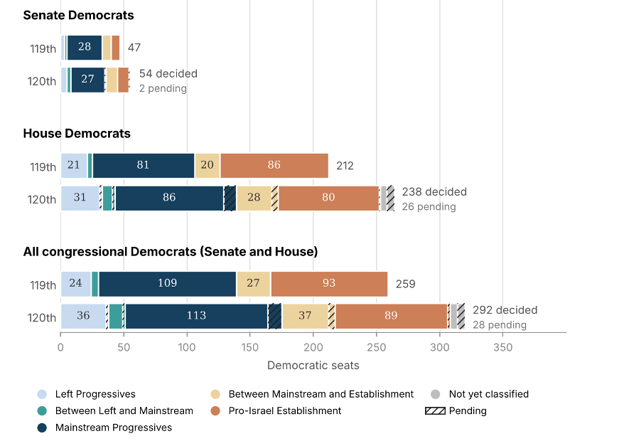
Moreover, these factional alignments are not fixed, and positions that seemed far-fetched a few years ago are increasingly mainstream. Widespread disapproval of Israel’s conduct in the Gaza war and its West Bank policies, and opposition to the joint U.S.-Israel war against Iran, have enabled critics of Israel to shape the public debate. Their wins in the midterm elections will not be ignored by incumbents or future challengers. Given this dynamic, more of Israel’s stalwart supporters in both parties, like Senator Coons, may embrace legislation that seeks to compel Israel to change its policies or downgrade the “special relationship” between the two countries.

In the near term, continued funding of the United States’ annual commitment of $3.3 billion in military assistance under the 2016 Memorandum of Understanding is in jeopardy. Even if President Trump were to reverse his announced decision to terminate such funding next month, the new Congress would still need to approve the budget. At the same time, gaining congressional approval for a new Memorandum of Understanding—one that had been expected to shift military assistance to strategic cooperation in arms development—also faces an uphill battle.

Israel’s political leadership is not powerless in the face of this sea change in U.S. politics. It can still seize the opportunity created by Israel’s own elections to shift the terms of debate. Doing so, however, will require forming a new Israeli government and acting swiftly to address some of the Democrats’ major concerns, particularly settler violence, new settlement construction, and implementation of the 20-Point Plan for Gaza.

The opinions expressed in INSS publications are the authors’ alone.
Theodore Sasson
Theodore Sasson is a senior researcher in the Israel-United States Research Program. He also serves as the Curt C. and Else Silberman Professor of Jewish Studies at Middlebury College in Vermont, USA. Professor Sasson is the author of The New American Zionism (NYU Press, 2014) and several previous books, as well as dozens of scholarly articles and research monographs in the fields of diaspora studies, Israel studies, heritage tourism, demography, and the sociology of crime and punishment. His essays have been published in Jewish Review of Books, Tablet Magazine, Foreign Policy, Times of Israel, Jerusalem Post, and other periodicals.

Avishay Ben Sasson-Gordis
Dr. Avishay Ben Sasson-Gordis is a Senior Researcher at the Institute for National Security Studies (INSS) at Tel Aviv University, where he heads the Israel-United States Research Field. He works on the implications of domestic American politics, and US policy more broadly on Israeli national security. Avishay is a Liberalism Rekindled postdoctoral fellow at the Hebrew University of Jerusalem. His academic work focuses on the democratic backsliding and the political theory of the military. He is a frequent commentator on Israeli current affairs in international and Israeli media, and his commentary has appeared in Foreign Affairs, Haaretz, and World Politics Review.

Publication Series INSS Insight
TopicsIsrael-United States Relations
עברית

Events

All events
Israel’s National Security Conference
27 July, 2026
10:00 - 14:00

Related Publications

All publications
REUTERS/Ammar Awad
Assembling the Toolkit: Democrats and the New Push for West Bank Sanctions
Democrats’ Moves Paving the Way for a Sanctions Regime — and Israel’s Options
03/11/26
REUTERS
Less Present, Less Influential? The War in Iran and the Future of U.S. Involvement in the Middle East
Between reducing military presence and preserving political influence: The emerging regional order and the test for Israel
29/10/26
Partisan Antisemitism in the United Kingdom and the United States: Response Mechanisms and Red Lines
Between the Palace of Westminster and Capitol Hill: Where Do Parties Draw the Red Line on Antisemitism Among Candidates and Elected Officials?
28/10/26

Stay up to date

Registration was successful! Thanks.
  • Research

    • Topics
      • Israel and the Global Powers
      • Israel-United States Relations
      • Glazer Israel-China Policy Center
      • Russia
      • Europe
      • Antisemitism and Delegitimization
      • Iran and the Shi'ite Axis
      • The Campaign Against Iran and the Shiite Axis
      • Iran
      • Lebanon and Hezbollah
      • Syria
      • Yemen and the Houthi Movement
      • Iraq and the Iraqi Shiite Militias
      • Conflict to Agreements
      • Israeli-Palestinian Relations
      • Hamas and the Gaza Strip
      • Peace Agreements and Normalization in the Middle East
      • Saudi Arabia and the Gulf States
      • Turkey
      • Egypt
      • Jordan
      • Israel’s National Security Policy
      • Military and Strategic Affairs
      • Israel's Security Strategy
      • Societal Resilience and the Israeli Society
      • Jewish-Arab Relations in Israel
      • Climate, Infrastructure and Energy
      • Terrorism and Low Intensity Conflict
      • Cross-Arena Research
      • Data Analytics Center
      • Law and National Security
      • Advanced Technologies and National Security
      • Foreign Information Manipulation and Interference
      • Economics and National Security
    • Projects
      • Preventing the Slide into a One-State Reality
      • India-Middle East-Europe Economic Corridor (IMEC)
  • Publications

    • All Publications
    • INSS Insight
    • Policy Research and Papers
    • Special Publication
    • Strategic Assessment
    • Technology Platform
    • Memoranda
    • Database
    • Posts
    • Books
    • Archive
  • About

    • Vision and Mission
    • History
    • Research Disciplines
    • Chairman of the Board
    • Board of Directors
    • Fellowship and Prizes
    • Internships
    • Annual Reports
    • Support
    • Privacy Policy and Terms of Use
  • Media

    • Communications
    • Video Gallery
    • Press Release
    • Podcast
  • Home

  • Events

  • Database

  • Team

  • Contact

  • Newsletter

  • עברית

INSS logo The Institute for National Security Studies, Strategic, Innovative, Policy-Oriented Research, go to the home page
40 Haim Levanon St. Tel Aviv, 6997556 Israel | Tel 03-640-0400 | Fax 03-744-7590 |
Developed by Daat ,Yael Group.
Accessibility Statement , Privacy Policy
This site is protected by reCAPTCHA and the Google Privacy Policy and Terms of Service apply.