


Publications
Democrats’ Moves Paving the Way for a Sanctions Regime — and Israel’s Options
INSS Insight No. 2211, November 3, 2026
Follow us on GoogleDemocrats in Congress remain divided over arms sales to Israel, AIPAC, and whether to call Israel’s conduct in Gaza a genocide. On issues concerning the West Bank, however, a consensus is forming. Democratic lawmakers have rallied behind five measures concerning settler violence and settlement expansion: the West Bank Violence Prevention Act, introduced in both chambers to restore the Biden-era sanctions that President Trump revoked; a Senate resolution demanding a State Department report on Israeli human rights practices in the West Bank; and two bills imposing targeted sanctions on settlement construction, one focused on the E1 corridor. Support for the settler-violence measures spans nearly every Democratic faction, from progressives to the party’s pro-Israel establishment. None of the measures is likely to become law while President Trump is in office. Together, however, they create a toolkit for a sanctions regime that a Democratic Congress and president could enact as early as 2029, one aligned with measures already adopted by the United Kingdom, France, Canada, and other Western nations. It is recommended that Israel take reasonable policy steps to reduce the likelihood the U.S. sanctions measures will be passed. Israel should also take administrative actions that would insulate the Israeli economy from such sanctions should they be adopted.
Introduction
Democratic members of the U.S. Congress are deeply divided over several issues related to Israel, including arms sales, AIPAC funding, and whether Israeli conduct in Gaza should be called a genocide. But in recent weeks, they have sought to unite around a shared set of policy priorities. In both chambers of the U.S. Congress, Democrats spanning a range of ideological positions have backed legislation meant to compel Israel to halt settler violence and stop new settlement construction. In doing so, they are increasingly calling for the use of the sanctions toolkit built by successive administrations to compel negative actors globally.
The timing of the initiatives is linked to events unfolding in Israel and the West Bank, and mirrors similar moves by European countries. Violent attacks against Palestinian civilians, villages, and property surged in recent years. More than 140 Palestinians have been injured in attacks by Jewish extremists and at least six have been killed since 2022, according to Israeli security sources. The issue of settler violence has received massive press attention in the United States, due partly to the killing of several American citizens and the denunciation by Ambassador Mike Huckabee of “Israeli terrorists.”
The new legislation also responds to the decision by Israel’s government to issue a tender for the construction of seven residential neighborhoods (more than 1,200 new housing units) in the area known as E1, a stretch of land situated between Jerusalem and Ma’ale Adumim. The parcel, which links East Jerusalem and the West Bank, is viewed as essential for the territorial contiguity of a future Palestinian state. The United States and Israel’s European allies have long objected to new settlement construction in the area, viewing it as an insurmountable obstacle to a two-state solution to the Israeli-Palestinian conflict. The decision to issue the tender has been widely interpreted as an effort by the outgoing Israeli government to establish “facts on the ground” and torpedo any future possibility of a Palestinian state.
New Legislation
Democratic lawmakers have advanced legislation on settler violence and new settlements in both chambers of Congress.
Settler Violence
On the issue of settler violence, House Minority Leader, Hakeem Jeffries, announced in late September that there exists broad support for a bill, the West Bank Violence Prevention Act (H.R. 3045), and indicated that the legislation could be brought to a vote when a new Congress convenes in 2027. Democrats are expected to win a majority in the House of Representatives in the November elections, and Representative Jeffries is the party’s presumptive choice for the agenda-setting role of Speaker of the House.
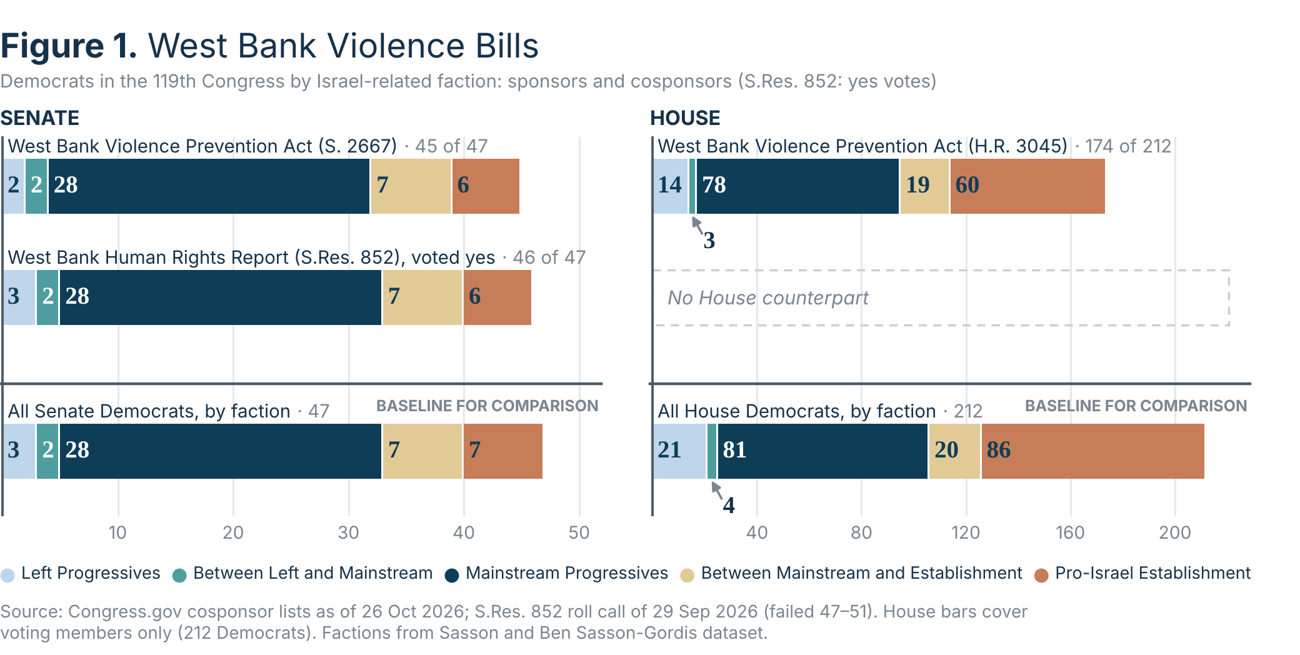
The bill was first introduced in 2025 after President Trump, on his first day in office, rescinded an executive order (14115) issued by President Biden the previous year. The new legislation, like the Biden executive order it seeks to replace, aims to address “extremist settler violence, forced displacement of people and villages, and property destruction,” which are described as threatening to the United States’ security and foreign policy. The proposed law imposes sanctions—including visa bans and asset freezes—on individuals held responsible for acts of violence against civilians, and for acts meant to compel civilians to abandon their homes. The bill is currently sponsored or co-sponsored by 174 of 212 voting House Democrats (about 82% of the Democratic caucus) spanning the party’s major faultlines, and including many pro-Israel stalwarts. A companion bill has been introduced in the Senate (S. 2667) by longtime pro-Israel senators Cory Booker and Chris Coons, and has drawn support from all members of the Democratic caucus except Bernie Sanders and John Fetterman.
Also in late September, Senate Democrats tried to pass a resolution requiring the U.S. Department of State to issue a report on Israeli human rights practices in the West Bank (S.RES. 852). The resolution was introduced by Senator Chris Van Hollen under provision 502B(c) of the Foreign Assistance Act of 1961—the Act allows Congress to demand a human rights report for any country that receives U.S. security assistance. The resolution lists nine U.S. citizens killed by Israeli settlers or security forces in the West Bank since 2022, as well as 13 categories of alleged Israeli human rights violations. The latter list includes items concerning settler violence, conditions in prisons and detention facilities, separate legal systems for Israelis and Palestinians, detention and interrogation of Palestinian children, settler attacks against Christian communities, and establishment of new Israeli settlements and outposts. Under the resolution, the failure of the State Department to issue the report within 30 days would result in a freeze of most U.S. military assistance to Israel. The resolution was ultimately defeated in a nearly party-line vote of 51-47.
Figure 1 shows the distribution of support for these three legislative initiatives in the House and Senate, according to the major factions of the Democratic Party on issues related to Israel and Palestine.
New Settlements
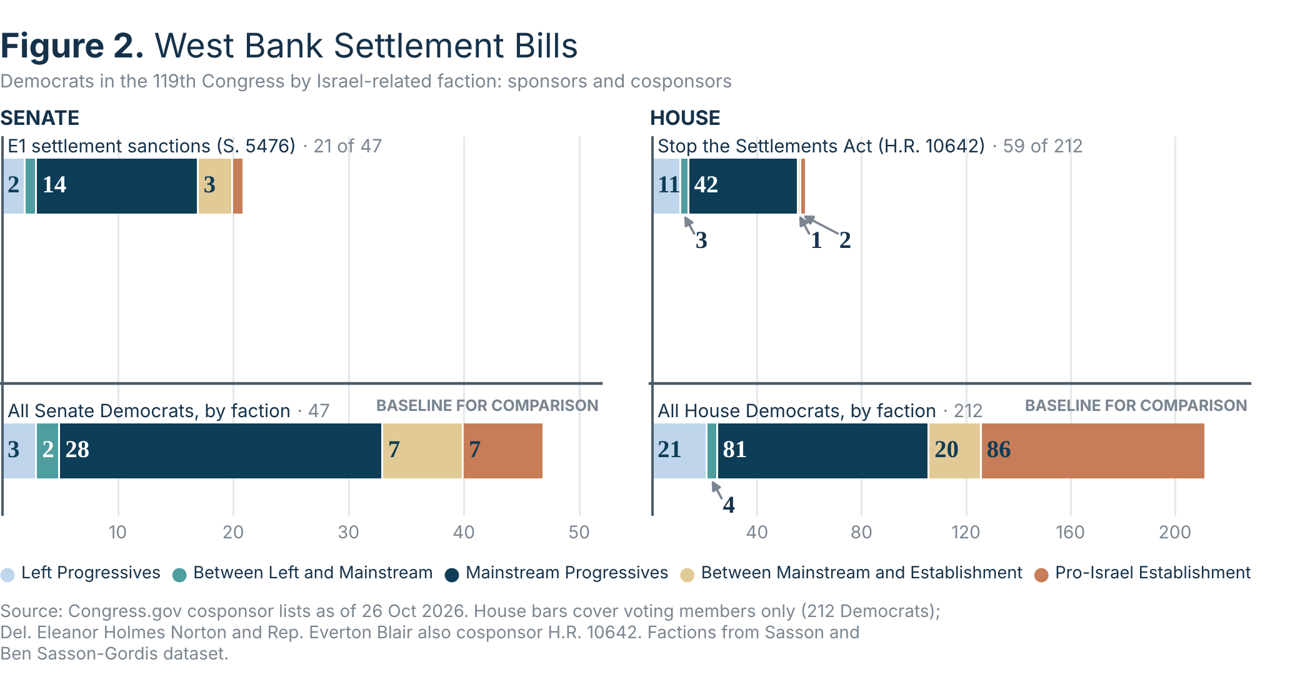
The sanctions toolkit now being assembled also includes dedicated House and Senate bills aimed at the construction of new settlements. In early October, Representative Joaquin Castro and 60 House Democrats, in this case predominantly from the progressive factions of the party, introduced the Stop the Settlements Act (H.R. 10642). The legislation imposes sanctions, in the form of asset freezes and visa bans, on foreign individuals and companies that facilitate new settlement construction. The prohibited activities include financing and constructing new settlements or the infrastructure supporting them, as well as facilitating the transfer of civilians into settlements. It covers leaders of any entities (including government officials) engaged in conduct proscribed under the law, and can be applied to existing settlements that are deemed by the U.S. President to undermine the viability of a future Palestinian state. The legislation also bans the importation of goods produced in settlements. It would sunset after 10 years.
A narrower measure, focused on new construction in the E1 area, has been introduced in the U.S. Senate (S. 5476). Like the House bill, the E1 legislation imposes sanctions on foreign companies and individuals that facilitate construction of new settlements or settlement infrastructure, albeit only within the designated area. It would also impose sanctions on companies and individuals that organize, finance, or facilitate the transfer of civilians into E1, and on leaders of entities that engage in any of the proscribed activities. It is written to sunset after seven years.
The sponsors of the E1 legislation contend that settlement construction in the area, which links East Jerusalem to other major Palestinian population centers, would “sever the West Bank in two, gravely threatening the viability of a future Palestinian state.” The legislation is sponsored or co-sponsored by 21 senators (more than 40% of the caucus), mostly from the progressive factions of the party, while also including pro-Israel figures such as Senators Chris Coons, Elissa Slotkin, and Mark Kelly.
Figure 2 shows the distribution of support for the New Settlements legislation according to the Democratic Party’s major factions.
Finally, the impetus to act against settler violence is not limited to Democrats. According to Amos Harel, reporting in Haaretz, the Trump administration is also considering measures—including banning the use of U.S. weapons by particular units or within particular sectors—to compel the Israeli government to act against settler violence. This reporting comes on the heels of the aforementioned unprecedentedly harsh comments by Ambassador Huckabee on the attacks.
Timing and Responses
The intensification of efforts by Democratic lawmakers to construct a sanctions regime is driven by worsening West Bank violence and the decision to proceed with bids for E1 construction. At the same time, the new legislative push also reflects opinion trends and political dynamics in the United States.
Among Democratic voters, three years of war have caused a major attitudinal change. In October 2023, the Economist/YouGov reported that Democratic voters sympathized more with Israelis (34%) than Palestinians (16%). In September 2026, the same polling firm reported a dramatic shift: by a ratio of more than 6:1, Democratic voters now sympathized more with Palestinians (44%) than Israelis (7%). In light of the reversal, the new legislation enables the party leadership to seek to narrow the gap between their own mostly moderate positions and the rapidly changing sympathies of rank-and-file voters, without shifting their basic stance on security assistance to Israel or their rhetoric regarding Israeli wartime policies.
The timing of the new bills also has a purely political component. enable congressional Democrats, divided over arms sales to Israel, AIPAC funding, and the use of terms such as genocide and apartheid, to galvanize attention around issues that are less divisive and more unifying, such as opposition to settler violence, ahead of the November elections. The hope may be that doing so can diminish the divisiveness of issues related to Israel and Palestine within the party.
The bills on settler violence and new settlements also reflect the growing influence of pro-Palestinian groups, as well as liberal Jewish advocacy organizations, especially J Street. As AIPAC has become a third rail in many races, in the wake of its massive spending against progressive critics of Israel in the midterm elections, J Street has emerged as an increasingly influential shaper of policy priorities of Democratic members of Congress. The organization was credited with driving down the number of Democrats voting in July for the Massie Amendment, which would have immediately halted military assistance to Israel (a position the organization opposed). On the issue of settler violence and settlements, the organization favors stepped-up U.S. pressure on Israel, and has lobbied to promote the four sanctions bills.
Although not endorsing any of the new legislation, Democratic Majority for Israel (DMFI), a moderate pro-Israel organization, issued a policy paper in September calling on Israel to act against settler violence and preserve the territorial integrity needed for a future Palestinian state. The paper makes no mention of sanctions or other mechanisms to compel Israel to heed the call. It does, however, underscore the breadth of consensus within the Democratic party on these issues.
Meanwhile, the establishment pro-Israel advocacy organizations, including AIPAC, AJC, ADL, and Conference of Presidents, have taken no public stand on any of the new legislation. The decision to avoid commenting on legislative initiatives to sanction settler violence and new settlement construction is instructive: it may signal, among other things, the difficulty of opposing sanctions on activities that are widely disdained in both the Democratic party and much of American Jewish public opinion. In contrast, the right-wing Zionist Organization of America issued a statement expressing outrage at congressional Democrats for promoting “propaganda about a supposed existence of…settler violence.”
Implications for Israel
In a broad sense, the legislative action is part of a growing sentiment questioning the longstanding, almost-unequivocal support for Israel. It is also a shift away from Congress’ historical role as a check on negative U.S. policy toward Israel.
In the November 2026 midterm election, the Democrats are expected to win a majority in the House of Representatives and possibly also the Senate. The West Bank Violence Prevention Act may be advanced early in the new Congress, which convenes in January 2027, as per Representative Jeffries’ recent comments. The bills that seek to sanction new settlement construction could also be advanced in the new Congress. It is unlikely, however, that any of these bills will be passed into law in the near future.
In the House of Representatives, passage of the bills would depend on the margin of Democratic majority and on leadership’s willingness to advance the measures pending the outcome of the Israeli elections. If the Democratic leadership believes Israel’s new government is charting a different course, there may be a willingness to hold off on a push for sanctions.
Even if one or more of the bills passed in the House, the legislative process would likely grind to a halt in the Senate, where a supermajority of 60 members is required to end debate and allow a vote. Moreover, any new legislation that is passed by majorities in both chambers would still require a presidential signature or would be subject to executive compliance. For the duration of his term in office, President Trump is unlikely to sign any of these bills into law or comply with congressional pressures to report.
However, without a major change in realities on the ground, political sentiment in the U.S., or Israeli policy, attempts to hold Israel accountable for settler violence and to limit new settlement construction are likely to persist. A Democrat may win the White House in 2028, and legislation held up due to a Senate filibuster or Trump’s veto could then be reintroduced and passed into law. Moreover, should Trump step in the way of such legislation, Democrats would likely view those items even more favorably and seek to enact them as part of a backlash to the current President.
If implemented, the proposed laws would supercharge the Western sanctions regime against settlements, reversing the current situation in which Washington serves as a check on international efforts against Israel. The Stop the Settlements Act, in particular, is explicitly aligned with the sanctions on settlements announced by the United Kingdom, France, Canada, Spain and other countries, according to the legislation’s co-sponsors.
The effects on the Israeli economy could be substantial. The proposed laws, or similar executive orders, would authorize sanctions not only on the primary targets but also on anyone enabling their continued access to prohibited services. Israeli government and private institutions involved in settlement activity, or even just facilitating it, could become targets themselves.
Additionally, outside of Israel, banks and companies seeking to avoid breaking U.S. regulations may refrain from a wide range of trade and transactions involving Israel, a phenomenon known as overcompliance. Mark Dubowitz, CEO of the pro-Israel think tank and lobby group “Foundation for Defense of Democracies” and a key architect of U.S. sanctions against Iran, has warned that banks seeking to manage their exposure would steer clear of anything they perceived as a risk: “At the final stage the distinction between the two sides of the Green Line could disappear, with measures expanded to target the Israeli government and the core of the economy.”
The potential for systemic damage stems less from the size of the settlement economy, which accounts for a small share of Israel’s output, than from its integration with Israel proper. All of Israel’s major banks operate on both sides of the Green Line, and foreign banks and investors may come to treat the Israeli financial system as a whole as too exposed to the risk of U.S. sanctions violations. In that scenario, the damage could be substantial and lasting, felt through a higher risk premium, costlier capital, reduced foreign investment, and lost exports.
Although other nations under U.S. sanctions, such as Russia and Iran, have found ways to bypass and exist alongside them, those nations suffered greatly in the process, relied on natural resources Israel lacks, and were not an integral part of the U.S.-led system to begin with in the way Israel is.
Some of these costs need not wait for legislation. Markets price the probability of sanctions, not only the measures in force, and a rise in that perceived probability can raise Israel’s risk premium and cost of capital and deter foreign investment in advance.
Whether the sanctions in the proposed legislation would remain targeted would depend in large part on Israel’s own response. If the government allowed banks to comply, as the Bank of Israel’s supervisory guidance already contemplates with respect to sanctioned individuals, the economic effects would likely remain contained. If, instead, the government pressured banks to shield sanctioned parties, furthering the integration of the settlement economy with Israel proper—a policy the Finance Minister has encouraged—it would then raise the risk that foreign institutions treat the entire Israeli financial system as exposed.
It is in this light that Prime Minister Netanyahu’s recent remark that Israel must prepare for comprehensive banking sanctions might be understood. Such a worst-case scenario becomes likely only in the event that Israeli banks do not comply with international sanctions and the Israeli government fails to address the policy concerns that motivate such sanctions.
Recommendations
Although Israel has faced boycotts in the past, the country has never faced a comparable threat of international sanctions that threaten its access to basic financial services and trade relationships. In light of this threat, Israel should take reasonable steps to reduce the likelihood sanctions laws will be passed, and administrative actions that will insulate the Israeli economy from such sanctions should they be adopted.
Specifically, Israel should take the following actions to mitigate the sanctions threat:
- Israel should act swiftly against settler violence: withdrawing any type of government assistance to participating militias and individuals; preventing Palestinians from being driven from their residences; enabling those who have been driven from their homes to return; and holding offenders legally accountable for their actions.
- Israel should develop and communicate a clear statement of where it will not build new settlements, so as to clarify the places that will remain outside of Israel, as part of a Palestinian state or some other future Palestinian entity. If Israel offers no such alternative, then it will have little chance to influence the scope of sanctions.
- Israel should freeze the tender process for new construction in E1. The likelihood that such construction will trigger very damaging sanctions is high, and no reasonable cost-benefit analysis can justify the risk.
- While acting to prevent the advance of the sanctions regime, Israel must also seek to mitigate the harm such sanctions would cause. Toward that end, Israel should engage in comprehensive planning to analyze the potential impact of sanctions, and propose strategies for mitigation.
- Israel should consider allowing its banks to comply with foreign sanctions and to fence off their West Bank operations, rather than pressing them to shield sanctioned parties.