


Strategic Assessment
This article examines the characteristics of the Syrian state and the events that led to the fall of Bashar al-Assad and the rise of the new regime, as reflected in the official curriculum from 2017–2026.[1] It proceeds from the assumption that curricula are a useful tool for Curriculum Informed Strategic Assessment (CISA). Experience shows that curricula can be read prospectively, because they reflect a national vision, or retrospectively, to assess their effects—and where the textbooks anticipated developments and or did not. In this article, we examine in hindsight the relationship between textbooks and the Assad regime’s policy during the Iron Swords War, as well as the events that led to the regime’s collapse. Looking ahead, we seek to understand where Syria is headed, on the assumption that the shaping of the new curriculum is an important axis as part of the broader pattern of the nation’s development. Broadly speaking, at least for the present, we identify in the new regime an aspiration to maintain the country’s authoritarian character and to build a nationalist, strong and ambitious Arab state committed to conservative Islam, while preserving strategic flexibility in the region. Syria is in a period of formation and construction, so the current environment remains complex. Jihadist elements exist, but they are not part of the official curriculum. Thus, the curriculum aligns with the regime’s broader direction, which seeks—at least for the present—to preserve the emerging status quo in Syria.
Keywords: Syria, Bashar al-Assad, Ahmad al-Sharaa, textbooks, national curriculum, CISA, Russia, national consciousness; education, Iran, Hezbollah, Türkiye, Iron Sword War, Hayat Tahrir al-Sham (HTS).
Introduction
This study examines the official Syrian curriculum,[2] along with the historical processes unfolding between 2017 and 2026. In the first part, we focus on Bashar al-Assad’s cautious policy since the outbreak of the Iron Swords War and the process of his regime’s collapse. We then analyze relevant elements in the curriculum of the former regime and show a relationship, alongside complexity, between the picture emerging from the textbooks and the regime’s conduct during the war and its collapse. In the second part, we focus on the rise of Ahmad al-Sharaa’s new regime and its initial effort to shape a new curriculum that navigates between different ideas and narratives in Syria.
How Did We Get to This Point? The Conduct of the Assad Regime from October 7, 2023, Until its Final Collapse in December 2024
By 2020, the assessment had begun to take shape that Bashar al-Assad’s rule in Damascus was an established fact. Assad sought to deepen his hold over the territory under his control, retake areas held by other actors, and normalize Syria’s diplomatic and international standing. After defeating his main opponents, the regime faced a series of challenges, including the need to contend with Russia’s and Iran’s ambitions to deepen their foothold in Syria, the remnants of ISIS, Turkish gains along the northern border and independent Shi’a militias that did not always obey Damascus.
In contrast to the shared Iranian-Hezbollah vision of turning Syria into a central link in the “Axis of Resistance,” and despite owing them his regime and his life, the Syrian president resisted directly intervening in the multi-front confrontation with Israel. His main concern was preserving his own survival and standing. This approach corresponded with the normalization process between Syria and Arab states in the region. Although there were several instances of fire from Syria toward Israel by Palestinian and Shi’a actors, Damascus generally acted decisively and did not allow Hezbollah or other Iranian-backed militias to operate from Syrian territory.
At the same time, Syria did not block the transit routes of the Iranian axis, and the regime did not stop Iran from continuing to entrench itself in the country. This Syrian policy was attributed in part to Russian pressure to limit Iran’s freedom of action in Syria. The Russians reinforced their forces in southern Syria to prevent escalation in the Golan Heights. Maher al-Assad, the president’s brother and commander of the Fourth Division, restricted the presence of pro-Iranian elements in the division’s camps so they would not be targeted by the Israeli Air Force. In October 2024, Syria was reported to be working to prevent drone launches toward the Israeli Golan. Earlier that year, Iran reportedly feared that elements in the Syrian army had passed critical intelligence to Israel, enabling targeted killings. Several senior Syrian officers known for their pro-Iranian orientation were replaced by others with a more Russian orientation (Valensi and Naftali, 2024; see also Cafiero, 2024).
The IDF’s forceful military activity in Syria and Lebanon rested on the assumption that the Syrian regime’s main interest was survival in the dangerous environment in which it operated. A Syrian strategic shift was identified, including closer ties with Arab states, reflected, among other things, in Syria’s return to the Arab League in 2023 and the reopening of Arab embassies in Damascus. The UAE, which had renewed relations with Assad as early as 2018, increased its civil and economic activity in Syria. This dynamic cautiously indicated that Assad was trying to gradually reduce his dependence on Iran and the axis of resistance, draw closer to the Sunni Arab camp, and perhaps even signal to Israel and others that Syria was changing direction.
However, the analysis also considered this to be a temporary and perhaps opportunistic move, suggesting that Assad may have wanted to purchase temporary calm from Israel and then allow Iran freedom of action in Syria after the war. Iran’s growing grip on Syrian civil society and cultural life through welfare organizations, infrastructure, education and Shi’a religious centers suggested a real difficulty in escaping the Iranian axis. Beside this, Iran made energetic diplomatic efforts to block an Emirati initiative (Valensi and Naftali, 2024, p. 5; see also discussion below). It should be noted that different estimates pointed to Iranian investments in Syria totaling between thirty and fifty billion dollars over the years, indicating Assad’s significant dependence on the Iranians (Natziv.net, 2024; Grajewski, 2024; The New Arab, 2025).
Assad’s regime collapse surprised many actors in the region, including the regime itself, and perhaps also the rebels who led the rapid offensive from Idlib in the northwest through Aleppo, Hama and Homs to Damascus. Simultaneous attacks also came from the south and reached the Syrian capital ahead of the main thrust coming from the North. Aleppo was attacked on November 27, 2023, and Damascus fell on December 8 —just eleven days that ended thirteen years of protest, uprising, and civil war since the outbreak of the Arab Spring in 2011.
The capture of Damascus by Hayat Tahrir al-Sham (HTS) resulted from a combination of circumstances that produced a perfect storm. Poor governance of the state and the army is probably the main explanation for the rapid collapse. The regime’s corruption and repression included humiliating and degrading treatment and neglect of soldiers, including an acute shortage of proper equipment and even food—leading to a lack of cohesion and damage to army morale. Just as important were Türkiye’s and others’ support for the various rebel groups and the withdrawal of support for the Syrian regime by Iran, Hezbollah, and Russia. The prolonged war with Israel left Iran—and especially its proxies Hezbollah and Hamas—in an unprecedentedly weak position, while Russia, absorbed in the war in Ukraine, apparently decided it could not open a new front.
Methodology – Examining National Perceptions Through the Study of Textbooks
The basic assumption of curriculum researchers is that textbooks reflect the prevailing public sentiment in a country, and certainly the expectations and vision of political leaders (Pardo and Winter, 2024, pp. 3–6; Podeh & Alayan, 2018, pp. 1–4). In an era of information overload, disinformation, and false information, the uniform, clear, and doubt-free message offered by systematic instruction, repeated and embedded over many years, has great power. Ben Williamson argues that the curriculum functions as a “microcosm of society” and reflects its aspirations and future vision (Williamson, 2013, p. 115). Firas Shaheen, a history and geography teacher in Syria, says that “the curriculum is a blueprint for the nation’s understanding of itself. It is not just a list of lessons — it defines what ‘the story of Syria’ is” (Soguel, 2025).
Textbooks, together with the constitution, national holidays, primordial and civic identity, religious institutions, culture and political culture, the anthem, and the flag — all of these reflect the national ethos and guide the behavior of the nation. Experience shows that curricula do indeed represent the ideological dictates of regimes, but they also necessarily reflect broader attitudes because of the wide range of stakeholders and participants, from academics, authors and teachers to families and students; in recent decades this also includes the international community, with its monitors and watchdogs. Changes in curricula may precede policy changes or follow them, sometimes clearly and explicitly, and sometimes in small steps.
The methodology we propose is to carry out a joint assessment by regional experts and curriculum analysts, so that educational texts can be read alongside the events from which a broader picture emerges. Understanding the meaning of curricula in relation to broader regional and political developments is a complex process, and they should therefore be seen as a cultural tool that helps in strategic understanding (Curriculum Informed Strategic Assessment, CISA). We believe that careful reading can identify policy trends, indicate intentions, and even provide a view beyond the horizon
The Syrian Curriculum During the Bashar al-Assad Era
In this section, we present findings and conclusions from a study of Syrian school textbooks in the years preceding the collapse of Bashar al-Assad’s regime (the 2017–2018 and 2024–2025 academic years),[3] with reference to the geopolitical circumstances during his rule. There are some differences between the two editions we examined, but the main themes remained unchanged.
The textbooks pointed to the centrality of Syrian Arab nationalism and the “Syrian Arab Army” in the national identity of the “Syrian Arab Republic,” alongside a pan-Arab identity and ties with Arab states, especially Egypt. Although Arab states severed relations with Syria during the civil war, President Assad sought to renew those ties and did not abandon the pan-Arab identity that Syria had adopted in modern times.
Interestingly, despite the solid Iranian-Syrian alliance, the attitude toward Iran in the textbooks included negative elements. Hezbollah is not mentioned at all. Syria, students were taught, had helped—on behalf of the Arab League—to establish peace in Lebanon and had supported the “national resistance in Lebanon” (History, Grade 9, 2017–2018, p. 42; History, Grade 12, 2017–2018, p. 66). The curriculum also reflected a certain hostility toward Türkiye , which also severed relations with Syria at the start of the civil war and occupied a long strip in the north of the country. Naturally, there was sharp opposition to the State of Israel, usually referred to as the “terrorist Zionist entity.” Israel was described in the curriculum as part of the district of Greater Syria (Iqlim al-Sham), which itself is part of the imagined pan-Arab state called the “Arab Homeland” (al-Watan al-‘Arabi), described as the second-largest state in the world after Russia. The curriculum makes virtually no reference to the issue of minorities within Syria.
Not surprisingly, given the fact that Moscow came to Assad’s rescue during the civil war and in light of the close relations between Russia and Syria, the textbooks present the Russian Federation and the Soviet Union that preceded it in a notably positive light, with praise for (secular) modernity and technology. In fact, this positive ideological affinity toward Russia characterized Syrian thinking even before Syria received military aid from Moscow. Since 2014, the Russian language textbooks have been included in foreign language studies and include abundant Russian cultural perspectives. (It should be noted that foreign language study in a given country does not necessarily include the transmission of foreign cultural content.), As such, the curriculum portrays the Russian Federation and the Soviet Union as modern, strong, scientific, secular and friendly.
Russia has no territorial or political disputes with Syria. The textbooks promote a Syrian political culture of authoritarian modern ethno-linguistic nationalism, corresponding to that of the Russian Federation. Syria’s aspirations—to create an “Arab Homeland” stretching from the Atlantic Ocean to the Gulf and covering large parts of Asia and Africa—do not contradict Russia’s political culture, which is seen in the role of a global power. Unlike Islamism, pan-Arabism exhibits no global ambitions. Reading between the lines, one gets the impression that Syria is a “little sister” to Egypt, and the Arab Homeland occupies a similar relationship with Russia, the great power.
The historical presentation of Iran and the ancient Persian Empire in the curriculum is mainly negative. Although the “Arab Homeland” and Iran share a long history, it has not always been a smooth one. According to the curriculum, the Iranian province of Khuzestan (Arabistan) belongs to the Arabs. At the same time, the Khomeini Revolution itself is taught positively because of its revolutionary character and militant stance toward Israel and the West. Iran is presented as technologically and economically advanced (cars, ships, weaponry, space, and nuclear energy). The main common denominator is the revolutionary proclivity and the struggle against Israel and the West. The Persian Empire, however—like the Greek and Roman empires—is described as “conquering,” foreign and greedy. The Syrian books of the Assad era make little reference to Iran’s cultural heritage or its contributions across multiple fields. Above all, the curriculum does not offer courses in Persian, whereas the Iranian curriculum began offering a series of practical Arabic textbooks, intended, ostensibly, to enable broad military, religious and economic penetration into the Arab world (Pardo, 2022, pp. 77–88).
In other words, during Assad’s period, Russia was perceived as a true and permanent friend, whereas the Iranians were seen as partners in the axis of resistance, but also as having the potential to dominate the homeland.
A 2018 study of Syrian textbooks summarized the differences between the Syrian and Iranian worldviews as presented in the schools of the two countries (Pardo & Jacobi, 2018):
- Pan-Arab and Syrian nationalism rejects Persian-Iranian hegemony and any Iranian leadership role in Greater Syria and the ‘Arab Homeland.’
- The worldview taught in Syrian textbooks advocates ethnically focused Arabism and secularism and does not accord with the regional ambitions of Iran’s Supreme Leader. The Islamic-Khomeinist political culture of Iran, as presented in the Iranian curriculum, was categorically rejected by the Syrian curriculum (except for the shared hostility toward Israel and the West).
- Strategic interests and pragmatic considerations may lead to the continuation of the decades-long Iranian-Syrian alliance. However, at the national and cultural level (Ba‘athist secularism versus Khomeinist Islamism), there is no real synergy between the two states (pp. 1–2).[4]
However, in the most recent edition (the 2024–2025 school year), elements of resistance to Iranian and Turkish culture were removed, perhaps out of a desire for cultural openness and an aspiration to moderation, recovery, and reconstruction. The description of Persian and Turkish influence in the eleventh century (shu‘ubiyya) as a “cultural invasion” at the heart of the “Arab-Islamic Caliphate” does not appear in the second edition (National Education, Grade 11, 2017–2018, p. 75).[5]
Another conclusion of the 2018 study was that “the potential for friction with Türkiye is even greater than that existing vis-à-vis Iran” (Pardo & Jacobi, 2018, p. 2). The Syrian curriculum of the Assad era presented territorial disputes centered on the conflict over the District of Alexandretta and the region of Cilicia.[6] Clearly, the neo-Ottomanism and pan-Turkic imperial drive of Erdoğan’s government, identified in studies of Turkish textbooks (Pardo & Ekinci, 2017; Yanarocak, 2021, pp. 24–28), stood in total opposition to the pan-Arab and Syrian nationalist ideology we found in the Syrian curriculum. Türkiye’s approach to Islam and the Islamic way of life did not fit the Syrian worldview reflected in the Assad-era curricula. No Turkish courses were offered at all, in contrast to schools in the north of the country—an area partly under Turkish control. All of this testifies to the troubled relations between the two states, to Assad’s refusal to accept the de facto occupation of Syrian territory by Türkiye , and to his ongoing refusal to reconcile with the Turkish regime.
The textbooks divided the “Arab Homeland” into districts, including the district of Greater Syria (Bilad al-Sham), comprising the territories of Lebanon, Jordan, the Palestinian Authority, and Israel. Egypt was granted a privileged status among the Arab states. Ancient empires within the Arab Homeland—especially Egyptian-Syrian and Syrian-Egyptian ones—were portrayed positively, and emphasis was placed on ancient Egyptian culture (as well as Mesopotamia). The books ignored the ancient cultures of Iran, Türkiye and Israel. One of the study’s conclusions was that the centrality of the Arab Homeland in the Syrian curriculum and Syria’s territorial claims against Iran and Türkiye hint at a possible change in its policy, which could “lead to the emergence of new axes in the region, just beyond the horizon” (italics added here; Pardo & Jacobi, 2018, p. 3).
The textbooks of the Assad era included anti-Israeli propaganda and antisemitic elements and justified “resistance” against Israel. At the same time, the curriculum referred to agreements with the State of Israel and to the possibility of peace, despite insisting on the use of the term “Zionist entity,” and at times “terrorist Zionist entity” (National Education, Grade 12, 2017–2018, p. 48). In one textbook, students learned through a photograph and caption about the “peacekeeping forces in the Golan, according to the 1974 disengagement agreement, following the October [1973] Liberation War” (Harb Tishrin al-Tahririyya). The caption did not explicitly mention Israel (National Education, Grade 12, 2017–2018, p. 54). The Madrid Conference was also described in that same year, together with the assertion that peace for Syria is a strategic choice, one that would also include Jordan, Palestine, and Lebanon. The declarations cited in the book are those of Hafez al-Assad in the context of the Madrid Conference, but a picture of Bashar al-Assad was placed on the same page immediately after the following passage (all emphases in the original; History of the Arab Homeland in Modern and Contemporary Times, Grade 12, 2017–2018):
Syria’s position on resolving the conflict with the Zionist entity: Syria agreed to resolve the Arab-Zionist conflict on the basis of United Nations Security Council resolutions and on the principle of land for peace [territories for peace], on the condition that the settlement be just, in accordance with the resolutions of international legitimacy, and that it include all parties (Syrian, Palestinian, Lebanese, and Jordanian). At the Madrid Conference of 1991, the late President Hafez al-Assad declared: ‘Peace for Syria is a strategic choice, but it is the peace that will restore rights and dignity.’ However, the Zionist entity renounced the demands of just and comprehensive peace and turned to signing separate agreements with Arab parties in order to weaken Arab unity—especially Syria—and to eliminate the Palestinian question (p. 58).
The Syrian commitment to peace as a strategic choice is emphasized less in the 2024–2025 edition, although it has not been completely removed at the root. There is some noticeable vagueness on the issue of the territories and the Golan, and at least one instance of antisemitic messaging has been removed. At the same time, harsh anti-Israel material remains intact and has even been strengthened, including references to Israel as the “terrorist Zionist entity.”
The reference, in which the role of UN forces in the Golan was discussed, no longer appears in the Syrian curriculum. The removal of the mention of understandings with Israel is a negative development that was recorded in the final period of Assad’s rule. In the 2024–2025 edition, a list of achievements of international organizations did appear, including “the deployment of international forces on the borders between states in conflict to preserve international peace and security,” but in practice all mention of the Golan and the connection to Israel was erased (National Education, Grade 12, 2023–2024, p. 74). The paragraph in the history book that explicitly stated that “peace for Syria is a strategic choice” also no longer appeared.
However, the new edition of the history book devoted space to the subject of “Syria and peace.” Within the text, without mentioning the Madrid Conference, Hafez al-Assad’s 1990 position was quoted: he opposed separate talks with Israel and insisted on an international peace conference. His arguments were presented, and at the end he stated: “The Arabs want peace; let us put forward a common peace plan that will achieve peace” (History of the Arab Homeland in Modern Times and Today, Grade 12, 2023–2024, p. 145). This is still about peace with Israel, but without emphasis and without mentioning Israel by name. The image in the new edition is that of the father, Hafez al-Assad—an arrangement that somewhat removes responsibility from President Bashar al-Assad, whose picture does not appear on that page. Those who want peace with Israel are all Arabs, including Syrian Arabs. A Syrian strategic commitment to peace is not highlighted.
But the new text also abandons the other principle, namely “land for peace.” Is this omission intentional? Perhaps the absence of any mention of the Golan is a positive development, a blurring of a disputed issue? In the discussion of “Syria and peace” [with Israel] in the new edition, the opening paragraph states that Syria assisted in a series of Arab issues and “strengthened its relations with the socialist camp and the Islamic Republic of Iran” (p. 145). This suggests that Syria had satisfied the axis of resistance.
In summary, in both editions of textbooks preceding the fall of the regime, the curriculum remained committed both to continued struggle and to peace with Israel within a broader Arab framework.
On the question of the possibility of rapprochement with Israel, the latest textbook from the Assad era is somewhat more cautious and less explicit than the 2017–2018 edition. The statement that peace for Syria is a strategic choice was removed, but Syria’s commitment to peace remained in place, and there are hints of a willingness to give up territory, vengeance and honor in favor of reconstruction and recovery. The former Syrian regime had no interest in preparing the younger generation for military adventures or for “resistance” activities in the style of Hezbollah. As noted, the organization is not mentioned at all and is therefore not presented as a model to emulate.
Beyond praise for a positive attitude toward women and the Christian community, and the avoidance of Islamization, the textbooks from the Assad period ignored any real discussion of minorities inside Syria, nor the aspiration for democracy in the Arab world and in Syria. Likewise, any serious discussion of the severe damage inflicted on Syrian civil society is omitted. They also ignored the destructive role of Iran, Hezbollah, Russia and the regime’s own gangs. The textbooks did address assistance to war victims and included descriptions of destruction, but the topic did not develop into a deeper discussion and no convincing vision was offered, except, as noted, the centrality of the Assad family and the army in national identity. The curriculum encouraged a degree of creativity and independent thinking, but within clear and tightly defined limits.
The Syrian Curriculum as a Backdrop to Assad’s Regime’s Conduct Until its Fall.
The collapse of the regime reveals a profound contrast between the idealized national picture painted by the textbooks and the reality of neglect, war crimes committed by Assad against civilians during the war, corruption, violent repression and the severe resultant economic crisis. Despite the jihadist roots of Hay’at Tahrir al-Sham, it is evident that large parts of the population supported the move to overthrow the regime out of frustration with Assad’s rule and the harsh living conditions. Cracks in the trust among the political and military elite of the regime paved the way for its rapid demise. This issue also emerges indirectly from the study of the textbooks. The curricula did not address core issues of Syrian society and the Syrian army; it therefore appears that these topics were neglected.
The curriculum also reveals—like the Iraqi curriculum (Eppel, 1997, p. 56; Bengio, 2024, 2025)—that Arab nationalism remained very strong in both countries. A comparison between the Iranian curriculum, which reconciles itself with Sunni Islam and openly supports the Muslim Brotherhood (Pardo, 2022, pp. 54–88), and the curricula of Iraq and Syria shows that the Iranians did not sufficiently appreciate Arab nationalism, both pan-Arab and state-centered forms, in the two countries. The logic of planting militias and establishing fronts inside troubled but proud Arab states could probably work only to a limited extent. This may help explain Assad’s tendency in the final period of his presidency—once he felt sufficiently secure in his position—to avoid total dependence on Iran and to limit its activities in Syria, while trying to move closer to the Arab world.
A renewed reading of the Syrian textbooks therefore teaches that Assad’s cautious policy during the Iron Swords War was not merely opportunistic (fear of Israel’s threats), but rested on solid ideological foundations inherited from his father: belonging to the Arab homeland; continuing to be part of the resistance along with a commitment to all-Arab peace processes; hints of a logic of giving up territory and honor in favor of recovery from a traumatic war; and a clear preference for Russia as a friendly great power. In the Syrian textbooks there is no trace of loyalty to Iran or to the Islamic Revolution, which requires an unceasing struggle for Muslims and the oppressed of the earth, including the destruction of the Israeli nation-state.[7] The Syrian curriculum remained secular, with strong emphasis on equal status for women, as befits a modern society. In texts and maps, the books raise the demands regarding territories that Syria and the Arabs are supposed to receive from Iran and Türkiye , as well as the continued struggle against Israel—a matter that concerned the Syrian regime less. Bashar al-Assad remained loyal to the pan-Arab legacy and tried to realize it as much as he could. Unlike Iraq and Türkiye in the 1990s, Syria did not undergo a process of Islamization. As the latest curricula show, Assad also did not move toward opening the economy to free competition—an issue that will await the conquering rebels.[8]
However, a comparison between the 2017–2018 academic-year edition and the 2024–2025 edition shows that: the reference to possible peace with Israel became more muted; the negative attitude toward Iran and Türkiye softened; and there are hints of a need to give up territory in favor of recovery and building a better future. In other words, the findings show that the worldview reflected in the 2017–2018 textbooks more closely and clearly match the actual policy chosen by President Assad from October 7 until the fall of his regime. Still, as mentioned, the latest edition also includes the statement that “The Arabs want peace; let us put forward a common peace plan that will achieve peace” (History of the Arab Homeland in Modern Times and Today, Grade 12, 2023–2024, p. 145). If anything, the relative coolness toward peace may reflect the growing influence of Iran in Syria in recent years, as well as the feeling within the axis of resistance that Israel could be defeated in a single blow (Tseitlin, 2025).[9]
Another action that was interpreted, perhaps mistakenly, as strengthening Iran’s power was the reform of religious legal institutions (2018–2021), which ended with the expansion of the “Scientific Jurisprudence Council” (al-Majlis al-‘Ilmi al-Fiqhi) in the Ministry of Awqaf and replaced the general mufti and the monopoly of Sunni authority with a council that also included female preachers, Shi’as, Alawites, Druze, Christians and academics (Jusoor, 2021). The latest edition of the textbooks was probably prepared in spring 2024, about half a year after the outbreak of the Iron Swords War, when it seemed that the war would end without a decisive outcome. However, the curriculum indicates that the deepening Iranian penetration into Syria was not welcomed, neither by the regime and nor by teachers and students. Thus, despite and perhaps because of the Iranian grip, the idea took shape in Assad’s Syria that it was possible and necessary to return to the Arab system and recover within it.
“The New Syria”: Education in Formation and a Look to the Future
This section addresses the dramatic events that have taken place in Syria since December 2024 and analyzes the official curriculum currently taking shape in the country.
As already noted, the curriculum does not recognize—and appears not to intend to recognize—the Kurdish, Alawite and Druze minorities. This suggests that both regimes: the Assad pan-Arabist regime, and the al-Sharaa Syrian Islamic regime, attempted to forcibly establish a unified Syria.
Mixed Signals: The Conduct of the New Regime Since December 2024
Syria is in a transitional period following the fall of the Assad regime and the rise of Ahmad al-Sharaa to power. Al-Sharaa carries with him the legacy of a jihadist but seeks to project the image of a pragmatic, statesmanlike and moderate leader. This process is unfolding in the wake of a civil war that has lasted more than a decade and saturated with violence and sectarian tensions; a severely strained economy; and state and military institutions functioning only partially—all adding to the potential for prolonged instability.
Since coming to power, the transitional government has taken steps of stabilization and restructuring (some rapid and superficial), including: the renewal of foreign relations; the establishment of a technocratic government and a temporary parliament; the formulation of a constitutional declaration; a national dialogue for reconciliation; reform of religious administration; a process of integrating armed militias into military and security institutions; and, as noted, the development of a new curriculum.
In terms of foreign relations, al-Sharaa’s government has achieved impressive successes: it has gained recognition from the international community and received American backing; benefited from a decision to suspend sanctions that had long suffocated the Syrian economy; and established diplomatic relations with the vast majority of countries in the region. On the domestic front, however, the regime is struggling to cope with its challenges, chief among them a lack of trust from minority communities toward the transitional government. Violent clashes—which turned into massacres among the Alawite community and later among the Druze—have heightened fears and strengthened separatist sentiments that challenge al-Sharaa’s aspiration to reunify Syria. Another challenge stems from deep currents within the country among extremist Sunni groups, driven by a sense of revenge and developing a perception of “Sunni supremacy” that encourages violence and radicalization, particularly against minorities.
This duality is also reflected in the debate over al-Sharaa’s character, which includes two competing interpretations from researchers and experts who have followed him over the years and argue that he is more a pragmatist and realist than an ideologue. According to them, in comparison to classical jihadist Islamists, the regime has conducted itself over the years—and especially now—with relative moderation and is willing to compromise, cooperate with non-Islamic actors and prioritize broader interests and stability over rigid religious doctrine. Others argue that this is merely a facade intended to consolidate control and power, and that it is only a matter of time before he reveals his “jihadist face.”
Under these conditions of uncertainty—of question marks and exclamation points—the curriculum attracts considerable attention among both researchers and actors within Syrian society. The way in which the Syrian leadership chooses to shape the consciousness of younger generations, and the public debate accompanying these changes, are important indicators for understanding how future and long-term goals may be perceived.
The Trial Balloon of the Previous Ministry of Education in al-Sharaa’s Government
Three weeks after the fall of Damascus to the rebels, the Syrian Ministry of Education, under Minister Nazir Muhammad al-Qadri, published an initial circular outlining changes to the curriculum. The document was posted on the ministry’s Facebook page on January 1, 2025 (Syrian Ministry of Education, 2025).[10] The first page of the document, which included its guiding principles and the minister’s signature, was later removed—apparently due to the controversy it sparked—but the changes themselves, presented in tables organized by grade level, remained available for some time without official authorization.
The content of the notice—including the date, the minister’s signature, the principles page, and the detailed tables—was the focus of a study published by the IMPACT-se institute, which analyzed the changes extensively. As will be seen below, large portions of the document were indeed implemented, though there are important exceptions. This initial document warrants detailed discussion to understand both the regime’s intentions in its infancy and the nature of public discourse and degree of freedom of action. The changes and the public debate surrounding them can also shed light on contemporary and future Syrian circumstances.
The proposed changes included: the removal of regime symbols from the previous government, primarily the national flag; the replacement of nationalistic components with Islamic ones; and the substitution of the term “Ottoman occupation” with “Ottoman rule” (al-ḥukm al-ʿuthmānī), a less anachronistic and more accurate term (although one that still conveys Otherness). This process included instructions to remove various figures from Syrian history beyond the Assad family itself, such as significant modern female academicians, statesmen, sports figures and historical figures such as Zenobia, Queen of Palmyra, 240–274 (Islamic Education, Grade 3, 2024‒2025, p. 19; Shporn, 2025, p. 33). Illustrations of girls, statues and archaeological reliefs—including the Code of Hammurabi—and scientific material related to Darwin’s theory of evolution were also marked for removal. The proposed changes spanned a wide range of subjects, from the cancellation of all National Education textbooks to revisions in Islamic studies, history, Arabic language, physical sciences (chemistry, physics, biology), informatics, mathematics, geography, philosophy, French and English. The document did not specify changes relating to Israel or Iran.
According to the published draft, the spirit of the changes reflects an Islamic conservatism that offers little promise to secular groups, religious minorities, women or Syria’s neighbors. One example is the redefinition of a war martyr (shahid) from someone who “sacrificed his life to defend his homeland” to someone who “sacrificed his life in the path of Allah” (fī sabīl Allah). This change removes both the defensive element of sacrificing one’s life for the homeland and the concept of homeland, in favor of death in an Islamic holy war (Islamic Education, Grade 9, 2024‒2025, pp. 16‒17; Shporn, 2025, p. 20). In another textbook, the definition of a “shahid” was changed from someone who “died during a war with an aggressive enemy in defense of the homeland and honor” to someone who “died in order to exalt the word of Allah” (li-iʿlāʾ kalimat Allah) (Islamic Education, Grade 7, 2024‒2025, p. 8; Shporn, 2025, p. 21).
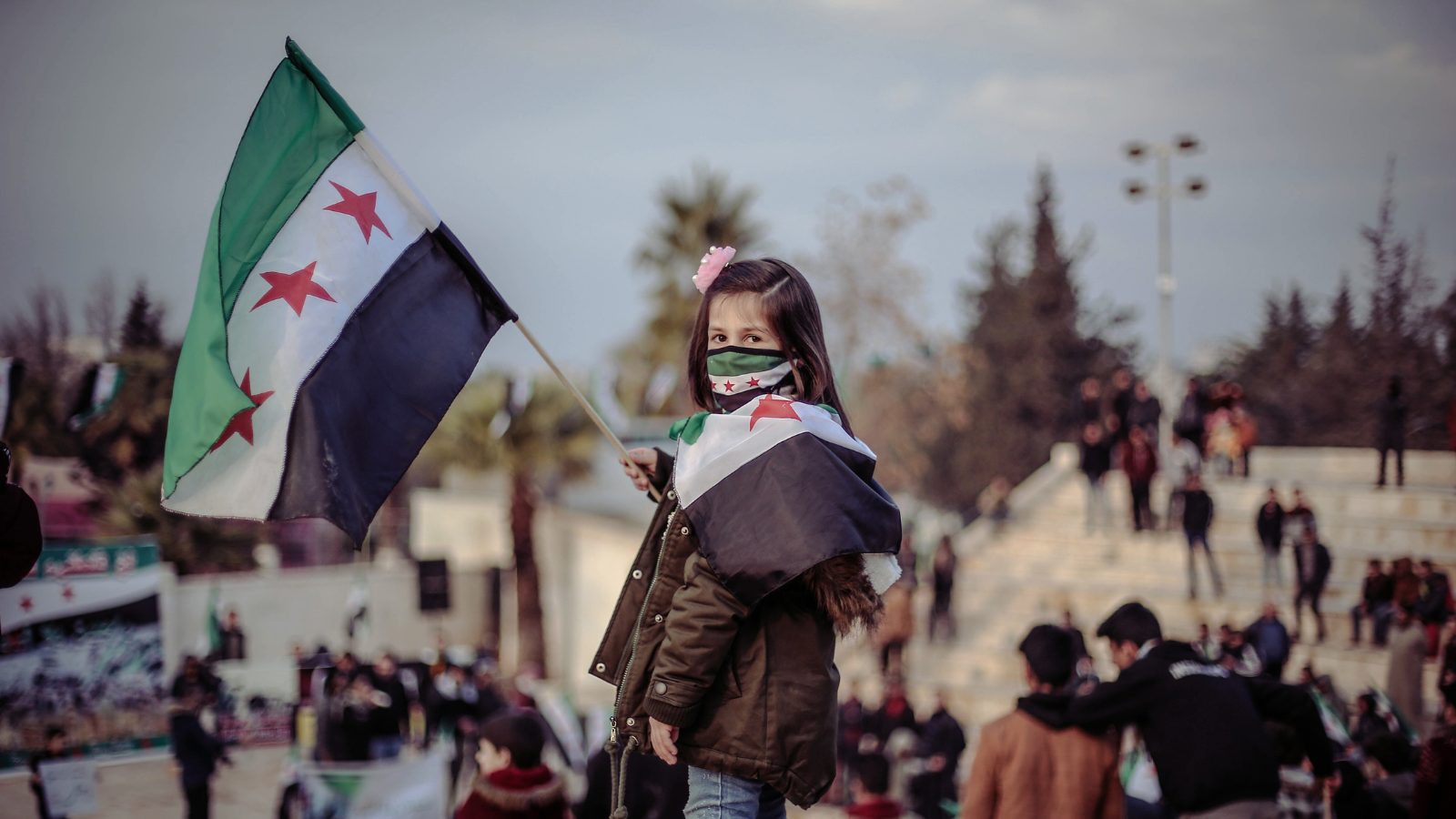
The new flag—the “flag of the revolution,” adopted as the official symbol in textbooks and schools—was not presented as a religious symbol but as one displaying a nationalistic character associated with the pre-Ba‘ath period. Unlike past attempts by Islamic actors to add the shahāda (the Islamic declaration of faith), the current administration avoided this step to preserve the flag as a unifying symbol across political currents. Educational framing of the flag offered it as a symbol of revolution, liberation from tyranny and a return to original Syrian identity—not as a vehicle for promoting a religious order (Press, 2018). Unlike the flags of Iran, Iraq, Saudi Arabia and even Türkiye , the flag shown in textbooks is a classic Arab-national flag in the spirit of pan-Arab nationalism.
A particularly negative shift in attitudes toward Jews and Christians—and toward Abrahamic discourse more broadly—was proposed in the teaching of the opening chapter of the Qur’an, Surat al-Fatiha, in Grade 1. Muslims recite al-Fatiha, considered “the heart and soul of the Qur’an” (Elqayam, 2015, p. 169), multiple times daily as part of the five daily prayers and on other occasions such as funerals and important gatherings. The chapter includes a plea for guidance along the path of the righteous: “the path of those upon whom You have bestowed favor, not of those who have incurred wrath, nor of those who have gone astray.” The commonly accepted (and intolerant) interpretation identifies the Jews as those who incurred wrath and the Christians as those who went astray (Rubin, 2005, p. 1, note 7). However, alternative interpretations exist within Islam that allow for shared recitation of al-Fatiha among Jews, Muslims, Christians, and others in interfaith events (Elqayam, 2015, pp. 157‒249).
Textbooks from the previous regime (at least since 2017), offered first-grade students a simplified graphical interpretation, explaining in very general terms that those who incurred wrath and those who went astray were simply those who “strayed from the path of good.” (ibtʿadū ʿan ṭarīq al-khayr) This indicates that Bashar al-Assad’s regime left ideological space for coexistence with Syria’s Christian communities and other groups, and even for peace with the State of Israel (Islamic Education, Grade 1, 2024‒2025, p. 15). The new guidelines, which called for teaching first-grade children that “the Jews and the Christians” (al-yahūd wa al-naṣārā) are the object of God’s wrath or have gone astray, risked promoting separatism, radicalization, and hatred embedded in daily prayer (Changes Document, Change No. 9, cited in Shporn, 2025, p. 30). In practice (as will be shown below), a different and more constructive solution was eventually adopted.
In other words, the Changes Document—representing an attempt to introduce greater religious conservatism into Syrian state education,[11] though not departing from previous curricula that also included elements of jihad and hostility toward Israel—was further moderated over time.
Criticism of the Proposed Changes and the Ministry of Education’s Response
The changes sparked widespread criticism among various circles in Syria, focusing on two main issues. Critics questioned the legitimacy of the transitional government to implement such fundamental changes, given its status as an interim authority whose mandate is limited to managing the state’s day-to-day affairs. Various actors, including educators and citizens, noted that curriculum reform must be conducted by a professional committee that allocates sufficient time for discussion, review, and approval of new content in a transparent manner (Singh, 2025; Usher, 2025).
Considerable criticism was also voiced on social media. Some users emphasized that the transitional government lacks the authority to alter educational content and that such changes should be carried out only with the formal approval of stable, elected governing institutions. Others questioned the identity of the professional committee that approved the changes, the qualifications of its members and their academic and educational expertise, stressing the need for public transparency in the process (CNBC Arabiya, 2025; Ebrahim, 2025).
In response to the controversy, the Minister of Education in the transitional government, al-Qadri (who has since been replaced), issued an official clarification. He stated that the changes had not yet been implemented and that the existing curricula would remain in force until professional committees were established to examine and approve the changes thoroughly and professionally. The minister emphasized that the directives referred only to the removal of content glorifying the Assad regime and the replacement of old regime symbols with the Syrian Revolution flag. He further added that the changes in Islamic education were intended to correct misinformation disseminated by the Assad regime, by adopting authoritative and accurate interpretations based on accepted Islamic legal sources.
For example, in an interview with the Qatari-owned outlet Al-Araby Al-Jadeed, the minister remarked—somewhat sarcastically—that Queen Zenobia (240–274) had been removed from Islamic studies textbooks because she had no connection to Islam: “Was Queen Zenobia among the Companions of the Prophet (ṣaḥābiyya)?” According to Al Qadri, “there are no fundamental problems with the curriculum, only with incorrect teaching methods. There is no intention to introduce an intensive Islamic curriculum into schools, as is being claimed” (Smeisem and Al Raheel, 2025).[12]
In any case, as of April 2025, only “urgent” directives had been implemented, such as the removal of Assad regime symbols, the cancellation of the subject “National Education,” and the adoption of the new flag. Structural and deeper changes were postponed to the 2025–2026 academic year, some of which were later realized.
In the new transitional government formed in late March 2025, a new Minister of Education was appointed: Muhammad ‘Abd al-Rahman Turko, a Kurd living in Damascus who is fluent in several Kurdish dialects as well as other languages. This government also included an Alawite minister and a Druze minister (Harrer, 2025). In brief remarks prior to his swearing-in, Turko referred to the right of fair education and equal opportunities for all Syrian children, without mentioning expected changes to the education system or textbooks (AlHadath, 2025). In an interview with Kurdish media in Iraqi Kurdistan, Turko stated that he is part of a technocratic expert government and that a solution must be found regarding recognition of the curricula used in Kurdish regions since 2011, so that their graduates can attend Syrian universities. Emphasizing the importance of cultural and linguistic rights and cultural diversity, he expressed hope that education in Kurdish could be maintained, while also reiterating: “I am the minister of all Syrian children” (Rudaw, 2025).[13]
The appointment of the first Kurdish Minister of Education in Syria’s history may represent an important step toward cultural openness in Bilad al-Sham (Greater Syria), though it is still too early to draw firm conclusions.
The Official Curriculum of al-Sharaa’s Government, October 2025 and Beyond
In October 2025, the Syrian transitional government, including the new Minister of Education, announced a broad reform of the school education system as part of both a symbolic and practical break from the previous regime. At the core of this move was the abolition of the subject “National Education,” together with a comprehensive rewriting of textbooks in history, geography, Arabic language and literature and religious studies. According to the government, there is no reason to continue teaching from books that glorify the era of Hafez al-Assad and the “victories” of the old regime while completely erasing the events of 2011 and their consequences, the civil war, bloodshed, destruction and displacement.
The new educational program[14] bolsters the amount of time and content allocated to the religious component in the curriculum. Religious and Qur’anic studies have been expanded, with increased emphasis on memorization of verses, Qur’anic recitation, and establishing a direct link between religious texts and discipline, morality and social conduct. A reduction in foreign language studies is also evident. Paradoxically, in subjects where the religious component has been strengthened, religious and Qur’anic studies have seen a reduction in instructional hours.
As with the previous attempt at curriculum reform, this also faced criticism. The main argument was that the transitional government has a limited mandate, intended to address immediate stabilization and reconstruction rather than long-term shaping of national identity and collective memory. Such a comprehensive reform, carried out without independent expert committees, without public debate, and without transparency regarding the authors of the curricula, was widely perceived as an overreach of authority. Critics argue that the reform is not merely a correction of past distortions but also an attempt to entrench a new narrative before broad political consensus has been established. Criticism emerged from across Syria’s political-religious spectrum: some claimed excessive “secularization” and deviation from religion, while others argued the opposite—that the reform represents religionization and Islamization.
Changes in the Curriculum
Analysis of curriculum changes indicates that in history education there is a clear shift from a pro-Assad narrative to a new narrative (ArabicPost.net, 2025). Textbooks have been rewritten with a more orderly, chronological structure. All glorifying references to the “Corrective Movement” (al-ḥaraka al-taṣḥīḥiyya), which brought Hafez al-Assad to power in 1970, have been removed. Consequently, the images of Hafez al-Assad, Bashar al-Assad, and Asma al-Assad have been omitted, along with much of the heroic language surrounding the “October Victory” of 1973. In their place, chapters on the 2011 Syrian uprising have been added, including its causes, the moment when “the barrier of fear of the regime was broken,” as week as protest symbols and prominent figures. Only negative references to the old regime remain focusing on war crimes, such as the bombing of civilians and the use of chemical weapons. Türkiye is portrayed in a less hostile manner. Analytical and critical-thinking questions that previously addressed Israel’s alleged crimes have in some cases been replaced with questions about the regime’s crimes during the civil war. The removal of content relating to ancient mythology, pagan gods and historical figures such as Zenobia has drawn sharp criticism for undermining the cultural-pluralistic dimension of Syrian history.
The new curriculum includes updated maps in geography studies, removing content that portrayed the previous regime as the “protector of national unity.” While scientific language is mostly retained, substantive chapters dealing with the development of evolutionary theory and the Big Bang have been removed (Biology and Geology, Grade 8, 2023‒2024, pp. 200‒209; Biology, Grade 11, 2023‒2024, pp. 237‒261; Biology, Grade 12, 2023‒2024, p. 12).
Conversely—and in clear contradiction to jihadist Salafism—there is a continued emphasis on intercultural dialogue, including praise for Orientalism in art as well as for pop art (Art Education, Grades 8 and 9, 2025‒2026). Pre-Islamic “Syrian” heritage, as represented in the city of Mari, and modern Syrian heroic figures that had initially been marked for removal, have remained in the curriculum including: Nazik al-Abid, heroine of the Battle of Maysalun, naval officer Jules Jammal, and others (Social Studies, Grade 3, 2025‒2026, pp. 96‒99). The term “Crusaders” has been replaced with the more neutral “Franks” (faranja) (History, Grade 10, 2025‒2026, p. 156).
The prominent Syrian Alawite poet Adonis, , has been removed from the curriculum (Arabic Language and Literature, Grade 12, 2023‒2024, pp. 186‒191), while Samih al-Qasim, a Druze-Israeli poet, remains—depicted as an anti-Israel Palestinian (Arabic Language and Literature, Grade 11, 2025‒2026, pp. 137‒140)—along with Mahmoud Darwish and others, without mention of his Druze background or his integration into Israel’s literary milieu (Pardo, 2014). Students study the “Arab Lebanese poet” Khalil Mutran (1871‒1949) through a poem praising the antiquities of Baalbek, accompanied by an image of the Roman Temple of Bacchus (without caption). Mutran, a Greek Catholic, was active primarily in Egypt. The textbook emphasizes his role in connecting Arab culture with foreign—namely European—culture. Similarly, the Orthodox Christian musician Mikhail Wardi (1904‒1978) is portrayed as an “Arab-Syrian poet,” and the introduction to the chapter highlights his “love of humanity.” In the same volume there is a poem by the pre-Islamic poet Hatim al-Tai (Arabic Language, Grade 9, 2025‒2026, pp. 17, 38, 112). These and other examples indicate that the curriculum remains deeply rooted in the Arab cultural renaissance of the modern era, which is closely linked to European culture.
In Arabic language and literature studies, poems and texts glorifying the regime and the “October Victory” have been removed, as well as texts deemed to have the potential to intensify sectarian or nationalist polarization. A particularly symbolic and sensitive step is the removal of the national anthem, “Guardians of the Homeland, Upon You Be Peace” (humāt al-diyār, ʿalaykum salām) from textbooks, without any official announcement of a change to the national anthem (Removed exercise from: Arabic is my Language, Grade 6, Part Two, 2023‒2024, p. 134).[15] This lack of clarification has fueled speculation about a broader effort to redefine state symbols, even if the process remains indirect and cautious at this stage.
One of the most symbolic changes is the removal of national education as a subject, which for decades served as a central tool for instilling loyalty to the regime. Its grading components were transferred to social studies courses to accommodate examination issues. A liberal atmosphere is reflected in social studies textbooks, especially in lower grades, with images of women and girls in colorful Western clothing shown beside others in conservative local dress, sometimes without the hijab (Social Studies, Grade 1, 2025‒2026, pp. 5, 17, 20). It is too early to determine whether this reflects genuinely pluralistic and universal education or an incoherent blend of secular-liberal language with stricter religious elements.
Iran is presented as the aggressor in the Iran-Iraq War, and Syria’s support for it—contrary to Arab consensus—is seen as part of Hafez al-Assad’s crimes. References to Iran’s strength and importance have been removed, including portrayals of its nuclear project as peaceful and a source of pride. Mentions of the Iranian Revolution and its support for the Palestinian struggle have also been omitted. In some textbooks, the Iranian province of Khuzestan, inhabited by an Arab ethnic population, is depicted as occupied Arab territory. As noted earlier, suspicion toward Iran was already present in the curriculum during Bashar al-Assad’s period.
The curriculum also contains implicit anti-Shi’a messages. A prominent example is the systematic erosion of the historical and cultural role of the Fatimid dynasty, now disparaged as the “Ubaydid” dynasty. Among the eliminated content is praise for the Fatimids’ favorable treatment of Copts and Jews (History of Civilizations, Grade 10, 2014‒2015, pp. 144‒147; History, Grade 10, 2025‒2026, pp. 149‒152).
Significant attention has been given to reshaping the curriculum’s approach to Türkiye, particularly the abandonment of the term “Ottoman occupation” and the adoption of more Ankara-friendly boundaries, such as recognizing Cilicia and Alexandretta (Hatay) as Turkish territory. The execution of Arab patriots in Damascus in 1916 by Ottoman authorities—a key symbol of Turkish repression—has been removed. A closer reading, however, indicates that Türkiye is still regarded as a foreign state, and the term “Ottoman rule” implicitly rejects neo-Ottoman aspirations.
The use of the expression “Arab-Islamic civilization” remains widespread in textbooks (History of Civilizations, Grade 10, 2014‒2015, p. 109; History, Grade 10, 2025‒2026, p. 105).In one instance however, it has been replaced by “Arab civilization,” which is credited with influencing the Renaissance. The textbook emphasizes Arab contributions to British, French, Russian, American, Chinese and Japanese cultures and concludes with the concept of a “dialogue of civilizations,” which stands in contrast to radical Salafi-jihadist perspectives (History, Grade 10, 2025‒2026, p. 6). During Bashar's time, this textbook blamed the "Ottoman occupation” for the "gradual distancing from the currents of thought and modern European revival" and in essence the cultural backwardness of the "Arab East" and the "Arab homeland." This presumed backwardness began in the late Middle Ages and lasted four hundred years (History of Civilizations, Grade 10, 2014‒2015, p. 20). The version of the textbook during al-Sharaa's regime changes the "Ottoman occupation" to "Ottoman rule," and the "Arab homeland" to "Arab lands," but leaves the "Arab East" intact. Yet the "Arab homeland" continues to flourish in Syrian schools.
While the Ottoman Empire continues to be blamed for cultural decline, an additional explanation is now provided: the empire’s preoccupation with conquests (futūḥāt) and resistance to European colonialism and efforts to occupy (iḥtilāl) the country (History, Grade 10, 2025‒2026, p. 18). This shift may reflect Turkish or governmental pressure. Nonetheless, Arab nationalism remains vibrant in Syria. Another history book notes that the Turkish Unity and Progress Government is to blame for allowing Jewish immigration and settlement in Palestine (History, Grade 12, 2025‒2026, p. 66). After the fall of the Turks, “the Arabs in the Shami region [Greater Syria] rule themselves after four hundred years” (p. 25).
The most controversial aspect of the reform concerns religious and Qur’anic studies. The Ministry of Education’s original intent—to introduce a more Islamized curriculum—was not fully implemented. A key example is Surat al-Fatiha. As mentioned above, while the initial intention was to teach the classical anti-Jewish and anti-Christian interpretation, the new textbooks avoid polemics and adopt a general interpretation: those who incurred wrath are not the “Jews” as originally intended, but “those who knew the truth and deliberately abandoned it,” and those who went astray are not “Christians,” but rather “those who abandoned the truth out of ignorance, deception, or negligence” (Islamic Education, Grade 1, 2025‒2026, p. 11).
While some secular humanist content has been removed, other such messages have been incorporated into Islamic studies. For example: “Islam is a religion of humanism/humankind that treats all people equally”[16] (Islamic Education, Grade 10, 2025‒2026, p. 50), and “people are equal in bearing the obligations and before the law”[17] (p. 50). These statements can be interpreted either as applying only to Muslims (bearing the [religious] obligations) or to all of humanity (before the law [and not before the Sharia]). The text also emphasizes the equality of revelations among the heavenly (monotheistic) religions, without blaming Christians and Jews for falsifying the Holy Scriptures (taḥrīf) (Islamic Education, Grade 10, 2025‒2026, p. 73). However, the Qur’an remains supreme (p. 85), and a text calling for equality between the communities and groups in Syria was removed (Islamic Education, Grade 8, 2017‒2018, p. 55).
Islamic studies continue to devote significant attention to jihad, described as “the pinnacle of Islam.” Individual jihad duty (farḍ ʿayn) applies to all Muslims in cases where Muslim lands or property are attacked (Islamic Education, Grade 12, 2025‒2026, p. 142). Occupied peoples have the right to pursue liberation “by all available means.” The case of the “occupation of Palestine and the Golan by the Zionists” continues to be defined as active aggression (ʿudwān wāqiʿ) (p. 143). A ceasefire (hudna) is permitted temporarily and only when it serves Islam’s interests (maṣlaḥa)—namely, when Muslims are weak and the enemy is strong (p. 148). More broadly, the curriculum remains saturated with narratives of martyrdom and the rights of martyrs, both in Islamic and nationalistic contexts.
Reactions to the Changes and Their Implications
The Ministry of Education offered the changes as a “correction of errors” and a standardization of religious interpretation, such as shifting from general expressions such as “a gift of nature” to “a gift of God.” However, the decision to reduce the number of hours devoted to Qur’anic and Islamic studies and to integrate some of the content into other subjects brought opposition from teachers’ organizations, foremost among them the “Free Syrian Teachers Network,” claiming that this constituted a “dangerous deviation” from Syria’s educational identity. They argued that the main changes were reflected in the cancellation or reduction of Qur’anic study hours and in fundamental changes to the parallel religious education network (Dar al-Wahy al-Sharif), considered one of the most prominent sharia-based educational programs in the region.
In several Syrian cities and towns, large demonstrations were held, focusing on what participants viewed as the marginalization of Qur’anic studies. At the same time, threats were directed even at the Minister of Education and Higher Education, Muhammad Turko, amid a general atmosphere of anger and dissatisfaction among teachers, parents, and students, due to the ministry’s decision to reduce Islamic education hours and replace them with music studies.
As to the claim that al-Sharaa’s regime is in fact an Islamic regime seeking to implement Sharia law, the new textbooks do not fully support this assertion; yet the revisions in this direction cannot be ignored. The books dealing with Islamic instruction are largely similar to those of the previous regime, but certain images identified as immodest—such as statues of nude women or figures from popular culture—have been removed. It should be noted that women have not disappeared from the textbooks; they continue to appear, and in some cases have been “covered” with the hijab (Islamic Education, Grade 2, 2023‒2024, pp. 42, 55; 2025‒2026, pp. 36, 49; Grade 3, 2023‒2024, p. 58; 2025‒2026, p. 56)—not only in Islamic studies textbooks but also in others (Social Studies, Grade 1, 2023‒2024, p. 41; 2025‒2026, p. 34). Women figures tend to appear less in books for middle and higher grades (Arabic Language, Grade 7, Part One, 2023‒2024, p. 19; 2025‒2026, p. 12). A quotation from the constitution addressing equality between men and women is still included (p. 107).
The case of the Dar al-Wahy al-Sharif school network (“House of the Noble Revelation”), a religious education program established in Idlib in 2017, illustrates the structural tension within post-Assad educational reform in Syria. In one sense, it is a conservative religious institution with Islamist worldviews; and one might have expected the current government to adopt its characteristics and expand its reach. However, while the institution has indeed expanded, it has been subordinated to the Ministry of Education and subjected to reforms perceived as more moderate. The network’s pedagogical model combines the official curriculum in general subjects with intensive Qur’anic study, Sharia sciences, and moral education. The Qur’an is not treated as a supplementary subject but as a central criterion for advancement, creating a distinct institutional identity of a “Qur’anic generation” that integrates religious studies with science, mathematics, English, social studies and sports (Sayfo, 2026, p. 10).
Following the fall of the Assad regime in 2024, the network expanded rapidly beyond Idlib into major cities in northern and central Syria. Within a short time, it became a prominent educational actor in the Sunni religious sphere, with tens of thousands of students and an institutional infrastructure supported by local donations and partial state funding. The network currently claims to include seventy elementary schools and twenty-eight kindergartens and highlights 1,409 students who have memorized the Qur’an by heart in the past year (Dar al-Wahy al-Sharif, 2025). The turning point came with its recognition as an official educational institution and its subordination to the Syrian Ministry of Education, with involvement by the Ministry of Religious Endowments—a move that granted access to state resources but also undermined its religious autonomy.
This subordination and the introduction of curricular changes were perceived by broad segments of the public not as a technical update, but as the beginning of a process of secularization or state politicization. Protests surrounding the move reflected an intense struggle over identity between the desire to preserve an independent and “pure” religious institution and the state’s attempt to unify the educational field as part of a broader post-Assad reform. This tension is further shaped by the political-security background of the network’s leadership, which is linked to Islamist-armed actors in northern Syria, reinforcing its role as a nexus of education, religion and politics.
References to Israel
The new textbooks continue to portray Israel as an enemy and its territory is labeled as “Palestine” (Social Studies, Grade 3, 2025‒2026, p. 73). Peace-oriented messages—such as Hafez al-Assad’s statement that “peace for Syria is a strategic choice”—no longer appear, given his complete portrayal as a war criminal (History, Grade 12, 2025‒2026, pp. 54‒56). At the same time, textbooks reflect a certain softening toward Israel. The label “terrorist,” frequently attached to Israel in Assad-era textbooks, has largely been removed, except in specific cases such as in reference to Ariel Sharon (History, Grade 12, 2025‒2026, p. 87), and in descriptions of events such as Deir Yassin and Sabra and Shatila as Israeli massacres. Several references to the Israeli Golan Heights have also been removed (Islamic Education, Grade 3, 2017‒2018, pp. 32, 96; 2025‒2026, pp. 30, 96; Islamic Education, Grade 11, 2017‒2018, p. 60).
Nevertheless, even in the new curriculum—and in contrast to the terminology used by al-Sharaa and his government in public discourse—Israel is rarely mentioned by name and is instead referred to as “the Zionist entity” (sometimes followed by “Israel” in parentheses in high school textbooks). This reflects the limits of reform and the persistence of the classical Arab-national narrative. Jews are not presented as a people but as a mixture of individuals with no connection to the “few Hebrews” who lived in Palestine thousands of years ago; therefore, their connection to the land is described as “religious rather than national” (History, Grade 10, 2025‒2026, p. 45).
Overall criticism of Israel is somewhat milder compared to previous textbooks and includes fewer conspiratorial elements—possibly in preparation for a future security arrangement between the states. While the portrayal of the Arab-Israeli conflict remains predictably biased, certain qualifying points are presented to students —such as Israeli acceptance of partition proposals and details about invading Arab forces. However, topics such as the persecution of Jews in Europe, the Holocaust, the destruction of Jewish communities in Arab countries, and the particularly difficult situation of Syrian Jewry are absent. Palestinian acts of violence are defined as resistance.
The national Memorial Day marking the October 1973 war has been abolished. In a Grade 7 Islamic Studies textbook, the heroism of Syrian soldiers against Israel in October 1973 has been replaced with the heroism of rebels against the Assad regime. In other places, references to military heroism have simply been removed and the Golan is mentioned less frequently (Arabic Language and Literature, Grade 9, 2023‒2024, p. 60). These changes suggest a shift toward internal issues and new national commemorations rather than mobilization against an external enemy—such as “Liberation Day,” marking the fall of the Assad regime on December 8, 2024; and “Syrian Revolution Day,” which celebrates the outbreak of the uprising on March 18, 2011 (Luzon, 2025).
The Golan Heights appear on maps as part of Syria (Social Studies, Grade 3, 2025‒2026, pp. 71, 73). This differs from regions such as Alexandretta/Hatay and Cilicia, which are shown as non-Syrian territories, but there is no clear graphical emphasis of the Israeli Golan (Biology and Environmental Studies, Grade 10, 2023‒2024, pp. 159‒160, 200; 2025‒2026, pp. 152‒153, 193). In a new map depicting the results of the 1967 War, the Israeli-controlled Golan is depicted rather crudely, appearing somewhat enlarged and lacking a recognizable shape. Arrows indicating Israeli troop movements have been removed, and the loss is partially blamed on the Assad regime. In literature studies, the Golan remains “our land” (Arabic Language and Literature, Grade 9, 2023‒2024, p. 284; 2025‒2026, p. 200). A textbook that previously described Israel, the Golan and Alexandretta as “occupied Arab lands” that in the dreams of Syrian poet Suleiman Isa would be liberated, now refers only to Israel and the Golan (Arabic is My Language, Grade 6, 2023‒2024, p. 27; 2025‒2026, p. 20). In an Islamic studies textbook, an exercise requesting three suggestions for “our people in the Golan” to confront the “Zionist Occupation” has been deleted (Islamic Education, Grade 8, 2017‒2018, p. 35; 2025‒2026, p. 33). At the same time, Jewish presence in Jerusalem in the nineteenth century continues to be mentioned, for example in the context of disputes over paving the Western Wall Plaza (History, Grade 10, 2025‒2026, p. 24).
All of Israel is depicted on maps as stolen land, and clear sympathy is expressed for the Palestinian struggle. Palestinian poets such as Mahmoud Darwish and Samih al-Qasim (without specifying his Druze origin) are widely included in the curriculum, accompanied with modern Arabic poetry expressing longing for occupied Palestine. The Canaanites are represented as Arab tribes from the Arabian Peninsula who settled in “Palestine” in the southern part of Greater Syria (Bilad al-Sham), and founded Jerusalem and other cities (History of Civilizations, Grade 10, 2014‒2015, p. 38; History, Grade 10, 2025‒2026, p. 36). Christianity was born, both according to Bashar and al-Sharaa, “in Syria and Palestine” (History, Grade 10, 2025–2026, p. 84); historical maps sometimes depict Palestine as part of Syria without any special designation, echoing the perception of Greater Syria.
Conclusion
The main focus of this article is the connection between Syrian curricula, and Damascus’s policy, and its attitude toward the countries involved in its affairs, especially in light of three dramatic developments: the Iron Swords War; the collapse of the Assad regime; and the characteristics and intentions of the new regime looking ahead.
The critical discourse in the textbooks toward Iran, and even more so toward Türkiye, indicates that the Assad regime did not trust the Ayatollah’s regime, which indeed disappointed at the moment of truth; public hostility in Syria toward this regime is even more evident in the era of the new regime. This stands in contrast to the clear sympathy for Russia in textbooks from the Assad period, which has managed to remain a relevant actor in the Syrian arena even during the al-Sharaa period (Borshchevskaya, 2025). Russian language textbooks and Russian history are included in the new curriculum.
With regard to Türkiye, the Assad regime’s curriculum was pan-Arab and hostile toward Türkiye’s control over Syrian territories and defining the Ottoman Empire as an occupying state. The new regime’s curriculum is friendlier toward Türkiye. The “Ottoman occupation” has become the “Ottoman rule” or “Ottoman rule in the Arab homeland” (History, Grade 11, 2025–2026, p. 154), that is, a foreign rule that was legitimate in its time. The new regime in Damascus is primarily focused on its independence and Syrian Arab identity. Although there is a noticeable strengthening of Islamic elements, it does not appear to be especially radical; certainly not as part of the pan-Turkic “New Caliphate” envisioned in Ankara. It is possible that the omission in textbooks of the provinces of Alexandretta and Cilicia, which lie within Turkish territory, but not of the Israeli Golan Heights, reflects Turkish pressure more than future intentions.
The treatment of Israel’s status is complex and relies upon stereotypical clichés common in textbooks across the Arab world. A close reading suggests that in the new curriculum there is no deterioration (and at times even a more neutral or positive tone) compared to the period of Bashar al-Assad; thus the portrayal of Israel remains neither uniform nor fanatical. Textbooks that mentioned Hafez al-Assad’s Arab peace strategy are no longer studied, against the backdrop of constructing a new ethos, just as laudatory references to the fighting against Israel in the Yom Kippur War have been removed.
The content of the textbooks allows al-Sharaa’s regime to maneuver between two powerful neighbors— Türkiye on the north and Israel bordering southwest—while strengthening its independence and shaping an authoritarian Arab-Islamic Syrian nationalism. Ongoing ties with Russia, Western countries and Arab states reinforce this assessment. In this sense, by governing strongly from the center, al-Sharaa can be seen as continuing Assad’s goal to position Syria as a respected member of the Arab world and the international community. Unlike Assad, however, whose normalization process was slow and gradual, al-Sharaa has achieved rapid successes in restoring Syria’s regional relations.
Bashar al-Assad educated Syrians to distrust Iran, rely on Russia and fear Türkiye’s intentions toward threatening its territory. Textbooks taught students to hate Israel, admire the military, ignore internal neglect and atrocities, deny sectarian divisions, and seek redemption through Arab unity. Syrian nationalism was framed within a broader pan-Arab identity. Students learned about ceasefire agreements with the “Zionist entity” and that Syria’s stance on peace was based on a collective Arab vision of a just and comprehensive settlement.
Studying the textbooks helps explain Assad’s policies during the Swords of Iron War and the limits of his commitment to the “axis of resistance.” While decisions were shaped by changing circumstances, they were filtered through a long-developed cognitive framework aligned with Arab consensus. In this respect, Ahmad al-Sharaa is not fundamentally different. The new curriculum is somewhat less secular—evolution studies have been removed—and education about jihad remains part of Islamic instruction, as in many Arab curricula. However, the textbooks do not reflect a jihadist or revolutionary program but rather a state-controlled, disciplined form of Islam under a centralizing regime. Some textbooks present a liberal world with vivid imagery, including women and girls in Western dress, while others emphasize jihad and martyrdom, perhaps reflecting the brutal realities of the civil war. Not all the harsher changes initially proposed by the Ministry of Education were implemented. Notably, the important Surah al-Fatiha was spared a radical interpretation.
The attitude toward other communities remains problematic, with an authoritarian approach and open questions regarding the future. The interview with the new Minister of Education—the first Kurdish Minister of Education—indicates a willingness to promote an inclusive policy and concern for minorities and for Syrian society as a whole, but also a degree of caution that points to the strength of Islamist elements within the leadership, and possibly also to the intimidating influence of Türkiye.
Looking ahead, and assuming that Hay’at Tahrir al-Sham has indeed undergone a process of relative moderation in recent years, some raise concerns about the possibility of a gradual takeover by a radical religious ideology, the exposure of minorities to repeated harm, or at the very least the emergence of an authoritarian regime in Syria (Levornik, 2025; Polka, 2025). Even if al-Sharaa has indeed undergone an authentic process of moderation, he is surrounded by extremist figures—some of whom have been incorporated into the political and military leadership—who may hinder him in his new path, challenge efforts to stabilize Syria’s turbulent and complex system and even threaten his life.
For the moment, unrestrained jihadist elements that have been unleashed against minorities serve as instruments in the hands of the president, while Syria maintains a fairly radical Islamist curriculum established by Hay’at Tahrir al-Sham in Idlib for younger age groups; its adoption, subject to certain modifications, forms part of the new regime’s agenda.
The mainstream national curriculum presents a complex and nuanced picture, yet one that follows a clear path of distinctly conservative Syrian Arab nationalism, albeit undeniably with a problematic religious undertone. One of the findings of this article is the flexible continuity of the educational reform, from the publication of the original circular of changes on January 1, 2025, through its successful implementation in the 2025–2026 academic year. Other problematic components—such as an exclusionary, hostile interpretation of Surat al-Fatiha—have been set aside.
The consolidation of the curriculum in this manner, similar to the drafting of the constitution and the construction of a new and diverse religious establishment, indicates that the Syrian president is gradually succeeding in steering the state he leads according to a systematic agenda, both over time and across a range of domains—not only in the international arena but also domestically. Unfortunately, part of this success has been achieved through extremely brutal acts of violence—whether under his control or not—against various minority groups.
The study of curricula seeks to provide us with a view beyond the horizon. Looking to the future—or the study of the future—is inherently speculative. Many factors, including unforeseen ones, may enter future scenarios. If we assume that what we observe in the textbooks continues in a linear fashion, we may expect that in ten years Syria will be an authoritarian, nationalist and ambitious Arab state committed to conservative Islam, striving to maintain its independence within a stable Middle Eastern framework. Already today, there are expectations within Syria and to some degree in the Gulf States that Damascus will become a central power in the Arab world (Schwartz, 2025). At the same time, it should be taken into account that textbooks do not necessarily represent a leader’s strategic plan of action. For example, in the early years of Erdoğan’s rule in Türkiye, the curriculum underwent a sweeping liberalization intended to calm the public, moderately strengthen the Islamic tone that had already entered schools in the 1990s and facilitate smooth integration into the European Union. History has shown that this optimistic beginning did not signal a moderation of Ankara’s strategic and Islamist ambitions. Similarly, alongside Syria’s Dar al-Wahy al-Sharif network, Türkiye maintains its own expanding system of Imam Hatip schools.
The Syrian ruler, Ahmad al-Sharaa, appears to be an ambitious individual willing to take risks and possessing proven leadership capabilities. It is to be hoped that the curriculum, as it is taking shape, indeed indicates his desire to establish a stable and peace-seeking nation-state. However, the path toward a radical ideological shift is not closed to him, due to the considerable amount of Islamic and anti-Israeli material still embedded in the curriculum.
From an Israeli perspective, any future arrangement with Syria would require early demands for open intercommunal dialogue among the various groups that currently are Syria—on education and culture in the Levant. This would ensure a cultural environment free from incitement and distortion while striving for genuine recognition of Israel across communities and countries in the region. The issue of minorities cannot be ignored. Without significant cultural change, Israel would need to maintain a clear military advantage, including a substantial demilitarized zone and deterrent capacity. Continuous and systematic monitoring of Syrian curricula will remain essential—particularly regarding themes such as peace, war, mutual respect, minority relations, regional cooperation and the portrayal of Israel. Additionally, the status of women will serve as an important indicator of extremism, militarism and potential authoritarianism within the regime.
Special thanks to Tomer Shporn, Dr. Yonatan Negev, and IMPACT-se for their collaboration, their great research contribution, and their valuable comments. Thanks to the editors of Strategic Assessment, Dr. Gallia Lindenstrauss and Dr. Raz Zimmt, to Amal Hayek, and to the anonymous readers of this paper.
APPENDIX
Curricula during the Assad and al-Sharaa Periods: A Comparative Overview and Implications
REFERENCES
List of Textbooks:
Biology Grade 11 (2023–2024).
Biology Grade 12 (2023–2024).
Biology and Geology Grade 8 (2023–2024).
Biology and Environmental Studies Grade 10 (2023–2024).
Biology and Environmental Studies Grade 10 (2025–2026).
National Education Grade 11 (2017–2018).
National Education Grade 12 (2017–2018).
National Education Grade 12 (2023–2024).
History Grade 9 (2017–2018).
History of Civilizations Grade 10 (2014–2015).
History Grade 10 (2025–2026).
History Grade 11 (2025–2026).
History Grade 12 (2017–2018).
History Grade 12 (2025–2026).
History of the Modern and Contemporary World Grade 11 (2017–2018).
Arabic Language Grade 7 (2023–2024).
Arabic Language Grade 7 (2025–2026).
Arabic Language Grade 9 (2025–2026).
Islamic Education Grade 1 (2024–2025).
Islamic Education Grade 1 (2025–2026).
Islamic Education Grade 2 (2023–2024).
Islamic Education Grade 2 (2025–2026).
Islamic Education Grade 3 (2017–2018).
Islamic Education Grade 3 (2023–2024).
Islamic Education Grade 3 (2024–2025).
Islamic Education Grade 3 (2025–2026).
Islamic Education Grade 7 (2024–2025).
Islamic Education Grade 8 (2017–2018).
Islamic Education Grade 8 (2025–2026).
Islamic Education Grade 9 (2024–2025).
Islamic Education Grade 10 (2024–2025).
Islamic Education Grade 10 (2025–2026).
Islamic Education Grade 11 (2017–2018).
Islamic Education Grade 12 (2025–2026).
Art Education: Visual and Aesthetic Grade 8 (2025–2026).
Art Education: Visual and Aesthetic Grade 9 (2025–2026).
Music Education Grade 8 (2022–2023).
Music Education Grade 8 (2025–2026).
Social Studies Grade 1 (2023–2024).
Social Studies Grade 1 (2025–2026).
Social Studies Grade 3 (2025–2026).
Arabic Is My Language Grade 6, Part Two (2023–2024).
Arabic Language and Literature Grade 9 (2023–2024).
Arabic Language and Literature Grade 9 (2025–2026).
Arabic Language and Literature Grade 11 (2025–2026).
Arabic Language and Literature Grade 12 (2023–2024).
Bibliography
AFP (January 23, 2025). “Syria's Economy Reborn After Being Freed from Assad.” https://tinyurl.com/4t8yatwc.
AlHadath (March 30, 2025), Speech by the Syrian Minister of Education, Mohammad Abdul Rahman Turko [Arabic: كلمة لوزير التربية والتعليم السوري محمد عبد الرحمن تركو- —video]. https://tinyurl.com/284ehp54.
Alrifai, O.A., Jahanbani, N. and Khalaji, M. (March 29, 2021). “Iran’s Long Game in Syria.” The Washington Institute for Near East Policy. https://tinyurl.com/44h3jc2t.
ArabicPost.net (October 7, 2025). “Reducing Religious Subjects and Deleting Historical Periods: Did the Sharaa Government Rush to Change the Curricula?” [Arabic: تقليص مواد الدين وحذف حقب من التاريخ. هل تسرّعت حكومة الشرع في تغيير المناهج التعليمية؟]. https://tinyurl.com/8f9aez38.
Barış, H. (2021). The Kurdish Model of Political Community: A Vision of National Liberation Defiant of the Nation-State. Lanham, MD: Lexington Books.
Bengio, O. (2024). “Clashing Narratives and Identities in Iraq’s School Curriculum, 2015–2022.” IMPACT-se. https://tinyurl.com/5n7vcxhf.
Bengio, O. (2025). “Vindicating the Poisoned Chalice: Iran’s Creeping Invasion of Iraq.” Middle East Quarterly 32, no.1. https://tinyurl.com/4vu6wau8.
Borshchevskaya, A. (October 20, 2025). “The Window to Counter Russia in Syria is Closing.” The Washington Institute. https://tinyurl.com/4pfvjjph.
Cafiero, G. (October 10, 2024). “Will the UAE Steer Assad Away from Iran‑Led War with Israel?” AMWAJ Media. https://tinyurl.com/3czx8c42.
CNBC Arabiya (January 4, 2025). Wide Debate Among Syrians After the Decision to Change School Curricula: What Happened?” [Arabic: جدل واسع بين السوريين بعد قرار تعديل المناهج الدراسية. ماذا حدث؟]. https://tinyurl.com/5czzpwnw.
Dar al-Wahy al-Sharif [دار الوحي الشريف] (n.d.). Facebook. https://tinyurl.com/37sxuahm.
Dar al-Wahy al-Sharif [دار الوحي الشريف]. (April 29, 2025). “Six Years Ago the Dream Began: ‘Dar al-Wahy al-Sharif’” [Arabic: قبل سِتِ سنواتِ بدأَ الحُلمُ "دار الوحي الشريف.—Video]. YouTube. https://tinyurl.com/ymjxczym.
Dirik, D. (2022). “Stateless Citizenship: “Radical Democracy as ‘Consciousness-Raising’ in the Rojava Revolution.” Identities 29, no.1: 27–44. https://doi.org/10.1080/1070289X.2021.1970978.
Dunya-ye Eghtesad (November 2, 2019). “Iran Ready to Participate in the Reconstruction of Syrian Schools” [Persian: آمادگی ایران برای مشارکت در بازسازی مدارس سوریه]. https://tinyurl.com/4xrmwvz9.
Ebrahim, N. (January 2, 2025). “Changes to Syria’s School Curriculum Spark Online Outrage.” CNN. https://tinyurl.com/2k76wwcb.
Elqayam, A. (2015). “Al-Fātiḥa: Koranic Readings” (Hebrew). In The East Writes Itself, edited by H. Pedaya, 157–249. Tel Aviv: Gama.
Eppel, M. (1997). “The Development of the Arab–Jewish Conflict From a Local to a Regional Conflict: The Background to the Involvement of Iraq and Syria in Palestine, 1936–1939” [Hebrew: התפתחות הסכסוך הערבי־יהודי מסכסוך מקומי לאזורי: הרקע לצמיחת מעורבותן של עיראק וסוריה בארץ-ישראל, 1936–1939]. Studies in the Revival of Israel 7: 39–74.
Grajewski, N. (December 9, 2024). “Why Did Iran Allow Bashar al-Assad’s Downfall?” Carnegie Middle East Center. https://tinyurl.com/46humx5u.
Groiss, A. and Toobian, N. (2006). “The Attitude Toward ‘the Other’ and to Peace in Iranian School Books and Teacher’s Guides.” IMPACT-se. https://tinyurl.com/2bpja2jb.
Harrer, G. (March 31, 2025). “Syria has a New Government by Sharaa’s Grace” [German: Syrien hat eine neue Regierung von Sharaas Gnaden]. Der Standard. https://tinyurl.com/2j4k6hyc.
Ibrahim, S. (January 24, 2025). “Three Conflicting Curricula in Syria’s Education System Today.” Daraj Media. https://tinyurl.com/5a5h345e.
Istanbouly, F. [فتون استانبولي] (August 21, 2025). “Rebuilding Education in Post‑Liberation Syria: A Comparative Study of International Experiences” [Arabic: إعادة بناء التعليم في سوريا بعد التحرير: دراسة مقارنة لتجارب الدول]. Syrian Dialogue Center. https://tinyurl.com/ms846c3k.
Jusoor (November 16, 2021). “The Syrian Regime Regulates the Religious Scene and Ends Sunni Exclusivity for Fatwas” [Arabic: النظام السوري يعيد رسم المشهد الديني وينهي خصوصية السنة للإفتاء]. https://tinyurl.com/k696vx37.
Levornik, Z. (December 23, 2025). “Special Report – One Year into the ‘New Syria’: Between Promises and Reality.” Alma Research and Education Center. https://tinyurl.com/2eamkyjt.
Luzon, M. (December 16, 2025). “The Education System in the New Syria: More Islam, Less Secularism” [Hebrew: מערכת החינוך בסוריה החדשה: יותר אסלאם, פחות חילוניות]. Sicha Mekomit. https://tinyurl.com/3bf2rax4.
Nziv.net. (December 19, 2024). “The Enormous Economic Losses of Iran as a Result of the Fall of the Assad Regime: A Partial Breakdown” [Hebrew: ההפסדים הכלכליים האדירים של איראן כתוצאה מנפילת משטר אסד. פירוט חלקי]. Nziv.net. https://nziv.net/112101/.
Pardo, E.J. (2016). “Iranian Education: The Continuous Revolution.” IMPACT‑se. https://tinyurl.com/mf74tfzx.
Pardo, E.J. (August 2022). “Iran’s Radical Education: An Interim Update Report, 2021–22. IMPACT-se. https://tinyurl.com/bdf99zs4.
Pardo, E. J. (August 29, 2014). “Songs That Became Anthems of Rage in the Palestinian Struggle [Hebrew: השירים שהיו להמנוני זעם במאבק הפלסטיני]. Haaretz. https://tinyurl.com/2pczyjnn.
Pardo, E.J., & Ekinci, M. (2017). “Neighbors and Rivals: China in Turkey’s Educational System.” IMPACT-se. https://tinyurl.com/4sk4473z.
Pardo, E.J. and Jacobi, M. (2018). « Syrian National Identity: Reformulating School Textbooks during the Civil War.” IMPACT-se. https://tinyurl.com/36x8puj8.
Pardo, E.J., & Winter, O. (February 4, 2024.). “Israel and Jews in Egyptian Textbooks—A Forward-Looking Perspective” [special publication]. Institute for National Security Studies. https://www.inss.org.il/publication/egypt-learning-books/.
Peri, O. (July 1, 2024). “Iranization and Shi’ization in Syria: Iran Tightens its Grip on the Country and Deepens It’s Influence There.” Middle East Media Research Institute (MEMRI). https://tinyurl.com/4xkjwd7u.
Podeh, E., & Alayan, S. (2018). ed. Multiple Alterities: Views of Others in Textbooks of the Middle East. Cham, Switzerland: Palgrave Macmillan.
Polka, S. (March 5, 2025). “Al-siyāsa al-sharʿiyya: The Pragmatism of Abu Muhammad al-Julani in Shaping the New Regime in Syria” [Hebrew: אלסיאסה אלשרעיה: הפרגמטיזם של אבו מחמד אלג'ולאני בגיבוש המשטר החדש בסוריה]. Bein Ha'maarachot [Between the Campaigns] 30. https://tinyurl.com/zfw59ak9.
Press, A. (November 14, 2018). “A Broad Rejection of the Decision to Change the Syrian Revolutionary Flag.” The Syrian Observer. https://tinyurl.com/2bccxz83.
Rubin, U. (2005). The Qur’an [Hebrew: הקוראן —Hebrew rendering, editing, and notes]. Tel Aviv: Tel Aviv University.
Rudaw (April 5, 2025). “Syria’s First Kurdish Education Minister Works to Bridge Gaps with Rojava.” https://tinyurl.com/2d86y738.
Sayfo, O. (2026). “Toward an Exceptional Qur’anic Generation: How Dar al-Wahy al-Sharif Schools Shape Islam, Identity, and Power in Northwest Syria.” International Journal of Middle East Studies, 1–19. doi: 10.1017/S0020743825101372.
Schwartz, T. (July 3, 2025). “The Integration of New Syria into the Regional Arena” [Hebrew: השתלבות סוריה החדשה במרחב]. The Forum for Regional Thinking, Van Leer Institute. https://tinyurl.com/4hkx57v5.
Shporn, T. (2025). “A Review of Hayʿat Tahrir al-Sham's Intended Changes to the Syrian Curriculum.” IMPACT-se. https://tinyurl.com/r8e8v96s.
Singh, N. (January 3, 2025,). “New Syrian Regime’s School Curriculum Changes Spark Backlash.” The Independent. https://tinyurl.com/a3e29755.
Smeisem, A. and Al Raheel, R. (February 25, 2025). Syrian Minister of Education Nadhir al-Qadri: “Our goal is to expand learning pathways, not ideologically indoctrinate curricula” [Arabic: وزير التعليم السوري نذير القادري: هدفنا توسيع مسارات التعلم لا أدلجة المناهج]. Al-Arabi al-Jadid. https://tinyurl.com/34rdv8p4.
Soguel, D. (October 27, 2025). “New Syria Revises Its School Curriculum: What’s In, What’s Out.” The Christian Science Monitor. https://tinyurl.com/yvav9kh2.
Syrian Ministry of Education [وزارة التربية والتعليم السورية] (January 1, 2025). “Modifications to School Curricula from First Grade to Twelfth Grade in the Syrian Arab Republic for the 2025 Academic Year” [Arabic: إجراء تعديلات على المناهج الدراسية من الصف الأول وحتى الثالث الثانوي في الجمهورية العربية السورية للعام الدراسي 2025 م]. Facebook post. https://tinyurl.com/484p35a3.
The New Arab (January 24, 2025). “How Much Did Iran Gamble on the Assad Regime in Syria?” https://tinyurl.com/4m3zfzx2.
The Syrian Observer (August 5, 2024). “Iran’s Influence over Syrian Higher Education: An In‑Depth Analysis.” https://tinyurl.com/ydx6cweh.
Usher, S. (January 2, 2025). “New Syrian Government's School Curriculum Changes Spark Concern.” BBC News. https://tinyurl.com/4p9azdbf.
Tseitlin, A. (February 1, 2025,). The “Axis of Resistance” victory theory—Interview with Brig. Gen. (res.) Itai Baron, head of IDF Military Intelligence Research Division [Hebrew: תאוריית הניצחון של מחנה "ההתנגדות" – ראש חטיבת המחקר באמ"ן תא"ל (במיל) איתי ברון]. YouTube video. https://tinyurl.com/mryv3jnn.
Valensi, C. and Naftali, M. (November 28, 2024,). “Assad and the “Axis of Resistance”: A Tense Partnership Put to the Test.” INSS Insight. Institute for National Security Studies. https://www.inss.org.il/publication/assad-and-the-axis/.
Williamson, B. (2013). The Future of the Curriculum: School Knowledge in the Digital Age. Cambridge, London: MIT Press.
Worth, R.F. (February 6, 2026). “The Fall of the House of Assad.” The Atlantic. https://tinyurl.com/yc4e5xs7.
Yahel, I. (September 14, 2021). “Influence Through Education: Iranian ‘Soft power’ in Syria” [Hebrew: השפעה באמצעות חינוך: "עוצמה רכה" איראנית בסוריה]. Institute for Policy and Strategy (IPS). https://tinyurl.com/3cara9da.
Yanarocak, H.E.C. (2021). “The Erdoğan Revolution in the Turkish Curriculum Textbooks.” IMPACT-se and HJS. https://tinyurl.com/bd388ute.
[1] The dating follows the academic school year; see note 3.
[2] The curriculum we examine is not the only one. The weakness of the regime and the loss of large territories allowed parallel education systems to emerge. In areas under Turkish influence and among the rebels in the northwest, local education systems took on distinctive features. Changes in textbooks in Idlib, the rebel enclave in the northwest, were introduced from 2013 onward and included purging textbooks of regime elements, including pictures of the Assad family, replacing the flag, and adopting a more positive attitude toward Türkiye . Distinct curricula were also developed in Kurdish-controlled areas or in the “Autonomous Democratic Administration of North and East Syria,” where a progressive curriculum based on the philosophy of the “democratic nation” was introduced, promoting autonomous political communities rather than nation-states. At the same time, since 2015 there have been reports of an Iranian effort at cultural change in Syria, including Shi’azation, Shi’a immigration to the country, the establishment of religious youth movements, academic ties, and the creation of Shi’a religious centers and schools in both Alawite and Sunni areas, along with Persian studies and principles of the Khomeini Revolution. Finally, territories controlled by the Islamic State (ISIS) operated an education system in the style of extremist Islam. (Alrifai et al., 2021; Barış, 2021; Dirik, 2022; Dunya-ye Eghtesad, 2019; Ibrahim, 2025; Istanbouly, 2025; Peri, 2024; The Syrian Observer, 2024; Yahel, 2021).
[3] Dating in the discussion follows the academic year (2017–2018 and 2024–2025). Note that the publication dates listed on the books are 2017–2018 and 2023–2024, as noted in References/List of Textbooks. Both studies were conducted within the framework of the IMPACT-se Institute (www.impact-se.org). In-depth studies on Syria were conducted in 2001 and 2018. The findings on the 2024–2025 academic year were investigated for this article and are published here for the first time (Pardo & Jacobi, 2018).
[4] Previous studies have substantiated these conclusions from the Iranian curriculum (Groiss & Toobian, 2006; Pardo, 2016).
[5] The 2023-2024 edition is edited differently, and the section on "Arab homeland problems" no longer appears.
[6] The province of Alexandretta in Türkiye, now known as Hatay Province, was formerly part of the Aleppo Province in northern Syria under French Mandate control. In 1939, after negotiations between France and Türkiye , the province was transferred to Turkish control in a controversial move, ignoring widespread Syrian opposition. Syria has never recognized Turkish sovereignty over the territory, and to this day the Syrian education system presents the area as occupied territory.
[7] The Supreme Leader of Iran does not include the name of his own country among his titles, and is considered, among other things, the Leader of the Islamic Revolution (in Arabic or Turkish), the Supreme Leader, or the Leader of the Muslims in the World (in Persian).
[8] First signs of economic reopening are emerging (AFP, 2025).
[9] This message was apparently conveyed by Hassan Nasrallah to Bashar al-Assad (Worth, 2026).
[10] The document was completed on December 29, 2024, and uploaded to Facebook on January 1, 2025, as Administrative Order No. 3422/943.
[11] A clear example of a shift from a universal interpretation to a religious interpretation of the Qur’an is the requirement to replace “human brotherhood” with “brotherhood in faith” (Islamic Education, Grade 9, 2024–2025, p. 70; Shporn, 2025, p. 29). The removal of Queen Zenobia and Khawla bint al-Azwar from an Islamic education textbook was also proposed (Islamic Education, Grade 3, 2024–2025, p. 19; Shporn, 2025, p. 32). In addition, it was recommended to remove the Code of Hammurabi from a history textbook (History, Grade 10, 2024–2025, p. 37; Shporn, 2025, p. 22).
[12] The Qatari-owned outlet Al-Araby Al-Jadeed is published in London.
[13] The interview was conducted in Sorani (with English subtitles), the official language of Iraqi Kurdistan, but Minister Turko is fluent in the various dialects of Kurmanji, his mother tongue spoken in Afrin, his home province. He teaches German at the University of Damascus.
[14] Textbooks from the Syrian Ministry of Education website (http://www.moed.gov.sy/).
[15] A similar militaristic song called "Guardians of the Homeland" (ḥumāt al-waṭan) has also been removed (it was present, for example, in Music Education, Grade 8, 2022‒2023, pp. 30‒31, and does not exist, in Music Education, Grade 8 from 2025‒2026).
[16] In Arabic: الإسلام دين الإنسانية يسوي بين جميع الناس.
[17] In Arabic: الناس سواء أمام التكاليف وتطبيق القانون.