


Publications
A year and a half after Assad's fall: What is the state of the Syrian economy, and what can it teach us about the future of the new Syria?
INSS Insight No. 2169, July 14, 2026
Follow us on GoogleA year and a half after the fall of the Assad regime, Syria faces a profound paradox. On the external front, the government led by Ahmed al-Sharaa has recorded significant diplomatic achievements: growing regional and international recognition and a wave of investment pledges from the Gulf states, Turkey, the United States, and Europe. On the domestic front, however, the picture is far more troubling: Syria faces ethnic tensions, security threats, ideological divisions, and a severe economic crisis that is becoming a central source of socio-political pressure on the new government. This paradox is also reflected in Syria’s reconstruction process. On the one hand, the country is at a unique starting point: it has repositioned itself within the region and, from a geopolitical perspective, has begun advancing initiatives to transform itself into a strategic logistical hub for the transit of goods and energy, against the backdrop of threatened maritime routes in the Gulf region. On the other hand, Syria faces significant challenges, including a devastated economy and dysfunctional institutions. Syria’s ability to establish a solid foundation for sustainable economic growth — not merely to absorb investment — will determine the future of its economy and, to a large extent, the country’s stability in the coming years.
Snapshot: The Economic Crisis and Its Implications
The Syrian public, having endured about 13 years of civil war, is under severe economic strain. Public dissatisfaction stems primarily from rising electricity tariffs, the depreciation of the Syrian pound (estimated at around 14,000 Syrian pound per dollar), the erosion of purchasing power, and the difficulty faced by households in buying food.
Available data on Syria illustrate the scale of the crisis generated by the civil war. GDP per capita, estimated at approximately $1,550 in 2011, declined to $670 in 2022 — the most recent year for which data are available — a drop of more than 50 percent. The rate of primary school completion fell from nearly 100 percent in 2011 to approximately 62 percent in 2023. While the official unemployment rate in Syria stands at “only” 13 percent, Syrian Minister of Economy and Industry, Nidal al-Shaar, stated in 2025 that the actual figure is closer to 60 percent.
In a report published in October 2025, the World Bank estimated Syria’s reconstruction costs at $216 billion. By comparison, Syria’s GDP in 2011 — the year preceding the war — stood at $67 billion. In other words, even in the pre-war economy, and even if every Syrian pound had been devoted solely to reconstruction (rather than, for example, food or consumption), it would have taken more than three years just to repair the damage caused by the war.
Public opinion surveys from 2026 illustrate the impact of economic conditions on support for the government. In February, 63 percent of Syrians surveyed believed the country was moving in the right direction. By April, however, only 13 percent believed the government was doing enough to address rising food and energy prices. During the same period, perceptions of personal security also declined sharply, from 67 to 38 percent. Economic distress — no less than ideology or security — has become the primary lens through which Syrian citizens assess their government.
In April, the UN Special Envoy for Syria, Claudio Cordone, told the Security Council that the deterioration in economic conditions is fueling social unrest, emphasizing that without inclusive governance, credible transitional justice, and international support, stabilization will remain fragile.
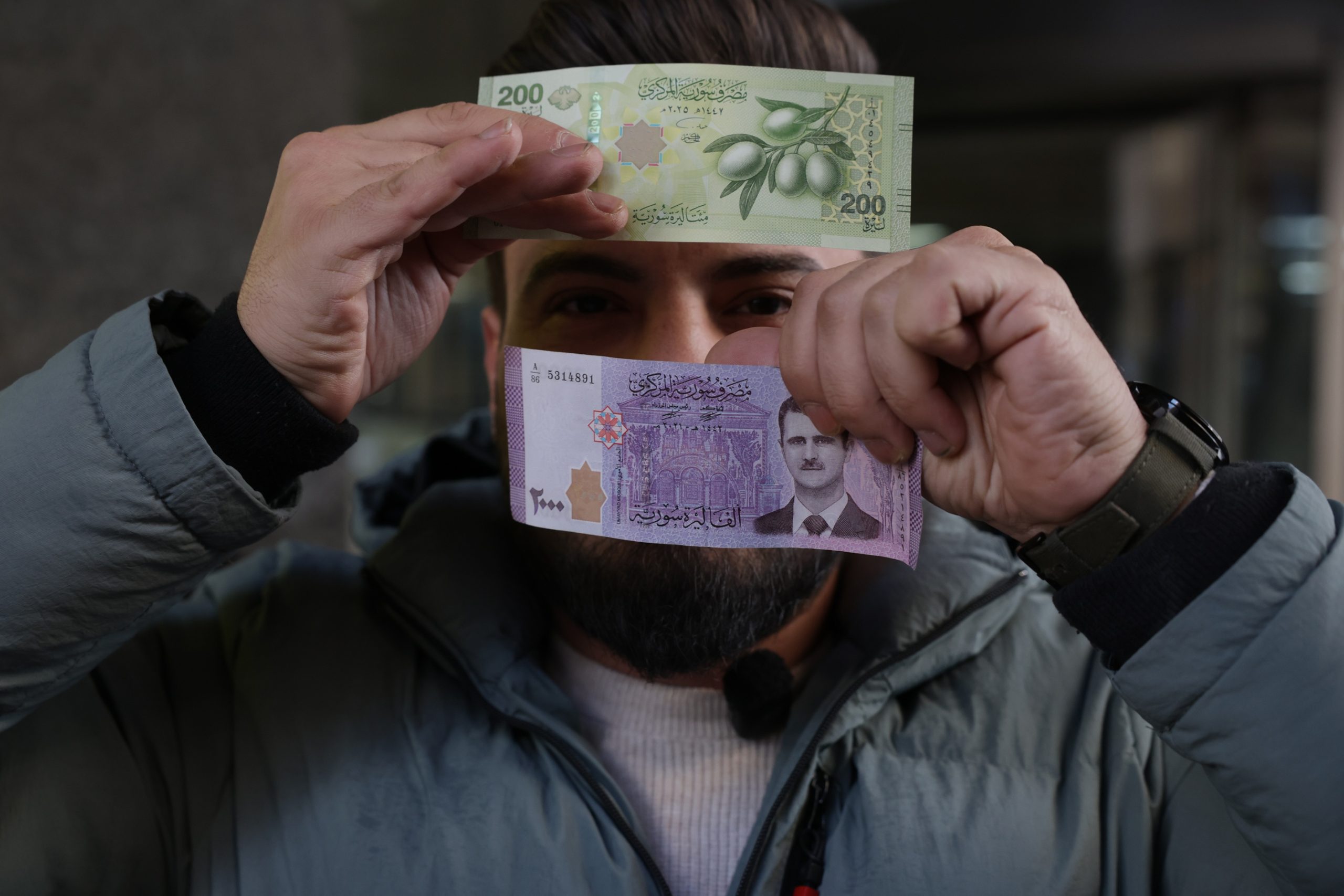
The Syrian regime, concerned about potential destabilization in light of these developments, has taken a series of measures aimed at alleviating public pressure. Last January, it decided to promote a currency redenomination and remove two zeros from the Syrian pound, with the aim of facilitating transactions and laying the groundwork for broader economic reform that would help restore public confidence. Later, Syrian President Ahmed al-Sharaa signed presidential decrees mandating broad wage increases across the public sector — including in health, education, religious affairs, and finance — in an effort to improve living conditions.
At the same time, Finance Minister Mohammed Barnieh introduced a comprehensive tax reform, which includes a full exemption from income tax for low-income earners (those earning below 640,000 Syrian pounds annually, approximately $4,600), and the introduction of a 5 percent consumption tax, with exemptions for essential goods such as food, medicine, and educational services, in order to prevent further erosion of the purchasing power of vulnerable populations. In addition, it was decided to increase public-sector pensions by 30 percent. Barnieh noted that pensions in Syria have risen by an average of approximately 56 percent over the past year, reflecting the government’s willingness to expand public spending to support weaker segments of society.
Economists commenting on these measures — intended primarily to ease the cost of living and improve purchasing power — have emphasized that wage increases must be accompanied by genuine reform in the public sector, including improvements in service to the citizens, addressing administrative inefficiencies, and enhancing overall effectiveness. Wage increases alone are insufficient, underscoring the need for monitoring and evaluation of public-sector performance to ensure measurable outcomes.
Another point of concern raised by economists is government intervention in subsidizing essential goods and procurement policies. The Syrian government faces a dilemma: on the one hand, public pressure for subsidies and assistance is growing in order to alleviate the severe economic hardship faced by citizens. On the other hand, excessive government intervention in the economy risks pushing Syria into a trap experienced by other governments that have accumulated debt due to subsidizing basic goods, yet have been unable to roll back such subsidies for fear of public backlash — as seen in Egypt.
This tension was reflected in a wave of protests that erupted in May 2026 in Syria’s main agricultural regions (al-Hasakah, al-Raqqa, Deir al-Zor, and the Hama countryside), in response to the government’s decision to set the wheat procurement price at 46,000 new Syrian pounds per ton (approximately $330). Farmers and leaders of agricultural unions opposed the official rate, describing it as exploitative and inconsistent with the effort invested in cultivating the country’s most significant crop. Protesters pointed to the paradox whereby the government chose to feature wheat sheaves on the new 500-pound banknotes as a symbol of national wealth, while in practice implementing policies that undermine the economic viability of producers.
In response to the issue and following mounting anger among farmers, al-Sharaa decided, by presidential decree, to grant an additional 9,000 Syrian pounds (approximately $80) per ton of wheat purchased from farmers, effectively raising the price to $420 per ton. Economists argue that this price is high relative to Russian or Ukrainian wheat purchased by Damascus, illustrating the government’s willingness to respond to public pressure even at the expense of long-term economic considerations. One of the key tests facing the Syrian government will be its ability to balance farmers’ demands with the broader public interest in long-term economic growth. In June 2026, commercial companies also began to join the protests, demanding improvements in wages and social benefits.
External Involvement in Reconstruction
From its earliest days, the Syrian government has acted with rigor to mobilize external investors for the reconstruction of the economy. On May 18, Finance Minister Barnieh participated in a closed session of G7 finance ministers and central bank governors in Paris. The discussions focused on Syria’s economic recovery and its reintegration into the global financial system. This participation marks another significant step in al-Sharaa’s government’s efforts to align with major economies and to mobilize international support for reconstruction ahead of the G7 summit held in June.
In May, two important developments occurred in the process of rebuilding Syria’s economy: the European Union’s decision to resume trade relations with Syria, and the decision by financial giants Visa and Mastercard to allow the use of international credit cards in the country. The central question is not only who will finance Syria’s reconstruction, but what kind of economy will emerge there: an open and competitive economy, or a reconstitution of a “crony economy” under new leadership.
At the same time, the international desire for reconstruction sometimes clashes with the instability prevailing in Syria. On July 7, as French President Emmanuel Macron became the first Western leader to visit the country since the fall of the Assad regime, several explosions occurred near his location in the capital, Damascus. This underscores another challenge facing Syria: a functioning economy requires an environment sufficiently secure to do business in.
Syria is now engaged in a “reconstruction race.” This race takes place alongside other countries in the region that have suffered massive destruction and require international assistance, including Lebanon, Yemen, Libya, Iran, Somalia, and areas such as the Gaza Strip. In this race, Syria has several advantages. First, the war on its territory has ended, and a new leadership has emerged that enjoys international recognition — unlike in places such as Gaza or Libya, where the situation remains unsettled. In addition, Syria occupies a unique geopolitical crossroads that creates incentives for many states to support its reconstruction.
Turkey, Syria’s ally, is interested in reconstruction in order to stabilize its border and expand its influence in the country and the region. With the support of Turkey and the Gulf states, Syria is repositioning itself as a meeting point between the Middle East and Europe, offering a potential alternative to the Strait of Hormuz and Bab al-Mandab. European states are interested in stability in Syria as a means of addressing the crisis and facilitating the return of Syrian refugees from their territories. A stable Syria also constitutes a clear interest in U.S. regional policy.
Despite these advantages, global instability may hinder Syria’s ability to raise the required capital. Gulf states are grappling with an economic crisis resulting from the war with Iran. Turkey, the most important ally of the new Syrian regime, ranks 11th globally in GDP adjusted for purchasing power parity (PPP), yet faces persistent inflation and structural challenges. Europe is preoccupied with inflation, electricity prices, and the need for rearmament, while the United States — despite President Trump’s recent moves — appears increasingly focused on domestic issues.
Despite the importance of international involvement, the scale of investment alone does not guarantee success. The experience of other countries shows that inflows of external capital can accelerate recovery, but are insufficient to generate sustainable growth. The central question, therefore, is not only how much money will be invested in Syria, but whether the state will be able to build economic institutions capable of utilizing these resources efficiently. This issue lies at the heart of several leading approaches in the study of economic growth.
Moreover, significant legal and financial barriers still impede Syria’s integration into the global system, contrary to the optimistic impression conveyed by U.S. investment guides. As long as Syria’s designation as a State Sponsor of Terrorism (SST) remains in place, foreign companies investing in the country remain exposed to the immediate seizure of their assets and funds by creditors, effectively undermining Syria’s ability to attract institutional Western capital.
Syria’s Economy Through the Lens of Economic Theories
Classical models of economic growth, most notably that of Robert Solow, suggest that countries emerging from wars may experience relatively rapid growth in the early following years, due to the high level of destruction and the need to rebuild infrastructure. In this sense, the extensive damage inflicted on Syria also creates significant potential for rapid growth, provided that sufficient resources are mobilized.
However, more recent research — particularly associated with the work of the 2024 Nobel laureates Daron Acemoglu, Simon Johnson, and James Robinson — emphasizes that investment and capital alone do not guarantee success. The quality of institutions, the rule of law, the protection of property rights, levels of corruption, and the ability to foster competition and entrepreneurship are key factors influencing the success of countries undergoing reconstruction and development.
In the Syrian context, the challenge extends beyond rebuilding infrastructure and injecting capital. The Assad regime left behind not only physical destruction but also a centralized, corrupt economic system dependent on political power centers. Accordingly, the success of reconstruction will be measured not only by the volume of investment mobilized, but also by Syria’s ability to build credible economic institutions, strengthen the private sector, and promote competition and innovation.
In this regard, the Assad regime left behind not only extensive physical devastation but also a damaged institutional and economic infrastructure. For years, the Syrian economy operated in a centralized, state-dependent manner, with key economic power centers controlled either by the state or by actors closely affiliated with the regime. The Syrian banking sector was particularly weak: most banks were nationalized and remained under state control, and the financial system failed to develop into a meaningful mechanism for credit provision, investment, and support for entrepreneurship.
The visit of International Monetary Fund (IMF) representatives to Damascus in June 2025 illustrates this point clearly. During their first visit to Syria since 2009, IMF officials emphasized that economic recovery requires not only aid and capital, but also the restoration of public trust, strengthening of the central bank, rehabilitation of payment and banking systems, tightening of financial supervision, and improvements in anti–money laundering and counter-terrorism financing mechanisms. During a follow-up visit in February 2026, the IMF noted that the central bank had maintained a tight monetary policy and that refraining from monetary financing through the central bank had helped curb inflation and contributed to some stabilization of the exchange rate. At the same time, the IMF stressed that the next phase requires strengthening the central bank’s independence, developing a modern monetary policy framework, assessing the condition of banks, and rehabilitating the banking and payments system. The appointment of Abd al-Qader Hasriya, formerly a partner at Ernst & Young in Syria, as governor of the central bank, further underscores the effort to present financial reconstruction as a technocratic-institutional project rather than a purely political one.
In light of all this, the status of the Syrian central bank is emerging as one of the key tests of the country’s reconstruction. A professional and independent central bank — capable of maintaining price stability, confidence in the currency, effective banking supervision, and integration into the international financial system — would signal the development of genuine economic institutions. Conversely, if money, credit, and the banking system remain subordinated to the needs of the regime and its affiliates, even large-scale investments and new infrastructure projects may ultimately reproduce a crony economy under a different name.
Syria is also seeking to cultivate a strong private sector. In June, the “First Conference for Dialogue with the Private Sector” was launched, during which Minister of Economy al-Shaar emphasized that the regime’s objective is not to privatize the entire public sector, but rather to create an economy that combines strong sectors. He also underscored the regime’s desire to integrate women into the economy.
Despite these declarations, Syria’s difficulty in developing an independent private sector is clearly reflected in data on the number of companies established in the country in 2025. Official figures published at the end of that year indicate that only about 30,000 companies exist in Syria — a particularly low number compared to regional states. That year, the Syrian government reported the establishment of approximately 18,000 new businesses, a figure that ostensibly places Syria alongside other countries in the region. However, a closer examination reveals that only 4,425 of these were formally registered companies, while the remainder were registered under categories similar to sole proprietorships or small self-employed businesses. When focusing solely on registered companies and comparing their number relative to the adult population, it becomes clear that the number of companies established in Syria in 2025 is significantly lower than in other regional countries.
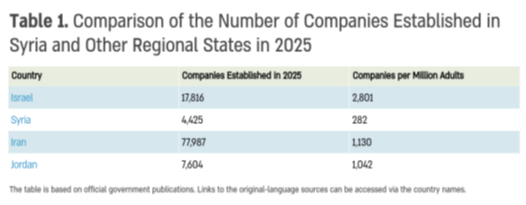
Accordingly, even after a dramatic political transition, Syria remains far from presenting a broad, competitive, and innovative private sector. The number of newly registered companies is low not only in absolute terms, but particularly relative to population size.
Moreover, economic institutions do not operate in a vacuum. A competitive and innovative economy also requires a social and cultural environment that enables knowledge, education, women’s participation in the public sphere, minority rights, and critical thinking. While Syria under the Assad dynasty was characterized by weak institutions, high centralization, and deep dependence on regime power structures, women maintained a presence in the public sphere and minority rights were preserved to some extent. In light of the more Islamist character of al-Sharaa’s regime, the question arises whether women will be allowed to participate in the economy, or whether Syria will effectively forgo half of its productive population.
Implications for Israel
Syria’s economic reconstruction will largely determine the nature of the Syrian state that Israel will face in the coming years and decades. A Syria mired in deep economic crisis may continue to serve as an arena of influence for foreign actors, militias, smuggling networks, and informal financing mechanisms, and may enable actors such as Iran or Hezbollah to exploit economic distress to expand their influence and presence, as occurred during the Assad era. In such a scenario, state weakness does not necessarily reduce the threat to Israel; rather, it may deepen instability along the northern border and allow both external and internal actors to exploit the economic and governance vacuum.
Conversely, even a Syria undergoing economic recovery does not necessarily bode well for Israel. A more economically robust Syria that remains politically or militarily hawkish may channel some of its resources into rebuilding its military, strengthening security apparatuses, and developing renewed capabilities vis-à-vis Israel. For Israel, the more decisive factor is the nature of the regime — along the spectrum from extremist Islamist to more moderate — and its orientation toward Israel. Beyond internal dynamics, the regime does not operate in a vacuum and is significantly influenced by Israeli policy toward it.
At the same time, official actors in Israel remain wary of the Syrian regime and its intentions. Beyond the obvious concerns stemming from its ideological origins, considerable uncertainty persists regarding Syria’s stability and future trajectory. Its economic condition is a critical component in assessing its overall situation. Accordingly, Israel would be well advised to monitor clear institutional indicators: the degree of independence and professionalism of the central bank; the quality of banking supervision; the reintegration of banks into the international financial system; the pace of new company registrations; the level of competition in key sectors; and the identity of actors involved in reconstruction projects.
Moreover, Israel should ensure that the geopolitical-economic competition surrounding Syria’s reconstruction — over status, influence, assets, and regional corridors — does not come at its expense. These indicators can help determine whether Syria is moving toward becoming a stable, open state with a functioning economy, or whether it is reconstructing a centralized, weak system dependent on political power centers. Over the long term, the quality of economic institutions may prove more significant than the volume of investment itself in shaping Syria’s character and the challenge it will pose to Israel.