The Question of Identity in Jordan and the Peace Treaty with Israel: Jordanian Discourse on the Social Media | INSS
go to header go to content go to footer go to search
INSS logo The Institute for National Security Studies, Strategic, Innovative, Policy-Oriented Research, go to the home page
INSS
Tel Aviv University logo - beyond an external website, opens on a new page
  • Campus
  • Contact
  • עברית
  • Support Us
  • Research
    • Topics
      • Israel and the Global Powers
        • Israel-United States Relations
        • Glazer Israel-China Policy Center
        • Russia
        • Europe
        • Antisemitism and Delegitimization
      • Iran and the Shi'ite Axis
        • Operation Roaring Lion
        • Iran
        • Lebanon and Hezbollah
        • Syria
        • Yemen and the Houthi Movement
        • Iraq and the Iraqi Shiite Militias
      • Conflict to Agreements
        • Israeli-Palestinian Relations
        • Hamas and the Gaza Strip
        • Peace Agreements and Normalization in the Middle East
        • Saudi Arabia and the Gulf States
        • Turkey
        • Egypt
        • Jordan
      • Israel’s National Security Policy
        • Military and Strategic Affairs
        • Societal Resilience and the Israeli Society
        • Jewish-Arab Relations in Israel
        • Climate, Infrastructure and Energy
        • Terrorism and Low Intensity Conflict
      • Cross-Arena Research
        • Data Analytics Center
        • Law and National Security
        • Advanced Technologies and National Security
        • Foreign Information Manipulation and Interference
        • Economics and National Security
    • Projects
      • Preventing the Slide into a One-State Reality
  • Publications
    • -
      • All Publications
      • INSS Insight
      • Policy Papers
      • Special Publication
      • Strategic Assessment
      • Technology Platform
      • Memoranda
      • Posts
      • Books
      • Archive
  • Database
    • Surveys
    • Spotlight
    • Maps
    • Dashboards
  • Events
  • Team
  • About
    • Vision and Mission
    • History
    • Research Disciplines
    • Chairman of the Board
    • Board of Directors
    • Fellowship and Prizes
    • Internships
  • Media
    • Communications
    • Video gallery
    • Press Releases
  • Podcast
  • Newsletter
  • Campus
Search in site
  • Research
    • Topics
    • Israel and the Global Powers
    • Israel-United States Relations
    • Glazer Israel-China Policy Center
    • Russia
    • Europe
    • Antisemitism and Delegitimization
    • Iran and the Shi'ite Axis
    • Operation Roaring Lion
    • Iran
    • Lebanon and Hezbollah
    • Syria
    • Yemen and the Houthi Movement
    • Iraq and the Iraqi Shiite Militias
    • Conflict to Agreements
    • Israeli-Palestinian Relations
    • Hamas and the Gaza Strip
    • Peace Agreements and Normalization in the Middle East
    • Saudi Arabia and the Gulf States
    • Turkey
    • Egypt
    • Jordan
    • Israel’s National Security Policy
    • Military and Strategic Affairs
    • Societal Resilience and the Israeli Society
    • Jewish-Arab Relations in Israel
    • Climate, Infrastructure and Energy
    • Terrorism and Low Intensity Conflict
    • Cross-Arena Research
    • Data Analytics Center
    • Law and National Security
    • Advanced Technologies and National Security
    • Foreign Information Manipulation and Interference
    • Economics and National Security
    • Projects
    • Preventing the Slide into a One-State Reality
  • Publications
    • All Publications
    • INSS Insight
    • Policy Papers
    • Special Publication
    • Strategic Assessment
    • Technology Platform
    • Memoranda
    • Posts
    • Books
    • Archive
  • Database
    • Surveys
    • Spotlight
    • Maps
    • Dashboards
  • Events
  • Team
  • About
    • Vision and Mission
    • History
    • Research Disciplines
    • Chairman of the Board
    • Board of Directors
    • Fellowship and Prizes
    • Internships
    • Privacy Policy and Terms of Use
  • Media
    • Communications
    • Video gallery
    • Press Releases
  • Podcast
  • Newsletter
  • Campus
  • Contact
  • עברית
  • Support Us
bool(false)

Publications

Home Publications INSS Insight The Question of Identity in Jordan and the Peace Treaty with Israel: Jordanian Discourse on the Social Media

The Question of Identity in Jordan and the Peace Treaty with Israel: Jordanian Discourse on the Social Media

INSS Insight No. 546, May 8, 2014

עברית
Udi Dekel
Orit Perlov
The upheavals in Jordan’s strategic environment have sparked a heated debate on the social media regarding the identity of the Hashemite kingdom and Jordan’s relations with Israel. The response to the killing in March 2014 of Raed Zeiter, a Jordanian-Palestinian judge, at the Allenby Bridge crossing by IDF soldiers presents an illustrative case study in this matter. Following the incident, three main trends were evident in the intensive discussions on the social media: 1. There are strong differences in approach between the various influential groups in Jordan – the Trans-Jordanians and the Palestinian Jordanians – on the question of identity and solidarity among “Jordanians” versus “Palestinians.” 2. The efforts by some Palestinians and opposition leaders in Jordan to mobilize public opinion and leverage the shooting incident for the purposes of escalating bilateral Israeli-Jordanian relations clearly failed. 3. The Jordanian-Israeli peace agreement remains of strategic importance in the eyes of the Trans-Jordanians.

The upheavals in Jordan’s strategic environment have sparked a heated debate on the social media regarding the identity of the Hashemite kingdom and Jordan’s relations with Israel. The dynamic challenges that form the background to this debate include the civil war in Syria, which has resulted in some 1.5 million refugees fleeing to Jordan and the establishment of jihadi Islamist terror infrastructures near the kingdom’s borders; the continued instability in Iraq, with nearly half a million Iraqi refugees settling in Jordan over the past decade; and the apparent stalemate in the Israeli-Palestinian arena, which greatly influences public opinion in Jordan, especially among the Palestinian majority.

The response to the killing in March 2014 of Raed Zeiter, a Jordanian-Palestinian judge, at the Allenby Bridge crossing by IDF soldiers presents an illustrative case study in this matter. Leftists, Islamists, and independent activists joined hands with MPs, most of them of Palestinian origin, and tried to leverage the incident to exert public and parliamentary pressure on the King. Their pressure included an explicit demand to annul the peace treaty with Israel, expel the Israeli ambassador from Amman, and release Ahmed Daqamseh, the Jordanian soldier responsible for the murder of seven Israeli schoolgirls in Naharayim in 1997.

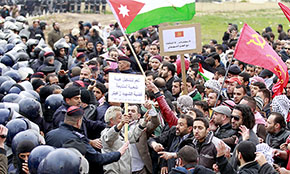
Three demonstrations of force took place the day after the judge was killed: one outside the Israeli embassy in Amman; a protest sponsored by the by lawyers and judges' unions, where Israeli flags were burned and protesters called for the expulsion of Israel's ambassador; and a vote of no confidence in the Jordanian parliament, in which the Palestinian committee and the Human Rights committee in the Lower House demanded that the peace treaty with Israel be revoked.

King Abdullah II publicly condemned the shooting incident. He sent Foreign Minister Nasser Judeh to deliver a condemnation in parliament and pledge that the judge's death would be investigated immediately. In addition, the King offered condolences to the family and had his photo taken while embracing the late judge's father. Some twenty-four hours after the incident, Israeli Prime Minister Benjamin Netanyahu, presumably in coordination with the Jordanian royal house, sent a public apology and expressed Israel’s sympathies to the people and government of Jordan, and announced the establishment of a joint Israeli-Jordanian team to complete the investigation.

Following the incident, three main trends were evident in the intensive discussions on the social media: 1. There are strong differences in approach between the various influential groups in Jordan - the Trans-Jordanians and the Palestinian Jordanians - on the question of identity and solidarity among “Jordanians” versus “Palestinians.” 2. The efforts by some Palestinians and opposition leaders in Jordan to mobilize public opinion and leverage this incident for the purposes of escalating bilateral Israeli-Jordanian relations clearly failed. 3. The Jordanian-Israeli peace agreement remains of strategic importance in the eyes of the Trans-Jordanians.

Palestinian Jordanians and Trans-Jordanian Relations

 “Palestinian” vs. “Jordanian” identity: An online crisis began when Palestinian activists chose to emphasize the Palestinian identity of the judge who was killed – he was originally from the northern West Bank city of Nablus – over his Jordanian nationality. This sentiment was likewise clearly evident when some protesters waved Palestinian flags at the demonstrations and used the event in order to put pressure on the King, embarrass him, and threaten a no-confidence vote in the parliament. This behavior led to a counter-response on the social media, primarily from Jordanian citizens and activists who are not of Palestinian origin.

Jordanian youth and the King: Young Jordanians are giving their support to the King because of his success in preserving Jordanian unity and obstructing the regional chaos that threatens to breach the gates of the kingdom. Young people who have witnessed the wave of revolutions in Arab countries are not interested in paying a similar price, and therefore are not eager to see the King’s legitimacy erode. The attempt to undermine his policies actually led to a counter reaction, a formation of a united front and immediate and definitive opposition to the demands being made. Online, some even went so far as to comment, “We are all Jordanians, so why make this distinction?” and “The only flag that should have been waved at the protests is the Jordanian flag.” Thus the three principal demands mentioned above have not received broad public support, and there was no online consensus on these issues. Overall, therefore, the attempt to leverage the Allenby Bridge incident into a strategic move against Israel has failed.

The “alternative homeland” vs. a country based on citizenship: Some online discussion maintains that Jordanian citizens of Palestinian origin have not relinquished their Palestinian national identity. At issue here is the kingdom’s future: will it retain its Hashemite character or, given the presence of many minorities - Palestinians, Syrians, and Iraqis, who in fact constitute a decisive majority - will Jordan become what is called the “alternative homeland” (al-watan al-badeel)? Young Jordanians see this as the most dangerous scenario for the stability of the royal house and of the country itself, as they fear that the Palestinians, who are already the dominant majority, will turn Jordan into a de-facto Palestinian state. There are discussions online of a different scenario, a country based on citizenship (“a state of all its citizens”) in which every Jordanian citizen would have equal rights and obligations, with no tribe or ethnic group having preference.

Israel-Jordan Relations

As a result of the incident at the Allenby Bridge, it is clear that today a majority of Jordanian youths participating in discussions on the social media support the Israeli-Jordanian peace treaty. It is not only the governing elite that understands the strategic importance of the treaty for Jordan; for young people, the agreement serves as a critical stabilizing element. In their view, the treaty actually maintains the dynamic and the internal balance in Jordan between Trans-Jordanian and Palestinian citizens and is essential for the survival of the royal house. If in the past there was opposition to the peace treaty among the Jordanian population, forcing the King and his ministers to defend it, today it enjoys broader legitimacy. This sentiment underlines the failure of using the shooting incident as political ammunition against the King.

Comments

Jordanian youths, especially Trans-Jordanians, are gradually taking the place traditionally held by the Bedouin tribes as the basis of support and legitimacy for the Hashemite royal house, and for King Abdullah II in particular. They have chosen to position themselves in the King’s camp out of a belief in their ability to influence him, bring about the desired reforms and changes, and successfully meet the challenges of regional instability, without unnecessary uprising. In the past eighteen months, young activists have been shown to side with the King time and time again when powerful groups in Jordan attempted to pressure him. This has enabled the King to remain powerful in the face of domestic pressures and prevent them from destabilizing the kingdom.

Today in Jordan, young people are the force that balances the two internal centers of power, the Trans-Jordanian tribal leaders and the Islamist movements, particularly the Muslim Brotherhood (whose support base comes from Jordanians of Palestinian origin). Therefore, any future domestic crisis in the kingdom will also have to be examined through the prism of this balance of power.

In the past, the peace treaty gave legitimacy to Israel in the region, while inside Jordan, increased criticism of the treaty and normalization with Israel prevailed. Today, however, at a time when the Arab world is in turmoil and Arab leaders are losing their legitimacy, the peace treaty with Israel has become a basis for legitimacy and a stabilizing factor for the Jordanian royal house. This insight has led young people in Jordan to respect the peace treaty and view it as a strategic asset whose importance should not be underestimated.

The weight of the challenges facing the kingdom, including outside interference in its domestic affairs; the refugees from Syria; the use of Jordan as a transit and supply route by jihadi elements on their way to Syria; the struggle between those who demand reforms and the traditional elites, who wish to preserve the old order; the stalemate in the Israeli-Palestinian conflict; and the economic crisis, have all led to discussions on the future identity of Jordan: preserving the Hashemite kingdom, becoming the new, “alternative homeland,” or ushering in a “state of all its citizens.” This conversation is just in its beginning, and it is worth following its development.

The opinions expressed in INSS publications are the authors’ alone.
Publication Series INSS Insight
TopicsIsraeli-Palestinian RelationsJordan
עברית

Events

All events
Iran, US, Israel, and the Global Jewish Community
10 March, 2026
12:00 - 13:00
Shutterstock

Related Publications

All publications
Habbou Ramez/ABACA via Reuters Connect and REUTERS (modified by INSS)
De-Hamasification of the Gaza Strip: Learning from Western and Arab Models of Deradicalization
The radicalization of Palestinian society in the Gaza Strip is not a new phenomenon, but the process has accelerated and deepened dramatically since Hamas’ takeover of the territory in 2007. Under its rule, an extremist religious-nationalist ideology has been systematically embedded across all spheres of Gaza life—from education and religious institutions to welfare and the media—producing a profound “Hamasification” of public consciousness. The war that erupted on October 7 brought unprecedented ruin to the Gaza Strip, both physically and institutionally, posing a monumental reconstruction challenge, but also a rare historic opportunity. This memorandum argues that military disarmament and physical rehabilitation alone will not ensure long-term security and stability, and that a far deeper process of “de-Hamasifcation” is required: dismantling Hamas’ ideological and institutional hegemony and replacing it with a more moderate civic and normative infrastructure. The study presents a comparative analysis of Western and Arab deradicalization models and finds that Western approaches—such as those implemented in Germany and Japan—struggle to provide an adequate response to Gaza’s cultural and political context. Instead, we propose adopting operational principles drawn from contemporary Arab models, particularly the “civic-transformative” model applied in the Gulf states, which combines a firm crackdown on extremist actors with re-education toward religious tolerance and broad-based economic rehabilitation. The paper outlines an integrative strategy encompassing sustained security demilitarization, the mobilization of an Arab coalition to provide religious and political legitimacy, and the establishment of a credible political horizon as a counterweight to the ethos of “resistance.” Only the combination of these elements can generate a viable governing and ideological alternative to Hamas and lead to a more stable long-term security environment for the State of Israel.
05/02/26
REUTERS / Jonathan Ernst
Trump’s Board of Peace: An Initiative for the Gaza Strip or an Alternative to the UN?
What is the mission of the international board established by the US president as part of his plan to end the war in the Gaza Strip—and what are the implications of Trump’s move?
04/02/26
Harun Ozalp / Anadolu via REUTERS
The Transition to Phase II in the Gaza Strip—An Unprecedented Challenge for Israel
What challenges and concerns have arisen—both in Jerusalem and in Ramallah—following the announcement of the transition to the second phase of the Trump plan for stabilizing the Gaza Strip, and how should Israel act?
27/01/26

Stay up to date

Registration was successful! Thanks.
  • Research

    • Topics
      • Israel and the Global Powers
      • Israel-United States Relations
      • Glazer Israel-China Policy Center
      • Russia
      • Europe
      • Antisemitism and Delegitimization
      • Iran and the Shi'ite Axis
      • Operation Roaring Lion
      • Iran
      • Lebanon and Hezbollah
      • Syria
      • Yemen and the Houthi Movement
      • Iraq and the Iraqi Shiite Militias
      • Conflict to Agreements
      • Israeli-Palestinian Relations
      • Hamas and the Gaza Strip
      • Peace Agreements and Normalization in the Middle East
      • Saudi Arabia and the Gulf States
      • Turkey
      • Egypt
      • Jordan
      • Israel’s National Security Policy
      • Military and Strategic Affairs
      • Societal Resilience and the Israeli Society
      • Jewish-Arab Relations in Israel
      • Climate, Infrastructure and Energy
      • Terrorism and Low Intensity Conflict
      • Cross-Arena Research
      • Data Analytics Center
      • Law and National Security
      • Advanced Technologies and National Security
      • Foreign Information Manipulation and Interference
      • Economics and National Security
    • Projects
      • Preventing the Slide into a One-State Reality
  • Publications

    • All Publications
    • INSS Insight
    • Policy Papers
    • Special Publication
    • Strategic Assessment
    • Technology Platform
    • Memoranda
    • Database
    • Posts
    • Books
    • Archive
  • About

    • Vision and Mission
    • History
    • Research Disciplines
    • Chairman of the Board
    • Board of Directors
    • Fellowship and Prizes
    • Internships
    • Support
    • Privacy Policy and Terms of Use
  • Media

    • Communications
    • Video Gallery
    • Press Release
    • Podcast
  • Home

  • Events

  • Database

  • Team

  • Contact

  • Newsletter

  • עברית

INSS logo The Institute for National Security Studies, Strategic, Innovative, Policy-Oriented Research, go to the home page
40 Haim Levanon St. Tel Aviv, 6997556 Israel | Tel: 03-640-0400 | Fax: 03-744-7590 | Email: info@inss.org.il
Developed by Daat ,Yael Group.
Accessibility Statement
This site is protected by reCAPTCHA and the Google Privacy Policy and Terms of Service apply.