


Publications
Survey, September 17, 2026
Follow us on GoogleTable of Contents:
This survey examines the attitudes and perceptions of the Palestinian public in the West Bank regarding the core issues of the Israeli–Palestinian conflict, the war in the Gaza Strip, the Palestinian leadership, and the challenges characterizing daily life in the West Bank. The study was conducted as part of a series of surveys assessing public sentiment in Palestinian society, following the previous survey conducted in September 2025. Data collection took place between June 27 and July 2, 2026, via telephone interviews with 400 adult Palestinian respondents in the West Bank, selected using district-level quota sampling. This analysis presents the survey findings and includes multivariate statistical models, which allow for the examination of the links and connections between the demographic and socioeconomic characteristics of the respondents and their positions on the issues surveyed.
Click here to download the full survey data | Survey results in Arabic – نتائج الاستطلاع باللغة العربية | View the Appendices
Key Findings
- Threat Ranking and Sense of Personal Security: An overwhelming majority of respondents identify unemployment and loss of income (97%), settler violence (96%), and IDF operations in the West Bank (91%) as the most central issues; 60% report a low or very low sense of personal security.
- The Palestinian Struggle and Conflict Resolution: 52% prefer negotiations as the best means to end the conflict, compared to 13% who chose unarmed popular resistance and 12% who chose armed resistance; 57% agree with the claim that violent resistance has failed and that the focus should shift to a diplomatic action in the international arena; none of the proposed frameworks for resolving the conflict commands majority support: 27% favor a two-state solution, 26% seek a Palestinian state from the Jordan River to the Mediterranean Sea (throughout all of "historic Palestine") without a permanent Jewish presence, 22% favor a single bi-national state with full equal rights, and 17% support a Palestinian state across the entire territory where Jews could live as citizens or residents.
- Perceptions of Israel and its Right to Exist: 41% responded that Israel has a right to exist, compared to 46% who responded that it does not. In a separate question, 42% estimated that it is possible to bring about the end of Israel's existence in the future.
- Repercussions of the Gaza War and the Future of the Gaza Strip: 74% of respondents fear the destruction of cities in the West Bank similar to Gaza; the most widely selected option for governing the Gaza Strip was a technocratic government (The National Committee for the Administration of Gaza), chosen by 32%; 21% selected the Palestinian Authority, 21% chose a Fatah–Hamas unity government, and only 5% chose Hamas.
- Identity: Most respondents defined their primary identity as Palestinian (49%), religious (37%), or Arab (13%).
Methodology
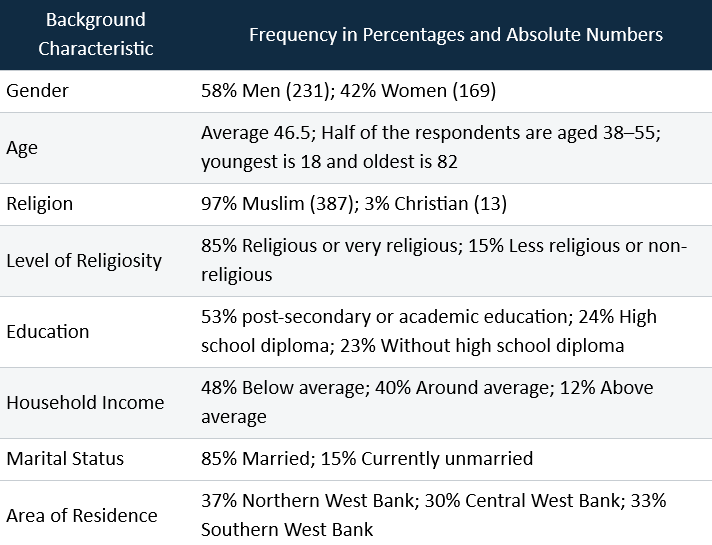
The empirical foundation of this study relies on a dedicated public opinion survey conducted between June 27 and July 2, 2026, led by the Data Analytics Center and the "From Conflict to Resolution" research program at the Institute for National Security Studies (INSS), as part of a research project tracking public opinion trends in the Palestinian public in the West Bank. Data collection was carried out in cooperation with "Stat-Net," headed by Yousef Makladeh, using structured telephone interviews conducted in Arabic with 400 male and female respondents. The sample is representative of the adult Palestinian population (aged 18 and older) residing in the West Bank. The maximum sampling error for the entire sample is estimated at ±4.9% at a 95% confidence level. The distribution of the sample characteristics is presented below:
Table 1. Distribution of Sample Characteristics (N=400)
Multivariate Models
The added value of this research report lies in the implementation of multivariate statistical models, beyond presenting descriptive frequencies detailing the distribution of attitudes across Palestinian society as a whole. The multivariate statistical models examine the relationships between respondents' characteristics and their attitudes, while statistically controlling for other background characteristics (gender, age, level of religiosity, education, income, area of residence, marital status, and the presence of children under 18 in the household). This means that when a gender gap or intergenerational difference is presented, it is done under a controlled comparison of respondents with a similar demographic profile. Furthermore, in order to reduce the risk of highlighting chance findings resulting from multiple comparisons, all findings presented in this report underwent strict statistical correction for multiple testing (Multiple Testing Correction using the Benjamini-Hochberg procedure). However, it should be clarified that this is a statistical analysis without prior research hypotheses; in particularly small sample subgroups (such as respondents who defined their identity as Arab or respondents defined as less religious and non-religious), the level of statistical uncertainty around the presented estimates is inherently higher.
Questionnaire Development and Quality Control
The questionnaire, originally drafted in Hebrew and translated into Arabic by two independent translators, was proofread by researchers at the Institute for National Security Studies (INSS). Prior to going into the field, a preliminary pilot was conducted among Palestinian employees at "Stat-Net" in order to adapt the wording of the questions to the local discourse. To minimize social desirability bias and respondents' concerns, and to encourage participation in an environment saturated with political and national sensitivity, a fixed protocol was implemented. Respondents were assured of complete confidentiality and the protection of the survey data; interviews were conducted by local female interviewers from their communities; no identifying details or personal information were requested; it was emphasized that the survey was not affiliated with any governmental, partisan, or political entity; and respondents were given complete freedom to answer openly or decline to answer altogether. The reliability of the fieldwork was maintained through continuous oversight by a dedicated quality-control manager, comprehensive interviewer training, internal consistency checks, and random monitoring of interviews. Nevertheless, the findings should be interpreted with due caution. Inconsistencies in responses and high nonresponse rates recorded for some questions reflect well-known methodological challenges involved in collecting data in conflict zones, stemming either from respondents’ reluctance to express their views openly or from insufficient familiarity with the complex issues examined. The quality-control measures were designed to reduce these biases but cannot eliminate them entirely.
Full Findings
Ranking of Issues in Palestinian Society and Sense of Personal Security
Unemployment, Settler Violence, and IDF Operations Ranked as the Most Severe Issues
An analysis of Palestinian public opinion in the West Bank outlines a complex array of issues, combining security and economic pressures with a deep erosion of domestic social and governance systems. The public displays near-total consensus regarding the severity of three key issues, each defined by an overwhelming majority as a "big" or "very big" problem (Figure 1). Unemployment and loss of income is identified as a central challenge by 97% of respondents (82% define it as a very big problem and 15% as a big problem); settler violence is tagged as a severe problem by 96% of respondents (81% as a very big problem and 15% as a big problem); and IDF operations in the West Bank are defined as a central problem by 91% (65% as a very big problem and 26% as a big problem). At the same time, the Palestinian public in the West Bank also perceives Internal Palestinian issues as central problems in particularly high proportions: the state of civil systems (86%), division in Palestinian society (81%), internal crime and violence (80%), and government corruption (78%).
Perception of Security: Six Out of Ten Report a Low Sense of Personal Security
The security and civil pressures reflected in the ranking of challenges translate into a deep fracture in the individual's sense of personal resilience (Figure 2). A majority of six out of ten respondents (60%) describe their sense of personal security as low (22%) or very low (38%). Conversely, 31% define it as medium, and only a minority of 9% report a high or very high sense of security.
A separate question (Figure 2) examined respondents’ exposure to settler violence over the previous year: 14% reported that they had personally been victims of such violence, 22% heard a first-hand account from a person known to them who experienced harm, 33% learned of such incidents through the news and on social media networks, and 31% responded that they had neither been harmed nor encountered such an incident in their surroundings (or declined to answer the question).
The findings of the statistical models highlight the direct impact of the nature of exposure to settler violence on the loss of personal security: compared with respondents who had not been exposed to such violence at all, direct victims were 27% more likely to report a very low sense of personal security, while those who had heard a firsthand account were 18% more likely to do so. By contrast, respondents exposed to settler violence solely through the news or on social media networks showed no statistically significant difference in their sense of security compared with those who had not been exposed at all. Alongside this, the model also reveals a significant and stable connection regarding intra-Palestinian challenges: the more seriously respondents rated internal problems (corruption, social divisions, crime, and the state of civilian systems), the greater their loss of personal security. Each one-unit increase in the index of internal problems was associated with an approximately 20% increase in the likelihood of reporting a very low sense of personal security.
The Palestinian Struggle and Conflict Resolution
A Majority Chose Negotiations, but No Political Solution Commanded Majority Support
An analysis of Palestinian public opinion in the West Bank regarding the end of the conflict and a future political settlement reveals a complex picture of a divided society, with no broad consensus around any single political solution. A 52% majority of respondents indicated negotiations as the best means to end the occupation, compared to only 12% who supported armed resistance and 13% who supported unarmed popular resistance (21% answered "don't know"; see Figure 4). By comparison, 43% of respondents chose negotiations in the previous survey, conducted in September 2025. However, the combined percentage of those choosing non-violent means (negotiations or unarmed popular resistance) stands at 65% in the current survey, compared to roughly 68% in the previous survey. The increase in support for negotiations alone should therefore not be interpreted as indicating an overall increase in the preference for non-violent means.
In a separate question, 57% of respondents agreed with the claim that the violent resistance has failed and that Palestinians should focus their efforts on a diplomatic action in the international arena, compared to 29% who disagreed. These figures indicate that this trend has gained momentum since the September 2025 survey, in which 50% agreed with the claim and 43% disagreed (Figure 5).
Regarding expectations for the development of political relations with Israel in the coming years (Figure 6), 34% anticipate a peace agreement, 13% expect progress toward a settlement, and 20% believe there will be no change. Conversely, a minority of 15% anticipates an outbreak of a popular uprising or armed resistance (of which 9% project a popular uprising and 6% armed resistance, while 18% answered "don't know"). These responses describe objective expectations and do not necessarily indicate value-based support for these scenarios.
The multivariate statistical analysis shows that the variables of age, education, and the severity of security-related friction play a significant role in shaping respondents’ views. Regarding the generational gap, the age variable shows a consistent pattern: each additional decade of age is associated, on average, with a 6% decrease in the likelihood of preferring negotiations and a 5% increase in the likelihood of supporting unarmed popular resistance. At the same time, level of education serves as a key predictor of expectations for the future. Compared with respondents who hold only a high school diploma, those with postsecondary or academic education show less confidence in the possibility of a political breakthrough: they are 16% less likely to anticipate a peace agreement, 6% more likely to expect either an unchanged status quo or a popular uprising, and 5% more likely to expect armed resistance. Finally, the issue-severity indices show that perceiving IDF operations and settler violence as more serious is directly associated with weaker support for negotiations, recognition of Israel’s right to exist, and coexistence.
Beyond respondents’ preferred means of ending the conflict, their views on the desired political solution reveal a complex picture in which none of the four alternatives commands a clear majority: 27% of respondents aspire to two states, 26% favor the establishment of a Palestinian state throughout "historic Palestine" without a permanent Jewish presence, 22% support a single bi-national state with full equality of rights, and 17% prefer a Palestinian state throughout the entire territory in which Jews could live as citizens or residents (8% answered "don't know" or selected another answer; Figure 7). It should be emphasized that the question examined respondents’ desired political outcome, rather than their assessment of its practical feasibility.
Accordingly, the public is almost completely divided over the question of the feasibility of living together in a single state with full civic equality (Figure 8): 46% of respondents assess that Israelis and Palestinians can live together within this framework, compared to 50% who believe they cannot (4% answered "don't know"). In the September 2025 survey, the figures stood at 40% and 59%, respectively.
In analyzing the variables predicting these attitudes, the multivariate models point to two significant relationships: First, a statistically significant gender gap is evident: compared to men with similar characteristics, women are 18% less likely to prefer a two-state solution, 19% more likely to favor a Palestinian state without a permanent Jewish presence, and 15% less likely to believe that coexistence based on equality is feasible. Second, regarding settler violence, local exposure to friction—either through direct harm or a firsthand account from someone close to the respondent—is associated primarily with a 17% decrease in preference for a bi-national state, though this effect weakens when the general threat perception index is weighted into the model.
The Regional Arena and the United States
On the question of expanding the Abraham Accords between Israel and Arab countries under a scenario in which a Palestinian state is established, the Palestinian public in the West Bank was evenly divided: 43% of respondents expressed support for expanding the Abraham Accords in exchange for the establishment of a Palestinian state, compared to an identical 43% who opposed it (while 14% answered "don't know"; Figure 9). However, the multivariate analysis reveals an opposite gender gap. While women expressed greater reservations regarding bilateral Israeli–Palestinian frameworks, in the regional context they were 14% more likely than men to support expanding the accords.
At the same time, the Palestinian public in the West Bank displays a skeptical and decisive view of US President Donald Trump’s commitment to protecting the rights and interests of the Palestinian people (Figure 10). An absolute majority of 53% of respondents states that the American president is not at all committed to Palestinian interests. The remaining respondents were divided in their assessments of US policy: 22% believe that President Trump supports the Palestinians only when doing so serves his own narrow interests, 14% describe his conduct as unpredictable, and only 2% believe that he is strongly committed to their interests (while 9% responded “don’t know”).
Perceptions Regarding the State of Israel and Its Right to Exist
Regarding the State of Israel’s right to exist (Figure 11), 41% of respondents stated that it has such a right, 46% stated that it does not, and 13% responded “Don’t know.” In a separate question examined in this context, 42% of respondents believed that it is possible to bring about the end of the State of Israel's existence—17% in the near future and 25% in the distant future—compared to 32% who responded that this is not possible and 26% who did not express an opinion.
The statistical models identify three key variables predicting perceptions regarding Israel: Religiosity is the most consistent predictor: religious respondents are 22% less likely to recognize Israel’s right to exist than less religious or nonreligious respondents with similar demographic profiles. Additionally, defining one's primary identity as Arab (compared to a Palestinian identity) increases the likelihood of responding that it is not possible to bring about the end of Israel's existence by 28% and reduces the expectation that this could occur in either the near or more distant future by approximately 14%–15%. Finally, age is associated with more moderate views: each additional decade of age increases the likelihood of recognizing Israel’s right to exist by 8%.
Hamas, the Campaign in Gaza, and Perceptions of the "Day After"
Repercussions of the Fighting in the Gaza Strip and Fears of Spillover
The prolonged war in the Gaza Strip is taking its toll on residents of the West Bank and generating deep concern that a broader escalation could result in similar destruction in their own communities (Figure 13). An overwhelming majority of 74% reported that they were very concerned (42%) or somewhat concerned (32%) that cities in the West Bank would be destroyed as cities in the Gaza Strip have been. By contrast, only a minority expressed little concern, with 6% being somewhat unconcerned and 17% not concerned at all (while 3% answered "don't know"). Compared to September 2025, the total proportion of those concerned remains unchanged (74%), but a decline in the intensity of concern is evident: the proportion of those very concerned dropped from 55% to 42%, alongside a corresponding increase in those who are somewhat concerned (from 19% to 32%).
This tangible sense of threat exists alongside pessimism and a clear-eyed public assessment of the outcome of the military campaign in Gaza (Figure 14): 38% of respondents project that the war will end in a loss for both sides, and 27% believe there will be no defined victor in the campaign. Only 9% anticipate a victory for the State of Israel, and an identical rate of 9% anticipate a victory for Hamas (while 17% answered "don't know"). Compared with September 2025, the proportion expecting the war to end in defeat for both sides declined from 53% to 38%, while the proportion anticipating no defined victor rose from 15% to 27%. The proportions of those projecting an unequivocal victory for Israel or Hamas remained relatively low in both surveys.
The Question of Hamas's Disarmament
The question of Hamas’s military future in the context of advancing Gaza’s reconstruction, presented in Figure 15, reveals a complex division among the West Bank public. Overall, 40% of respondents believe that Hamas should disarm, although fewer than half of them believe that the organization would actually agree to do so. In a detailed breakdown: 18% believe that Hamas should disarm and that it will indeed agree to do so, 22% believe that Hamas should disarm but will not agree to do so, 23% state categorically that the organization should not disarm; and a substantial 37% responded "don't know" to this question.
The multivariate model reveals that opposition to Hamas’s disarmament is associated with the severity of respondents’ security-related friction with Israeli forces. Each one-unit increase in the combined index measuring the perceived severity of IDF operations and settler violence is associated with a sharp 31% increase in the likelihood of responding that Hamas should not disarm. This is one of the strongest and most stable connections recorded in the analysis of the models, although the magnitude of the effect should be interpreted with due methodological caution, given that 63% of respondents received the maximum score on this severity index.
Governance Alternatives for Managing the Gaza Strip on "The Day After"
Regarding the alternatives for governing the Gaza Strip on “the day after” (Figure 16), a technocratic government received the greatest support. 32% of respondents selected a technocratic government or the National Committee for the Administration of Gaza, 21% supported transferring management to the Palestinian Authority, and an additional 21% favored the establishment of a Fatah-Hamas unity government. By contrast, only a small minority of 5% of respondents expressed a desire for Hamas to continue managing the Gaza Strip exclusively and directly, while 2% selected another option and 19% either declined to answer or responded "don't know."
By comparison, in the September 2025 survey, only 17% selected a technocratic government, while 39% chose a unity government. This comparison should be qualified, however, because the wording of both the question and the response option differed between the surveys. In September 2025, respondents were asked about the governance of Gaza after the war, and the option was phrased as “a technocratic administration (neither Fatah nor Hamas) under the supervision of Arab states.” In the current survey, it was defined as “a technocratic government / the National Committee for the Administration of Gaza.” The entire difference therefore cannot be attributed to a shift in public opinion or viewed as a direct measure of declining confidence in a unity government.
- Internal Palestinian Politics and Identity
The Issue of Succession in the Palestinian Authority Leadership
The public debate surrounding the question of "the day after" the era of Mahmoud Abbas (Abu Mazen) is characterized by a high degree of uncertainty and the absence of a clear leadership consensus. In an open-ended question designed to examine who the preferred successor to the presidency of the Palestinian Authority is, nearly half of the public (44%) answered that they do not know or refused to answer—a particularly high figure that may point to a deep leadership crisis or a fear of expressing a position on this sensitive issue. Among respondents who presented a clear political preference, Marwan Barghouti leads by a substantial margin over the other candidates with the support of 34% of respondents, while Hussein al-Sheikh receives the support of 8% and Hussein/Mahmoud Dahlan (Mohammad Dahlan receives just 5%. The remaining candidates evaluated—Jibril Rajoub, Majed Faraj, and others—receive 3% of the votes each.
In addition, statistical model analysis reveals that gender serves as a key variable in evaluating the preferred successor: compared to men with a similar demographic profile, Palestinian women have an 18% higher probability of preferring Marwan Barghouti as Mahmoud Abbas's successor.
Voting and Political Participation
Regarding voting and political participation, 44% of respondents stated that they would not vote if elections were held in the Palestinian Authority today. Among those who expressed a political preference, Fatah was selected by 30% of all respondents, the “Third Way” by 11%, Hamas by 4%, the Popular Front by 2%, and another option by 1% (an additional 8% answered "don't know" or declined to answer). These figures reflect only respondents’ hypothetical preferences at the time of the survey and should not be viewed as a forecast of actual voter turnout in future elections or as a measure of support for holding elections.
Alongside the general picture, the statistical models reveal several significant relationships. First, a statistically significant gender gap was recorded: Palestinian women are significantly less likely than men to express an active party preference. In the controlled model, women were 24% less likely than men with similar background characteristics to name a specific party for which they would vote. Second, a generational gap indicates a greater tendency to participate in the established political system with increasing age. Each additional decade of age increases the likelihood of naming a specific party by 6%. Finally, level of religiosity was found to be directly associated with civic political participation at the local level. Respondents defined as religious or very religious were 18% less likely to report that they had participated and voted in the most recent local elections than less religious or nonreligious respondents with similar demographic profiles.
Collective Identity and Self-Definition
An examination of the primary identity within the mosaic of identities among Palestinians in the West Bank reveals that 49% of respondents define themselves first and foremost as Palestinian, 37% as Muslim, and 13% as Arab (an additional 1% selected another response).