


Publications

The recent terrorist attacks are a tangible illustration of the growing concern in the security establishment and among the public of possible escalation approaching and during Ramadan. Israel has a few possible ways to act to lower the flames, including political and security moves that can be taken by virtue of improved ties with states in the region
INSS Insight No. 1580, March 30, 2022
Follow us on GoogleThe talk in Israel in recent weeks over possible escalation in the Israeli-Palestinian arena in advance of the upcoming month of Ramadan received new momentum with the two recent deadly attacks: the attack in Beer Sheva by a resident of Hura who was identified with ISIS, and the attack in Hadera by two ISIS loyalists from Umm al-Fahm, which killed two border police officers. Behind this discourse is the deterioration of security in the West Bank and the memory of May 2021 and Operation Guardian of the Walls, which boosted the status of Hamas. At the same time, the discourse ignores recent changes in the Palestinian arena. Hamas has lost momentum, and the tension between it and the Palestinian Authority, which ignited the area, has subsided to some extent. Reconstruction in the Gaza Strip is proceeding well, and the war in Ukraine has silenced all official Palestinian figures. For its part, Israel can take a number of steps to preempt problems, including using the renewed contact with Turkish President Erdogan to prevent Islamic incitement around al-Aqsa; strengthening coordination with Jordan and the PA over arrangements for Jewish and Palestinian religious observance in Jerusalem during the coming month; and encouraging efforts at restraint by Qatar and Egypt, which are working with Israel on the reconstruction and development of the Gaza economy.
The two recent deadly attacks – on March 22, 2022 in Beer Sheva by a resident of Hura who identified with ISIS; and on March 27 in Hadera by two ISIS loyalists from Umm al-Fahm, in which two Border Police were killed – has heightened fears of escalation in the Israeli-Palestinian arena and of a wave of attacks during the approaching month of Ramadan. Along with Israeli concerns, the debate in this context reflects a complex Palestinian examination of the incidents, which are unrelated to any attempts originating in the Gaza Strip to escalate the situation. Israel’s Palestinian citizens and Bedouin citizens in the Negev largely condemned the murders and expressed fears that the shared fabric of life in the country would be damaged. To be sure, Hamas spokesmen stressed the legitimacy of the attacks and described them as an expression of the geographical unity of all of Palestine and the Gaza Strip, and called for additional attacks. However, the perpetrators had no links to any Palestinian organization active in the West Bank or Gaza Strip: ISIS is an organization that Hamas and most Palestinians do not support, and have even vehemently opposed. Other Palestinian opposition factions used the opportunity to increase incitement and call for further attacks.
In fact, the current talk of possible escalation began in Israel before the murders by ISIS loyalists, centered around fears of escalation in East Jerusalem and elsewhere in advance of the coming month, which this year includes Ramadan and Passover and ends just before Independence Day and the anniversary of Operation Guardian of the Walls. There are a number of key events in Jerusalem during this period: Ramadan night prayers draw worshippers to al-Aqsa, and many remain within the mosque area during the month. Passover is accompanied by mass visits to the Western Wall, the Temple Mount, and the city of Jerusalem as a whole.
Behind this discourse is the difficult memory of the fighting in May 2021 between Israel and Hamas during Operation Guardian of the Walls, which focused on the issue of al-Aqsa and East Jerusalem. On the eve of these clashes, in protest at the Abu Mazen’s cancellation of Palestinian Legislative Council elections, Hamas positioned itself as the guardian of the holy places and succeeded in persuading huge numbers in the West Bank and among the Palestinian citizens of Israel to identify with Jerusalem. The actual fighting, initiated by Hamas, began with rockets fired toward Jerusalem, but was focused on the Gaza Strip.

Today, however, the atmosphere in the Israel-Palestinian arena is very different from what it was when the Palestinian elections were on the agenda. At that time Hamas enjoyed public support, and even today its status is stronger, bolstered in part by the self-criticism that emerged among the Israeli public after the operation, although it has lost the momentum that enabled it to recruit the masses for the fight against Israel. And indeed, just a few months later, there was a growing sense of frustration and impatience in the Hamas ranks in view of their inability to fulfill the bombastic promises about rebuilding the ruins of Gaza and ease the blockade on the area. Israeli opposition to the continued entry of Qatari cash into the Gaza Strip in the familiar format, delays in the reconstruction promised by Egypt, and civilian distress within the Strip all weigh on the Hamas leadership.
The changes are reflected in several parameters:
- Reconstruction work in the Gaza Strip, which began a few months ago. Egypt, which after long delays leads the work with heightened cooperation with Israel, is also expanding its economic activity in the Strip and creating jobs.
- Restraint: unlike in the past, Qatar and Egypt are working together on Gaza. The mechanism for bringing in Qatari money, which no longer involves suitcases full of cash, now operates through payments for fuel brought in from Egypt. This procedure not only reflects the shared interests of the two countries, but also strengthens them as elements that are able to restrain Hamas and other factions in the Strip. Qatari Ambassador Mohanmed al-Emadi, who visited Gaza on March 24, announced that a Qatari grant of $360 million to Gaza had been approved, including fuel for the power station and a grant of $100 million, some of which will be paid to needy families. Emadi added that there was an agreement to issue 30,000 work permits for Gazans for work in Israel.
- Work in Israel: Thousands of workers now leave the Gaza Strip every day to work in Israel. Israel unilaterally announced that over 10,000 permits for work in Israel would be granted and that it intended to increase the quota to 20,000, and it thus deprived Hamas of the ability to take credit for the permits. In Gazan terms, this is a major change – work in Israel leads the ambitions of all breadwinners in Gaza, and the announcement of the increased quota of permits has changed the atmosphere in the Gaza markets.
- Mitigated inter-organizational rivalry: The anger of Hamas and the general public against Abu Mazen and the Palestinian Authority in the days prior to Guardian of the Walls has essentially died down. The rivalry between the various factions exists in the old format, but without the fuel to fan the flames. Hamas threats regarding an Israeli attack on al-Aqsa, which have increased in recent weeks, have so far failed to mobilize the masses toward protest and resistance.
- The War in Ukraine: The Russian invasion of Ukraine is the focus of international attention. The leaderships of both Hamas and the Palestinian Authority are well aware of the gravity of the event and hesitate to adopt a position that could be interpreted as supporting one side or the other. Hamas even corrected some statements made by its people and stressed its neutrality. It is very doubtful whether escalation at this time would serve any Palestinian objective, since it would not receive the media coverage that brings it to the notice of the international community. Moreover, Hamas or any other Palestinian element that tries to incite violence in the area could arouse inter-Arab and international anger. The call to maintain neutrality is therefore the thread that runs through all Palestinian announcements, even if there is generally a clear bias toward support for Russia.
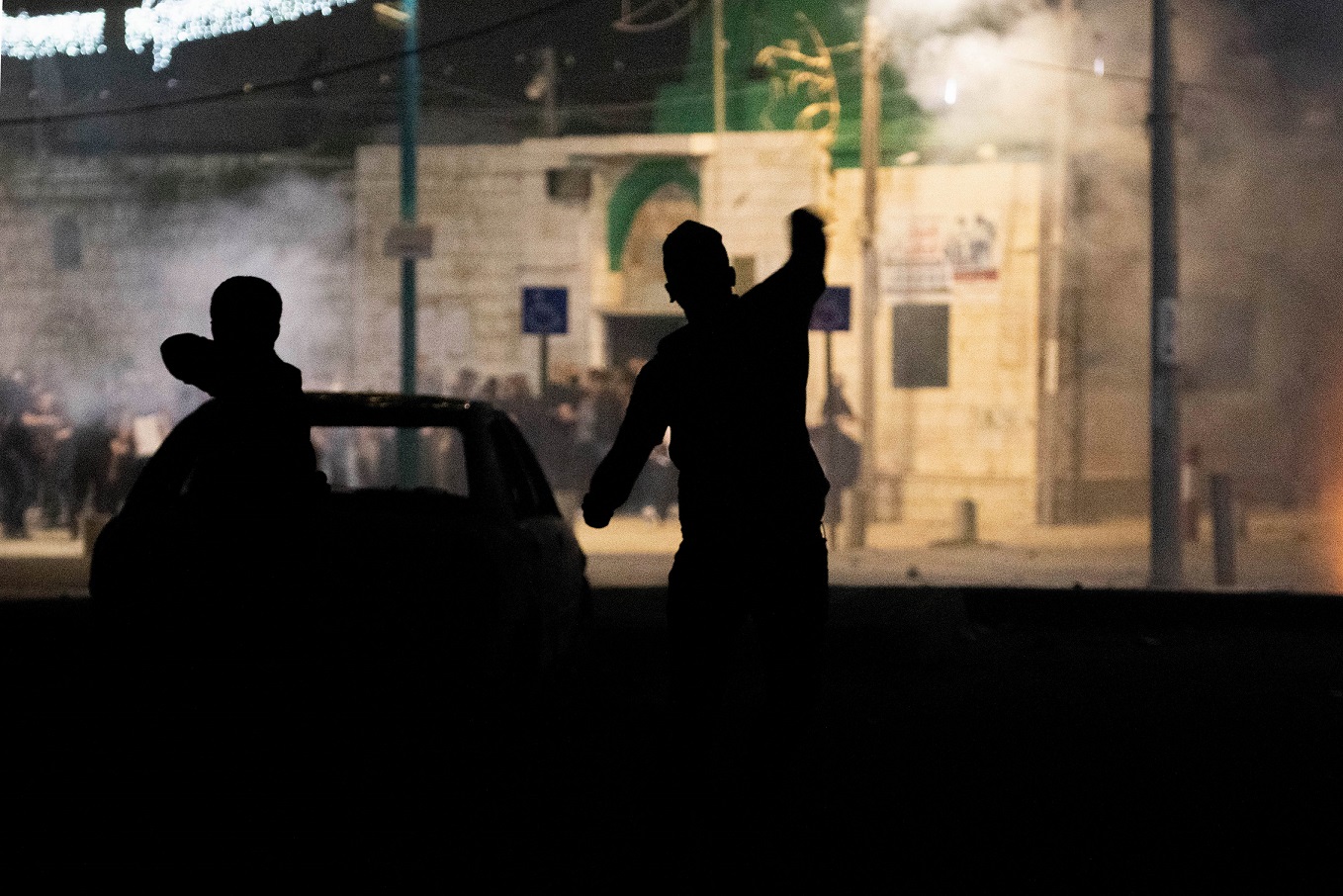
At the same time, the friction that has increased between the Israeli security forces and Palestinians throughout the West Bank, and in East Jerusalem in particular since Guardian of the Walls, is highly evident. The number of Palestinians killed in clashes with Israeli forces rose steeply over the past year; in East Jerusalem there were more attempted attacks by individuals; the number of Israeli entries to Areas A and B has increased considerably, leading to more friction with armed Palestinians, including Fatah activists. In addition, the weakness of the Palestinian security apparatuses diverts anger in the Palestinian public toward Israel. There is no loss of control, but there is a perceptible decline in the deterrent ability of these apparatuses.
Moreover, the commitment of Hamas and other Palestinian opposition elements to maintain the spirit of resistance that characterized the period of Guardian of the Walls persists. Hamas calls for action against Israel and the Palestinian Authority in Jerusalem and the PA territories, and protests the restrictions imposed by Israel on Palestinians in East Jerusalem. As Ramadan approaches, all these could create a critical mass leading to escalation. In the case of organized terror, cost-benefit considerations are decisive. Individual, unorganized terror was and remains unpredictable, although in most cases it is less deadly than organized terror.
Israel faces a broad basis for action that could help preempt problems, prevent escalation, and suppress any outbreaks of violence, including:
- Leverage created recently in the framework of contacts with countries of the region, including Turkey. President Erdogan has influence on Islamic activity in al-Aqsa and on Hamas. Israel should leverage this influence to restrain the calls for escalation.
- Increased coordination with Jordan and the Palestinian Authority, both of which have influence on events in and around al-Aqsa. Jordan’s King Abdullah, who is troubled by talk of escalation and other matters, is due to visit Ramallah. Coordination with Jordan and the Palestinian Authority to define rules for the movement of Muslim worshippers from the West Bank to Jerusalem and of Jewish worshippers to the Temple Mount during Ramadan could help prevent escalation.
- The Egyptian-Qatari lever is already making its mark on the Gaza Strip. Neither Egypt nor Qatar is interested in another round of fighting and further destruction in the Strip, and restraining efforts on their part, coordinated with Israel – which is already demonstrating openness in this context – will help to prevent escalation.
- Limited police presence in areas of friction in East Jerusalem, particularly around Damascus Gate, which was the focus of violence before Guardian of the Walls, and in other places, could limit the potential for violent eruptions, based on ongoing information.
- Possible issuing of permits to Gaza residents to visit al-Aqsa during Ramadan.
Israel has previously confronted equally difficult periods of tension and fears of escalation. Too much talk about escalation and expressions of deep concern about its outcomes could become a self-fulfilling prophecy, in part because it reinforces the motivation of extremist factions and individuals to copy recent terror attacks. On the other hand, dialogue at early stages with anyone who can bring calm to the area has proven to be effective. A demand that the Palestinian security apparatuses prevent escalation, when not accompanied by statements showing Israel’s willingness to promote a solution to the issues in dispute, is interpreted as an effort to strengthen these apparatuses in their struggle against Hamas, and not as an attempt to strengthen them so they can promote the objectives for which they were set up – and this undermines the legitimacy of their existence and activity.