


Cyberspace and National Security: Selected Articles | INSS
go to header go to content go to footer go to search
INSS logo The Institute for National Security Studies, Strategic, Innovative, Policy-Oriented Research, go to the home page
INSS
Tel Aviv University logo - beyond an external website, opens on a new page
  • Campus
  • Contact
  • עברית
  • Support Us
  • Research
    • Topics
      • Israel and the Global Powers
        • Israel-United States Relations
        • Glazer Israel-China Policy Center
        • Russia
        • Europe
        • Antisemitism and Delegitimization
      • Iran and the Shi'ite Axis
        • The Campaign Against Iran and the Shiite Axis
        • Iran
        • Lebanon and Hezbollah
        • Syria
        • Yemen and the Houthi Movement
        • Iraq and the Iraqi Shiite Militias
      • Conflict to Agreements
        • Israeli-Palestinian Relations
        • Hamas and the Gaza Strip
        • Peace Agreements and Normalization in the Middle East
        • Saudi Arabia and the Gulf States
        • Turkey
        • Egypt
        • Jordan
      • Israel’s National Security Policy
        • Military and Strategic Affairs
        • Societal Resilience and the Israeli Society
        • Jewish-Arab Relations in Israel
        • Climate, Infrastructure and Energy
        • Terrorism and Low Intensity Conflict
      • Cross-Arena Research
        • Data Analytics Center
        • Law and National Security
        • Advanced Technologies and National Security
        • Foreign Information Manipulation and Interference
        • Economics and National Security
    • Projects
      • Preventing the Slide into a One-State Reality
      • India-Middle East-Europe Economic Corridor (IMEC)
  • Publications
    • -
      • All Publications
      • INSS Insight
      • Policy Research and Papers
      • Special Publication
      • Strategic Assessment
      • Technology Platform
      • Memoranda
      • Posts
      • Books
      • Archive
  • Database
    • Surveys
    • Spotlight
    • Maps
    • Dashboards
  • Events
  • Team
  • About
    • Vision and Mission
    • History
    • Research Disciplines
    • Chairman of the Board
    • Board of Directors
    • Fellowship and Prizes
    • Annual Reports
    • Internships
  • Media
    • Communications
    • Video gallery
    • Press Releases
  • Podcast
  • Newsletter
  • Campus
Search in site
  • Research
    • Topics
    • Israel and the Global Powers
    • Israel-United States Relations
    • Glazer Israel-China Policy Center
    • Russia
    • Europe
    • Antisemitism and Delegitimization
    • Iran and the Shi'ite Axis
    • The Campaign Against Iran and the Shiite Axis
    • Iran
    • Lebanon and Hezbollah
    • Syria
    • Yemen and the Houthi Movement
    • Iraq and the Iraqi Shiite Militias
    • Conflict to Agreements
    • Israeli-Palestinian Relations
    • Hamas and the Gaza Strip
    • Peace Agreements and Normalization in the Middle East
    • Saudi Arabia and the Gulf States
    • Turkey
    • Egypt
    • Jordan
    • Israel’s National Security Policy
    • Military and Strategic Affairs
    • Societal Resilience and the Israeli Society
    • Jewish-Arab Relations in Israel
    • Climate, Infrastructure and Energy
    • Terrorism and Low Intensity Conflict
    • Cross-Arena Research
    • Data Analytics Center
    • Law and National Security
    • Advanced Technologies and National Security
    • Foreign Information Manipulation and Interference
    • Economics and National Security
    • Projects
    • Preventing the Slide into a One-State Reality
    • India-Middle East-Europe Economic Corridor (IMEC)
  • Publications
    • All Publications
    • INSS Insight
    • Policy Research and Papers
    • Special Publication
    • Strategic Assessment
    • Technology Platform
    • Memoranda
    • Posts
    • Books
    • Archive
  • Database
    • Surveys
    • Spotlight
    • Maps
    • Dashboards
  • Events
  • Team
  • About
    • Vision and Mission
    • History
    • Research Disciplines
    • Chairman of the Board
    • Board of Directors
    • Fellowship and Prizes
    • Internships
    • Annual Reports
    • Privacy Policy and Terms of Use
  • Media
    • Communications
    • Video gallery
    • Press Releases
  • Podcast
  • Newsletter
  • Campus
  • Contact
  • עברית
  • Support Us
bool(false)

Publications

Home Publications Books Cyberspace and National Security: Selected Articles

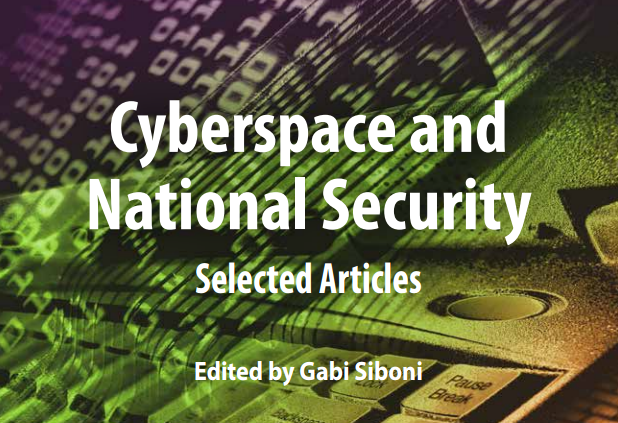
Cyberspace and National Security: Selected Articles

Tel Aviv: Institute for National Security Studies, June 2013

Follow us on Google
עברית
Gabi Siboni

The INSS program on cyberwarfare focuses on the conceptualization and creation of a common languageregarding cyberspace and national security, the development and examination ofnational policy, and the identification of guidelines for a doctrine of cyber warfarefor Israel,both at the national and the inter-organizational level. Research aims tocontribute to an informed public debate on cyberspace security and promotestrong public policy on the issue. This volume compiles eight essays published previously in Military and Strategic Affairs. Written primarily by INSS researchers, the essays present some of the research produced in the framework of the Cyber Warfare Program at the Institute for National Security Studies.


Since most systems in developed societies depend on computer and information infrastructures, nations are increasingly vulnerable to criminal as well as hostile elements in the realms of computer and communications capabilities and the global proliferation of information systems. Indeed, the growing dependence on information technology and communications results in a situation in which damage to computers and the flow of information may lead to tangible, physical damage. It is possible to disrupt management and command and control systems through changes in computer software, rendering physical attacks unnecessary. Israel’s well developed technological capabilities in computers and communications give it a tremendous edge in all fields, especially security, and allow it to act in cyberspace both to foil attacks and gain advantages on the modern battlefield. At the same time, the growing dependence on computers is also a potential Achilles' heel requiring solutions. This volume, prepared in advance of the Institute for National Security Studies 2013 conference on cyberspace, compiles eight essays published previously in Military and Strategic Affairs. Written primarily by INSS researchers, the essays present some of the research produced in the framework of the INSS Cyber Warfare Program, which is supported by the Philadelphia-based Joseph and Jeanette Neubauer Foundation. This research program deals with a range of aspects, such as a framework for basic concepts in cyber warfare and an analysis of cyber warfare capabilities as part of specifically designated research on countries of special interest to Israel and the world at large, e.g., China and Iran. Other topics in the research program include the influence of cybercrime on national security, the proliferation of cyber weapons, the failure of existing cyber defense methods and investigation of new directions for comprehensive cyber defense, and a proposal to promote cyber defense regulation in the civilian sector. This past year INSS launched a Cyber Policy and Strategy Forum to address the current gap in the discourse between two expanses – the active technological world, which has witnessed exponential growth in the knowledge reservoir both in Israel and abroad, and the world of strategy and policy formulation. This forum allows for direct discourse between technology companies and strategists and policymakers, thereby generating new insights to enhance cyber defense in Israel and to promote the relevant research both in Israel and around the world.

Gabi Siboni Head of the Cyber Warfare Program at INSS, June 2013
Protecting Critical Assets and Infrastructures from Cyber Attacks

Cyberspace and Terrorist Organizations 

Critical Infrastructure Protection against Cyber Threats 

What Lies behind Chinese Cyber Warfare 

Cybercrime: A National Security Issue?

The Proliferation of Weapons in Cyberspace 

The Classic Cyber Defense Methods Have Failed – What Comes Next?

The opinions expressed in INSS publications are the authors’ alone.
Publication Series Books
TopicsAdvanced Technologies and National Security
עברית

Events

All events
Israel’s National Security Conference
27 July, 2026
10:00 - 14:00

Related Publications

All publications
Generated with AI
From Red to Blue-and-White: The Strategic Necessity of Developing the Israeli Drone Industry
Chinese-made drones pose a range of security, technological, and geopolitical challenges for Israel. What measures should Israel take to mitigate the risks involved?
07/07/26
Shutterstock
The Battle over Access to Artificial Intelligence: Israel’s Next Strategic Challenge
The restrictions recently imposed on Anthropic — including the U.S. administration’s directive to limit access to certain models for users and entities outside the United States on national security grounds[1] — constitute a significant milestone in the evolving relationship between technology, national security, and foreign policy. Whereas over the past decade, the discourse surrounding digital sovereignty has focused on issues such as privacy, data localization, regulation, and cloud infrastructure, recent developments point to a transition to a new phase in which access to advanced artificial intelligence capabilities is becoming a strategic asset in itself. In this reality, not only data or chips are becoming objects of government policy, but also the models themselves. This article argues that the Anthropic case is not an isolated incident but rather a manifestation of a broader trend, in which artificial intelligence is becoming a central component of national power. As a result, access to advanced models may in the future become a policy tool, a mechanism of geopolitical influence, and a means of advancing strategic interests. For Israel, this development necessitates a reassessment of its approach to technological sovereignty and its policies in the fields of artificial intelligence, computing, and infrastructure, as well as a rethinking of its broader security paradigm. [1] The directive conveyed to Anthropic on June 12 by the Trump administration required the company to terminate access to its Fable 5 and Mythos 5 models for all foreign users, including the company’s foreign employees, users outside the United States, and international clients. According to reports, the company was given a very short timeline to implement the directive, under the threat of civil and criminal sanctions in the event of non-compliance. At a later stage, a limited exemption was granted, allowing the use of Mythos 5 for a small number of critical infrastructure organizations within the United States, while Fable 5 remained restricted.  
01/07/26
Shutterstock
The Pentagon’s AI-First Doctrine and Its Implications for Modern Warfare: Lessons from the Conflict with Iran
How has the new US policy—under which AI is positioned as a foundational component in the chain of command, intelligence gathering, and the planning of complex operations—been reflected on the battlefield, and what conclusions should be drawn in Israel?
19/03/26

Stay up to date

Registration was successful! Thanks.
  • Research

    • Topics
      • Israel and the Global Powers
      • Israel-United States Relations
      • Glazer Israel-China Policy Center
      • Russia
      • Europe
      • Antisemitism and Delegitimization
      • Iran and the Shi'ite Axis
      • The Campaign Against Iran and the Shiite Axis
      • Iran
      • Lebanon and Hezbollah
      • Syria
      • Yemen and the Houthi Movement
      • Iraq and the Iraqi Shiite Militias
      • Conflict to Agreements
      • Israeli-Palestinian Relations
      • Hamas and the Gaza Strip
      • Peace Agreements and Normalization in the Middle East
      • Saudi Arabia and the Gulf States
      • Turkey
      • Egypt
      • Jordan
      • Israel’s National Security Policy
      • Military and Strategic Affairs
      • Societal Resilience and the Israeli Society
      • Jewish-Arab Relations in Israel
      • Climate, Infrastructure and Energy
      • Terrorism and Low Intensity Conflict
      • Cross-Arena Research
      • Data Analytics Center
      • Law and National Security
      • Advanced Technologies and National Security
      • Foreign Information Manipulation and Interference
      • Economics and National Security
    • Projects
      • Preventing the Slide into a One-State Reality
      • India-Middle East-Europe Economic Corridor (IMEC)
  • Publications

    • All Publications
    • INSS Insight
    • Policy Research and Papers
    • Special Publication
    • Strategic Assessment
    • Technology Platform
    • Memoranda
    • Database
    • Posts
    • Books
    • Archive
  • About

    • Vision and Mission
    • History
    • Research Disciplines
    • Chairman of the Board
    • Board of Directors
    • Fellowship and Prizes
    • Internships
    • Annual Reports
    • Support
    • Privacy Policy and Terms of Use
  • Media

    • Communications
    • Video Gallery
    • Press Release
    • Podcast
  • Home

  • Events

  • Database

  • Team

  • Contact

  • Newsletter

  • עברית

INSS logo The Institute for National Security Studies, Strategic, Innovative, Policy-Oriented Research, go to the home page
40 Haim Levanon St. Tel Aviv, 6997556 Israel | Tel 03-640-0400 | Fax 03-744-7590 |
Developed by Daat ,Yael Group.
Accessibility Statement
This site is protected by reCAPTCHA and the Google Privacy Policy and Terms of Service apply.