


Publications
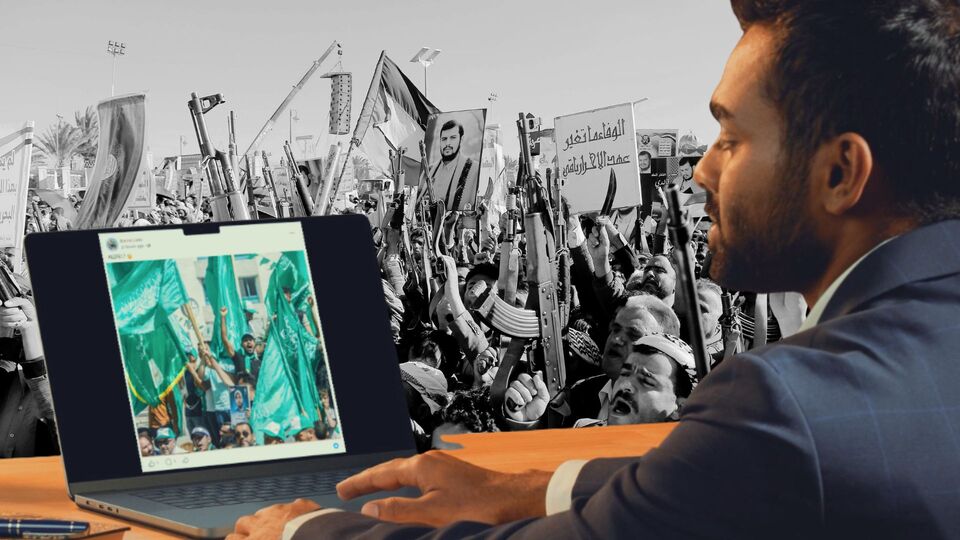
An analysis of surprising trends in Gazan discourse regarding "the day after"
INSS Insight No. 2201, October 22, 2026
Follow us on GoogleGaza’s social media discourse has recently shown a clear shift regarding the disarmament of Hamas. Once an ideological symbol whose relinquishment was seen as surrender, the issue has become the subject of pragmatic debate about the benefits of continuing the armed struggle weighed against the heavy price Gaza’s population is paying. The online debate falls into three main approaches: (1) Hamas’s critics, who support disarmament as a necessary step toward ending the war, preventing displacement, and beginning Gaza’s reconstruction, placing the population’s survival above preserving Hamas’s military strength; (2) Hamas’s supporters who are willing to compromise gradually, accepting the transfer of heavy weapons alone to a Palestinian entity in return for an Israeli withdrawal and reconstruction—a move intended to avoid the humiliating image of surrender and ensure the organization’s continued existence; (3) Hamas’s supporters who oppose handing over the weapons, viewing it as a dangerous and irreversible strategic concession that would not stop Israeli aggression but would leave Palestinians without the ability to deter it and intensify instability and internal conflict in the Gaza Strip. An examination of these three lines of discourse reveals that the dispute is not merely over the surrender of arms itself, but also over the purpose of giving them up, the power remaining in Hamas’s hands, and Gaza’s image and future in the “day after.”
The issue of disarming Hamas reflects one of the most distinct shifts taking place in Gazan social media discourse since the start of the Swords of Iron war. For years, the "weapon of resistance" was not merely a military tool, but also an ideological and political symbol, and even discussing their abandonment was considered an act of surrender. But given the price Gaza has paid in the war, the weapons themselves are now being put to the test. The debate is not limited to whether they should be handed over. It also raises broader questions about Hamas and the idea of “resistance”: What has the armed struggle achieved in relation to the price Gaza has paid? Do weapons still serve Gaza’s residents? And what would giving them up mean for Hamas’s future? In this way, the question of disarmament has also become a debate about the war’s consequences and the path Hamas has led Gaza down.
The discourse surrounding arms is not new. Throughout the war, as conditions in Gaza progressively worsened, voices began to emerge online criticizing Hamas and calling on the organization to give up its weapons in order to bring the war to an end. However, sustained and substantial online debate about disarmament took shape mainly over the past year, against the backdrop of the implementation of President Trump’s 20-point plan, the release of the hostages, and the publication of the roadmap for Gaza. During this period, a shift in discourse became evident: the debate over disarming the “weapons of resistance” moved beyond Hamas’s critics and began to appear among Hamas supporters as well, including voices willing to accept disarmament under specific conditions.
The significance of this discourse lies not only in the shift in views on the weapons themselves, but also in the arguments and reasoning behind those views, which clarify what the shift means and indicate the limits of compromise over the weapons. To examine these arguments, this article looks at three main lines of discourse: Hamas’s critics who support disarmament; Hamas’s supporters who are willing to accept it under certain conditions; and Hamas’s supporters who oppose it. This division does not represent unified camps. Rather, it serves to distinguish among the different positions expressed online and clarify the reasoning behind each one.
The analysis is based on a systematic review of tweets and posts about disarmament over the past year. It draws on years of monitoring accounts operating from within the Gaza Strip, and focuses on discourse on X (formerly Twitter), alongside posts on Facebook, TikTok, and Telegram. To bring the writers’ voices into the analysis, the article includes selected quotations from the posts examined. However, to protect their safety and prevent them from being identified, names, handles, and account details are withheld.
The aim of this analysis is to reflect the discourse emerging from Gaza on social media and present the positions and narratives taking shape there in response to the reality in the Gaza Strip at the present moment, after three years of war.
Hamas’s Critics Who Support Disarmament
Among those who criticize Hamas, disarmament is seen as a necessity for which there is no better alternative. Weapons are no longer evaluated strictly as a national symbol or a means of fighting Israel, but also by their practical value. Four goals underpin the willingness to give them up: ending what Gaza’s social media discourse calls Israel’s “war of extermination” against the Strip; preventing displacement (“another Nakba”) or forced emigration; securing an Israeli withdrawal; and beginning Gaza’s reconstruction. If disarmament could help achieve these goals, it is seen as a price that can, and even must, be paid.
This willingness does not necessarily reflect ideological moderation or a principled abandonment of the idea of "violent resistance to the occupation." Rather, it marks a shift in priorities resulting from the consequences of the war: for now, the population’s survival and the reconstruction of the Strip take precedence over preserving Hamas’s weapons.
A sense of abandonment evident in the discourse reinforces this position. One recurring claim is that Gazans have effectively been left to fend for themselves: the Palestinian leadership in the West Bank, Arab states, and the international community are seen as having failed to stop the war or protect the people of the Strip. Qatar and Turkey are viewed somewhat differently in some of the discourse, as countries still trying to advance a solution for the Palestinians.
This leads to a practical conclusion: if no outside actor can guarantee an end to the war, anything that could give Israel a pretext to restart it should be avoided. The discourse reflects a clear concern that Hamas's refusal to disarm, or its procrastination in doing so, will enable Israel to secure American support for renewing the war. The assessment is that as long as Hamas or another organization retains an independent armed force in the Strip, the war could flare up again. Consequently, even those who view disarmament as a harsh and even humiliating condition are willing to accept it, believing the alternative to be far more destructive.
At the same time, “resistance” itself is being judged by its results. The discourse challenges the priority given to resistance over the lives of the population, as well as the assumption that the price exacted in its name is inherently justified simply because it is part of the struggle. The discourse repeatedly criticizes "turning death, destruction, and displacement into the price of resistance" and glorifying "steadfastness" (sumud), while "the public bears the consequences" and anyone who dares to demand accountability is branded a "defeatist." Even a father who has lost his children and questions the meaning of that price is portrayed as someone who "does not understand the spirit of resistance."
This criticism comes through sharply in questions about the “Al-Aqsa Flood”: "What did Gaza gain? And what did Palestine gain from October 7, other than more blood, destruction, and displacement?" Such questions in the discourse challenge the very idea that harming Israel, continuing the fight, and being willing to make sacrifices can serve as measures of success. Resistance, they argue, must be judged by what it achieved for the Palestinians and by the price they were made to pay.
This does not necessarily indicate an ideological rejection of resistance and armed struggle, much less a change in attitudes toward Israel. Some of Hamas’s critics continue to view armed resistance as legitimate. What has changed is its standing. The statement that “resistance is not a blank check” captures the essence of this change: resistance is not rejected in principle, but it is no longer immune to criticism, nor does it justify any price exacted from the public in its name.
Accordingly, Hamas is being held to account. The organization’s survival, its “steadfastness,” and its ability to keep operating are not accepted in the discourse as proof of victory, despite Hamas’s efforts to present them that way. Its critics apply a different standard: what did Hamas achieve for the public, given the price its strategy exacted?
Hamas's agreement to disarm is not perceived as an achievement, nor does it erase the cost of the war. On the contrary, it raises a demand for self-examination: if Hamas is willing to accept concessions it once rejected, why did Gaza have to pay such a heavy price to reach this point?
This leads to criticism of the organization’s decision-making and its failure to seize real opportunities to end the war. A recurring claim in the discourse is that Hamas waged the war as a continuing gamble at the public’s expense: “Maybe Israel will change, maybe the United States will change its position, maybe the world will intervene, and maybe time will improve the terms.” The accusation that follows is: “You’re gambling on time… and the people are paying for that gamble with their blood.” From Hamas’s perspective, time may improve its position and preserve its assets; for Gaza’s residents, it means another “day of killing, destruction, hunger, and loss.”
This is accompanied by criticism of Hamas’s priorities and its claim to act in the public’s name and interest. The discourse argues that for years the organization prioritized military buildup and resistance infrastructure over the population's needs, and that even during the war, it placed its own survival above that of the people of Gaza: “You even stole cans of fava beans and sold them to displaced people who had been driven from their homes by your war, and you expect us to stand with you?!”; “A movement that claims to fight for the people but turns civilians into human shields for its fighters cannot claim to be protecting those same people.” Sharp criticism is also directed at Hamas’s external leadership, seen as sharing responsibility for decisions to continue the war without directly bearing their cost.
This sharpens a central distinction in the discourse: Hamas’s interests and those of Gaza’s public are no longer necessarily seen as aligned. Preserving the organization’s weapons, power, and political standing may serve Hamas, but is not necessarily seen as serving the Strip’s residents, particularly if it puts an end to the war and reconstruction at risk. The statement "Palestine is greater than any faction, and Gaza is no one's hostage" expresses this challenge to the idea that the movement’s fate and the public’s fate are one and the same.
Alongside the anger, the discourse also mocks the gap between Hamas’s promises of Israel’s total defeat and the war’s results and the situation Gaza has been left in. Writers ridicule Hamas’s boasts of military achievements, including footage of attacks marked with red triangles and declarations that “Gaza is the graveyard of invaders” and “Israel is weaker than a spider’s web.” They contrast these with the hope now attributed to the organization that “Netanyahu will lose the election and political change in Israel will achieve what the war did not.”
This leads to calls for Hamas to acknowledge its failure, say “We were wrong; we lost,” and hand over its weapons to save what remains. Yet the discourse expresses doubt that the movement will actually do so: “A dead donkey is still a donkey,” and it “drags an entire herd with it into the abyss.” The claim is that the public as a whole continues to pay the price for Hamas’s refusal to give up its weapons and acknowledge failure, even in the face of the war’s devastating consequences. This refusal is described not only as a military obstacle, but also as a threat to the narrative Hamas uses to justify the war and its cost—a narrative that will force the organization to answer the question that keeps recurring in the discourse: “All this blood, for what?”
Yet Hamas is being asked to justify not only the cost of the war, but also the weapons it seeks to retain afterward: whom do they serve, and to what end? The discourse surrounding Israel’s capture in early September of Muin al-Arbid, a senior figure in Hamas’s Internal Security Forces, raised the question: If the weapons are held in the name of “resistance” and public protection, why did Hamas call on families in Gaza to help it confront the “occupation forces?” And are the weapons being kept “to fight their own people and their families?” Behind this criticism lies a broader question: if the weapons are effective against Gaza’s residents but useless against Israel, what justification is there for keeping them after the war?
The shift in attitudes toward Hamas, then, is not limited to criticism of the outcome of the “Al-Aqsa Flood” and the war; it also concerns the organization’s right to continue taking risks on behalf of the public. Hamas may have survived the war, but it must now withstand scrutiny from Gaza’s public. In the face of the destruction and human cost of the war, the organization must explain what it achieved for Gaza, at what cost, and why its survival also serves the interests of Gaza’s residents.
Hamas’s Supporters Who Favor a Partial Handover of Weapons
The most interesting shift is evident among Hamas’s own supporters. Weapons are central to Hamas’s identity as a resistance movement and to its claim that the struggle against Israel continues. They afford Hamas independent operational capacity, leverage against Israel, and standing in the Palestinian arena. For this reason, surrendering the "weapons of resistance" was seen not only as a loss of military capability, but as a surrender that would undermine the legitimacy of the cause and even Hamas’s existence as a resistance movement.
Now, however, pragmatic voices are also being heard among Hamas’s supporters, willing to discuss disarmament as part of an arrangement that would end the war and allow Gaza’s reconstruction. This should not be interpreted as abandoning the idea of resistance or as declining support for Hamas. Rather, it marks a shift in the limits of compromise that its supporters are willing to defend: giving up some military capability to ensure Hamas’s survival and allow the armed struggle against the “occupation” to continue in a different form.
For an organization whose weapons are central to its identity and legitimacy, however, the question is how to make such a concession without it being interpreted as an admission of surrender.
To understand how such a concession has become possible, it is necessary to understand the distinction made in Palestinian discourse between defeat (hazima) and surrender (istislam). A military defeat can be explained as the result of an imbalance of power and does not require abandoning the legitimacy of the struggle. Surrender, by contrast, entails laying down one’s weapons and handing them over to the enemy, and therefore carries the connotation of humiliation.
Because surrender remains illegitimate, discussion among Hamas’s supporters frames the handover of weapons not as humiliating surrender, but as a limited, gradual relinquishment of some military capability in exchange for reconstruction, while preserving Hamas and the idea of resistance.
This logic centers on references in the discourse to a "dignified formula" for handing over arms: “They would be stored or handed over not to Israel, but to a Palestinian entity, and the move would be limited to "heavy weapons only," in exchange for "withdrawal and reconstruction.” In other words, the act of handing over weapons does not itself determine whether it constitutes surrender. What matters are the terms: which weapons, to whom, and in exchange for what. Accordingly, these terms carry decisive weight in the discourse among Hamas’s supporters.
Heavy weaponry is presented as a "bargaining chip" that has lost its military value, "if such heavy weaponry remains at all." The reality in Gaza has changed, and "the model of an army fighting Israel using brigades, battalions, and companies no longer fits the current phase," in which Israel controls "more than seventy percent of the territory of the Gaza Strip." It is therefore necessary to "create new bargaining chips." Accordingly, heavy weapons can be used as leverage to secure an end to the war, an Israeli withdrawal, reconstruction, and guarantees, thereby making their handover justifiable.
Light weapons, by contrast, are described as serving “self-defense and the protection of honor and dignity.” Hamas’s retention of them is therefore considered essential to its ability to protect its members and continue operating in the Strip. The distinction between types of weapons marks the limits of compromise in this discourse: it allows supporters to justify giving up some military capability vis-à-vis Israel without abandoning Hamas’s continued existence as an organized armed force.
Handing over weapons to a "Palestinian entity that enjoys national and factional consensus" makes it possible to present the move as an internal arrangement rather than a surrender to Israel. A gradual handover, meanwhile, would give Hamas room to maneuver: it could delay irreversible steps, adapt to changing realities, preserve its assets, and respond to developments in Israel and across the region and the international arena. An Israeli withdrawal is itself framed as a course of action that “completely contradicts the Zionist project of continued occupation, settlement, and forced displacement,” one that Israel is compelled to accept because it is “stuck in a dead end.”
Finally, the entire disarmament process is presented as an arrangement concerning Gaza and the reality that has taken shape there, not as the dismantling of Hamas as a movement or a principled abandonment of armed resistance. Gaza is portrayed as an arena that, for now, has exhausted its role in the current military form. This does not mean the struggle itself is over: “Resistance does not exist only in Gaza.” In this context, the discourse argues that “the Al-Aqsa Flood laid the groundwork” for the next phase, in which the West Bank is expected to become the center of gravity of the resistance, “especially because it is a target of settlement, annexation, and forced displacement, and because, for the occupiers, it is an ideological issue they call "Judea and Samaria.”
Hamas’s Supporters Who Oppose Handing Over Weapons
Opposing the pragmatic camp is a position that views handing over the weapons as a strategic mistake: an irreversible concession, with no certainty about what Hamas would receive in return or what would follow. Opposition to disarmament rests on two related concerns. Vis-à-vis Israel, the fear is that handing over the weapons would not stop the fighting but would expand the IDF’s freedom of action. Within Gaza, the concern is that disarming Hamas would upset the balance of power and intensify the struggle for control in the "day after."
The first concern is rooted in a fundamental distrust that concessions by Hamas will lead to a change in Israel's conduct. Online discourse points to the release of the hostages as proof of this distrust: "The captives were handed over, yet the slaughter continues." From this follows the argument that handing over the weapons would not guarantee an end to the fighting, but could allow Israel to act “with no one to deter or stop them.” The claim is that “if surrender would stop the destruction, perhaps it would make sense,” but instead it would make Israeli action “easier for the enemy and less costly for it.” In this context, the weapons are described as “the last bullet” and “the last insurance policy the Palestinians have left.” This is accompanied by the belief that “the enemy’s demands will not end, but will only keep growing” even after the weapons are handed over.
The same distrust extends to what is being offered in exchange for disarmament: an Israeli withdrawal, international guarantees, or an alternative Palestinian mechanism. Disarmament is seen as difficult to reverse, while the commitments offered in return are viewed as uncertain and reversible. The fear is that handing over the weapons would leave the Palestinians without leverage if the fighting continued or Israel made further demands. From this perspective, the question is not whether the weapons can bring victory, but whether it is wise to give up the last means of force before an end to the war is actually guaranteed.
Alongside the fear of Israel is a concern about internal dynamics. Hamas’s weapons are also part of the balance of power within the Strip, so disarmament is seen as a move that could change Gaza’s political and security order as well. The concern is that weakening Hamas could lead to internal clashes among armed actors and heighten instability in the "day after."
Thus, the justification for retaining weapons shifts. It rests less on the gains they brought in the war and more on the risks attributed to a reality without them. From this perspective, giving up the weapons carries a double risk: losing the ability to deter Israel and depriving Hamas of its center of power within the Strip. Hamas’s supporters who oppose disarmament respond to critics asking what Gaza gains from keeping the weapons with a question of their own: what will Gaza be left with if the promised return never materializes?
Implications and Conclusion
The online discourse on disarmament reflects a rare moment in which the boundaries of debate in Gaza are shifting. For the first time, issues once treated as beyond question—the preservation of the “weapons of resistance,” the price the population may be made to pay, and the presentation of Hamas’s mere survival as victory—are being publicly reassessed in light of the war’s consequences. Underlying this shift is a recognition that Gaza’s reality has changed and that the role of the weapons must be reconsidered. Yet alongside this recognition, the discourse reveals differing views about what giving up the weapons, or keeping them, is meant to achieve, and about Gaza’s image and future in the "day after."
Hamas's critics seek first and foremost to extract Gaza and its people from the war; Hamas's supporters seek to extract Hamas from the war in a manner that allows the organization to survive in its aftermath.
In the eyes of Hamas’s critics, the weapons have become a liability rather than an asset. Retaining them delays the end of the war and reconstruction, so they must be surrendered in full to avoid giving Israel an excuse to resume the fighting. For Hamas’s supporters, the weapons remain an asset. The pragmatists see them as a bargaining chip: heavy weapons can be handed over in exchange for an end to the war, an Israeli withdrawal, and reconstruction, allowing Hamas to continue as an organized force in the Gaza Strip. Those who oppose disarmament, by contrast, see the weapons as the last safeguard against Israel. They fear an irreversible concession without any guarantee that the promised end to the war, withdrawal, and reconstruction will materialize.
The discourse exposes a broader question: whether that which is required to preserve Hamas and "the resistance" necessarily serves the residents of the Strip as well. The war has not erased the legitimacy of the "weapons of resistance," but it has challenged its standing as a self-justifying value. The weapons are shifting from a source of legitimacy to a subject of scrutiny: What have they achieved? What is the cost of keeping them? And what are the risks of giving them up? What has clearly eroded is the automatic acceptance of the military model that took shape in Gaza and the price required to sustain it—not necessarily the idea of “resistance” itself.
Willingness to hand over weapons is not equivalent to willingness to dismantle Hamas's power. Hamas and its supporters are engaged in a battle over how the move is understood, seeking to present disarmament not as an admission of failure but as a strategic adjustment to a new reality. The distinctions some of the organization’s supporters draw—between light and heavy weapons, between handing them over to Israel and handing them over to a Palestinian entity, and between immediate and gradual disarmament—point to the limits of compromise. In their view, certain military capabilities can be relinquished without giving up Hamas’s ability to remain an organized armed force in the Strip.
In conclusion, the question of disarmament is not simply how many weapons will be handed over. It is what their surrender or retention is meant to achieve, and what will remain of Hamas and of the resistance in the "day after." The essential test is which capabilities, and how much independent power, Hamas will retain after the handover. For Israel, the question extends beyond the weapons: how can it prevent Hamas from adapting to the new reality in a way that allows the organization and “resistance” to survive politically and militarily, and to continue as an organized movement in a different form within the Gaza Strip.