


A “Traffic Light” Model for Implementing the Board of Peace Framework in the Gaza Strip: Policy Recommendations for Israel
Policy Paper, September 26, 2026
Tamir Hayman
Executive Summary
- Without a political framework to complement its military achievements in the Gaza Strip, Israel risks eroding the military victory achieved during the war. The impasse—resulting from the delayed implementation of the Board of Peace framework, at a time when a military operation to take control of the entire Gaza Strip is off the table—is creating a short-term sense of security, but carries the seeds of future calamity. This is mainly due to the fact that Hamas controls the population of Gaza and is growing stronger. Given past experience, Israel must not become accustomed to this status quo.
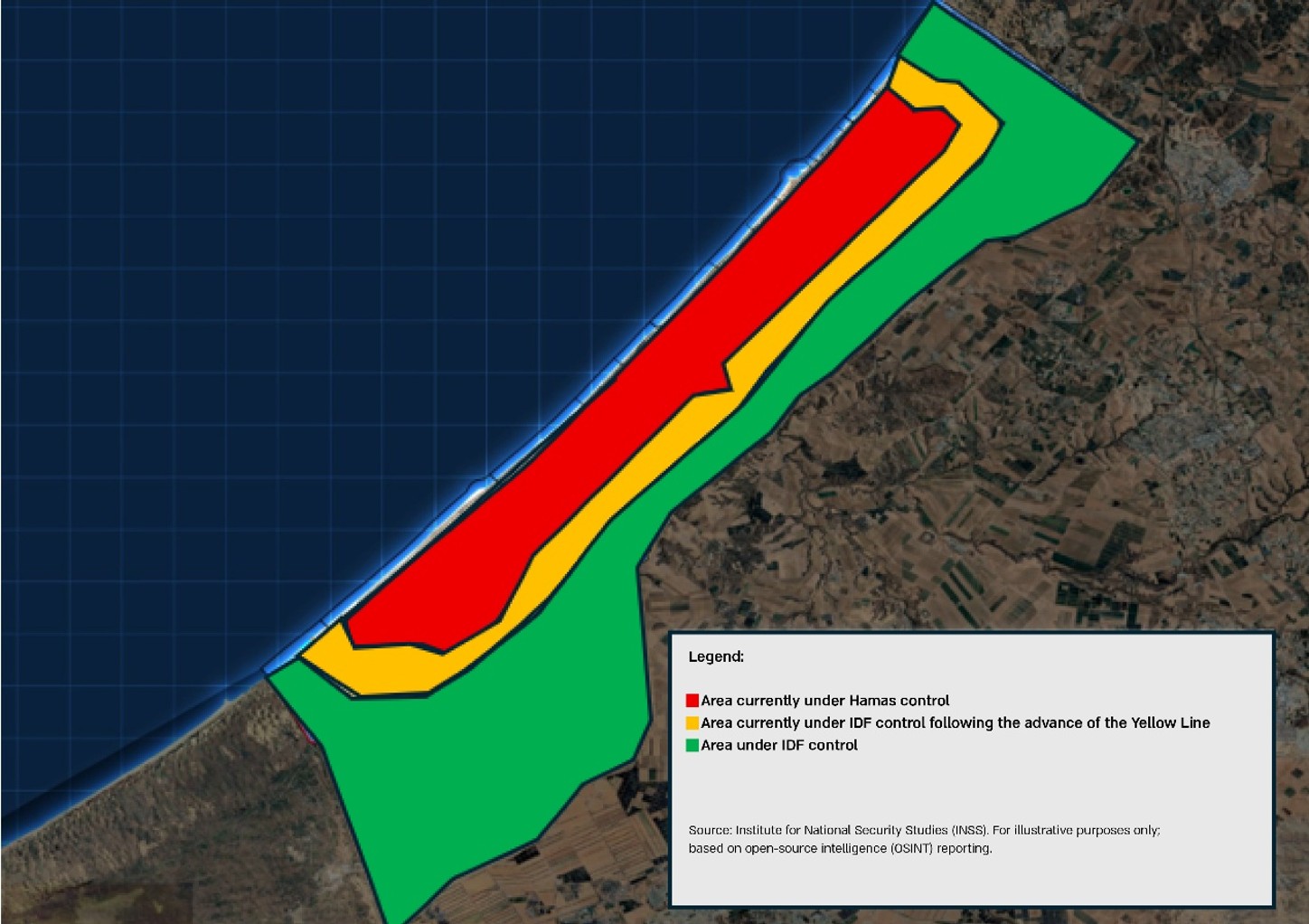
- This policy paper proposes a complementary political framework that can be implemented through a differentiated “traffic light” model. It is an adaptation of the Board of Peace plan for the future of the Gaza Strip that does not jeopardize Israel’s security. The guiding principle is a distinction among three geographical zones that already exist in practice within the Gaza Strip: Red, Orange, and Green. The proposed framework would be implemented differently in each zone:
- Red Zone– Transfer of civil authority from Hamas to the Gaza technocratic administration.
- Orange Zone – Targeted reconstruction in areas cleared of Hamas and controlled by the International Stabilization Force (ISF) and the technocratic administration.
- Green Zone – An Israeli-controlled security zone, that will gradually be governed by the technocratic administration as Israel withdraws and Hamas disarms.
- The end state is an almost complete Israeli withdrawal from the Gaza Strip, subject to Hamas’s full disarmament and demilitarization verified by an independent international authority acceptable to both Israel and Hamas. The implementation will be phased, gradual, and geographically adapted to the three zones. This phased approach is preferable to the wholesale rejection of the Board of Peace initiative (the 15-Point Plan), and is more responsible than a sweeping acceptance and attempted implementation of an idealistic, yet unrealistic, solution.
General Background and Context
Background: “Constructive Ambiguity” as an American Working Method
The Israeli government has agreed to the deployment of the International Stabilization Force (ISF) in the Gaza Strip. This marks the beginning of the implementation of the Board of Peace’s 20-Point Plan. If deployed, the Force will initiate the practical realization of a US vision that extends far beyond a local solution for Gaza alone: the United States is working vigorously to advance this vision in Syria and Lebanon as well. Contrary to the widespread claim that President Trump lacks a coherent strategy for the Middle East, US conduct in the region reflects fairly clear guiding principles. Although these principles incorporate utilitarian considerations related to economic and business interests, they indicate an overarching organizing concept.
“Constructive ambiguity” is the chosen means for implementing this vision. In other words, upon signing agreements (whether with Iran, Hamas, or Lebanon), a significant portion of the details is deliberately left undecided and, at the same time, undisclosed to the public. This creates degrees of implementation freedom. However, this flexibility carries a price: ambiguity makes it difficult to understand the situation in real time; each party can interpret the provisions of the agreement in the manner most convenient to it; and misunderstandings may arise, potentially escalating into violence and rendering the agreement invalid (for example, the June 2026 Memorandum of Understanding with Iran). This ambiguity thus distorts perceptions of reality and increases the risk that threats will go undetected and opportunities will be missed.
This policy directly affects Israel, which has effectively agreed to a form of “American outsourcing” of its national security policy. While Israel is involved in some of the processes, and certainly through direct channels with the President, the decisions shaping the future of its relations with the region are largely made in Washington. It is therefore necessary to recognize that Israel’s policy is effectively US policy, although Israel still retains the ability to influence it. This paper presents a proposal for implementing US policy in the Gaza Strip in a manner that could similarly be applied to Lebanon and Syria in the future.
The Context: The 20-Point Plan is an Implementation of an Israeli Concept Through External Enforcement
The 20-Point Plan was presented on September 29, 2025 (on November 17, 2026, the UN Security Council adopted Resolution 2803, endorsing the plan). Contrary to the prevailing perception in Israeli public discourse, this was not an American concept imposed on Israel. Rather, it effectively constitutes the implementation of an Israeli “day after” framework for the Gaza Strip.
The comprehensive strategic framework for Gaza was presented to the war cabinet on the eve of the ground maneuver in the Gaza Strip (October 26, 2023). The cabinet adopted the framework, which was presented by the Ministry of Defense.[1] The framework set out the following concept: After the defeat of Hamas (which, according to the plan, would require three months to dismantle its battalions, destroy its underground infrastructure, and eliminate its commanders), “Phase III” would begin. During this phase, civil control over Gaza would gradually be transferred to a technocratic administration, unaffiliated with either Hamas or the Palestinian Authority. When the war cabinet adopted the framework, it was agreed that an expanded cabinet meeting would be held, before “Phase III” began, to approve the subsequent stages of implementation. No such discussion took place during the first two years of the war. This procrastination was the basis for sharp criticism alleging that the Israeli government had failed to establish a political framework to complement its military campaign. Ultimately, this same framework was imposed on the Israeli government as part of the 20-Point Plan.
The plan, whose initial implementation secured the release of the living Israeli hostages held by Hamas, provides for the establishment of an international governing body for Gaza, the Board of Peace. This body is intended to guide and oversee the technocratic administration that will replace Hamas rule: the National Committee for the Administration of Gaza (NCAG). This administration will be assisted by an international security force, the ISF, to maintain law and order and oversee the demilitarization of the Gaza Strip.
The enforcement of the 20-Point Plan by the United States in the autumn of 2025 was driven by a combination of three developments: (1) an Israeli plan to conquer and completely destroy Gaza City (“Gideon’s Chariots III”) pushed Hamas toward compromise; (2) pressure by the families of the hostages held by Hamas prompted President Trump to strengthen his commitment to finding and implementing a solution to the issue; (3) an Israeli strike in Doha, Qatar, which undermined the Gulf states’ sense of security, led them to exert additional pressure on President Trump. Within the framework of the plan, Israel agreed to a ceasefire and a gradual withdrawal from the Gaza Strip, contingent on demilitarization. It also agreed to permit reconstruction in areas already “cleared of Hamas,” even without Hamas’s cooperation (Article 17). The most politically sensitive provision is Israel’s consent to a future political process that would lead to the establishment of a Palestinian state (Article 19). This initial political process constitutes a key condition for expanding the “Abraham Accords.”
The Israeli government agreed to this political framework, presumably under the assumption that Hamas would fail to honor its commitments and that the plan would not advance beyond the first phase (the release of the hostages). Hamas would then be blamed for the failure of the subsequent phases, enabling Israel to resume its military campaign in the Gaza Strip, with US backing.
Indeed, with the launch of Operation “Roaring Lion” against Iran in late February 2026, Hamas reneged on its commitment to hand over its heavy weaponry, as well as its tunnels and weapons production sites, to the technocratic administration (NCAG). In response, the IDF continued to take control of additional parts of the Gaza Strip (expanding the territory under its control from 53% at the time the 20-Point Plan was adopted to nearly 65% today), and accelerated the rate of targeted eliminations of Hamas leaders and terrorists who participated in the October 7th massacre. For its part, Hamas has refrained from firing at Israel and is investing instead in internal force-building and tightening its civil grip on the Gaza Strip through the taxation of goods and the enforcement of law and order.
The Current Context—The 15-Point Plan: An Opportunity with Three Structural Weaknesses
The 15-Point Plan is an agreement between the Board of Peace and Hamas, designed to convince the organization to agree to the entry of the technocratic administration into the Gaza Strip and return to the path of negotiated agreements. Israel is not a party to this agreement, except insofar as its authorization is required for a foreign military force to enter the territory of the State of Israel (a decision approved by the Security Cabinet). Although the plan does not formally contradict the 20-Point Plan, its wording is problematic from an Israeli perspective: its tone toward Hamas is obsequious to the point of groveling; great emphasis is placed on the security of Hamas operatives during the interim phase; and there is a built-in symmetry between Hamas and Israel regarding basic assumptions of mutual distrust. Beyond this, three practical problems require an active Israeli response:
- The Verification Mechanism: Qatar and Turkey are part of the mechanism responsible for reporting on Hamas’s disarmament. A report from these two countries confirming that disarmament has taken place will obligate Israel to take a corresponding step toward withdrawal. A major concern is that both countries are, in fact, interested in preserving Hamas’s status in the Gaza Strip, rather than dismantling it.
- The Transfer of Weapons: Hamas’s weapons are to be placed in the custody of a Palestinian security authority whose composition and mandate remain undefined. It is entirely unclear what falls within the categories of Hamas’s so-called “defensive weapons” and “offensive weapons.” Permitting Hamas to retain defensive weapons could also create a slippery slope toward the accumulation of heavy weaponry. Moreover, the lack of precise definitions regarding timetables and quantities could make it impossible to monitor and oversee the effective transfer of weapons.
- The Identity of the Internal Security Force: The Palestinian force that will be authorized to maintain law and order in the Gaza Strip has not been precisely defined. The agreement, in principle, to incorporate Hamas personnel into this force (subject to security clearance and the surrender of weapons) could, in practice, create a technocratic administration whose internal security force is staffed by Hamas. The alternative security force consists of local “Palestinian police officers” who have undergone security clearance and specialized training in Egypt, under US supervision. However, their entry into the Gaza Strip has been delayed because Egypt will not agree to train a Palestinian force on its territory without advance commitment from the Israeli government that its members will be permitted to return to Gaza and deploy there.
Proposed Policy
The Opportunity: Red, Orange, and Green – The Current Ground Map in the Gaza Strip
At time of writing, the Gaza Strip is effectively divided into three zones that differ in character and in the degree of control exercised over them. This division forms the basis of the “traffic light” model:
- The Red Zone – Approximately 38% of the Gaza Strip, and home to roughly 1.8 million Gaza residents, subject to Hamas control.
- The Green Zone – Approximately 53% of the Gaza Strip, extending from its border to the Yellow Line, which marked the extent of Israeli control on the day the 20-Point Plan was adopted, and controlled by the IDF.
- The Orange Zone – Between 9% and 15% of the Gaza Strip, compromising territory captured by the IDF beyond the Yellow Line between the ceasefire and the present.
This division reflects the current distribution of physical control in the Gaza Strip. It developed gradually on the ground, rather than as the product of a deliberate top-down policy designed to create an opportunity. Nevertheless, it can now serve as the basis for a reconstruction and demilitarization system that would ensure Gaza no longer poses a threat to Israel, that Hamas is disarmed, and that a process begins that ultimately transfers control of the Gaza Strip to an enhanced Palestinian Authority (after undergoing necessary reforms). Realizing this goal will enable IDF operational freedom of action to thwart threats, while initiating the implementation of a political vision. Adopting the framework will allow for the expansion of the “Abraham Accords” and reduce international criticism of Israel and its growing international isolation.
Details of the Proposed Model – Practical Policy Recommendations
- The “Traffic Light” Model – Differential Implementation Across Three Zones
- The Red Zone – The technocratic Gaza administration, the National Committee for the Administration of Gaza (NCAG), will assume control, with Hamas transferring civil governing power to it while temporarily retaining only light weapons for self-defense purposes. The Israeli government will commit to permitting the return to Gaza of the Palestinian police force trained in Egypt (following screening and security clearance).[2] A binding timetable for the handing over of light weapons remaining in Hamas’s possession will be determined in accordance with the pace and effectiveness of the Palestinian police force’s deployment. It is critical to define in precise detail the category of light weapons.
Prior to depositing light weapons, upon the entry of the technocratic administration into Gaza, the surrender of heavy weaponry (rockets, explosive devices, and anti-tank launchers) must begin. In other words, the dismantlement of all tunnels and the transfer of heavy weapons (including antitank missiles, mortars, rockets, and machine guns) must begin immediately. The surrender of light weapons is a condition for any Israeli withdrawal from the Green Zone, as detailed below. All weaponry collected from Hamas will be transferred to the custody of the ISF (in the Orange Zone, detailed below); the weapons will be rendered inoperable or destroyed. Another possible alternative is placing Hamas’s weapons in the custody of the Egyptian General Intelligence Service. Disarmament will be verified exclusively by an international mechanism that will include, beyond Turkey and Qatar, the United States and additional countries whose credibility is held in high regard by Israel.
This mechanism, the International Verification Committee (IVC), should be authorized to conduct unannounced inspections, access any suspicious site, perform engineering and technological assessments, receive intelligence from external sources, and reopen a previously approved phase if new information emerges. This will directly address both the shortcomings of the verification mechanism and the central challenge involved in disarming Hamas. Any report regarding disarmament will be accompanied by verification from an entity trusted by Israel, rather than by Qatar and Turkey alone.
- The Orange Zone – A phased Israeli withdrawal back to the original Yellow Line will be executed. The ISF would deploy in each area from which Israel withdraws, and civil reconstruction would begin there, including housing projects for residents who have passed security screening. This zone will serve as the key to building a new Gaza Strip that poses no threat to Israel. As reconstruction progresses, the Orange Zone will gradually expand, forming a monitored buffer between the Red and Green Zones.
The expansion of the Orange Zone should follow a functional model rather than a fixed geographical division between a section designated for demilitarization and a section designated for reconstruction. In exchange for the disarmament of a pre-determined quantity of Hamas weaponry, for example, the corresponding proportion of the Orange Zone will be reconstructed. Thus, the surrender of 5,000 weapons might unlock 30% of the area designated for reconstruction in the Orange Zone. In other words, the exchange of demilitarization for reconstruction would be governed by a quantitative inventory of the weapons relinquished by Hamas rather than by geographical boundaries. The Orange Zone is thus a dynamic area that expands according to the potential for reconstruction. For example, an Orange Zone large enough to begin reconstruction could already be established in the Rafah area, subject to the aforementioned demilitarization conditions (see map). In other areas, the Orange Zone will be expanded before reconstruction begins – whether through further advancing the line by IDF forces or through transferring territory from the Green Zone to the Orange Zone, and at times, a combination of both.
It is important to emphasize that the Orange Zone forms the nucleus of the reconstruction of a “New Gaza,” which will be built under the control of the ISF, not under Hamas control. Regulated and monitored movement of residents from the Red Zone to the Orange Zone will be permitted. Until Gaza is fully demilitarized, entry into and exit from the Orange Zone will be overseen by the International Stabilization Force (with inspections conducted at checkpoints). Once the fully vetted Palestinian police force has been deployed in the Red Zone and has become firmly established and operationally capable, its deployment could be extended to the Orange Zone.
- The Green Zone – This zone will remain under IDF control as a bargaining chip and main guarantee that the process will be implemented to the satisfaction of both Israel and the Board of Peace: a gradual Israeli withdrawal from the zone, one section at a time, will take place exclusively in exchange for verified demilitarization in the Red Zone, including–and with particular emphasis on–the surrender of light weapons. The guiding principle is “territory in exchange for verified demilitarization.”[3] This arrangement is intended to address the problem of weapons surrender: as long as there is no cross-verified confirmation regarding the weaponry, including weapons classified as “personal,” Israel’s withdrawal from the Green Zone will be suspended.
This framework will enable Israel to actively improve its security position without contradicting the Board of Peace initiative or President Trump’s 20-Point Plan. This holds true even though the Board of Peace’s original plan does not currently distinguish sufficiently among the three zones in the Gaza Strip. Any violation of the framework would trigger the immediate forfeiture of the corresponding benefit: the next stage of Israel’s withdrawal would be suspended. If a violation were discovered retroactively, after the relevant withdrawal had already taken place (for example, if a weapons cache that should have been surrendered at an earlier, completed milestone were subsequently uncovered), the sanction would be applied to the next milestone, and the corresponding Israeli withdrawal would be skipped.
- Systematic Public Diplomacy for the Israeli Public
The plan is complex to implement. The Israel Prime Minister’s Office, together with the National Security Council, should therefore formulate an organized public diplomacy mechanism. This should include briefings for the Knesset Foreign Affairs and Defense Committee, background briefings for the media, and the publication of policy principles (as distinct from operational details) to clarify to the public the policy being implemented on the ground, considerations guiding it, and opportunities embedded within it. Controlled transparency would mitigate the adverse effects of unexplained “constructive ambiguity” and strengthen the policy’s legitimacy in the eyes of the public.
- Preserving Cooperation with the Trump Administration While Managing Reservations Through Diplomatic Channels
Israel should continue to cooperate with President Trump’s policy and refrain from confronting him publicly, given, among other considerations, Israel’s limited number of allies in the international arena and the president’s acute sensitivity to what he perceives as ingratitude. At the same time, a dedicated Israeli–American working channel should be established between Israel’s National Security Council and its counterparts on the Board of Peace. Through this channel, Israel should consistently raise the reservations detailed in this paper, particularly the proposal for differential implementation across the three zones (namely the “traffic light” model), as well as its concerns regarding the verification of disarmament and the categories of weapons to be removed from the possession of Hamas and other armed groups operating in the Gaza Strip. This would be more effective than relying solely on public statements of criticism.
- Accelerating the Establishment of the Alternative Civil Administration and the Palestinian Security Force
Israel should work to expedite the operational establishment of the technocratic administration (NCAG) in the Red Zone and the deployment of the ISF in the Orange Zone. Despite the shortcomings and weaknesses of these bodies, the continuation of Hamas rule in the Gaza Strip remains the worst of available alternatives. Concurrently, Israel must continue to take operational action against emerging security threats. This necessitates the establishment of a friction-management mechanism with the various Board of Peace entities operating in the Gaza Strip. Rules of engagement and procedures for opening fire must be agreed upon in advance.
The guiding principle underlying these policy recommendations is that converting the IDF’s military achievements (territorial control and the degradation of Hamas capabilities) into a stable political-governance outcome is preferable to allowing Hamas to remain the de facto sovereign in the Gaza Strip. This is the case even if considerable doubt persists regarding the extent of weapons that will ultimately be surrendered and dismantled.
Challenges and Responses
- Dependence on Hamas’s Willingness to Renounce its Identity as an Armed Resistance Organization
The Challenge: Implementation of the plan requires Hamas’s cooperation. As an armed resistance organization, Hamas is unlikely to agree to disarm or relinquish its political survival, which rests on its military capabilities. Hamas can therefore be expected to resort to deception and concealment and to obstruct progress in implementing the plan.
The Response: A long-term process through which Hamas is stripped of its primary power base–its ability to recruit from among the civilian population in the Gaza Strip. The population in the Red Zone will come under the control of the alternative technocratic administration, which will provide internal security services, employment opportunities, collect taxes, and distribute humanitarian aid, thereby weakening Hamas’s hold over the population. Civilians who move to the reconstructed Orange Zone will reside in an area where Hamas has no presence. The Green Zone, which would progressively shrink as the Orange Zone expands, would contain no civilians at all.
- The Risks of Withdrawal
The Challenge: Residents of southern Israel, and Israeli citizens in general, view the territory captured during combat in the Gaza Strip (at a heavy cost in lives) as a guarantee of their security. Therefore, any minor withdrawal, let alone a complete one, will be accompanied by grave concerns of compromising security in exchange for promises and plans that are difficult to implement and whose effectiveness is therefore questionable.
The Response: Implementation should proceed slowly and gradually, ensuring that every territorial withdrawal corresponds to the dismantlement of threatening military capabilities in the Gaza Strip. Oversight of Hamas’s demilitarization and verification of its disarmament will be entrusted to a US force, while Qatar, Turkey, and other countries will participate only as members of the broader monitoring mechanism. A further safeguard will be Israel’s authority to eliminate any emerging threat within or emanating from the Gaza Strip. Israel will not relinquish its right to self-defense or to neutralize threats. Finally, the withdrawal will be to a line within the Gaza Strip that will enable forward defense of the communities in the western Negev and the construction of a forward security layout providing early warning and defense for vital areas within Israeli territory. This forward line has not yet been agreed upon, and Israel should work to secure recognition of its vital importance to Israeli security.
- Restrictions on the IDF’s Operational Freedom of Action
The Challenge: The deployment of the International Stabilization Force in the Red Zone will restrict the IDF’s ability to maneuver back into it. Furthermore, the very presence of foreign forces will diminish the IDF’s freedom of action. Sovereign security authority is thus denied to the IDF, undermining the realization of the concept of “overriding security authority.”
The Response: A clear division of the Gaza Strip into three zones would make it considerably easier for Israel to define and implement procedures for opening fire. Clearly delineated boundaries will allow for differentiated use-of-force policies: for example, because no international force will be deployed in the Red Zone, firing will be conducted without coordination, but only against threats predefined as free-fire targets; in the Orange Zone, because an international force is deployed there, firing will take place only with prior coordination; and in the Green Zone, firing will be conducted without any restrictions. A deconfliction mechanism will be established to implement this foundational division. Should a renewed IDF ground maneuver in the Gaza Strip become necessary, the ISF will evacuate its positions, allowing the IDF to advance into the Red Zone through the Orange Zone, which will be evacuated.
- Hamas Ruling Behind the Scenes
The Challenge: Hamas operatives will sign a commitment document of some kind and enlist in the Palestinian policing force. Over time, they will form an armed militia that will implement the policy of “armed resistance,” in part with Iranian support, as is currently occurring in Iraq and Lebanon. If such a force emerges, it will constitute a future threat to Israel from the Gaza Strip.
The Response: Hamas operatives must not be recruited without a cooling-off period and a prolonged de-radicalization process. Under no circumstances should they be recruited as a unit–meaning as an organizational framework. In addition, the salaries of the Gaza police force’s commanders should be paid by the Board of Peace, which will ensure that all salary recipients undergo periodic security clearance. It must be assumed that Palestinian resistance factions will continue to exist in the Gaza Strip. Israel must continue to act against them through a sustained “mowing the lawn” strategy, pursued both by the IDF and in cooperation with other security entities operating in Gaza.
- Lack of Gulf and European State Involvement
The Challenge: Because the process is not explicitly defined as leading to the establishment of a Palestinian state, Arab states will not cooperate with the plan, viewing it as serving Israeli security interests alone at the expense of Palestinian national aspirations. Without adequate resources, the actors involved in stabilizing the Gaza Strip will struggle to gain public legitimacy, as they will be perceived as collaborators with Israel. Furthermore, the absence of support from moderate Gulf states could bring Qatar to the forefront. If Qatar is responsible for Gaza’s reconstruction, a spillover of funding to terrorism and the rebuilding of Hamas– both below and above ground–is to be expected.
The Response: Israel should demonstrate its commitment to the political track it accepted under the Trump administration’s 20-Point Plan, without committing at this stage to the ultimate political goal of a Palestinian state. Nevertheless, it should advance a vision of separation that would enable independent but limited Palestinian sovereignty, distinct from Israel. Even if this vision cannot be realized under current conditions, it would mark the beginning of a process aimed at breaking the longstanding political stagnation. The involvement of the Gulf states in Gaza’s economic, civil, and security reconstruction efforts would constitute both a foundation and a condition for the plan’s success. Their economic capabilities are essential, and they can also be expected to act to ensure that their investments do not go to waste.
Conclusion
Israel has effectively relinquished a considerable degree of autonomy over its foreign and security policy in the Gaza arena in favor of a policy largely formulated in Washington. In this reality, US “constructive ambiguity” affords Israel genuine degrees of freedom to implement the 20-Point Plan for stabilizing the Gaza Strip through a differential framework based on territorial control according to a new deployment, contingent on the cross-verification of Hamas’s disarmament. The judicious exploitation of these degrees of freedom and a clear explanation of the updated policy’s guiding principles, alongside ongoing cooperation with Washington and policy continuity even after the formation of a new government in Israel, will determine whether the 20-Point and 15-Point Plans are translated into a sustainable security improvement for Israel, or remain declarations of intent that fail to alter the reality on the ground, and whose failure will largely be laid at Israel’s door.
_____________
[1] The framework was presented by the author of this paper while serving as head of the strategic team advising then-Defense Minister Yoav Gallant.
[2] Egypt is unwilling to admit the Palestinian police force to its territory for training without a formal commitment from the Israeli government that it will permit the force to return to the Gaza Strip. This objection stems from Egypt’s concern that the “voluntary migration” of Gaza residents to Egyptian territory could be advanced — an idea that Cairo vehemently opposes.
[2] “Verified demilitarization” would be achieved only once Hamas’s military weapons have been decommissioned; its tunnels and weapons-production facilities have been destroyed or rendered inoperable; its military formations have been dismantled; and a mechanism has been established to prevent their reconstitution.