


Publications
Iran’s use of missile launches, public messaging, and digital activity to create a cumulative effect of deterrence, attrition, and demoralization
INSS Insight No. 2117, March 23, 2026
Follow us on GoogleIran’s strategic communications effort in Operation Roaring Lion reflects an integrated strategy of military action, information warfare, and advanced technologies aimed at influencing domestic, regional, and international audiences. The current campaign reflects an advanced stage in the evolution of Iranian doctrine, which has shifted from religious-ideological propaganda to operational, multidimensional information warfare. This article examines Iran’s main patterns of operation, including the use of missiles and UAVs as a communications tool, the spread of both overt and covert disinformation, the activation of digital influence networks, and the growing use of artificial intelligence. The analysis suggests that Iran seeks not only direct military gains but also to shape perceptions, create psychological deterrence, and gradually build adversary resilience while creating international pressure to end the fighting on terms favorable to Tehran.
Iran employs a multilayered strategic communications doctrine that combines messaging through kinetic actions, official statements by leaders and state media, covert influence efforts on social networks, cyber operations designed to shape perceptions, and the strategic use of regional proxies while exploiting the digital information space. Over the past decade, Iranian strategic communications have shifted from primarily religious-ideological propaganda to a more realist and national form of information warfare, directed simultaneously at domestic, regional, and international audiences. Its aims are to strengthen deterrence, amplify military achievements, and signal that continued confrontation will be costly. At the same time, Iran seeks to generate international pressure to halt the fighting on terms favorable to it.
Iran’s security doctrine rests on a conception of power that centers on missiles and UAVs as both offensive and defensive pillars. These capabilities enable Iran to challenge militarily superior adversaries—chiefly the United States and Israel, and, in the current campaign, also Gulf states. They allow Tehran to exert sustained pressure even without air superiority while threatening targets across the region.
The ongoing targeting of Israel with missiles and UAVs constitutes a central component of Iran’s strategic communications. Whereas during the summer 2026 campaign, Iran sought to frame at least some missile strikes as strategically and operationally significant—targeting military, research, and infrastructure sites—in the current war, it is best characterized by dispersion. Launches are distributed across hours of the day, across geographic areas in Israel, and extend to Gulf states, and include extensive use of cluster warheads. Overall, this indicates that the purpose of missile use is not necessarily to maximize physical damage but rather to convey a message aimed at exhausting and harassing Israeli society—as well as Iran’s Gulf neighbors—and thereby generate pressure the United States to end the campaign. Fear-based attrition is a central component of Iran’s communications strategy, alongside actions in the information domain.
Iran’s overt strategic communications effort in its conflict with the United States and Israel is directed at several key target audiences: the United States, Israel, Arab states—especially its Gulf neighbors—and the Iranian public itself.
Lies as a Component of Cognitive Warfare—Official regime spokespeople spread false information about Iran’s performance in the campaign and attempt to downplay the extent of the damage it has sustained, often without even incorporating partial truths. Examples include claims of severe damage to US and Israeli forces, the alleged capture of soldiers, fabricated military successes, and exaggerated portrayals of damage to Israel’s civilian rear. Together, these narratives are part of an effort to enhance Iran’s military image and present it as capable of confronting and even defeating the United States and its allies. At the same time, regime spokespeople continuously emphasize Iran’s ability to impose cumulative damage over time on all parties involved in the campaign against it. In theoretical terms, this can be seen as the use of the “Big Lie,” previously attributed to Iran—namely, the construction of an alternative reality that strengthens the regime while obscuring the successes of its adversaries. The “Big Lie” constitutes an integral part of the cognitive campaign, closely linked to military and diplomatic actions, and is intended to sustain psychological and political deterrence over time.
Outreach to US Media—Iran is devoting significant effort to creating tension between Israel and the United States and to increasing domestic opposition to the war in the United States by emphasizing its futility. Messaging directed at the US public and political system claims that the current campaign is the result of manipulative Israeli policy that has dragged Washington into a conflict that does not serve American interests. At the same time, Iran highlights the high economic costs of the war for US citizens and the American economy, with the aim of strengthening domestic criticism of continued involvement. One of Iran’s central messages is its willingness to sustain a prolonged conflict. Official regime spokespeople emphasize Iran’s strategic patience and its readiness to continue the campaign for months or even years while maintaining its operational capabilities, contrasting this with what they portray as the West’s desire to end the war quickly. Additionally, Iran hints at capabilities that have not yet been rvealed and may emerge later in the war, including direct threats toward President Trump. Alongside this, Iran has attempted to link the crisis to the Epstein affair, claiming that the war serves as a distraction from it.
Overt and Covert Messaging of Intimidation and Deterrence Toward Israel—These messages are conveyed through statements by leaders, state media, and social networks. Through overt messaging, Iran exaggerates its military achievements and those of its allies, such as Hezbollah and the Iraqi militias that have joined the campaign, emphasizes the effectiveness of its strikes in Israel, and issues ongoing threats against Israel’s civilian areas and military installations. This direct approach is also reflected in phone calls and SMS messages sent to Israeli civilians designed to instill fear and panic. The objective is to create a sustained sense of insecurity and demoralization, portraying life under the Iranian threat as persistently unstable.
Iranian Influence Efforts on Social Media—Iran operates on social media both overtly, through users, pages, and channels that promote Iranian narratives of the campaign, and covertly, through accounts impersonating Israelis. Some of these accounts have limited reach, while others have tens or even hundreds of thousands of followers and millions of views. Analysis of accounts suspected of posing as Israelis and linked to Iran suggests the following narratives:
- Harsh criticism of the Israeli government and prime minister, portraying the war as a politically motivated maneuver that exploits citizens for personal gain, and emphasizing the gap between the leadership, the public, and the military;
- Messages emphasizing despair, fear, and suffering, including claims of inadequate protection, damage to civilian areas, and exaggeration of destruction, casualties, and chaos in Israel;
- Narratives highlighting divisions within Israeli society in the context of the war and portraying the state as losing international support.
Figure 1. An Account Suspected of Foreign (Possibly Iranian) Interference that Achieved Particularly High Reach
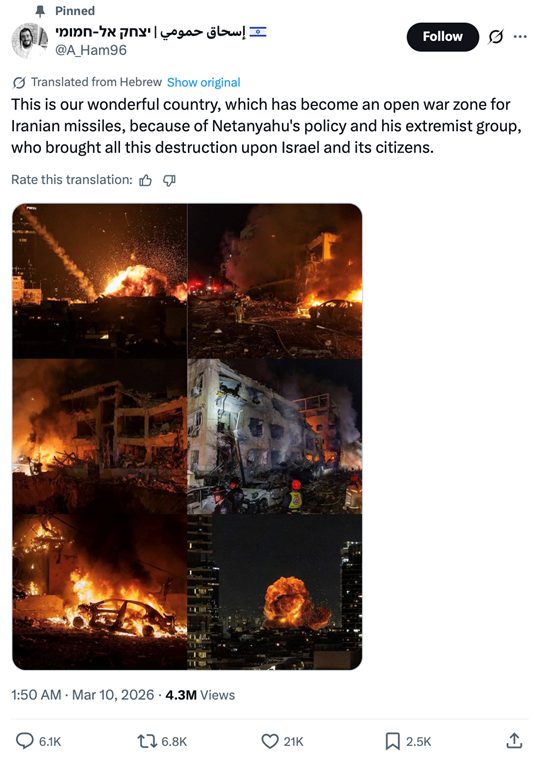
Note. The profile “Yitzhak al-Hamoumi” was flagged for several reasons: due to a mismatch between the follower count and the account’s creation date, the user’s location in West Asia, and the nature of its content—especially exaggerated levels of destruction in Israel. In addition, the account shared official Iranian content, such as material from Tasnim News.
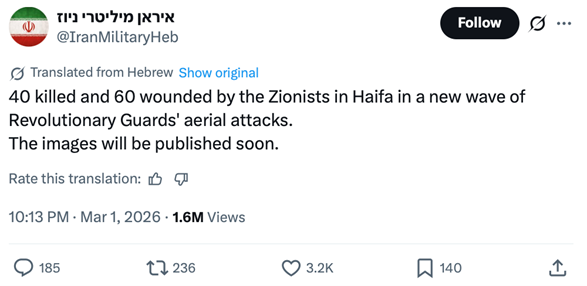
Alongside covert activity, there is extensive activity by overt channels affiliated with Iran to varying degrees, which publish content similar to that disseminated covertly while mimicking legitimate news outlets. These channels attempt to present themselves as news sources, featuring accounts of widespread destruction in Israel, alongside claims that Israeli and Western media are concealing the true scale of the damage, and portraying Iran as the victor in the campaign.
Figure 2. An X Account Suspected of Being Operated by Ira
In the regional context—Iran is pursuing a strategy of pressure toward the Gulf states that combines threats and deterrence with a message of potential neutrality. Senior Iranian officials have warned that states allowing the use of US bases on their territory for operations against Iran could become targets of Iranian strikes. Conversely, Tehran signals that states that refrain from direct involvement in the conflict will not be targeted. At the same time, Iran emphasizes its ability to disrupt shipping through the Strait of Hormuz and highlights risks to regional energy infrastructure in order to demonstrate to Gulf states that continued conflict could cause significant economic disruption—thereby generating regional and international pressure to end the fighting.
Alongside the strategic communications conveyed through missile launches and public messaging, there are likely also covert channels with Gulf states explaining Iran’s use-of-force policy in the Gulf. Iran is also working to frame the campaign as a “Ramadan war,” incorporating religious messaging aimed at Arab and Muslim audiences. The use of this framing allows Tehran to combine religious symbolism with physical deterrence: It signals to its neighbors that its operational endurance and continued strikes are expressions of both spiritual and strategic superiority.
In the Iranian domestic arena—A parallel effort is underway to shape public perceptions within Iran through a communications strategy that operates in routine periods and intensifies during emergencies. Here too, the central message is conveyed through violent action, as illustrated by the brutal suppression of protests by the regime in early January 2026, alongside activity in the information domain through official media and social networks (even if these are not consistently active). In addition to threats against citizens who might dare to protest, the regime releases documentation of arrests of demonstrators or individuals allegedly assisting Israel and the United States. At the same time, efforts are made to portray support for the regime through organized demonstrations, combined with the use of media tools and artificial intelligence to simulate broad public backing. Another effort focuses on minimizing the visible impact of the damage caused by Israeli and US strikes. The regime restricts the publication of images from affected areas, limits internet access, and creates a “fog of war” to obscure the extent of the damage from the public. When visible damage does occur—such as to energy infrastructure—the regime tends to present it as marginal and not affecting state functioning.
Recently, it has also emerged that the regime is directing influence efforts toward the Persian-language Wikipedia in an attempt to edit politically sensitive content and portray anti-regime protesters as violent. This activity included the gradual removal of sensitive information and the reframing of narratives in key articles—illustrating the strategic use of digital platforms to shape public opinion.
Artificial Intelligence—During the current conflict, Iran has used AI as a central tool to shape both public and leadership perceptions in Israel, the United States, and the Gulf states. Advanced models enable the generation of high-quality content in Hebrew, Arabic, and English and allow fake profiles to penetrate local discussions and influence public discourse without being easily detected. In addition, Iran uses deepfakes and AI tools to produce fabricated images and videos depicting damage to infrastructure and military successes. The combination of tailored content creation, real-time audience analysis, and social engineering enables Iran to conduct an ongoing digital campaign targeting multiple audiences simultaneously. AI thus becomes a strategic tool, enabling the conduct of a data-driven “cognitive war” in real time.
A report by the company Cyabra indicates that Iran’s objective in the cognitive domain is to construct an alternative narrative of victory to rapidly influence global public opinion. According to the report, this involves coordinated activity based on the repeated use of the same videos and captions, mass dissemination of identical messages across thousands of posts, the use of consistent hashtag clusters such as #standwithiran and #israelterroriststate, and concentrated bursts of posting within short timeframes.
The scale of this activity underscores the importance Tehran assigns to it: More than 37,000 manipulative or AI-based content items were identified, generating over 145 million views and more than 9.4 million interactions. TikTok was the primary platform in this context, accounting for approximately 72% of exposure, while Facebook and X together contributed nearly 40 million views. Some accounts operated simultaneously across multiple platforms and at times left indicators that the content had been generated using GenAI tools.
Conclusion
Iran is conducting an integrated campaign in which military, cognitive, and technological dimensions operate as a unified whole. Strategic communications are not secondary to military action but constitute a central component: Missile launches, public messaging, and digital activity combine to produce a cumulative effect of intimidation, attrition, and demoralization. Unlike other actors in the international arena, Iran makes systematic use of disinformation without relying on factual content or partial truths, thereby constructing an alternative reality that serves its objectives.
The increasing use of AI and technological tools enables the dynamic adaptation of messages to different audiences and transforms information into a force multiplier in the cognitive domain. This combination of military capabilities, information control, and technological innovation allows Iran to maximize its influence even against stronger adversaries, sustain a prolonged campaign aimed not at rapid victory but at shaping the strategic environment over the long term, and turn consciousness itself into a central battlefield.