


Publications

Special Publication, May 4, 2026
Follow us on GoogleBias against Israel on English Wikipedia is a known and documented phenomenon, yet its internal mechanisms often remain hidden from the broader public. This article examines the underlying mechanisms of this phenomenon through a focused analysis of the behavioral patterns of Iskandar323, a senior and experienced editor who operated on the platform for nearly twelve years before being permanently banned in early 2026 for violating prior restrictions on editing articles on the Israeli–Palestinian conflict. The study is based on mapping the scope of his activity, categorizing his primary areas of editing within the domain under examination, and conducting a qualitative content analysis of selected edits in core articles.
The findings indicate a systematic pattern of knowledge poisoning that does not rely solely on the insertion of false information but rather operates through reframing, omission of context, selective organization of facts, and wording changes with broad interpretive implications. Two main axes of activity emerge from the analysis: the first involves rewriting the foundations of Jewish identity, Zionism, and the State of Israel by weakening the Jewish connection to historical sites and spaces, reframing ancient Jewish history in the Land of Israel, and undermining the right to national self-determination; the second involves shaping the narrative of the Israeli–Palestinian conflict in a manner that frames Israel within a one-sided, judgmental critical framework.
The banning of Iskandar323 demonstrates that Wikipedia’s enforcement mechanisms are capable of functioning effectively. However, the fact that many of his edits remained in place even after his pattern of activity was exposed raises questions regarding the effectiveness of oversight, transparency, and accountability on the platform. It also underscores the need to consider state-level initiatives, including a formal complaint to the Wikimedia Foundation, alongside a legal examination of aspects of responsibility related to the phenomenon as a means of reducing existing harm and preventing its recurrence in the future.
In recent years, a growing body of research suggests that Wikipedia, one of the most influential encyclopedic repositories in the world, has become an intensive arena for knowledge poisoning. The project’s operating model, based on collaborative knowledge production (peer production) and the pursuit of community consensus, was founded on the assumption of good faith among editors engaged in knowledge production. However, this open architecture, which does not require editor identification, has become a vulnerability that allows ideological and political actors to introduce systemic biases into sensitive topics.
Wikipedia’s importance as a strategic knowledge arena stems from its status as one of the main entry points to information for billions of readers worldwide. Its high ranking in search engines, along with the fact that its content is automatically indexed by search engines and leading language models, means that any manipulation within it has a far-reaching impact. The collaborative ethos and lack of external oversight have created conditions that enable exploitation of the platform for agenda-driven purposes, manifested in various editing practices that narrow the public’s range of judgment on politically and socially sensitive issues.
This activity forms part of a broader process of knowledge poisoning, whose purpose is to shape and direct public consciousness in ways that appear ostensibly legitimate. Whereas disinformation focuses on the dissemination of false or partial information, knowledge poisoning involves deliberate framing that includes selective choice of facts, omission of context, and organization of information into a coherent whole that bears the characteristics of authoritative knowledge. In this way, knowledge is intentionally distorted while being presented in a biased and one-sided manner. Even when the facts themselves are accurate, their tendentious organization shapes the boundaries of discourse and prevents readers from forming opinions based on neutral information and a plurality of perspectives.
These biases serve a variety of purposes and may operate through different mechanisms. In some cases, they serve social, commercial, or state reputation management, as revealed in the Portland Communications case, in which the company advanced the interests of wealthy clients, corporations, and governments, including Qatar. In other cases, they operate through networks of ideologically motivated editors, some of whom have been exposed as working collaboratively to entrench political narratives and marginalize competing interpretations. All of this occurs under a veneer of apparent neutrality that makes manipulation difficult to detect.
Although the identities of editors involved in such bias are often concealed, the platform offers a unique transparency mechanism. The fact that every change is recorded in the edit history makes it possible to trace patterns of behavior, strategies of knowledge bias, and indications of coordinated activity. Accordingly, in relation to articles dealing with sensitive topics, Wikipedia is not only a site of information warfare but can also be seen as a research laboratory for examining the mechanisms shaping public consciousness in the digital age.
This article analyzes the activity of Iskandar323, a senior editor on English Wikipedia who contributed tens of thousands of edits. The study categorizes his editing targets, conducts a content analysis of selected articles, and examines editing patterns indicating systematic knowledge bias, thereby revealing how a single highly skilled editor, exploiting Wikipedia's structural vulnerabilities, can systematically reshape collective knowledge over time.
Chapter 1: Iskandar323 as a Case Study
Iskandar323 is one of approximately one hundred pseudonymous editors whose consistent editing patterns indicate a tendentious agenda directed against Israel, alongside a recurrent tendency to sanitize terrorist organizations such as Hamas. His extensive activity, cumulative influence on key articles, clearly discernible patterns of bias in his edits, and his extensive network of connections with other prominent editors within the group make him a unique case that allows for exposure of the operational mechanisms of knowledge bias characteristic of the group as a whole.
Iskandar323’s activity on English Wikipedia began in March 2014 and continued for nearly twelve years. During this period, he accumulated 25,909 edits in the main article space (mainspace), with a similar number on talk pages. A substantial portion of his edits dealt with Israel and the Israeli–Palestinian conflict and exhibited a consistent pattern of bias. He also played a central role in community discussions regarding policy interpretation, often undermining Israel’s standing.
The scale of his activity and the explicit manner in which he operated as part of a network of editors with an anti-Israeli agenda ultimately led to the initiation of proceedings before the Arbitration Committee (ArbCom) of English Wikipedia. Between late 2024 and early 2025, the committee conducted an extensive and unusually severe case, known as Palestine-Israel articles 5. The investigation exposed widespread violations of community rules and systematic bias in sensitive articles. It also revealed attempts to obscure terrorist crimes against Israeli civilians, including the Hamas massacre, alongside the sanitization or softening of actions by Iran and affiliated organizations.
In January 2025, the Arbitration Committee issued its final decision, which indefinitely banned Iskandar323 from all involvement in the Israeli–Palestinian conflict, broadly defined (Indefinite Topic Ban, broadly construed). Under this ruling, he was prohibited from editing historical or political articles in the field, responding on talk pages, participating in community discussions, or proposing changes related even indirectly to Israel, Zionism, Hamas, Palestine, or the Arab–Israeli conflict. The possibility of appeal was set at 12 months from the date of the decision, and thereafter at 12-month intervals. However, during the period in which he was barred from engaging in these topics, a complaint was issued to the Arbitration Committee (ArbCom) presenting evidence that he continued to advance a biased narrative through historical and religious articles, even after warnings and sanctions.
Following these violations, the committee decided to impose a full site ban in January 2026. The decision included a broad and unprecedented definition of the topic ban, encompassing any aspect related to Israel, Judaism, and antisemitism, even if an appeal might be submitted and accepted in the future. Despite opposition from a large group of editors, the permanent ban took effect following the appeal's rejection in February 2026.
The Analytical Process
The analysis consisted of several stages. First, the full set of articles in which Iskandar323 operated within English Wikipedia’s article space was examined. This space includes all publicly accessible articles and is distinct from the talk pages accompanying them, where editing-related issues are discussed. Statistical data indicate that he performed 25,909 edits in the article space, of which 7,979 were edits to unique article pages.
Following initial sampling, the articles relevant to this study were mapped, and from this list, a categorical classification was carried out. This process enabled the identification of two main domains of activity: rewriting the foundations of Jewish and Israeli identity and framing the conflict as a means of delegitimizing Israel. Based on these categories, a qualitative analysis was conducted of edits in specific articles. Finally, based on these data, recurring patterns of action characteristic of his methods of knowledge bias were examined.
Mapping Iskandar323’s Editing Activity
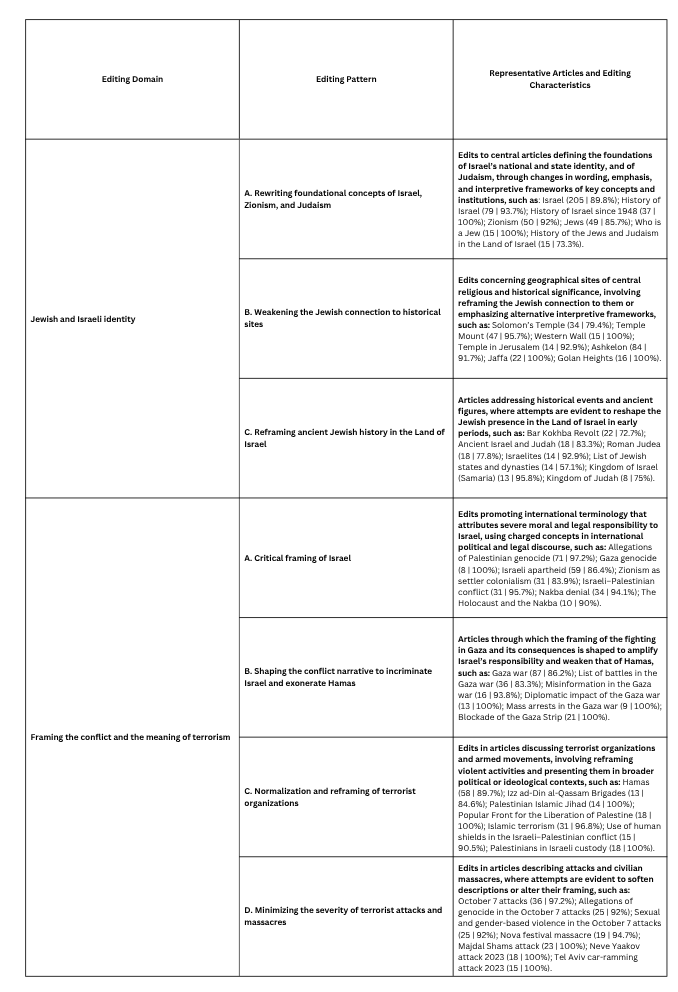
The map of articles in which Iskandar323 operated, presented in Table 1 below, identifies his main areas of activity regarding Israel, the conflict, and the meaning of terrorism. The table presents a division by topics, including editing patterns identified in the data analysis and examples of specific articles. Alongside each article, the number of edits he made and the percentage that remained intact (that is, were not deleted and are still part of the article) are indicated. For example, 100% indicates that all edits remained, while 90% indicates that 10% of the edits were removed.
The table presents the editing domain, editing pattern, and quantitative reference, including the number of articles modified and the percentage of edits that remained following tendentious editing. It should be noted that the number of edits alone does not always indicate their importance, as in some cases, a single edit is sufficient to change the meaning of an entire article. Nevertheless, the figures help identify where efforts were invested, and thus priorities and areas of extensive involvement. In addition, the proportion of edits that were not reverted may more clearly indicate deep and lasting impact, as such edits become embedded in the article’s wording and, over time, shape the interpretive framework through which it is presented.
Table 1 (Click for full size)
Chapter 2: Analysis of Selected Edits
To assess the depth of intervention and the significance of the edits, a content analysis was conducted on a sample of edits, including both extensive changes and more localized ones, some in core articles and others in secondary entries. The first section, “Reducing the Severity of the October 7 Events,” examines two articles related to the October 7 attack and shows how certain edits reduced the visibility of atrocities, weakened the perceived scale of cruelty, and diminished the clarity with which the attack's characteristics were presented. The second section, “Rewriting the Foundations of Israeli Identity and Jewish History,” presents five examples of wording that weaken central components of Israeli and Jewish identity, thereby undermining the national and historical legitimacy of Jewish sovereignty in Israel. The third section, “Normalizing Terrorism and Sanitizing Armed Organizations,” focuses on two examples illustrating how certain edits present terrorist organizations and events in ways that blur their severity and diminish their significance.
Reducing the Severity of the October 7 Events
- Erasing Terror: The “October 7 Attacks” Article
36 edits | 97.2% remained intact
The article “October 7 Attacks” describes the assault by Hamas and other Palestinian organizations on Israel on October 7, 2023. It is a foundational entry for understanding the massacres and the cause of the outbreak of the Swords of Iron war. Framing the events as a violent border breach within the context of a military confrontation, rather than as a premeditated massacre targeting civilians, fundamentally alters the meaning of the event.
In an edit on November 10, 2023, Iskandar323 deleted a passage stating that the “militants were prepared for different contingencies, such as killing all hostages, setting houses and other properties on fire, or using hostages as human shields.” He also removed the note that a document found on the body of one of the deceased militants read: “The enemy is a disease that has no cure, except beheading and removing the hearts and livers.”
The edit summary justified the change as “trimming extraordinary claims from a single source,” but in practice, it removed information attributed to multiple sources that reinforced the understanding that the attack included not only murder and abduction but also prior preparation for killing hostages, using them as human shields, and burning homes. This deletion removed both indications of planning and explicit expressions of murderous dehumanization, resulting in a softened description of October 7 that weakens the perceived scale of ideological violence, incitement, cruelty, systematicity, and intent attributed to the perpetrators.
In an edit on December 18, 2023, Iskandar323 removed from the article’s lead the Associated Press description of the event as an “atrocities-filled rampage,” as well as the statement by Physicians for Human Rights–Israel that the attack included “widespread sexual and gender-based crimes.”
Here, too, the removal was presented as a technical action, but, in practice, it reduced the visibility of the most extensively documented descriptions of atrocities and rendered the lead, which defines the nature of the event for readers, detached from the severity of the acts and from the fact that they included sexual violence. The result is a sequence of edits that dulls the intensity of violence, blurs its scale and distinctive features, and shifts the attack from a framework of deliberate massacre of civilians to a more ambiguous and cautious framing, diminishing the moral and historical significance of the event.
- Softening the Events of October 7: The “Gaza War” Article
87 edits | 86.2% remained intact
This article describes the ongoing war between Israel and Hamas in the Gaza Strip, which began following the Hamas attack on October 7, 2023. Accordingly, the way the events leading to the outbreak of hostilities are described plays a significant role in shaping readers’ understanding of the conflict and its origins.
In an edit made on November 23, 2023, a broad deletion of concrete descriptions of atrocities committed by Hamas during the attack is evident. The edit summary framed the change as a technical shortening, but it actually removed passages dealing with sexual violence, torture, and the burning of victims alive, alongside references to forensic findings, journalistic testimonies, and documentation presented to foreign journalists. In place of the detailed structure, a more condensed and general paragraph was inserted, reducing the level of detail and the direct illustration of the nature of the acts.
The result is a softening of the image of the attack and the scale of the associated atrocities. A layer that enabled understanding of the exceptional, documented, and shocking nature of the events was removed from the article. Thus, a framing emerges in which readers are exposed less to the concrete cruelty of the acts and more to a general, compressed description that lacks the same level of vividness. In this sense, the edit does not merely shorten the text but alters the nature of the memory it constructs.
Rewriting the Foundations of Israeli Identity and Jewish History
- Rewriting Israel: The “Israel” Article
205 edits | 89.8% remained intact
The article “Israel” is a core entry that serves as a central gateway to understanding the state’s identity, history, and sovereignty. It is one of the articles in which Iskandar323 was most intensely active. The many changes he made to the article addressed a series of central areas, including the state’s democratic characteristics, its civilian achievements, the description of the origins of the conflict, and details of its history. These editorial actions converged into a negative and tendentious framing of Israel.
One of the central characteristics of the State of Israel is that it is a democracy committed to the rule of law; yet this aspect became a target of edits seeking to undermine it. In an edit from October 7, 2023, Iskandar323 deleted the reference to Israel as a state that maintains universal suffrage for all its citizens without distinction on the basis of religion, race, or sex, and replaced it with wording that qualified this statement by shifting the discussion to broader issues of regime, territory, and population connected to the conflict.
The new wording places the equal political rights of all Israeli citizens, Jews, Arabs, Druze, and Christians alike, on the same level as the status of those who are not Israeli citizens. The result is that the very existence of voting rights in Israel is presented not as a clear institutional feature but as a claim subject to reservation.
Another intervention by Iskandar323 in the article’s lead reduced the visibility of Israel’s civilian achievements. In an edit from May 24, 2022, references to Israel’s high rankings in higher education, investment in research and development, life expectancy, happiness, and the Democracy Index of the Economist were removed from the lead, while the reference to its low ranking in the peacefulness index remained in place. This change not only shortened the lead but altered its framing: instead of presenting a complex picture of Israel as a developed country with notable civilian achievements alongside security tensions, it created a framework emphasizing primarily one negative aspect.
His activity in the article was not limited to the presentation of modern Israel but also addressed the origins of the conflict and the role of Arab states. Thus, in an edit from March 6, 2023, wording that pointed to the responsibility of the Arab leadership for rejecting the Partition Plan and the connection between this rejection and the outbreak of the War of Independence was deleted. The original sentence, “The 1947 United Nations Partition Plan for Palestine and the 1948 Israeli Declaration of Independence were rejected by Arab leaders, leading to the 1948 war,” was replaced with more ambiguous sentences: “After a civil war between Palestinian Arab forces and the Yishuv, Israel declared independence on 14 May 1948 at the termination of the British Mandate. A day later, the surrounding Arab countries intervened, leading to the 1948 Arab–Israeli War.” The choice of the word “intervened” to describe the act of invasion following the rejection of the Partition Plan diminishes the sense of aggressive responsibility. It presents the action almost as a neutral intervention in an existing conflict rather than as the military entry of neighboring states against a newly established state, legally constituted under a UN decision. The deletion of information about the Arab leadership’s rejection of the Partition Plan also weakens the causal link between the refusal of compromise and the outbreak of the war.
On the historical level, Iskandar323’s edits also addressed the shaping of the ancient Jewish political continuum. In an edit from April 10, 2023, he changed the references in the “Antiquity” section so that, instead of links to “Israelites,” “Kingdom of Israel,” and “Kingdom of Judah,” links to broader and later frameworks, including Canaan, the Herodian dynasty, and Syria Palaestina, were added. In addition, details about the destruction of the Canaanite cities of Hazor and Megiddo were omitted, thereby affecting the understanding of early Jewish consolidation in the region. This reorganization of the information diminishes the centrality of ancient Jewish political existence and renders it a secondary, incidental component within the broader historical narrative.
- Defining Judaism: The "Jews" Article
49 edits | 85.7% remained intact
The article “Jews” serves as a conceptual foundation for defining Jewish identity on Wikipedia. It addresses the history, identity, culture, and religion of the Jewish people, surveying their ancient origins, the development of Judaism, major historical events throughout the generations, and the global Jewish diaspora.
On September 3, 2023, Iskandar323 changed the article’s short description from “ethnoreligious group and nation originating from the Levant” to “ethnoreligious group and cultural community.” This change removed the recognition of Jews as a nation, as well as the explicit geographic-historical connection to the land.
The move is especially significant because it was made at the level of the article’s short description; that is, in a meta-textual framing layer with particularly high visibility. This is one of the first places readers encounter in search results, previews, and various reading interfaces. A semantic change in this location therefore carries a broad interpretive effect since it pre-shapes how Jewish identity is perceived in the initial encounter with the article.
On the same date, Iskandar323 made several significant edits that framed Judaism in a new way. In one, he revised the lead by removing the term “the Jewish people,” which had previously been treated as synonymous with “Jews.”
The deletion was justified on the grounds that the term was not an alternative name but a separate topic, “Jewish peoplehood.” This change narrows the conventional perception of Jews as a people and leaves wording that can be interpreted more narrowly. In another edit, he defined Jews as “adherents of Judaism,” phrasing that reduces Jewish existence and suppresses the dimensions of peoplehood, lineage, history, and shared language, which existed prior to the formation of an organized system of belief. Similarly, on September 4, 2023, he deleted the reference to Jews as a nation and changed the definition from a national-ethnic framework to that of an ethnoreligious group “whose members claim descent from the ancient Hebrews.” This wording adds another layer that undermines historical continuity and presents the connection between Jews and Hebrews as a matter of subjective claim rather than an established fact.
These terminological changes act to replace and narrow the distinctive interpretive framework of Judaism. The conception of Judaism as a people with historical rootedness and geographic connection is replaced by the narrower category of culture and religion. This shift weakens the historical foundation linking the Jewish people to the Land of Israel, thereby making it easier to present Zionism not as a national claim to self-determination but as a disputed issue.
- The Reduction of Zionism: The “Zionism” Article
50 edits | 92% remained intact
The article “Zionism” is among the most biased articles on English Wikipedia. The reason is that the article concerns the very definition of the legitimacy of Jewish nationalism. It has undergone thousands of edits, with its central editors belonging to the core group that has worked for years on the platform to bias knowledge against Israel; today, Zionism is described primarily from the perspective of a colonialist movement.
On July 12, 2023, Iskandar323 made an edit to the article’s lead in which he deleted the paragraph: “Zionism has never been a uniform movement. Its leaders, parties, and ideologies frequently diverged from one another. Compromises and concessions were made in order to achieve a shared cultural and political objective as a result of the growing antisemitism and yearning to return to the ‘ancestral’ country. A variety of types of Zionism have emerged, including political Zionism, liberal Zionism, revisionist Zionism, cultural Zionism, and religious Zionism.”
Following the edit, what remained in the lead was the direct contrast between Zionism, as described by its supporters as a national liberation movement, and as described by critics as a colonialist or racist movement. This edit weakens the Jewish historical context of Zionism and the fact that the movement was the combined product of rising antisemitism and the demand for self-determination in connection with a historical past. Second, when the clarification regarding the plurality of Zionist streams is deleted, the significance of Zionism’s internal history as a complex and pluralistic movement is diminished, while the prominence of the polemical framework, in which Zionism appears primarily as an object of ideological judgment, increases.
It should be emphasized that this flattening of Zionism’s complexity, while ignoring streams that aspired to binational identity or deep political partnership with Arabs, opened the door for other editors to produce further abstraction of the movement’s historical meaning and a dilution of its significance in a way that leads to its delegitimization, as was done later in the article’s lead in the sentence: “Zionists wanted to create a Jewish state in Palestine with as much land, as many Jews, and as few Palestinian Arabs as possible.”
- Erasing the Connection to Jerusalem: The "Israelites" Article
14 edits | 92% remained intact
The article deals with the Israelites as an ancient ethnoreligious group that lived in the Land of Canaan during the Iron Age. It describes their origins, their affiliation with the tribes attributed to the sons of Jacob, their development into the kingdoms of Israel and Judah, and modern scholarly views that see them as descendants of populations from the ancient Near East. The article’s political importance lies in demonstrating a connection between the Jewish people and Israel, grounded in their development in the land as an entity with political, territorial, and linguistic frameworks.
On November 5, 2025, Iskandar323 deleted from the article “Israelites” the sentence stating that Israel and Judah were two adjacent kingdoms whose capital cities were Samaria and Jerusalem. Through this deletion, a basic formulation anchoring the Israelites in a concrete political structure of two kingdoms, territorial concentration, and identified capitals was removed. Its removal weakens the understanding that this was not merely an abstract ethnic or religious group but rather real historical political entities that operated in the Land of Israel. In addition, Samaria and Jerusalem are not merely geographic points; they signify centers of rule, historical memory, and sovereignty. When this information is deleted, readers receive a less grounded version of Jewish history, in which the sovereign connection between the Jewish people and the land is less distinct, less institutionalized, and therefore also easier to challenge.
Since one of the central axes in the struggle over the representation of Jewish history is the recognition that Jews had a religious and territorial connection to the land, based on real political presence, deleting an explicit reference to two kingdoms and their capitals in Samaria and Jerusalem weakens this dimension. Instead of a concrete description of people, territory, and sovereignty, a more diluted history emerges, one that is easier to detach from the Jewish-national context.
- Deleting Reference to Ancient Hebrew: The “Ancient Israel and Judah” Article
18 edits | 83.3% remained intact
The article “Ancient Israel and Judah” addresses the development, rise, and fall of the kingdoms of Israel and Judah during the Iron Age. It describes the initial appearance of the Israelites in the Land of Canaan, the consolidation of the two separate kingdoms, and the central events that shaped their fate, including the Assyrian and Babylonian conquests, the destruction of the First Temple, and the exile. In addition, it presents the archaeological findings and textual sources used to reconstruct history, along with the scholarly debate over the reliability of biblical traditions. Its historical importance stems, among other things, from the fact that it concerns how language, script, and distinct cultural traditions that formed the basis of Israel's and Judah's cultural identity developed in this region.
In an edit made on August 13, 2023, Iskandar323 deleted the section “Language and Literature,” which stated that “a writing system unique to the Israelites emerged from the Phoenician alphabet around the 10th century BCE. This system is known today as the Paleo-Hebrew alphabet.”
The removal of the section significantly reduces the cultural and linguistic description of ancient Israelite history, leaving the article focused mainly on political structures and events. Instead of presenting the development of Israel and Judah through linguistic, scribal, and literary characteristics, which are central foundations in the formation of a collective identity, the article loses the context in which distinct cultural frameworks were created. Processes such as the development of a unique script, the use of different dialects, and the consolidation of Biblical Hebrew as a living language thus vanish from the narrative. The effect is the weakening of one of the central markers of identity in ancient Jewish history: instead of viewing Israel and Judah as entities with cultural depth, they appear mainly as administrative units.
It should be noted that Iskandar323's move to erase ancient Hebrew from the English Wikipedia does not stand alone. Similar activity is still evident today on the part of another editor, who also operates on topics related to the history of the people of Israel in antiquity and has begun systematically redefining many inscriptions from Jerusalem dating to the biblical period as “Canaanite inscriptions,” even removing the word “Hebrew” from an ancient Hebrew seal found in the City of David. These patterns reinforce the understanding that Iskandar323’s actions are not an isolated deviation but part of a broader trend of attempts to reshape historical knowledge on Wikipedia.
Normalizing Terrorism and Sanitizing Armed Organizations
- Softening Hamas: The “Hamas” Article
58 edits | 89.7% remained intact
The article “Hamas” on English Wikipedia has, over time, undergone a series of changes indicating a pattern of softening, blurring, and at times even whitewashing central aspects of the organization’s ideology and activities. Already in the lead, the organization is described in neutral terms as “a Palestinian nationalist Sunni Islamist political organization with a military wing known as the al-Qassam Brigades,” a description that does not allow readers to grasp its true nature.
On October 10, 2023, just three days after the massacre, Iskandar323 split off a large portion of the material dealing with antisemitism, anti-Zionism, and Hamas’s violent rhetoric from the main article, moving it to a secondary article called “Criticism of Hamas.” Although the edit was justified as a change of structure and organization, in practice, a detailed antisemitism section was removed and replaced with general wording referring to the secondary article. In this way, explicit calls by the organization for the destruction of Jews were removed from the main article, including quotations from senior Hamas officials, references to antisemitic “blood libels,” and opposition to Holocaust education in UNRWA schools. Alongside this, evidence was also removed regarding the use of human shields, rocket fire from populated areas, mosques, and schools, the use of hospitals as headquarters, and the condemnation of the killing of Osama bin Laden. In place of the previous detail, only a general summary remained in the main article, briefly noting that Hamas had faced “criticism” for incitement and the use of human shields.
This editorial change has a decisive impact since most readers are satisfied with the main article and do not move on to secondary entries. Thus, the antisemitic and violent aspects of the terrorist organization are suppressed precisely in the place most visible to the public eye. Moreover, the very framing of acts of terrorism and an ideology of extermination under the heading “criticism” constitutes bias, as these are not matters of external “negative opinion” but essential components of the organization’s activities and ideology. The timing of the edit is also significant. In the immediate aftermath of October 7, when many were seeking information about Hamas, much of the information dealing with the organization’s antisemitism and violent rhetoric was removed from the main article.
Iskandar323’s efforts to cleanse Hamas were also expressed through the deletion of visual evidence. For example, on November 20, 2023, he removed a photograph from the article “Hamas” documenting weapons seized in a mosque, which had appeared with the caption “Weapons found in a mosque during Operation Cast Lead, according to the IDF.” The deletion was justified as “removing an image with a biased point of view, not verified or supported by reliable sources.” In practice, its removal erased visual evidence intended to support claims that religious buildings were used for military purposes.
- Sterilizing Terrorist Attacks: The “2023 Hamra Junction Shooting” Article 16 edits | 100% remained intact
Iskandar323’s edits did not focus only on core articles about the State of Israel, Zionism, the conflict, and terrorist organizations. They can also be found in articles dealing with terrorist attacks. One example is the article describing the 2023 Hamra Junction shooting, during which terrorists fired at an Israeli vehicle in the northern Jordan Valley and murdered members of the Dee family: a mother and her two daughters, residents of Efrat.
In an edit from May 2023, Iskandar323 renamed an article originally called “Murder of Lucy, Rina, and Maia Dee” to “2023 Hamra junction shooting.” This change depersonalizes the victims of this attack. It shifts the focus from the murdered women to the geographic location where the event took place, thereby creating psychological distance that dulls the moral and human significance of the act. In his edits from July 9, 2023, he continued along the line of erasing personal identity and neutralizing emotional aspects. He removed the names of Lucy, Rina, and Maia from the lead and described them as “two women and another woman,” noting only that they were “family members” at the end of the sentence, in a way that dulls the human aspect of the event.
The process of “neutralizing” the article reached its peak in edits on July 25, 2023, when the names of the murderers and their affiliation with Hamas were deleted. As part of these edits, Iskandar323 replaced the active and direct statement “Hamas operatives Hassan Qatanani, Muath al-Masri and Ibrahim Jaber shot at an Israeli Vehicle,” with an indirect and passive formulation of an attack that was carried out by “unknown assailants," in which "an Israeli vehicle was shot.” This wording transforms the murder into a circumstantial event detached from a human perpetrator; it is not a matter of murderers who shot women but rather an organization that “claims responsibility” for an incident in which “an Israeli vehicle was shot at near the Hamra junction.”
Chapter 3: Iskandar323’s Main Patterns of Action in Biasing Knowledge
Iskandar323’s activity in the English Wikipedia mainspace reveals a series of recurring patterns of action, indicating systematic intervention in the shaping of knowledge. Below is a summary of the main patterns reflected in the examples discussed above:
- Weakening the Connection Between the Jewish People and the Land of Israel Through Anachronism and Reframing
This pattern includes the removal, reduction, or weakening of basic historical information attesting to the continuity of Jewish presence, sovereignty, or connection to the Land of Israel. The effect is the creation of a softer or more fragmented historical picture, in which the Jewish connection to the land appears less real, less political, and less rooted, presenting the Israeli–Palestinian conflict as a struggle between foreign invaders and a local population.
- Reducing or Deleting Positive Characteristics of Israel
This pattern is reflected in the removal of data, rankings, and favorable descriptions of Israel, especially in article leads, resulting in a less balanced, more negative overall picture. Instead of also presenting institutional, social, or economic achievements, the editing primarily emphasizes weaknesses, criticism, or negative rankings. The result is a shift in the article's overall tone through the selective removal of positive context.
- Simplifying Information About Israel as a Means of Strengthening Criticism of It
This pattern is reflected in the removal of information that emphasizes internal complexity, a variety of streams, and multiple historical contexts, leaving a binary and simplistic framework that facilitates criticism and delegitimization. Within this framework, different streams are merged, historical contexts are omitted, and the diversity that exists within Judaism, Zionism, and Israeli society is diminished. This process strips the concepts of their complexity and weakens the understanding of the historical, cultural, and national contexts connected to them. Thus, instead of reflecting the complexity of the subject, the pattern reduces it and operates contrary to what is expected of an encyclopedic entry seeking to present all aspects of a given topic.
- Sanitizing Antisemitic and Murderous Aspects of Terrorist Organizations Operating Against Israel
This pattern includes the removal of information attesting to extremist religious ideology, antisemitism, or murderous intentions of organizations working to destroy Israel, while relying on procedural arguments concerning source quality, source marginality, or encyclopedic relevance. Instead of engaging with the content itself, the edit undermines the organization's authority by quoting or interpreting it, thereby enabling the deletion of essential information without refuting it. The effect is to present organizations with antisemitic or violent doctrines as more rational and abstract political actors through the systematic cleansing of the harsher theological and ideological components from the narrative. This cleansing is also evident in the deletion of images that provide visual evidence to the article.
- Obscuring the Historical Responsibility of the Arab World for War and Jewish Refugees
This pattern is reflected in the deletion, softening, or replacement of historical information indicating the responsibility of Arab leaders, Arab states, or Arab societies for rejecting political solutions, initiating wars against Israel, and creating Jewish refugee populations from the Arab world. Instead of direct descriptions of rejection, invasion, persecution, or coercion, the editing replaces the information with more general, symmetrical, or passive wording that diffuses responsibility and obscures the dimensions of initiative, aggression, or coercion on the Arab side. The effect is the creation of a softer narrative, in which clear historical responsibility becomes an ambiguous sequence of “events,” “interventions,” or “departure,” without sufficient distinction between attacker and defender or between expulsion and migration.
- Reframing Terrorist Events While Neutralizing the Violent Aspect and the Responsibility of Perpetrators
This consists of systematic use of wording changes intended to blur the presentation of terrorist attacks against civilians and reduce their severity and significance. Within this pattern, charged terms with emotional value, which convey the cruelty of the murders and the harm done to innocent victims, are deleted and replaced with neutral or technical terms. Thus, terrorist acts are presented as operational actions, victims are described in a distant and alienated manner, and the responsibility of perpetrators is obscured through the omission of essential details about the responsible parties, the circumstances of the event, and the degree of violence involved.
This process reduces the severity of the event and the human element involved, producing a moderate, sterile narrative that detaches the act from its murderous context. In this way, an act of terrorism becomes an ambiguous and depthless “incident,” dulling the understanding of reality and its meaning.
- Depersonalization of Terror Victims
This pattern is reflected in the removal of the names of Israeli victims, identifying details, and signs of human connection, replacing them with general and distant descriptions. The result is the sterilization of the event, cleansing it of everything that enables readers to recognize it as a human act, with responsible actors and named victims. The significance of this pattern becomes even clearer when considering research findings on the role of emotions in knowledge processing. Studies in social psychology and theories of collective memory indicate that emotional connection, such as identification with a victim who has a name, face, or story, is a central mechanism in transforming information into a meaningful fact. When the emotional dimension is removed, readers’ ability to process the event as a human reality is diminished, and it is perceived as an abstract, nonbinding datum.
Conclusion: The Contribution of a Single Editor to Knowledge Bias on English Wikipedia
An examination of Iskandar323’s editing patterns shows that knowledge bias on Wikipedia can occur systematically and uninterruptedly over many years. A review of the articles in which he was active reveals extensive involvement in mainspace. It points to a coordinated strategy intended to undermine Israel’s standing and the historical connection of the Jewish people to the region, while simultaneously softening the representation of terrorist organizations such as Hamas and downplaying the severity of their actions.
Arbcom's determination and the actions leading to Iskandar323’s complete ban from the platform do not negate the seriousness of the situation. For years, a systematic pattern of bias persisted, producing a body of edits that largely remained in effect even after the ban and continue to influence how topics related to Israel, the conflict, and terrorism are presented on the platform.
The categorical structure of Iskandar323’s activity, the scope of the edits, and the persistence with which a false neutrality was constructed around a wide range of edits indicate that this is not an isolated, biased action or a legitimate interpretive dispute; rather, it is a structural vulnerability that allows the use of the platform for information warfare to be concealed. This vulnerability rests on deep familiarity with the rules of the editing community, the accumulation of reputation through persistence and knowledge, and the use of professional language to justify tendentious edits through arguments such as “shortening,” “splitting,” “summarizing,” “reducing undue weight,” and “improving structure.” It follows that, under the current conditions, there are structural factors that enable breaches through which ideological, political, and sometimes economic actors can use Wikipedia for their purposes. In theory, neutral editors could have corrected the situation, restoring balance to mainspace. In practice, however, studies indicate that distinct and minority groups face significant challenges when attempting to edit articles on sensitive topics.
Added to this is the fact that the platform relies on the appearance of collaboration and neutrality; yet, in practice, veteran editors with networks of connections enjoy broader influence, including the shaping of the boundaries of discussion and the determination of outcomes on questions such as what constitutes legitimate sources. The great complexity of the system of rules, policies, talk pages, and internal mechanisms grants a clear advantage to those who command the procedural language well and know how to translate an ideological position into seemingly technical reasoning. In addition, the cumulative power of community reputation plays a significant role: An editor such as Iskandar323, who operated over time, accumulated seniority, and came to know the community culture in depth, enjoyed symbolic capital that enabled him to influence not only the content but also the way objections to him were perceived.
This article focused on sampling Iskandar323’s activity in the mainspace in anti-Israeli contexts. However, it is important to note that his efforts to bias knowledge and undermine Israel’s standing were not expressed solely through the edits themselves. His activity also included initiatives to change platform policy, involvement in talk pages, and collaboration with other editors from a broader network of editors and administrators operating in a tendentious pattern against Israel. They also included work with Euro-Med, an anti-Israeli organization active on the platform that operates, among other things, the WikiRights project to train young Palestinians in writing, developing, and updating content on Wikipedia in Arabic and English, including the documentation of “Israeli crimes” and “genocide in Gaza” through field testimonies. These significant aspects justify further research examining all of his edits, the network of connections he created, his involvement in talk pages and community decisions, and the cumulative influence of his activity on knowledge production.
To date, the State of Israel has refrained from having professional bodies officially approach the global Wikimedia Foundation. However, given the recent evidence of the scale of bias created through Wikipedia regarding Israel and the conflict, it would be advisable to consider action at the diplomatic level, including a formal appeal to the Foundation demanding an examination of how the tendentious edits of Iskandar323 and other editors exposed as acting in bad faith can be undone. Such a move could include a request for joint discussion of preventive measures that would address the existing breach and the way the site is used to undermine Israel’s legitimacy in the international arena, alongside examination of the possibility of legal steps against what appears to be deliberate bias that abuses the platform.
At the same time, cultivating critical thinking and digital literacy in the curriculum from an early age is crucial. Integrating the study of reading, writing, editing, and the critical evaluation of online texts, including Wikipedia entries, into information skills or English language studies can help students understand how information is created, identify biases, and treat digital sources with caution while engaging thoughtfully in the online space.
Strengthening digital literacy is only a long-term response and cannot, on its own, address biases that have already become embedded in the global knowledge base and continue to shape public consciousness today. The transformation of the English Wikipedia into a significant source of knowledge poisoning requires formal intervention to stop and prevent it from further solidifying its role in distorting global knowledge.
This article was written in the framework of the project “Foreign Interference” carried out at the Institute for National Security Studies (INSS), with the support of the Israel National Cyber Directorate and the Directorate of Defense Research and Development (MAFAT), in collaboration with Here4Good.