


Publications

What are the implications of a change in the framework of direct US aid to Israel?
INSS Insight No. 2094, February 11, 2026
US military aid to Israel has, for decades, constituted a central pillar of the strategic relationship between the two countries and a foundational component of Israel’s national security concept. Beyond its financial scope, this aid serves as an institutional, political, and symbolic anchor of the alliance between Jerusalem and Washington, embodying the United States’ commitment to preserving Israel’s qualitative military edge in a challenging regional environment. The current multiyear agreement (2019–2028), signed in 2016, sets the annual level of aid at $3.8 billion, of which $3.3 billion is provided as direct foreign military financing and $500 million annually is allocated by the US Department of Defense for the joint development of missile defense systems. The United States also provides assistance to other countries in the region, with Jordan and Egypt each receiving approximately $2 billion annually. Nevertheless, aside from the exceptional case of Ukraine since the outbreak of the war with Russia, Israel is the largest recipient of US military aid.
In recent years, the public and professional discourse within Israel regarding the future of US military aid has intensified. Public statements by Israeli political figures—including the Prime Minister’s recent remarks expressing a desire to gradually reduce this aid over the coming decade—reflect a conceptual shift: from a technical discussion of agreement terms to a principled debate over security independence, economic resilience, and the strategic implications of prolonged reliance on foreign aid, alongside an understanding of US domestic politics and its changing view of Israel. At the same time, in the United States, public and political debate over foreign aid in general, and military aid to Israel in particular, has grown amid changes in the domestic and international political arenas and the security environment. This article analyzes the economic implications of changes in the framework of direct US aid to Israel and offers policy recommendations for the future of defense relations between the two countries.
Israeli Domestic Considerations
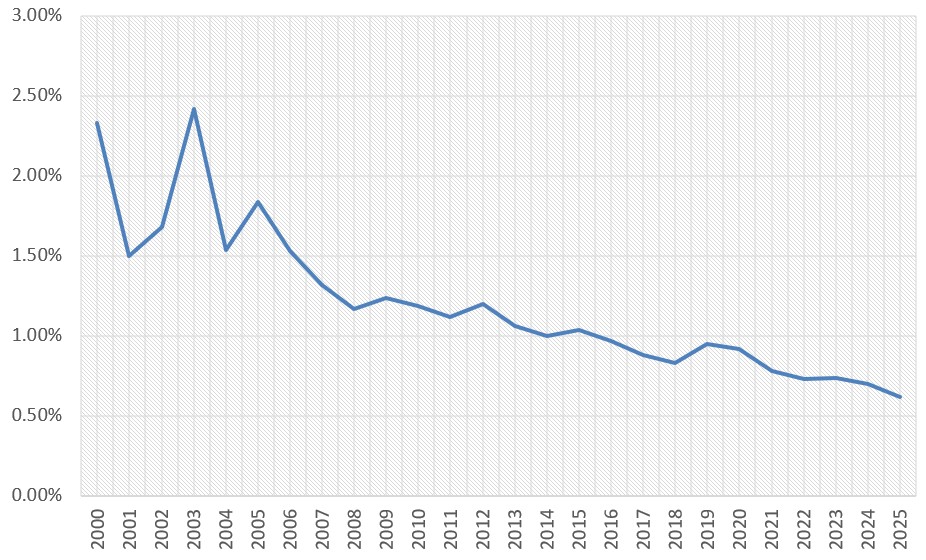
From an economic perspective, Israel’s current economic conditions differ fundamentally from those that prevailed when the current agreement was signed in 2016. Over the past decade, the Israeli economy has experienced sustained growth, reflected by a significant expansion of GDP and a strengthened capacity to cope with extraordinary crises, including the COVID-19 pandemic and the October 7 war. As a result, as shown in Figure 1, the share of US military aid in Israel’s GDP has declined to about half a percent. This figure suggests that, from a macroeconomic perspective, Israel is now capable of bearing a greater budgetary burden on its own than in the past.
Figure 1. US Military Aid as a Percentage of Israeli GDP, 2000–2025 (Excluding special assistance during the October 7 war)
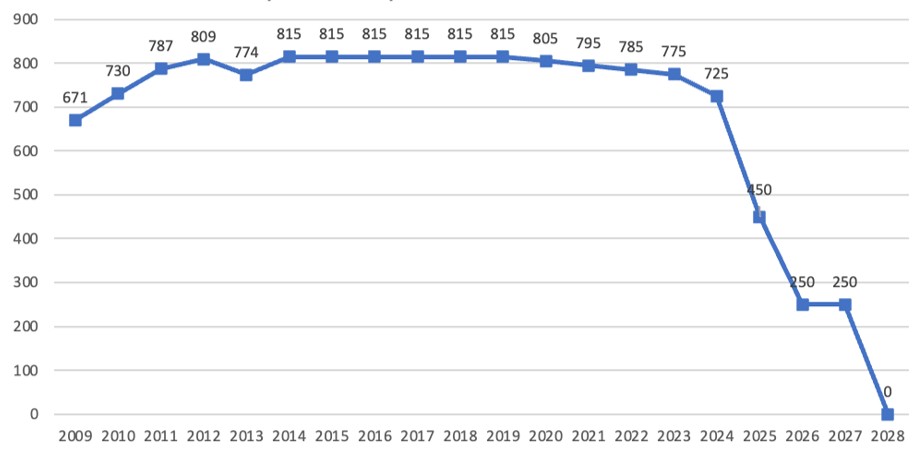
In addition, the terms of the aid have changed in ways that reduce its direct contribution to the Israeli economy. Whereas in the past, a portion of the aid funds could be converted for domestic procurement, this option has been gradually eroded and is expected to disappear entirely by 2028. This trend is illustrated in Figure 2, which presents the amounts of aid dollars convertible into shekels, based on data published on April 10, 2018, by the Congressional Research Service. The implication is that aid is now channeled almost exclusively toward procurement in the United States, contributing less than in the past to the strengthening of Israel’s domestic defense industries.
Figure 2. Conversion of Aid Dollars into Shekels under the Agreement
However, an examination through the lens of the defense budget presents a more complex—and even more challenging—picture, particularly against the backdrop of sharply rising security needs following a prolonged war and an unstable strategic environment. US aid still constitutes roughly 15% of Israel’s defense budget; therefore, its reduction or termination would require significant budgetary adjustments at a particularly sensitive time. In this context, a budgetary gap created by a decline in US aid could heavily affect the system’s ability to meet all of its objectives and exacerbate tensions between security needs and competing civilian priorities.
The necessary adjustments may include increased domestic defense spending, the postponement or reduction of non-urgent procurement and development projects, and budgetary efficiency measures. However, given the magnitude of security challenges and the lessons learned from a prolonged war, the defense establishment’s capacity for budgetary maneuvering is more constrained than in the past. Consequently, reducing aid cannot rely solely on technical cuts; it requires a systemic reassessment of priorities, a rebalancing between investments in immediate readiness and long-term development, and a clearer definition of essential core capabilities.
Even under these conditions, reducing aid does not necessarily entail a full dollar-for-dollar replacement and may create significant opportunities for efficiency gains and the strengthening of domestic industry. A planned and gradual process could serve as a lever for improving the quality of defense spending, enhancing transparency and budgetary oversight, and reinforcing multiyear planning mechanisms. In addition, reduced assistance could incentivize the Ministry of Defense to expand “blue-and-white” Israeli-made procurement, strengthening the domestic knowledge and production base and reducing dependence on external supply chains. In this light, the budgetary challenge arising from a potential decline in US aid could, over the long term, contribute to enhancing both structural efficiency and the fiscal resilience of the defense establishment—provided it is managed carefully and in close alignment with the evolving security context.
Beyond budgetary considerations, US support plays a central role in preserving Israel’s military capabilities. It enables systematic access to advanced weapon systems, participation in US development programs, and broad-based technological cooperation. Particularly notable is its contribution to the development of multi-layered air and missile defense systems, which have demonstrated their operational importance in military confrontations over the past two years. In this sense, the aid is not merely a funding source but part of a deep security-technological relationship that shapes the IDF’s force buildup. Therefore, as long as an alternative agreement is concluded that secures Israel’s access to the US defense industry, this relationship can be preserved and even expanded.
Considerations Regarding Relations with the United States
The existence of this aid and its anchoring in a unique long-term agreement in the international arena reflect the special relationship between Israel and the United States, which limits the discretion and policy changes toward Israel during transitions between US administrations. These relations, their institutionalization, and public expression over the years have served as a central source of Israel’s strength. However, this relationship also incurs strategic and political costs. First, the provision of aid grants the United States a lever of influence over Israeli policy. Even when this leverage is not applied directly or overtly, it somewhat constrains Israel’s freedom of action and heightens its sensitivity to shifts within the US political arena.
From the American perspective, the strategic rationale underlying the aid has shifted. Economically, the sharp rise in global defense spending—against the backdrop of the war in Ukraine and intensified great-power competition—has generated unprecedented demand for military equipment. In this context, US defense industries enjoy a substantial backlog in orders even without relying on aid to Israel, thereby diminishing the American incentive to maintain military aid at its current level for purely industrial reasons.
From a domestic US political angle, changes in the structure of the memorandum of understanding with Israel intersect with an internal American debate amid a structural shift in attitudes toward Israel. For many years, aid to Israel rested on a broad bipartisan consensus. However, long-term trends and more rapid processes have eroded this consensus. Over the past decade, indicators of this erosion have been particularly evident at the fringes of the political spectrum. Among segments of the progressive wing of the Democratic Party, growing criticism has emerged regarding Israeli policy and the extent of US support. Conversely, at the opposite end of the political spectrum, some proponents of the “America First” approach associated with Trump have challenged US support for Israel in all its dimensions, including the economic aspect. (Trump himself, despite urging various international actors not to rely on the United States for their needs, supports the continuation of aid in its current form, according to reports in the media.) This trend accelerated during the “Swords of Iron” war and led to an unprecedented crisis in American public opinion regarding Israel, including growing support for restricting US military aid. In this context, military aid is perceived as a lever for influencing Israeli policy and as a moral justification for imposing unique demands on Israel regarding its political conduct. In other words, in the eyes of certain segments of the American public, the provision of direct military aid to Israel renders Americans themselves partners in responsibility for Israel’s actions, thereby obligating them to exert pressure on Israel to change its behavior.
Policy Recommendations
- Although Israel now relies less on direct US financial assistance than in the past, the continuation of aid in some form retains political significance as an expression of the bilateral relationship between the two countries, as well as military importance in ensuring Israel’s access to US systems and its capacity to integrate into their development. Simultaneously, changing the characteristics of the aid could enhance Israeli independence, standing, and capabilities within the defense industrial sector. Even if this change does not entirely mitigate criticism of Israel among those in the United States who oppose providing military support, it would eliminate a central argument from their arsenal.
- Accordingly, we believe that efforts should be made to establish a new formal agreement to replace the current one, in a manner that reflects and anchors the relationship between the two countries. Such an agreement should facilitate a gradual transition from military aid to a business partnership. Within this framework, joint force buildup for defense should be encouraged, including the removal of export and import barriers, the enhancement of production capacity in both the United States and Israel, and comprehensive integration of Israel into American R&D efforts.
- Macroeconomic recommendation: While increasing the defense budget may seem like the intuitive policy choice, it is not the correct one. A full monetary replacement of every dollar eliminated from a future agreement should be avoided. This does not imply that the defense budget should not be increased at all in the short term; rather, it should be increased based on actual needs and following thorough discussions regarding the reduction of military aid. In other words, a change in the structure of the aid presents an opportunity for structural efficiency and more appropriate resource allocation, which could address the financial gap that may arise.