


Publications
How does Trump’s initiative for the Gaza Strip create new opportunities for Israel to change the security and political reality, and what challenges might stand in its way?
INSS Insight No. 2040, September 30, 2025
President Trump’s initiative for the Gaza Strip, which received the support of Prime Minister Benjamin Netanyahu and of Arab states, represents an important attempt both to break the deadlock in which Israel has found itself in its war against Hamas and to move from a bilateral confrontation framework to a multilateral process involving the United States and Arab states. The initiative also signals a welcome intention to integrate political and military efforts—through the reconstruction of the Strip and the cultivation of a governmental and ideological alternative to Hamas—as vital components of a multidimensional strategy to eradicate the organization. The initiative is positive for Israel, especially if Hamas accepts it, but also in the more likely case that it rejects it. However, realizing the opportunities it contains depends on Israel’s genuine and long-term commitment—not only to continue the military suppression of Hamas but also to advance civilian reconstruction and a political settlement for the Gaza Strip and the Palestinian issue as a whole.
On September 29, the White House published President Trump’s twenty-point initiative to end the fighting in the Gaza Strip and to shape a new reality of stability and reconstruction for the “day after” the war. Prime Minister Benjamin Netanyahu announced his agreement in principle to the plan, and a number of Arab and Muslim leaders, including Egypt and the United Arab Emirates, likewise expressed support for the initiative. Hamas has not yet delivered its response, but given the negative reactions from Palestinian Islamic Jihad and the Houthis—who described the initiative as an American–Israeli conspiracy to continue control over the Gaza Strip—it is reasonable to assume that Hamas will refuse it.
In the immediate term, the plan stipulates that upon acceptance of the agreement by the parties, the war will cease, Israel will begin a gradual withdrawal, and all hostages will be returned within 72 hours. At the same time, there will be a large-scale release of Palestinian prisoners and bodies, and Hamas members who choose to do so will receive amnesty or safe passage to host countries. The flow of humanitarian aid will be significantly increased and managed by the UN, the Red Crescent, and other international actors, while vital infrastructure will be restored and rubble removed. In parallel, a Palestinian technocratic interim government will be established under the supervision of an international framework (the “Board of Peace”), chaired by President Trump himself. This body will be responsible for outlining reconstruction programs and securing funding for their implementation until reforms in the Palestinian Authority (PA) are completed that will enable it to assume responsibility for the Strip.
In the medium and long term, the initiative sets out the outlines of a new security, economic, and political framework for the Gaza Strip. Hamas will be excluded from governance, required to surrender its weapons, and its military infrastructure will be dismantled. An international stabilization force, in cooperation with the United States and regional partners, will be established to oversee the collection of Hamas’s weapons, the demilitarization of the Strip, and the training of a Palestinian police force.
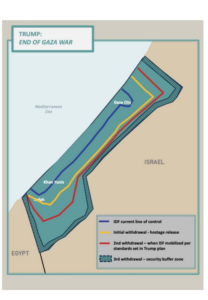
Israel commits not to occupy or annex the Gaza Strip and will partially withdraw from the territory: a first withdrawal to a more rearward line with the release of the hostages, and a second withdrawal to the border areas, carried out gradually and in line with the progress of the demilitarization process. In any case, Israel will maintain long-term control over the perimeter and the Philadelphi Corridor.
In parallel, an economic reconstruction program will be launched, including a special trade zone, international investments, and local employment, alongside a deradicalization process and interfaith dialogue. As the Gaza Strip’s reconstruction advances and reforms in the PA progress, conditions will emerge for a political horizon toward a Palestinian state, accompanied by direct dialogue between Israel and the Palestinians.
If Hamas delays or rejects the proposal, the above provisions will be implemented in areas cleared of its presence, which the IDF will gradually transfer to the international stabilization force. This clause points to the possibility of partial and phased implementation of the initiative, even if Hamas does not agree to it—where reconstruction processes would begin in the areas cleared of Hamas, while in areas not yet cleared, the IDF would continue to operate intensively.
What follows is a preliminary analysis of Trump’s initiative, highlighting its advantages and opportunities for Israel, as well as the risks and points of weakness.
Opportunities
First and foremost, the plan adopts Israel’s core principles: the immediate release of all hostages, the complete exclusion of Hamas from governance, the demilitarization of the Strip, overriding Israeli security responsibility, and the continued presence of the IDF along the borders (the perimeter and the Philadelphi Corridor).
The principle of a Palestinian technocratic administration under international supervision is substantively correct. The official wording defines it as a non-political entity (in line with Netanyahu’s demand for Palestinian governance that is “neither Hamas nor the Palestinian Authority”), but in practice, this administration will likely maintain a connection to the PA, as demanded by the Arab states. This will occur at least through its personnel composition (a hint of this is found in clause 8, according to which the Rafah crossing will be opened and operated according to the mechanism implemented in January 2025, which was, in practice, staffed by PA personnel. It is also known that some of those designated for the local administration leadership, certainly the new police force, come from the ranks of Fatah and the PA).
From media reports, it appears that the tenure of the technocratic administration may extend over several years. In any case, it is important to emphasize that the transfer of responsibility and authority from the technocratic administration to the PA will occur only after significant reforms within the PA, and not according to rigid timeframes (unlike the Egyptian initiative, which proposed that the technocratic administration operate for six months before transferring authority to the PA).
On the security level, the principle of gradual Israeli withdrawal can help maintain long-term IDF control over key points—particularly the Gaza perimeter and the Philadelphi Corridor—as a defensive “depth inward” for protecting the communities of the western Negev and preventing the smuggling of weapons through the Sinai Peninsula. Moreover, if Hamas rejects the deal, the initiative, as noted, grants Israel the freedom to continue deploying the IDF to clear areas under Hamas control, alongside advancing processes of political, security, and civil stabilization in areas cleared of Hamas.
On the political and civil level, the initiative reflects an understanding of the need for an integrated reconstruction of the political-governing system, the living systems (infrastructure and the economy), and Palestinian society and its prevailing extremist ideas (deradicalization). These are essential foundations for creating a path of material and ideological transformation that will contribute to the stability of the Strip and reduce the motivations to resort to violence and extremist worldviews.
The proposal concludes in its final clauses that if the preceding provisions are implemented—including deep reforms in the PA and the reconstruction of the Strip—the conditions will be created for “a credible path toward a Palestinian state.” This is a positive definition, balancing the need to incentivize the Palestinians to adopt a more moderate and peace-oriented political approach, with preserving Israel’s security responsibility and preventing the transfer of sovereign powers to the Palestinians as long as they have not changed their fundamental approach to the conflict with Israel.
Risks and Weaknesses
Alongside its advantages, the American proposal also contains gaps and points of weakness in relation to Israel’s interests.
First and foremost, it is reasonable to assume that Hamas will find it difficult to accept the plan in its current form, which will perpetuate the deadlock over the release of the hostages. Second, the plan includes gaps in the security domain. Granting amnesty to Hamas members who commit not to return to terrorism is a “hard pill to swallow,” if only for emotional reasons (since from a security perspective, as long as they remain within the Strip, Israel reserves the right to target them if they resume terrorist activity). Even more problematic is the willingness to allow Hamas operatives to emigrate to another country if they so choose, since there they could continue to operate within the organization and against Israel. Still, this is a reasonable concession and one that is consistent with known international models for dismantling extremist groups.
The central problem lies in the absence of a clear mechanism for the complete dismantling of Hamas and for the demilitarization of the Strip, including addressing the tunnels and other armed groups. It is evident that the international stabilization force, as well as the local security force to be established under the model of the PA’s security mechanisms, will not be able—or likely willing—to confront Hamas directly and fully (at most engaging in pinpoint actions or operating in supporting activities). In addition, the American proposal leaves open questions regarding the scope and timing of the IDF withdrawal in relation to the degree of demilitarization.
Another clause in the administration’s proposal requiring clarification concerns humanitarian aid, which—according to the wording published in the media—will be distributed by the UN and the Red Crescent, alongside other international organizations not connected to Israel or Hamas. It is of historic importance to insist that UNRWA not continue to be part of the UN mechanisms operating in the Strip, not only because of Hamas’s extensive use of it but also because the agency has, in practice, served as a mechanism for preserving and cultivating the Palestinian consciousness of refugeehood and the right of return.
Conclusion
Trump’s initiative (not coincidentally) resembles the Arab initiatives placed on the table since the beginning of the year, from the Egyptian initiative (February 2025) to the French–Saudi initiative (July 2025). Its main points are acceptance of Israel’s demand for the release of all hostages, the exclusion of Hamas from governance, and the demilitarization of the Strip; the initiation of reconstruction processes through a local Palestinian administration linked to the PA; and a declarative commitment to Palestinian independence (conditional on the Palestinians implementing reforms in the Gaza Strip and in the PA), which would enable a return to the path of expanding normalization agreements between Israel and the Arab states.
The most significant and important principle in Trump’s plan (similar to the recommendation put forward by the Institute for National Security Studies and more recently) is the shift from bilateral sparring between Israel and Hamas to multilateral decision-making about the future of the Strip (primarily between Israel, the United States, and the Arab states), bypassing Hamas, and combining military action with political action. In this regard:
Israel has acceded to the political demands set by the Arab states as a condition for their involvement in civilian stabilization efforts and their support for Israel’s military freedom of action: Israeli recognition of the Palestinians’ national right to statehood and a commitment to refrain from permanent occupation and annexation of the Strip.
The Arab states, by supporting Trump’s initiative, have accepted Israel’s demand to retain freedom of action to continue suppressing Hamas and to condition the extent of the IDF withdrawal on the extent of the territory’s demilitarization.
In addition, clause 17 of the plan stipulates that even if Hamas refuses the initiative, it would still be possible to begin building the alternative governing framework and advancing reconstruction processes in areas cleared of Hamas, while the IDF continues operating to clear the remaining parts of the Strip of Hamas’s military presence.
Assuming, as is likely, that Hamas will reject Trump’s plan (either outright or through conditional acceptance), the initiative will not secure the release of the hostages, nor does it present an effective mechanism for disarming Hamas and demilitarizing the Strip through non-Israeli forces. However, it does create conditions for regaining internal and external legitimacy for Israel’s continued military struggle against Hamas, alongside the beginning of the construction of a political and ideological alternative to its rule in the Strip.
The transition to a more correct and wiser Israeli strategy against the organization—multilateral and attentive to the needs of the Arab states, combining political and civilian efforts with the military effort—may, for the first time, create real conditions of pressure on the organization to soften its terms for ending the war and returning the hostages. At the same time, this strategy reopens the door to expanding the Abraham Accords and promoting Israel’s normalization processes in the region.
Nevertheless, capitalizing on the opportunities inherent in Trump’s plan depends on Israel’s genuine and long-term commitment—not only to continue the military suppression of Hamas, but also to advance civilian reconstruction and a political settlement for the Gaza Strip and for the Palestinian issue as a whole.