


Publications
INSS Insight No. 612, October 2, 2014
Follow us on Google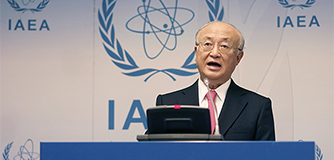
{image}In fact, however, the international and regional practitioners who have been engaged in actual discussions of regional security have channeled their efforts since last autumn in a potentially more fruitful direction. At several meetings held primarily in Switzerland, Israeli and Arab officials have tried to hammer out a common understanding of what could realistically be on the agenda in a renewed discussion of arms control and regional security, in the context of a WMDFZ conference. So far they have little to show by way of results, due to a deep conceptual divide regarding the meaning of WMD arms control in the Middle East that continues to plague these efforts. But at least the parties sat down to address the issues.
At the same time, in the current Middle East, the disconnect between a discussion of a WMDFZ and the realities on the ground could not be more stark. With the challenges posed by radical terrorist elements to states across the region, instability in Libya and Lebanon, the pending disintegration of Iraq and perhaps Syria as well, and indiscriminate Hamas rocket fire at Israeli civilian population centers for 50 days, including an attempt to create an environmental disaster by striking Dimona, is a WMDFZ even remotely viable? Is this where international efforts should be directed at a time when there are forces set to rip the region apart with brutal fighting techniques?
Even the chemical weapons chapter in Syria – no doubt a WMD nonproliferation success story, although the file has yet to be closed definitively – is offset by the continued killing there, including the horrific barrel bombs that are lobbed on the civilian population. In such circumstances, who would attend the WMDFZ conference? Who would represent Syria, Lebanon, and Iraq in this context? What about Iran? As nuclear negotiations between the P5+1 and Iran move toward what looks increasingly like a bad nuclear deal, Khamenei announced that the solution to fighting in Gaza is the annihilation of Israel.
More and more, forces in the Middle East seem divided along an axis that separates “pragmatic” and/or status quo regional forces from the extremist radical elements. The so-called pragmatic camp includes Israel, Egypt, Jordan, Saudi Arabia, the PA, and UAE – states and entities trying to preserve a viable regional status quo. The radical camp, with forces led by Iran and Hizbollah on the one hand and Hamas and ISIS terrorists on the other, seeks to change the face of the region in very dangerous ways. This emerging division is far from written in stone, as the situation in the Middle East remains in flux. Yet especially given this dynamism, it is important to explore a possible new alignment of regional forces that might set the stage for a more positive message regarding the ongoing WMDFZ conundrum.
Looking back at the history of efforts to launch a WMDFZ process in the Middle East, Egypt has traditionally been at the helm. Egypt pressed for the WMDFZ idea to be included in the final documents of the NPT Review Conferences in 1995 and 2010. A critical assessment of Egypt’s interests and motivation, however, reveals that although it consistently targets Israel in the nuclear realm, Egypt is not threatened by the arsenal it attributes to Israel. Its interests seem to lie elsewhere, in international and regional dynamics and politics. At the international level, the WMDFZ agenda is a platform for Egypt to assert its role in the arms control and disarmament circuit at UN institutions. At the regional level, Egypt has sought to use its arms control agenda as a means of underscoring its regional leadership among the Arab states, while also hoping to diminish Israel’s strategic prominence in the Middle East.
If a new regional alignment of forces is indeed emerging in the Middle East, Egypt’s role in the pragmatic/status quo camp will be pivotal. Over the past few months, and after a period in which Turkey and Qatar vied for roles to mediate between Hamas and Israel, Egypt emerged as the unchallenged mediator, with ceasefire talks held in Cairo. Egypt certainly recognizes that Israel strongly supports it in this role and overall, regards Egypt as an anchor of stability in the emerging landscape.
The question is whether in this new regional atmosphere, Egypt can be persuaded to temper its harsh approach to Israel in the nuclear realm, in favor of continued cooperation with Israel in confronting the emerging challenges to regional stability. At the September 2014 IAEA General Conference, Egypt was arguably still on the familiar confrontational path regarding Israel, as found expression in actively promoting the resolution that the Arab states tried to pass on “Israeli nuclear capabilities.” Had the resolution passed it would have put a damper on hopes for a possible change. What remains to be seen is whether there might now be a reassessment of Egypt’s approach in line with the foreign policy interests of the new government, which faces new and severe security challenges in the region.
Following the 2014 Gaza war, and on the basis of whatever arrangement is reached between Israel, Egypt, and the PA, Israel must also reassess its policy and adopt a more proactive approach. Israel should strive to widen its security dialogue with Egypt, and seek to transform it into a broader regional security conversation. Furthermore, since arms control and disarmament proceed within a political context, Egypt would do well to consider the new approach in the context of a renewed political process between Israel and the Palestinians.