


Terrorism in the Jerusalem Synagogue: From National Struggle to Religious War? | INSS
go to header go to content go to footer go to search
INSS logo The Institute for National Security Studies, Strategic, Innovative, Policy-Oriented Research, go to the home page
INSS
Tel Aviv University logo - beyond an external website, opens on a new page
  • Campus
  • Contact
  • עברית
  • Support Us
  • Research
    • Topics
      • Israel and the Global Powers
        • Israel-United States Relations
        • Glazer Israel-China Policy Center
        • Russia
        • Europe
        • Antisemitism and Delegitimization
      • Iran and the Shi'ite Axis
        • The Campaign Against Iran and the Shiite Axis
        • Iran
        • Lebanon and Hezbollah
        • Syria
        • Yemen and the Houthi Movement
        • Iraq and the Iraqi Shiite Militias
      • Conflict to Agreements
        • Israeli-Palestinian Relations
        • Hamas and the Gaza Strip
        • Peace Agreements and Normalization in the Middle East
        • Saudi Arabia and the Gulf States
        • Turkey
        • Egypt
        • Jordan
      • Israel’s National Security Policy
        • Military and Strategic Affairs
        • Societal Resilience and the Israeli Society
        • Jewish-Arab Relations in Israel
        • Climate, Infrastructure and Energy
        • Terrorism and Low Intensity Conflict
      • Cross-Arena Research
        • Data Analytics Center
        • Law and National Security
        • Advanced Technologies and National Security
        • Foreign Information Manipulation and Interference
        • Economics and National Security
    • Projects
      • Preventing the Slide into a One-State Reality
      • India-Middle East-Europe Economic Corridor (IMEC)
  • Publications
    • -
      • All Publications
      • INSS Insight
      • Policy Research and Papers
      • Special Publication
      • Strategic Assessment
      • Technology Platform
      • Memoranda
      • Posts
      • Books
      • Archive
  • Database
    • Surveys
    • Spotlight
    • Maps
    • Dashboards
  • Events
  • Team
  • About
    • Vision and Mission
    • History
    • Research Disciplines
    • Chairman of the Board
    • Board of Directors
    • Fellowship and Prizes
    • Annual Reports
    • Internships
  • Media
    • Communications
    • Video gallery
    • Press Releases
  • Podcast
  • Newsletter
  • Campus
Search in site
  • Research
    • Topics
    • Israel and the Global Powers
    • Israel-United States Relations
    • Glazer Israel-China Policy Center
    • Russia
    • Europe
    • Antisemitism and Delegitimization
    • Iran and the Shi'ite Axis
    • The Campaign Against Iran and the Shiite Axis
    • Iran
    • Lebanon and Hezbollah
    • Syria
    • Yemen and the Houthi Movement
    • Iraq and the Iraqi Shiite Militias
    • Conflict to Agreements
    • Israeli-Palestinian Relations
    • Hamas and the Gaza Strip
    • Peace Agreements and Normalization in the Middle East
    • Saudi Arabia and the Gulf States
    • Turkey
    • Egypt
    • Jordan
    • Israel’s National Security Policy
    • Military and Strategic Affairs
    • Societal Resilience and the Israeli Society
    • Jewish-Arab Relations in Israel
    • Climate, Infrastructure and Energy
    • Terrorism and Low Intensity Conflict
    • Cross-Arena Research
    • Data Analytics Center
    • Law and National Security
    • Advanced Technologies and National Security
    • Foreign Information Manipulation and Interference
    • Economics and National Security
    • Projects
    • Preventing the Slide into a One-State Reality
    • India-Middle East-Europe Economic Corridor (IMEC)
  • Publications
    • All Publications
    • INSS Insight
    • Policy Research and Papers
    • Special Publication
    • Strategic Assessment
    • Technology Platform
    • Memoranda
    • Posts
    • Books
    • Archive
  • Database
    • Surveys
    • Spotlight
    • Maps
    • Dashboards
  • Events
  • Team
  • About
    • Vision and Mission
    • History
    • Research Disciplines
    • Chairman of the Board
    • Board of Directors
    • Fellowship and Prizes
    • Internships
    • Annual Reports
    • Privacy Policy and Terms of Use
  • Media
    • Communications
    • Video gallery
    • Press Releases
  • Podcast
  • Newsletter
  • Campus
  • Contact
  • עברית
  • Support Us
bool(false)

Publications

Home Publications INSS Insight Terrorism in the Jerusalem Synagogue: From National Struggle to Religious War?

Terrorism in the Jerusalem Synagogue: From National Struggle to Religious War?

INSS Insight No. 633, November 25, 2014

Follow us on Google
עברית
Udi Dekel
The terrorist attack on November 18, 2014 in a synagogue in the Har Nof neighborhood of Jerusalem was another step in an emerging trend whereby the Israeli-Palestinian conflict is liable to evolve from a national struggle into a religious war. In recent months, the main Palestinian area of concern has been the struggle over Jerusalem, and debate of the issue is rife with religious extremism. Israel must prevent the continuing slide of the conflict from the national to the religious level, particularly given the lack of effective tools for managing a religious problem. The soil nurturing the seeds of religious hatred is an outgrowth of many years of neglect of the Arab population of East Jerusalem. Much time and a massive infusion of resources are needed to create any real change that will affect popular opinion and improve the atmosphere in the city. The article proposes several tracks that the government can pursue in the immediate term in an effort to restore calm in Jerusalem.

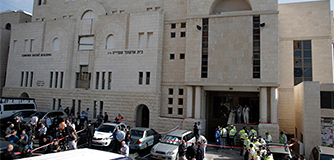
The terrorist attack carried out on November 18, 2014 in a synagogue in the Har Nof neighborhood of Jerusalem, which killed four men during their morning prayers and an Israeli policeman trying to stop the attack, was another step in an emerging trend whereby the Israeli-Palestinian conflict is liable to evolve from a national struggle into a religious war.

In recent months, the main Palestinian area of concern has been the struggle over Jerusalem, inflamed by Fatah through the inciting label of “the war for Jerusalem” and by Hamas’ rhetoric of “the al-Aqsa intifada.” Debate of the issue is rife with religious extremism, manifested in the social media discourse, which stresses repeatedly that the only alternative for a change in the status quo is religious in nature. The effort to enlist popular Palestinian support for the immediate need to defend al-Haram al-Sharif (the Temple Mount) and the al-Aqsa mosque is heightened by attempts by certain Israeli interest groups and Knesset members to change the status quo on the Temple Mount. The Israeli government’s hesitant response to these attempts is seen by the Palestinian public as yet another manifestation of Israel’s doctrine of “establishing facts on the ground.” According to Palestinians propaganda, the next Israeli objective is the takeover and destruction of the al-Aqsa mosque. In the eyes of the younger Palestinian public, because the rest of the Muslim Arab world is preoccupied by infighting in many arenas, there is no one to protect al-Haram al-Sharif other than the Arabs of East Jerusalem, who enjoy the significant advantage of freedom of movement within Israel.

The religious aspects of regional conflicts and the phenomenon of Islamic wars of jihad, which are part of the backdrop to the current tension, have permeated the Israeli-Palestinian conflict. This trend is evident in the use of images of the Islamic State organization (ISIS) and adulation of the organization’s limitless zeal for carrying out barbaric terrorism, including the beheadings it has publicly glorified. By and large, the Palestinians – with the exception of the radical fringe – do not currently uphold the radical religious ideologies of ISIS, but they have embraced the tool used by ISIS to maximize exposure of terrifying images in order to enlist supporters and activists. The two largest social media campaigns in the current Palestinian arena are “Ada’es” (from the word “to run over,” which also sounds like “Da’esh,” the Arabic acronym for ISIS) and “Aten” (from the word “to claim,” which means “stabbing”; the symbol for this campaign is a picture of Palestinian youths wielding axes in order to decapitate). The campaigns, through minimal effort and without a necessary critical mass of volunteers, aim to produce a psychological effect of terror and undermine the Israeli public’s sense of safety. The terrorists who carried out the synagogue attack did not murder in the name of the Islamic State or for its sake, but there can be no doubt that the pictures and videos in the social media fueled their fanaticism and motivated them to act in similar fashion. The addition and emphasis of inter-religious strife to the roots of the Israeli-Palestinian conflict, joining the songs of praise in the Gaza Strip and West Bank for the “shahids” who perpetrated the horror, only add fuel to the fire.

In the social media, young Palestinians call the terrorist acts in Jerusalem “fedayeen” operations by “the defenders of Jerusalem.” This group is keeping its distance from the veteran, institutionalized political movements – Hamas, Fatah, and Islamic Jihad – that bear the stigma of failure as a result of their lack of significant achievements over several decades. Unlike the young people, the political movements are trying to ride the current wave of terrorism, attribute their own influence to it, and use the image of “jihad on behalf of Jerusalem” as well as descriptions such as “the Jerusalem intifada” and “the Jerusalem uprising.”

Although one could point an accusing finger at the Palestinian Authority and President Mahmoud Abbas for inciting the atmosphere by calling on people to defend Jerusalem, in practice there is no evidence for organized activity. There is no responsible party in charge dispatching the terrorists; recent acts have been the result of personal initiative. Moreover, the terrorists who carried out the synagogue attack embarked on their mission from areas under Israeli security control, not from the PA. In the social media in the Gaza Strip and West Bank, President Abbas is presented as a collaborator with Israel, and often called “traitor” and “the Zionists’ dog.” According to the more vocal members of this discourse, Abbas’ influence in East Jerusalem is nonexistent, and there are even social media campaigns calling for his assassination. The fact is that Abba is not interested in the outbreak of a violent, terrorism-infused intifada, because he believes it would not serve the Palestinian cause. To date, Abbas has believed that controlled escalation in Jerusalem supports the strategy pursued by the PA in recent years, a diplomatic strategy that turns to the international community for recognition of a Palestinian state within the 1967 borders as part of a binding UN Security Council resolution that stipulates two years for implementation. Stressing Israel’s failure to provide freedom of access and worship at the holy sites in Jerusalem is designed to promote the strategy. However, it seems that Abbas has begun to understand that he and the PA are losing control of the situation and the escalation. Under pressure from US Secretary of State John Kerry, Abbas condemned the attack, but his influence on the Palestinian public is in any case limited and seems to be shrinking.

The Israeli government’s attempt to place responsibility for the current escalation in Jerusalem on Abbas stems from the fact that Israel knows how to operate against a specific, defined address. Absent such an address, there is no one to blame for the sequence of attacks and disturbances other than the usual suspect. Furthermore, the continuity of events is interpreted as Abbas’ hesitation in stopping them; hence the notion that damaging Abbas’ image and status, by accusing him of fomenting terrorism, will undermine the Palestinian political option of appeal to the UN for recognition of a Palestinian state.

Following the synagogue attack, the world expressed momentary empathy with Israel, but one mustn’t err in reading the international community’s take on the situation. The basic attitude reflects the assessment that the escalation is the result of the deadlocked political process, which nurtures hopelessness among the Palestinian public. Israel is viewed as the main culprit for this state of affairs.

In light of recent events, the Israeli government must make an updated strategic assessment to formulate new methods of coping with the worsening challenge. We are witnessing the collapse of the strategic approach that saw Israel as a “villa in the jungle” and maintained that it was possible to isolate Israel from the events occurring in the region and view them from a standoff position without the wave of regional events spilling across its borders. But the policy of response without being proactive on the political front is no longer effective. Therefore, what Israel needs is a formative policy that will use the current period of time to change the paradigm of the Israeli-Palestinian conflict. This change should focus on promoting transitional arrangements in conjunction with the Arab world under the umbrella of Arab Peace Initiative, and the formulation of regional guarantees for implementing political agreements with the Palestinians.

Israel must prevent the continuing slide of the conflict from the national to the religious level, particularly given the lack of effective tools for managing a religious problem. The soil nurturing the seeds of religious hatred is an outgrowth of many years of neglect of the Arab population of East Jerusalem, both on the individual level and on the scale of public infrastructures. Remedying the cumulative failures of almost 50 years is impossible in the near term. Much time and a massive infusion of resources are needed to create any real change that will affect popular opinion, change the atmosphere in the city, and make a viable contribution to the restoration of calm. In the immediate term, the government must act along several concurrent tracks:

Easing religious hostility: It is necessary to invest colossal efforts to prevent a response by Jewish radicals to attacks carried out by Palestinians and to demonstrate actively that the Israeli government has no intent to change the status quo on the Temple Mount.

Gathering intelligence: Concerted effort must be made to identify the inciters motivating members of the younger generation from East Jerusalem to carry out terrorist acts under the cloak of religious symbolism.

Neutralizing falsehoods: Via the social media and the media in general, it is necessary to expose the lies designed to incite and escalate events. As part of this effort it is important to prevent the dissemination of photographs that should not be published and that only encourage more violence on both sides.

Focusing on Jabel Mukaber: This neighborhood has been home to most of the perpetrators of mass-casualty attacks in recent years. Movement out of the neighborhood should be monitored, along with a concerted effort on the part of the General Security Service to neutralize religious radicalism nurtured by incitement, preaching, and the enlistment of young people to terrorist activity.

Dialogue with the Arab civil society in East Jerusalem: An effort must be made to establish an open dialogue with the city’s Arab residents and integrate them in measures to resolve municipal problems and manage municipal affairs.

Adopting a responsible conciliatory policy: On the cusp of dangerous escalation in Jerusalem and the high probability that the fire will spread beyond the city boundaries, the Israeli government must adopt a conciliatory tone in its internal discourse. Given the radical elements, bolstered by statements and actions providing inspiration for extremist acts on both sides of the divide, decision makers must display responsibility and restraint, promote solutions to issues that can be addressed in the immediate future, and avoid steps that could potentially fan the flames.

Attention to the Israeli-Arab sector: Discourse on the social media reveals close ties between the younger activists in East Jerusalem and Israeli Arabs. In order to prevent negative developments among Israel’s Arab population, a plan must be devised how to handle social gaps, reduce discrimination, conduct an open dialogue, and soften the negative feelings stemming from the events in Jerusalem.
The opinions expressed in INSS publications are the authors’ alone.
Publication Series INSS Insight
TopicsIsraeli-Palestinian RelationsTerrorism and Low Intensity Conflict
עברית

Events

All events
Iran, US, Israel, and the Global Jewish Community
10 March, 2026
12:00 - 13:00
Shutterstock

Related Publications

All publications
REUTERS
Alternatives for the Gaza Strip Following the Campaign Against Iran
As the campaign against Iran winds down, attention is expected to return to the Gaza Strip. In the meantime, Hamas is exploiting the strategic vacuum to rehabilitate its governance and military capabilities. Simultaneously, the Trump framework remains stalled, and the “Board of Peace” faces professional, operational, and budgetary difficulties in advancing its declared objectives. The issue of demilitarization remains trapped between Israel’s demand for the complete and immediate disarmament of Hamas and the organization’s stalling tactics. Israel faces three main alternatives: (1) Renewal of efforts to fully implement the Trump framework across the Strip, a course that carries the risk of “mock demilitarization” and depends on Hamas’s consent; (2) Gradual stabilization and reconstruction of areas cleared of Hamas while continuing to erode its control in areas still under its rule. This option is vulnerable to violent disruption and could entrench the Strip’s division; (3) A return to war and the reoccupation of the Gaza Strip, which would entail extremely heavy military, economic, and diplomatic costs for Israel. The key recommendation is to avoid perpetuating the status quo, which establishes Hamas’s rule, and instead adopt a proactive approach. Israel should allow the implementation of the Mladenov framework for gradual demilitarization, beginning with heavy weapons, while coordinating with the Trump administration regarding scenarios that would justify use of force. If Hamas obstructs the process, Israel should implement a differential alternative: the entry of a civilian committee and Palestinian police into “green zones” cleared of Hamas (alongside increasing Israeli security responsibility modeled on Judea and Samaria). Simultaneously, Hamas’s capabilities and governance in the “red zone” should be systematically degraded, including the gradual erosion of its territorial control. The alternative of returning to war and military occupation should remain a last-resort alternative, contingent on the formulation of an exit strategy and a designated body to assume civilian responsibility.
10/06/26
Anadolu via Reuters Connect
Israel's Post-Iran War Challenge: The Return of the Palestinian Issue to the International Agenda
When the focus shifts away from the war with Iran, the Palestinian issue is likely to return to the center of the agenda—and Israel must prepare accordingly
25/05/26
Majdi Fathi via Reuters Connect
Local Elections in the Palestinian Authority: Between Procedural Democracy and Clan Politics
What lessons can be drawn from the local elections held in Judea and Samaria and Gaza, looking toward future general elections?
18/05/26

Stay up to date

Registration was successful! Thanks.
  • Research

    • Topics
      • Israel and the Global Powers
      • Israel-United States Relations
      • Glazer Israel-China Policy Center
      • Russia
      • Europe
      • Antisemitism and Delegitimization
      • Iran and the Shi'ite Axis
      • The Campaign Against Iran and the Shiite Axis
      • Iran
      • Lebanon and Hezbollah
      • Syria
      • Yemen and the Houthi Movement
      • Iraq and the Iraqi Shiite Militias
      • Conflict to Agreements
      • Israeli-Palestinian Relations
      • Hamas and the Gaza Strip
      • Peace Agreements and Normalization in the Middle East
      • Saudi Arabia and the Gulf States
      • Turkey
      • Egypt
      • Jordan
      • Israel’s National Security Policy
      • Military and Strategic Affairs
      • Societal Resilience and the Israeli Society
      • Jewish-Arab Relations in Israel
      • Climate, Infrastructure and Energy
      • Terrorism and Low Intensity Conflict
      • Cross-Arena Research
      • Data Analytics Center
      • Law and National Security
      • Advanced Technologies and National Security
      • Foreign Information Manipulation and Interference
      • Economics and National Security
    • Projects
      • Preventing the Slide into a One-State Reality
      • India-Middle East-Europe Economic Corridor (IMEC)
  • Publications

    • All Publications
    • INSS Insight
    • Policy Research and Papers
    • Special Publication
    • Strategic Assessment
    • Technology Platform
    • Memoranda
    • Database
    • Posts
    • Books
    • Archive
  • About

    • Vision and Mission
    • History
    • Research Disciplines
    • Chairman of the Board
    • Board of Directors
    • Fellowship and Prizes
    • Internships
    • Annual Reports
    • Support
    • Privacy Policy and Terms of Use
  • Media

    • Communications
    • Video Gallery
    • Press Release
    • Podcast
  • Home

  • Events

  • Database

  • Team

  • Contact

  • Newsletter

  • עברית

INSS logo The Institute for National Security Studies, Strategic, Innovative, Policy-Oriented Research, go to the home page
40 Haim Levanon St. Tel Aviv, 6997556 Israel | Tel 03-640-0400 | Fax 03-744-7590 |
Developed by Daat ,Yael Group.
Accessibility Statement
This site is protected by reCAPTCHA and the Google Privacy Policy and Terms of Service apply.