


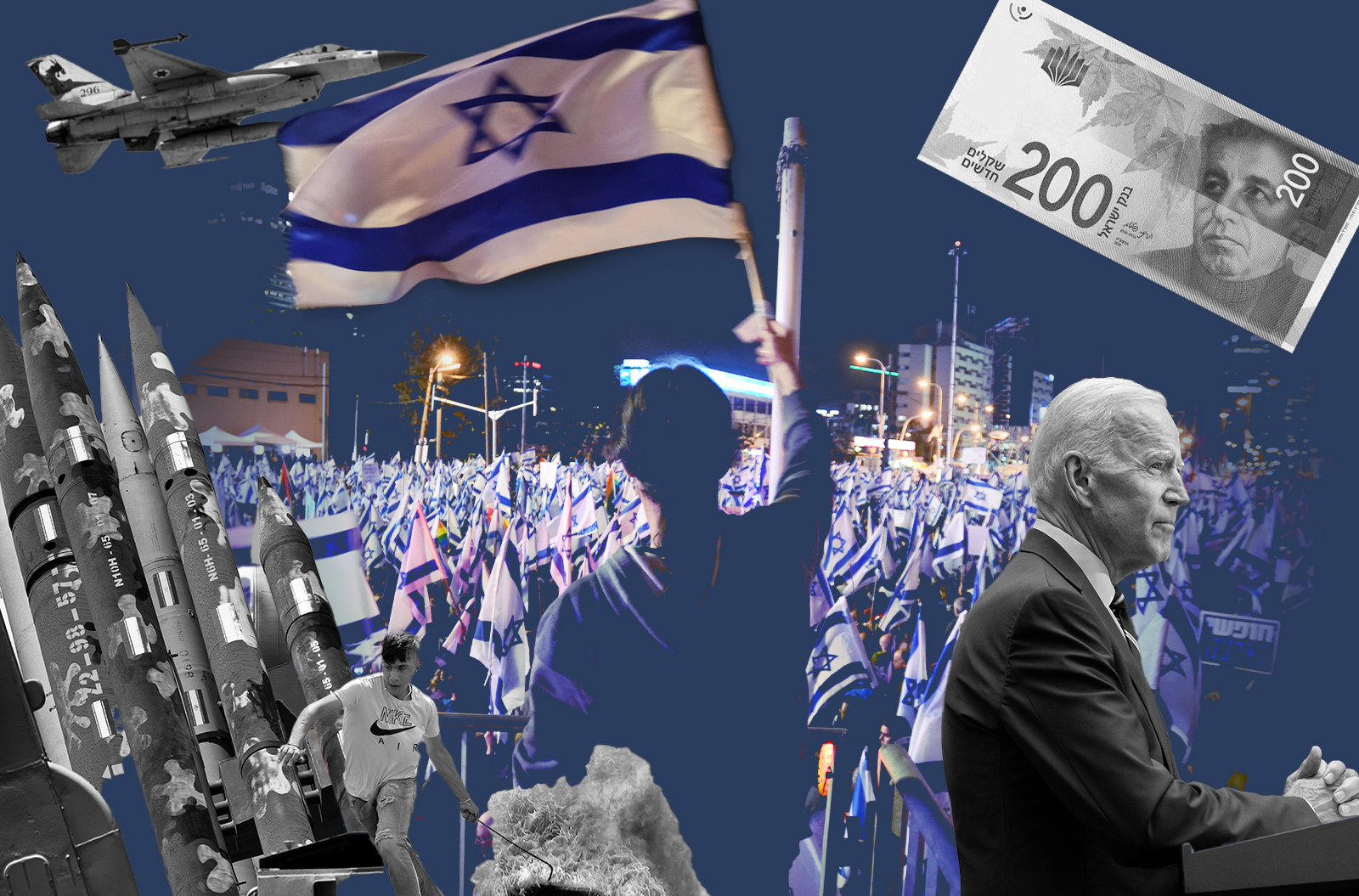
A Strategic Alert in the Wake of the Judicial Reform | INSS
go to header go to content go to footer go to search
INSS logo The Institute for National Security Studies, Strategic, Innovative, Policy-Oriented Research, go to the home page
INSS
Tel Aviv University logo - beyond an external website, opens on a new page
  • Campus
  • Contact
  • עברית
  • Support Us
  • Research
    • Topics
      • Israel and the Global Powers
        • Israel-United States Relations
        • Glazer Israel-China Policy Center
        • Russia
        • Europe
        • Antisemitism and Delegitimization
      • Iran and the Shi'ite Axis
        • The Campaign Against Iran and the Shiite Axis
        • Iran
        • Lebanon and Hezbollah
        • Syria
        • Yemen and the Houthi Movement
        • Iraq and the Iraqi Shiite Militias
      • Conflict to Agreements
        • Israeli-Palestinian Relations
        • Hamas and the Gaza Strip
        • Peace Agreements and Normalization in the Middle East
        • Saudi Arabia and the Gulf States
        • Turkey
        • Egypt
        • Jordan
      • Israel’s National Security Policy
        • Military and Strategic Affairs
        • Societal Resilience and the Israeli Society
        • Jewish-Arab Relations in Israel
        • Climate, Infrastructure and Energy
        • Terrorism and Low Intensity Conflict
      • Cross-Arena Research
        • Data Analytics Center
        • Law and National Security
        • Advanced Technologies and National Security
        • Foreign Information Manipulation and Interference
        • Economics and National Security
    • Projects
      • Preventing the Slide into a One-State Reality
      • India-Middle East-Europe Economic Corridor (IMEC)
  • Publications
    • -
      • All Publications
      • INSS Insight
      • Policy Research and Papers
      • Special Publication
      • Strategic Assessment
      • Technology Platform
      • Memoranda
      • Posts
      • Books
      • Archive
  • Database
    • Surveys
    • Spotlight
    • Maps
    • Dashboards
  • Events
  • Team
  • About
    • Vision and Mission
    • History
    • Research Disciplines
    • Chairman of the Board
    • Board of Directors
    • Fellowship and Prizes
    • Annual Reports
    • Internships
  • Media
    • Communications
    • Video gallery
    • Press Releases
  • Podcast
  • Newsletter
  • Campus
Search in site
  • Research
    • Topics
    • Israel and the Global Powers
    • Israel-United States Relations
    • Glazer Israel-China Policy Center
    • Russia
    • Europe
    • Antisemitism and Delegitimization
    • Iran and the Shi'ite Axis
    • The Campaign Against Iran and the Shiite Axis
    • Iran
    • Lebanon and Hezbollah
    • Syria
    • Yemen and the Houthi Movement
    • Iraq and the Iraqi Shiite Militias
    • Conflict to Agreements
    • Israeli-Palestinian Relations
    • Hamas and the Gaza Strip
    • Peace Agreements and Normalization in the Middle East
    • Saudi Arabia and the Gulf States
    • Turkey
    • Egypt
    • Jordan
    • Israel’s National Security Policy
    • Military and Strategic Affairs
    • Societal Resilience and the Israeli Society
    • Jewish-Arab Relations in Israel
    • Climate, Infrastructure and Energy
    • Terrorism and Low Intensity Conflict
    • Cross-Arena Research
    • Data Analytics Center
    • Law and National Security
    • Advanced Technologies and National Security
    • Foreign Information Manipulation and Interference
    • Economics and National Security
    • Projects
    • Preventing the Slide into a One-State Reality
    • India-Middle East-Europe Economic Corridor (IMEC)
  • Publications
    • All Publications
    • INSS Insight
    • Policy Research and Papers
    • Special Publication
    • Strategic Assessment
    • Technology Platform
    • Memoranda
    • Posts
    • Books
    • Archive
  • Database
    • Surveys
    • Spotlight
    • Maps
    • Dashboards
  • Events
  • Team
  • About
    • Vision and Mission
    • History
    • Research Disciplines
    • Chairman of the Board
    • Board of Directors
    • Fellowship and Prizes
    • Internships
    • Annual Reports
    • Privacy Policy and Terms of Use
  • Media
    • Communications
    • Video gallery
    • Press Releases
  • Podcast
  • Newsletter
  • Campus
  • Contact
  • עברית
  • Support Us
bool(false)

Publications

Home Publications Special Publication A Strategic Alert in the Wake of the Judicial Reform

A Strategic Alert in the Wake of the Judicial Reform

To watch the presentation of the INSS Strategic Alert - click PLAY

Special Publication, March 21, 2023

Follow us on Google
עברית

Click here to read the full research paper on the subject

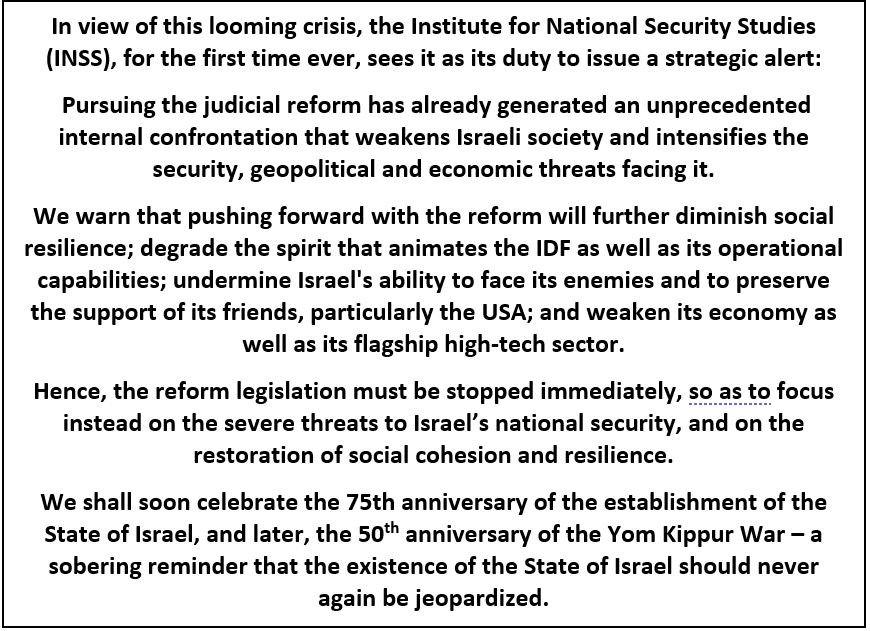
Israel is facing an ominous combination of severe threats to its national security, widening rifts in its relations with the US, and increasing economic risks amid the global economic crisis. At the same time, Israeli society is in the midst of an unprecedented internal conflict stemming from the proposed judicial reform, which magnifies these threats and impairs our ability to tackle them. Without dwelling on the controversial contents of the reform, this much is clear: the proposed reform entails a far-reaching change of the political and judicial regime of Israel, a change that many perceive as a serious threat to democracy. Furthermore, the reform is being pushed forward hastily, without a real opportunity to reach broad agreement. As a result, a widespread public outcry is growing in extent and intensity, inevitably seeping into all aspects of life in Israel, including into the IDF.

Two decades ago, Israel faced a fateful combination of crises on two fronts: the second intifada and the bursting of the dot-com bubble. We were then able to overcome them relying on the strength of social solidarity and the unity of purpose. This time we have to contend with grave challenges on three fronts, i.e., threats to Israel’s national security, international standing, and economic robustness. However, instead of closing ranks as we did then, the proposed judicial reform exacerbates political polarization and societal rifts and weakens social resilience, which is one of the main pillars of national security. Additionally, the reform shifts governmental attention and Israel’s collective energies towards this corrosive internal conflict, at the expense of dealing properly with the external threats.
Click here to read the full research paper on the subject

I. Security Threats

Security threats to Israel have recently intensified along key fronts, even before the introduction of the judicial reform: First, Iran has become a de facto nuclear threshold state, has acquired valuable military expertise from its role in the Ukraine war, and is set to receive advanced weapons systems from Russia. Meanwhile, it is deepening its regional influence and enhancing relations with its Gulf neighbors, brokered by China. Second, we are currently facing a worrying escalation on the Palestinian front, with a wave of terror attacks in the wake of the Palestinian Authority's weakness and the growth of extremist groups, while Ramadan approaches and with it the potential for wider unrest, particularly around the Temple Mount. Third, Hezbollah has been exhibiting a more aggressive behavior, indicating that deterrence might be eroding.

In these dire circumstances, we would have expected Israel to focus entirely on confronting these very serious threats, but unfortunately, the internal rift is badly affecting its ability to do so. The most severe impact is on the IDF as the one organization that was always above internal disputes, and on the readiness to serve in it, which relies not only on conscription but also on a deep sense of belonging and of a shared ethos. The impact is particularly severe on those serving in the reserves, especially in elite volunteer units – the air force, the commandos, and the military intelligence. Senior officers are struggling to navigate between the necessity to protect the IDF from the corrosive effects of the dispute, and their familiarity with those protesting the reform, many of them serving in the top units of the army.

There is no doubt that significant damage has already been done, not only in terms of the readiness to volunteer, but also in terms of cohesion and mutual trust within the army teams, and between them and their commanders. Furthermore, faith in the righteousness of Israel’s cause may falter if, in the eyes of many in the IDF ranks, those responsible for fateful decisions like going to war, stop abiding by democratic principles. Furthermore, the internal struggle absorbs the attention of the government and even of the security establishment, undermining their ability to deal with the pressing security issues – Iran, the Palestinians and the northern front. Finally, there is no doubt that Israel’s enemies draw encouragement from our internal rift, and may even be tempted to undertake dangerous actions as a result.

II. Damage to Relations with the USA and to Israel's International Standing

The world is closely following the internal turmoil in the wake of the proposed reform, and the almost universal reaction is of puzzlement and deep concern, ranging from heads of state to street protests. In particular, the special relationship with the United States, based not only on interests but also on shared values, shows signs of growing strain in the wake of the reform.

These are alarming developments, for in view of the most pressing security threat confronting Israel, namely, Iran, we need the strong support of the United States more than ever. Furthermore, the drive to expand the Abraham Accords to additional countries as a central goal of Israel's foreign policy depends to a significant extent on the goodwill of the United States. Therefore, the deterioration in these relations endangers one of the cornerstones of Israel's national security, and calls into question the rationale of thus pursuing the judicial reform. Israel's standing in other Western democracies is also affected, and even autocratic states wonder over the lack of stability and internal rifts that the crisis exposes. Countries in the region are also taking notice – in particular, the UAE is now more reluctant to deepen its relations with Israel, and other countries are distancing themselves as well.

III. The Economic Crisis

The corona virus, the war in Ukraine, and the escalating conflict between the US and China have shaken the global economy in recent years, causing high inflation, interest rate increases, and the retreat of globalization. The shockwaves are also reaching Israel, fueling inflation, causing layoffs in high-tech and harming growth. The situation is serious enough, and it should have prompted all the responsible parties to deal with it - the Treasury, the Bank of Israel and the Prime Minister - as was the case in the great crisis of 2008. Instead, the proposed reform is poised to inflict yet another blow to the economy, arising serious concerns among economic circles abroad, who warn of the dire consequences that might follow.

The sudden collapse of SVB Bank illustrated the fragility of the global economy, as well as the fateful consequences when trust in institutions is undermined. The high-tech sector in Israel is particularly sensitive to these risks since it is export oriented and relies on the continuous flow of venture capital from abroad. The efforts to enact the reform have increased political instability and economic uncertainty in Israel, thereby harming the confidence of investors and their willingness to invest here. Furthermore, high-tech employees and entrepreneurs have taken an active and conspicuous part in the protests against the reform, and some of them have even announced their intention to take their business activity out of the country. As in the case of the reservists, the issue is not whether these statements are justified, but rather the fact that they reflect deep feelings that may be consequential.

If the reform legislation continues, Israel's credit rating will most likely go down, with dire consequences for the economy. Above all, it will be very difficult to restore the damage to Israel's image as a country associated with economic success, which was built over decades of responsible economic policy, regime stability and an independent and reliable judiciary.

In view of this severe crisis, INSS issues for the first time, out of a deep sense of responsibility and with a heavy heart, this strategic alert.

Click here to read the full research paper on the subject


The opinions expressed in INSS publications are the authors’ alone.
Publication Series Special Publication
TopicsThe Judicial Overhaul: Relations with the United StatesThe Judicial Overhaul: Social SolidarityThe Judicial Overhaul: The Civilian ArenaThe Judicial Overhaul: The Judicial DimensionThe Judicial Overhaul: The Military DimensionThe Judicial Overhaul: The Regional Arena“The judicial revolution”
עברית

Events

All events
Iran, US, Israel, and the Global Jewish Community
10 March, 2026
12:00 - 13:00
Shutterstock

Related Publications

All publications
Generated with AI
Between Lebanon and Iran: The Efforts to Prevent Escalation and Separate the Arenas
The test of the Lebanese arena from the perspectives of the United States, Iran, Lebanon, Hezbollah, and Israel
11/06/26
Stringer/dpa via Reuters connect
The Price of the War in Lebanon: Cracks in Shiite Support for Hezbollah
How is Hezbollah's standing among the Shiite community being eroded, and what opportunities does this create?
10/06/26
REUTERS
Alternatives for the Gaza Strip Following the Campaign Against Iran
As the campaign against Iran winds down, attention is expected to return to the Gaza Strip. In the meantime, Hamas is exploiting the strategic vacuum to rehabilitate its governance and military capabilities. Simultaneously, the Trump framework remains stalled, and the “Board of Peace” faces professional, operational, and budgetary difficulties in advancing its declared objectives. The issue of demilitarization remains trapped between Israel’s demand for the complete and immediate disarmament of Hamas and the organization’s stalling tactics. Israel faces three main alternatives: (1) Renewal of efforts to fully implement the Trump framework across the Strip, a course that carries the risk of “mock demilitarization” and depends on Hamas’s consent; (2) Gradual stabilization and reconstruction of areas cleared of Hamas while continuing to erode its control in areas still under its rule. This option is vulnerable to violent disruption and could entrench the Strip’s division; (3) A return to war and the reoccupation of the Gaza Strip, which would entail extremely heavy military, economic, and diplomatic costs for Israel. The key recommendation is to avoid perpetuating the status quo, which establishes Hamas’s rule, and instead adopt a proactive approach. Israel should allow the implementation of the Mladenov framework for gradual demilitarization, beginning with heavy weapons, while coordinating with the Trump administration regarding scenarios that would justify use of force. If Hamas obstructs the process, Israel should implement a differential alternative: the entry of a civilian committee and Palestinian police into “green zones” cleared of Hamas (alongside increasing Israeli security responsibility modeled on Judea and Samaria). Simultaneously, Hamas’s capabilities and governance in the “red zone” should be systematically degraded, including the gradual erosion of its territorial control. The alternative of returning to war and military occupation should remain a last-resort alternative, contingent on the formulation of an exit strategy and a designated body to assume civilian responsibility.
10/06/26

Stay up to date

Registration was successful! Thanks.
  • Research

    • Topics
      • Israel and the Global Powers
      • Israel-United States Relations
      • Glazer Israel-China Policy Center
      • Russia
      • Europe
      • Antisemitism and Delegitimization
      • Iran and the Shi'ite Axis
      • The Campaign Against Iran and the Shiite Axis
      • Iran
      • Lebanon and Hezbollah
      • Syria
      • Yemen and the Houthi Movement
      • Iraq and the Iraqi Shiite Militias
      • Conflict to Agreements
      • Israeli-Palestinian Relations
      • Hamas and the Gaza Strip
      • Peace Agreements and Normalization in the Middle East
      • Saudi Arabia and the Gulf States
      • Turkey
      • Egypt
      • Jordan
      • Israel’s National Security Policy
      • Military and Strategic Affairs
      • Societal Resilience and the Israeli Society
      • Jewish-Arab Relations in Israel
      • Climate, Infrastructure and Energy
      • Terrorism and Low Intensity Conflict
      • Cross-Arena Research
      • Data Analytics Center
      • Law and National Security
      • Advanced Technologies and National Security
      • Foreign Information Manipulation and Interference
      • Economics and National Security
    • Projects
      • Preventing the Slide into a One-State Reality
      • India-Middle East-Europe Economic Corridor (IMEC)
  • Publications

    • All Publications
    • INSS Insight
    • Policy Research and Papers
    • Special Publication
    • Strategic Assessment
    • Technology Platform
    • Memoranda
    • Database
    • Posts
    • Books
    • Archive
  • About

    • Vision and Mission
    • History
    • Research Disciplines
    • Chairman of the Board
    • Board of Directors
    • Fellowship and Prizes
    • Internships
    • Annual Reports
    • Support
    • Privacy Policy and Terms of Use
  • Media

    • Communications
    • Video Gallery
    • Press Release
    • Podcast
  • Home

  • Events

  • Database

  • Team

  • Contact

  • Newsletter

  • עברית

INSS logo The Institute for National Security Studies, Strategic, Innovative, Policy-Oriented Research, go to the home page
40 Haim Levanon St. Tel Aviv, 6997556 Israel | Tel 03-640-0400 | Fax 03-744-7590 |
Developed by Daat ,Yael Group.
Accessibility Statement
This site is protected by reCAPTCHA and the Google Privacy Policy and Terms of Service apply.