


Publications
INSS Insight No. 985, October 26, 2017
Follow us on Google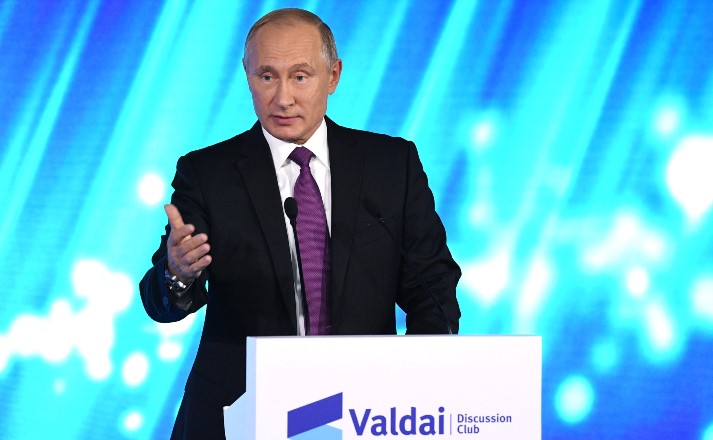
In his recent speech by at the Valdai Discussion Club, Russian President Vladimir Putin expressed both frustration with Russia’s international situation and the drive to improve its status. Russia proposes to work for a new world order, in which it will be recognized as an important power and will gain a central role in the process of shaping the future order. Putin stressed that Russia already has means, including military means, to pose a significant challenge to the West. And while it is clear that Russia is still far from the optimism presented by Putin in is address, its ability to rebuild itself as a world power while challenging the international system should not be underestimated. Russia must deal with economic gaps, internal disputes, and geopolitical challenges in its areas of interest in the post-Soviet region, but it is determined to continue striving to achieve its objectives.
On October 16-19, 2017, the Valdai Discussion Cub hosted its main annual conference in Sochi, Russia, bringing together experts on Russia from all over the world. These conferences also serve as a platform for Russian politicians to deliver messages to the international system. As in previous years, President Vladimir Putin appeared at the event - along with several senior members of his government - and used the opportunity to present his political doctrine.
As Putin sees it, the greatest future value lies in technology, rather than land or assets. This requires suitable preparation, which is also necessary in view of the increasing competition and growing tensions between countries, peoples, and systems. In addition, special preparation is required given the balance in the international system that has been upset and the unrestrained struggles to promote interests. These have led to a deterioration of order and increased terror in the global space and undermined international security.
Putin claimed that the United States and Europe show signs of a harsh anti-Russia trend. Notwithstanding Russia's efforts to draw closer to the West after the breakup of the Soviet Union, the West exhibited hostility and worked to promote its own interests with no consideration of Russia. This approach is the basis of the current conflict between Russia and the West. In this context, the United States was criticized widely for its negative, and according to Putin, unfair attitude, reflected in its attempts to undermine Russia and take advantage of Moscow’s past openness in matters of arms control. Putin said that this is the background to the gradual reduction in cooperation between Russia and the United States, and its complete halt in recent years. In his eyes, the internal criticism in the United States regarding the election of Donald Trump to the presidency is simply an expression of this anti-Russian trend, which is designed to undermine any rapprochement between the countries. Trump himself was presented in a fairly positive light in Putin's speech, as someone with strong personal skills and good intentions regarding cooperation with Russia. For its part, Putin said, Russia welcomes the attempt to improve its relations with the United States, described as the strongest and most important country in the world.
In contrast, Europe and NATO were accused of a whole range of negative actions with respect to Russian interests and various international areas of crisis. Putin described the Ukrainian crisis as the result of subversive European activity, carried out with American backing. The crisis in Spain over the Catalonia issue was also presented as a result of European encouragement of various separationist trends. Putin stressed that creating single-nation states is not a solution but a problem, and that Russia itself is worried about separationist tendencies, partly for fear that Muslim populations in its territory or in its areas of influence – the former Soviet Union – will adopt them. The original sin, according to Putin, is the case of Kosovo. He included incidents of harsh and ineffective intervention in various places in the Middle East in this category. In addition, Putin blamed pressure and threats by the West for the complications around the issue of North Korea.
However, Putin argued that notwithstanding economic and political pressure, Russia is gradually gaining a leading position in the international arena; its status is growing stronger and its relations with many important countries, including China and India, are good. He also stressed Russia's good relations with all countries in the Middle East, including Saudi Arabia, Egypt and Qatar, and its interest in cooperation in the region as a substitute for the West. As for the talks and the attempt to resolve the crisis in Syria, Putin described the situation as difficult, but progressing. His advice to all the local actors in Syria, and to the relevant regional and international actors, is to join forces in order to stabilize the country. At the same time, Putin maintained that even if the struggle against terror in the Middle East is successful, the violence will continue because Western influence has entrenched its roots in certain societies.
Israel received positive mention in Putin's speech. According to a senior minister in the government who was at the conference, Israel, which is friendly with Russia and has a large population of immigrants from Russia and elsewhere in the former Soviet Union, is important globally and is a key country in the Middle East. It is true that Israel has built its status as a military power in the region, a natural process in the challenging reality it faces. However, according to this minister, the risks Israel faces from its neighbors have declined, and there is no justification for exaggerated fears regarding Hezbollah, for example. He also stated that it may be a mistake on the part of Israel to see its enmity with Iran as a challenge, particularly since a change of the Iranian regime may not necessarily benefit Israel; he argued that it cannot be that Israel is not aware of this. The minister also mentioned the existence of a Sunni coalition with Israeli cooperation, adding that a solution of the Palestinian issue is essential, because the lack of a solution reinforces violence in the region. He advised Israel to take Russia's considerations into account, declaring that for his part he supported Russia’s taking Israel's considerations into account.
Putin himself talked at length about the military aspect of international relations, both current and future. While accusing the United States of the breakdown of the arms control and disarmament process that began soon after the breakup of the Soviet Union, he claims that it is possible and desirable to return to disarmament efforts, including relating to nuclear weapons. True, Putin accused the United States of developing advanced weaponry that he described as no less powerful that nuclear weapons (he was possibly referring to the global missile deployment referred to as Prompt Global Strike, or PGS), and which in his opinion might be used against North Korea, but he pointed out that Russia's capabilities in this area are currently no less than those of the West. As evidence, he stated that its achievements in the war against terror in Syria surpass those of the West: Russia has innovative missile arrays equal to those of the United States, and their capabilities were demonstrated in the war in Syria (Putin was apparently referring to the cruise missiles that were launched from distant platforms at sea).
In Putin's view, standard tools for handling crises are becoming outdated, while new ones are not yet available, and all this, he claimed, is due to Western conduct that promotes political tendencies and ideologies that are not acceptable or liked in various parts of the world. He said that the best solution for all the challenges is to shape a world order based on a change of attitude, built on a look to the future and a bridge of current disputes between Russia and the West. The West should stop its threats and the use of what Putin calls excessive force. In his view, the best way is through dialogue and taking account of the parties' sensitivities, with the broadest possible international cooperation and unity between the various independent positive forces in the international system. In this context, Putin contended, there is no good alternative to the United Nations.
Assessment
Expectations of a sensational speech from Putin were not met. The Russian President did not present any new or revolutionary claims, but focused on familiar allegations – mainly complaints against the West over its attitude to Russia and its creation of crises that undermine the international system. There were also messages that Russia has effective solutions to improve the situation.
Beyond the declarative level, it appears that Russia is interested in stopping the deterioration of its relations with the West. Indeed, while accusing the United States of anti-Russian activity, it appears that Putin is optimistic about the possibilities for cooperation with the Trump administration. However, although Putin presented the internal situation in Russia as positive, it has in fact been adversely affected by the various international conflicts and particularly the Ukrainian crisis, which prompted the West to impose sanctions on Russia. In this context, Russia's anger is directed primarily toward Europe, which was accused of initiating the crisis and working to undermine any rapprochement between the United States and Russia. Putin's references to Middle East matters show that notwithstanding the image of successful intervention in Syria, Russia is in fact still experiencing difficulty in bringing about a dramatic breakthrough to end the crisis there and reaching understandings with other regional actors regarding a settlement. Nonetheless, over the last two years Russia has become an influential element in the Middle East, demonstrating smart political conduct. Significantly, Israel is presented by Russia as a partner and a noteworthy regional actor, indicating that Russia is aware of the need to take Israel's interests into account.
Overall, Putin's speech expressed frustration with Russia's international situation and the drive to improve its status. Russia proposes to work for a new world order, in which it will be recognized as an important power, with a central role in the process of shaping the future order. Putin stressed that if these objectives are not promoted, Russia already has means, including military means, to pose a significant challenge to the West. And although it is clear that Russia is still far from the optimism presented by Putin, its ability to rebuild itself as a world power while challenging the international system should not be underestimated. Russia must deal with economic gaps, internal disputes, and geopolitical challenges in its areas of interest in the post-Soviet region, but it is determined to continue striving to achieve its objectives.