


Publications
INSS Insight No. 1014, January 18, 2018
Follow us on Google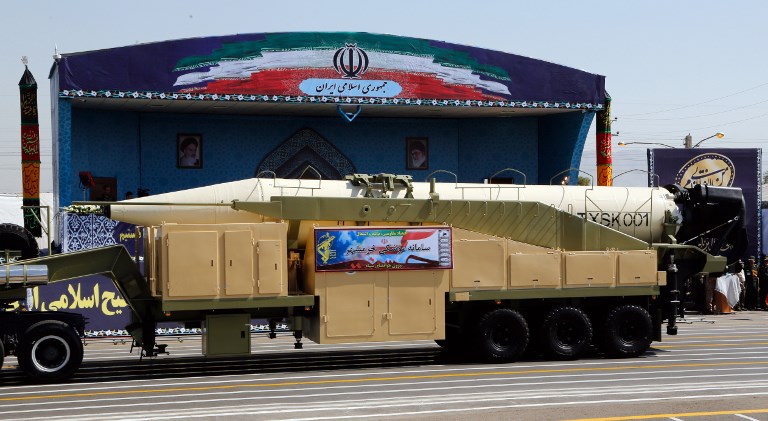
On January 12, 2018 US President Donald Trump, for the third time, waived the sanctions on Iran that were lifted in the framework of the JCPOA. The announcement on the decision stressed that over the coming four months, the administration will work with Congress and the JCPOA’s European signatories to “fix” the problems with the agreement. Trump warned that unless agreements are reached within this period of time, the United States will withdraw from the deal. There are therefore two main possibilities: A US-European agreement to impose new restrictions on the Iranian nuclear program regardless of Iran’s consent, or a US withdrawal from the deal, which is increasingly probable given that Trump’s threats are boxing him in. Israel’s basic assumption must be that a parallel agreement is preferable to withdrawal unless a satisfactory alternative emerges. Of special importance is a preliminary understanding between Israel and the United States and the European nations about what Iranian steps will be seen as crossing a red line necessitating an immediate response. Israel must also make it clear that the definition of long range missiles (Trump’s term) must extend to the mid-range surface-to-surface missiles that endanger Israel that Iran already has in an operational state.
President Trump’s announcement of January 12, 2018 on the nuclear agreement with Iran included a demand of the E3 partner nations – France, the United Kingdom, and Germany – to reach a bilateral parallel agreement of indefinite duration ensuring that Iran will never be able to be close to a nuclear military capability. As such, the European nations would immediately have to impose new sanctions on Iran if it develops and tests long range surface-to-surface missiles, if it obstructs any site inspection, or if it makes progress toward nuclear weapons.
These and other demands were also stressed in the President’s appeal to Congress that the weaknesses of the JCPOA be addressed through changes to existing legislation, whereby the United States would withdraw from the agreement under certain conditions. In this framework:
- Iran is required to allow immediate access to inspectors at all sites.
- Assurances will be given that “Iran never even comes close to possessing a nuclear weapon.”
- The restrictions to prevent Iran from attaining nuclear weapons will have no expiration date.
- Unless Iran complies with the demands, the US sanctions will be automatically imposed.
- For the first time, it will be determined that long range surface-to-surface missiles and nuclear arms are connected, and that if Iran develops such missiles or holds missile testing, severe sanctions will be imposed.
Concurrent with the President’s announcement, the US Department of the Treasury issued a list of 14 new individuals and entities to the designations list (since the inception of the Trump administration, some 100 names have been added). Prominent among these is the head of the Iranian judiciary, Ayatollah Sadeq Larijani (brother of Ali Larijani, the speaker of the parliament). The administration’s background briefing stressed that the addition of this name was a message to Iran’s top leadership that the United States does not intend to ignore the regime’s human rights abuses.
As expected, Iran responded to the announcement by completely rejecting the possibility of reopening the JCPOA, emphasizing that the inclusion of Sadeq Larijani on the list of sanctioned individuals and entities is illegal and constitutes the crossing of a red line. The regime further threatened that it will react and that “Washington will bear the responsibility.”
To date, the EU has made do with issuing a statement saying that the E3 and other EU nations will study Trump’s decision and its implications, and that the EU is committed to full implementation of the JCPOA.
Implications
Trump’s declaration reflects his persistent opposition to the nuclear agreement signed during President Obama’s term in office. The statement serves to box him in even more than his previous declarations on the subject, making it increasingly likely that in the end, the United States will withdraw from the agreement.
The move President Trump is suggesting bypasses Iran as well as Russia and China while trying to force the European signatories to present a united front with the United States. Thus, there are now two main possibilities. The first is a US-European agreement to impose new restrictions on the Iranian nuclear program regardless of Iran’s consent after the restrictions embedded in the JCPOA are lifted. This option would seem to be the more effective one, given the European opposition to opening the agreement. In this scenario, the US administration would have to coordinate a list of possible Iranian violations and joint US-European responses. It may be that such a move, if taken, would also be based on the rationale that if an agreement between the United States and the European nations is reached, it will be possible to leverage it later in applying pressure to Russia and China to join the efforts to persuade Iran that accepting changes in the agreement is preferable to dismantling it.
The second possibility is a US withdrawal from the deal. This is increasingly likely, given Trump’s threats to withdraw before the next four months are up if he feels that there is insufficient progress. Under such circumstances, Iran’s reaction would likely depend on the impact of the expected damage to the achievements made as a result of the sanctions being lifted and the return of European and other businesses and financial institutions to Iran. If a US withdrawal from the agreement is accompanied by the imposition of secondary sanctions forcing foreign companies to choose between investing in Iran and continuing to operate in the United States and they decide to freeze their activities in Iran, Iran would go back to its pre-JCPOA nuclear activity.
Behind the scenes, one may assume that Trump’s announcement once again reflects some kind of intra-administration compromise between the President’s “strong inclination” to withdraw from the agreement and the opposition of senior administration officials to this move. And yet, Trump has forced an ultimatum aimed on senior members of his administration and Congress and the European signatories, and has also limited the time available to reach new understandings, making the process of discussions very difficult, if at all possible. Moreover, the President has (again) acted against the advice of Secretary of Defense Jim Mattis and Secretary of State Rex Tillerson, which has implications for their status and room for maneuvering.
The President’s announcement was also used to highlight the series of actions the United States has taken – steps stopping the flow of money to the Revolutionary Guards and Iran’s allies, such as Hezbollah; supervising arms shipments; preventing cyber activities; and applying pressure to stop the repression of Iranian citizens – for the benefit of US allies in the international arena and the Middle East. The President demanded that they join in these steps to confront Iran’s nefarious activities in the Middle East. The key implication of this statement and of his previous declaration on Iran is that the United States believes that the strategy to contain Iran must be based on joint efforts. This approach will also obligate Israel to expand its discourse with other nations, including European states, because without their active involvement, the overall international ability to impede Iran’s attempts to tighten its hold on the region will be harmed. In such a reality, Israel is liable to be left on its own to try to contain Iran.
Conclusion and Recommendations
At present, it is clear that the administration is determined either to improve the agreement or to cancel it, but it is not clear how close it is to concrete demands expected to be presented to the European nations in the forthcoming discussions. What stands out in particular is the lack of clarity on the way the US administration and the European signatories (Iran will not be a party to a parallel agreement) are likely to shape a response to the demand to thwart Iran’s progress toward nuclear weapons and how they will succeed in finding a response to the President’s demand to link the nuclear issue to the long range surface-to-surface missile issue. If the President does not succeed in articulating a parallel agreement in this spirit, the United States is liable to face a dangerous scenario in which it will not have much legitimacy to act against Iran at the very time that Iran’s path to a nuclear weapon will be free of obstacles.
However, the administration’s policy makes it possible for US allies, including Israel, to influence the formulation of a response to the Iranian threat. The short time assigned until Trump makes good on his promise to withdraw from the JCPOA obligates Israel to hold a close, intense exchange on the topic both with the US administration and France, the United Kingdom, and Germany to try to affect the contents of a desirable parallel agreement. Israel’s stance must be that it is preferable to attain such an agreement in the very near future rather than allow a situation in which Trump makes good on his threat and withdraws from the JCPOA, a move liable to cause the agreement to collapse in the absence of a previously formulated alternative that would also safeguard Israel’s security interests.
If realized, the model of a bilateral agreement, joining the JCPOA, could constitute an important precedent for Israel, which would be able to try to translate its joint working groups with the administration already discussing the Iran issue into another parallel agreement – this one between Israel and the United States. As part of policy coordination on Iran, a prior agreement between Israel and the United States on what Iranian steps would represent the crossing of a red line demanding a response is of particular importance. Beyond the need to define the triggers for coordinated action against Iran, it is critical that Israel clarify the danger inherent in distinguishing between long range missiles (Trump’s term) and the mid-range missiles Iran already has in operational use, because this distinction provides Iran with ostensible legitimacy to develop missiles capable of reaching Israel and develop the technology that would very enable Iran to equip long range missiles with similar capabilities.