


Publications
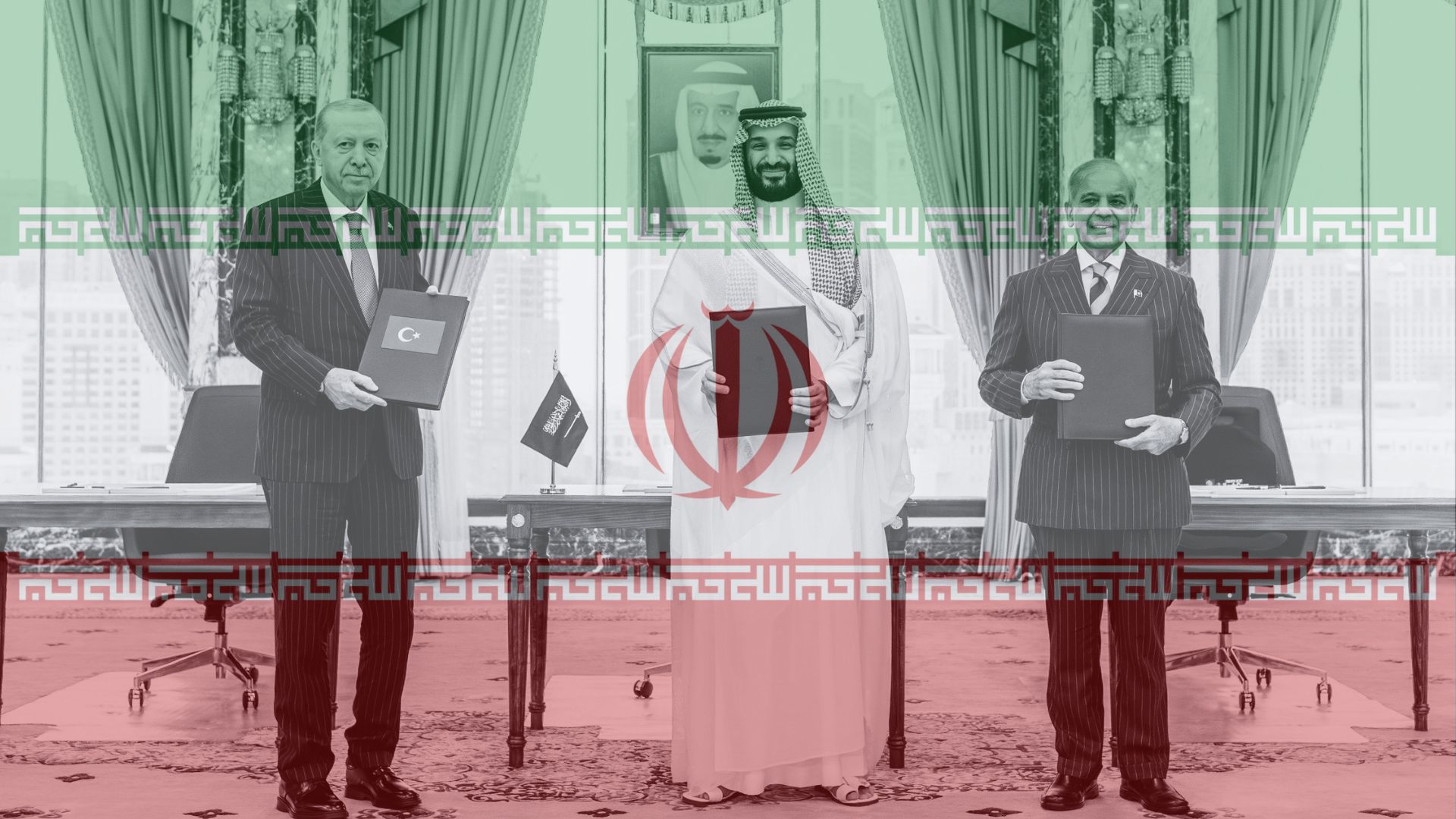
How does Tehran view the defense agreement signed between Saudi Arabia, Turkey, and Pakistan?
INSS Insight No. 2182, August 10, 2026
Follow us on GoogleReactions in Iran to the security agreement between Saudi Arabia, Turkey, and Pakistan reflect a cautious and complex approach regarding its implications. At this stage, most commentators do not view the agreement as a cohesive anti-Iranian military alliance or an “Islamic NATO” capable of shifting the regional balance of power. These commentators emphasize the gaps between Saudi Arabia, Turkey, and Pakistan, as well as the ambiguity surrounding their military commitments. However, others identify the agreement as an expression of a broader shift in the regional security architecture: a transition from near-exclusive reliance on the United States toward more diversified regional security networks. Reactions to the agreement also reflect the political divide in Tehran: hardline circles present the agreement as proof of the failure of American deterrence and Iran’s success in undermining the old regional order. By contrast, more pragmatic circles warn of the strategic costs of continuing Iran’s current policy, which could encourage the formation of a regional security framework that would challenge Iran.
The mutual defense agreement signed on August 7 between Saudi Arabia, Turkey, and Pakistan sparked extensive discussion in Iran, although official reactions have thus far remained limited and cautious. Unlike the initial political reactions, some of which were characterized by dismissiveness regarding the new alliance’s ability to provide security for Saudi Arabia, commentaries published in the Iranian media presented a more complex picture. Most of them refrained from defining the "Mecca Agreement" as an anti-Iranian offensive military alliance or an "Islamic NATO" capable of changing the regional balance of power. However, many viewed it as an expression of a broader process of transformation in the Middle East's security architecture against the backdrop of the ongoing regional campaign, centered on a gradual shift away from near-exclusive reliance on the United States toward more diversified regional security networks.
From Iran's perspective, the significance of this development is not unequivocal. On the one hand, Iranian commentators emphasize the gaps between the three countries, the ambiguity surrounding their military commitments, and the fact that Turkey and Pakistan are not expected to rush into a direct confrontation with Iran. On the other hand, Saudi Arabia's growing security ties with Iran's two large neighbors—particularly NATO-member Turkey and nuclear-armed Pakistan—is perceived as a signal that cannot be ignored. In their view, as long as the confrontation between Iran and the United States continues and the Arab states feel increasingly threatened by Iran and its allies, a regional security network could gradually solidify, posing a more significant challenge to Tehran.
The most senior official response thus far came from Foreign Minister Abbas Araghchi, who refrained from directly criticizing the agreement. In a post on his X account, he called on Muslim countries to rely on themselves and act in a spirit of “genuine brotherhood.” According to Araghchi, when Muslims are united, they are capable of confronting any challenge posed to them by hostile foreign actors.
By contrast, two hardline members of the Majlis National Security and Foreign Policy Committee responded to the agreement with dismissiveness. Ebrahim Rezaei called it an "agreement on paper" and a form of "begging for security," arguing that, just as years of reliance on the United States did not bring Saudi Arabia security, neither would an agreement with Turkey and Pakistan. Mahmoud Nabavian took a similar line, claiming that if American bases had failed to grant Saudi Arabia security, "clinging to the servants of the United States" would not avail it either.
The Iranian media responded to the Mecca Agreement in a series of commentary articles that reflected, to some extent, a debate over whether to view the agreement as evidence of the weakness of Iran's rivals or as an early sign of a new regional organization that could, in the long run, work to Iran's detriment. The conservative Alef website presented the agreement as further evidence of Saudi Arabia’s strategic failure. It argued that Riyadh is seeking to obtain security through the agreement amid concerns over retaliatory action by pro-Iranian militias in Iraq, but questioned whether Turkey and Pakistan could provide what the United States had failed to deliver, particularly given that they themselves face severe economic, security, and governance challenges. The website even mocked the ongoing Saudi dependence on external actors despite a defense budget exceeding $70 billion, whereas Iran—which maintains a much smaller defense budget—managed to stand up against the United States and Israel and even achieve strategic gains, chief among them its control of the Strait of Hormuz.
An even harsher line was taken by Hossein Shariatmadari, editor of the hardline Kayhan newspaper. He linked the agreement to what he described as cooperation by the three countries with Israel and the United States against the "Axis of Resistance," and particularly the Houthis. His main criticism was directed at Pakistan, which he claimed is attempting to fill two contradictory roles simultaneously: mediating between Tehran and Washington, while at the same time participating in a framework designed to serve American and Israeli interests. Shariatmadari doubted the very ability of the three countries to add a military dimension that had not already been tested by the United States and Israel.
The pragmatic Asr-e Iran website presented a different picture. Its analysis described the alliance as a kind of “Islamic NATO” and a first step toward the establishment of a new regional security structure centered on Turkey and Pakistan. The purpose of the agreement was explained primarily as a Saudi need for deterrence against future attacks from Iran in light of its experience during the war. According to this interpretation, Riyadh is not necessarily seeking to create a war front against Iran, but rather to leverage Ankara and Islamabad's relatively good relations with Tehran to deter it and reduce the risk of another confrontation.
The Khabar Online website likewise presented the agreement as part of a structural shift in the regional security architecture in the wake of the war. According to the website, the alliance combines three complementary components: Saudi Arabia, which brings economic power and energy resources; Pakistan, the only Muslim country possessing nuclear weapons; and Turkey, which has NATO’s second-largest military and an advanced defense industry. This combination creates a regional umbrella of deterrence centered around "Saudi money, the Pakistani nuclear bomb, and Turkish drones."
The article rejects the label "Islamic NATO," arguing that it is misleading because the alliance is not based on religious identity, and senior Saudi officials stressed that it is not directed against any particular state. Instead, the article suggests viewing the alliance as a "NATO satellite"—that is, an ostensibly independent regional alliance that, in practice, operates in coordination with NATO through military standards, intelligence sharing, and joint exercises. Nevertheless, the website emphasized that the alliance suffers from weaknesses, including ambiguity regarding military commitments and differing interests among its three members.
The potential for a troubling future development from Iran's perspective was particularly evident in the commentary published in the reformist daily Shargh. The newspaper described the agreement as one of the most important recent security developments in the Islamic world. It warned that Tehran cannot ignore the gradual shift in patterns of security cooperation around it, even if it is unclear at this stage whether the alliance will remain at the level of a political declaration or develop into an actual military mechanism. According to the daily, the central message for Iranian policy is that the security environment is changing and requires monitoring, active diplomacy, and careful management of tensions with neighboring states.
International relations expert Mohsen Jalilvand, interviewed by the daily, argued that the agreement should not be viewed merely as cooperation among three countries, but rather as part of a broader American strategy to establish regional coalitions against Iran. In his view, as long as the confrontation between Tehran and Washington drags on, regional and international alliances against Iran will also expand. Former diplomat Sadegh Maleki similarly warned of this scenario. According to Maleki, the only path to achieving stability is a comprehensive agreement that would lead to normalization between Iran and the United States and to the creation of a new security order in which Iran's security is integrated with that of its neighbors.
International affairs analyst Dr. Kamran Karami also cautioned against dismissing the agreement in an article published in the economic daily Donya-ye Eqtesad. In his opinion, the real question for Iran is not whether its name appears in the agreement, but whether, in the coming years, a regional security network will emerge in which Saudi Arabia, Turkey, Pakistan, and perhaps also Egypt, Qatar, and additional countries combine their military, intelligence, and industrial capabilities. If such a process does materialize, Iran's strategic environment will become more complex.
Karami emphasized that the United States remains the most important external military actor in the Gulf and that, for the foreseeable future, no Arab state can dispense with American intelligence, logistics, and military capabilities. Nevertheless, the events of recent years have reinforced the sense among Arab states that absolute dependence on an external security provider has itself become a security risk. Hence, the "Mecca Agreement" should not be seen as a substitute for the United States, but rather as part of a regional effort to reduce the risk inherent in such dependence. Karami suggested viewing the agreement as an opportunity for Iran to participate in shaping an independent regional security order in cooperation with regional powers, and to consider whether Iran will have a role in the Middle East's new security architecture, or remain outside of it.
In conclusion, reactions in Iran to the Mecca Agreement currently reflect a cautious and complex approach regarding its implications, particularly based on the assessment that this is the first stage of a long-term process. Furthermore, the responses serve as another expression of the political divide in Tehran: conservative and hardline circles frame the agreement as evidence of the failure of American deterrence and Saudi Arabia's vulnerability in light of Iran and its proxies successfully undermining the old security architecture. They also view it as further validation of Tehran's traditional claim that "imported security" does not work and that the region's states must rely on themselves rather than on the United States.
Conversely, more pragmatic circles view the agreement as a warning sign of the strategic costs of continuing current policy and as a challenge—albeit over the long term—to Iranian interests. In their view, even if the agreement reflects an erosion in the United States' standing as a security provider, its signing could incentivize regional states to establish independent security frameworks in which Turkey and Pakistan play a more significant role. Consequently, the relative weakening of the American security umbrella could give rise to a regional system that challenges Iran and its regional standing. The agreement therefore requires Tehran to reassess its policy toward de-escalating tensions with its neighbors, and perhaps even with the United States.