


Publications
An examination of the various factions within the Republican Party and their stance toward Israel
INSS Insight No. 2161, June 28, 2026
Follow us on GoogleUntil now, American support for Israel has often been understood through a party lens: Democrats were becoming more critical, while Republicans remained reliably supportive. That framework is no longer sufficient. Older pro-Israel assumptions are weakening not only among Democrats, but also within parts of the Republican coalition. Views of Israel are increasingly shaped by religion, generation, nationalism, and competing ideas about America’s role in the world. Israel therefore needs a more segmented approach to American Christians and conservatives, distinguishing between older and younger evangelicals, Catholics, mainline Protestants, post-liberal conservatives, and America First currents rather than treating them as one pro-Israel bloc.
Beyond the partisan lens
Israeli strategic analysts have often treated American support for Israel as a matter of party politics: Democrats were seen as critical; Republicans as supportive. This framework captures an important part of the picture, but it misses another force shaping American political identity: political theology. Religious ideas about covenant, chosenness, redemption, justice, nationalism, sovereignty, and America’s role in the world continue to influence how many Americans understand Israel. This is especially true within Christian communities, but those communities cannot be treated as a single bloc.
White Evangelicals, Catholics, mainline Protestants, Black Protestants, and newer nationalist or post-liberal conservatives often approach Israel through very different religious and political frameworks. This matters because support for Israel has never rested on one foundation alone. For some American Christians, Israel is understood through biblical covenant and the return of the Jewish people to their ancestral homeland. For others, Israel is admired as a democratic ally, a strategic partner, or a Western outpost in a hostile region. For still others, especially in younger religious and progressive circles, Israel is increasingly interpreted through a social justice prism.
Christian theological and moral language can therefore produce different political conclusions. One Christian may see Jewish sovereignty as the fulfillment of biblical promise or historical justice. Another may read the Palestinian cause through Christian obligations to the oppressed, identifying Palestinians with the poor, the suffering, or the dispossessed. A third may evaluate Israeli military action through Christian just-war reasoning, asking whether a particular war meets standards of just cause, proportionality, necessity, and protection of civilians. Still another may be uneasy with evangelical support for Israel when that support is tied to apocalyptic or end-times expectations, including ideas about Jewish conversion at the end of history.
A fragmented party
Recent polling suggests that the internal foundations of Republican support for Israel are becoming more fragile. Pew Research Center found in March 2026 that Republicans overall still view Israel more favorably than unfavorably, 58 percent to 41 percent. Among Republicans aged 18–49, however, 57 percent now hold an unfavorable view of Israel, up from 50 percent the previous year. Large majorities of Republicans over 50 continue to view Israel favorably, but the generational split is now unmistakable.
Gallup data point in a similar direction. In 2026, 70 percent of Republicans still sympathized more with Israelis than with Palestinians, compared with 13 percent who sympathized more with Palestinians. Yet Republican sympathy for Israelis had declined by ten points since 2024, reaching its lowest level since 2004. At the national level, Gallup found that American sympathies had shifted in a historically significant way: 41 percent of Americans sympathized more with Palestinians, while 36 percent sympathized more with Israelis.
Israel can no longer assume that support from the American right is automatic, uniform, or rooted in the same religious and ideological assumptions that once shaped it.
Evangelicals: still supportive, but not monolithic
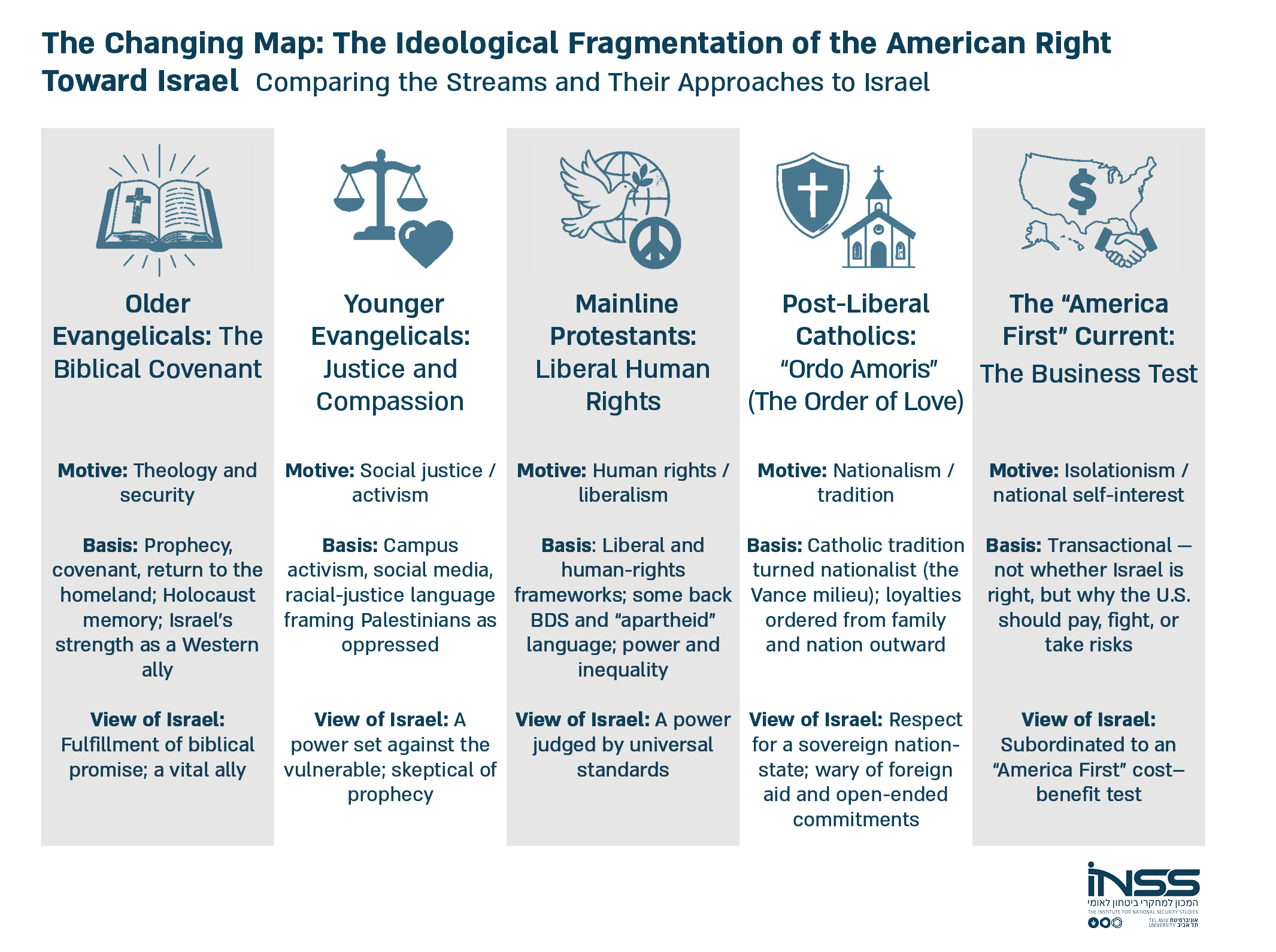
White evangelicals remain one of the most pro-Israel constituencies in the United States. Pew found in 2026 that 65 percent of white evangelical Protestants held a favorable view of Israel, making them one of Israel’s strongest religious constituencies. Yet even this support requires more careful analysis: younger evangelicals appear far less attached to the older pro-Israel consensus than their parents and grandparents.
For decades, evangelical support for Israel was often associated with biblical prophecy, covenantal theology, and the belief that the return of the Jewish people to the land of Israel carried religious significance. But this was not the whole story. Evangelical support also overlapped with Cold War anti-communism, post-9/11 attitudes toward radical Islam, Republican foreign-policy hawkishness, admiration for Israel’s military strength, and a broader identification with the United States as a nation with a providential role in world history.
In Israel itself, this support has often generated ambivalence: many policymakers welcome evangelical friendship, advocacy, and political mobilization, while others worry about the apocalyptic or missionary assumptions that sometimes accompany it, especially end-times expectations about Jewish conversion.
Today, the foundations of evangelical support for Israel are changing. Some younger evangelicals are less attached to older prophetic frameworks that treated the modern State of Israel as central to biblical prophecy and the Second Coming, or the return of Jesus. This shift is visible in polling on younger evangelicals, where support for Israel has declined sharply compared with older evangelical cohorts. Many younger Christians also encounter Israel less through sermons about covenant and prophecy than through campus activism, social media, humanitarian campaigns, and racial-justice language that presents Palestinians as an oppressed or colonized people. This reflects a broader generational change in which younger and more diverse evangelicals have shown greater openness to Palestinian narratives. Others are influenced by a growing skepticism of American power and foreign intervention, especially in parts of the “America First” right, where the question is not necessarily whether Israel is morally justified but why the United States should commit resources, weapons, or diplomatic capital abroad. In this environment, some younger Christians may remain culturally conservative on domestic issues while feeling far less emotionally or theologically attached to Israel than their parents’ generation.
This does not mean that young evangelicals are uniformly anti-Israel. But it does mean that Israel cannot assume that the older evangelical relationship will reproduce itself automatically.
That is a serious challenge. Facts about Hamas, security threats, or regional strategy remain necessary, but they are not sufficient. Increasingly, the pro-Palestinian narrative tells a story about innocence and power, suffering and oppression, empire and resistance.
Mainline Protestants and Catholics
The term “Christian support for Israel” is too broad to be analytically useful. Several mainline Protestant denominations — including the Presbyterian Church (USA), the United Church of Christ, the ELCA, the Episcopal Church, and parts of the United Methodist Church — have often approached Israel-Palestine through liberal foreign-policy and human-rights frameworks. In some cases, denominational bodies and affiliated advocacy networks have supported boycott or divestment measures, used language of Israeli apartheid, or framed the conflict through what they regard as contested questions of justice, power, and Palestinian rights. Quaker and Mennonite peace organizations have also shaped Christian advocacy around Israel-Palestine through the language of nonviolence, ceasefire, and human rights. Their critique of Israel is usually not based on older theological hostility toward Jews in explicit form, but on universalist moral language that places Israel within debates over power, vulnerability, nationalism, and structural inequality.
Catholic attitudes are more complex, and recent events show why. Catholic opinion is not usually formed by evangelical ideas of covenant and prophecy, but by Catholic social teaching, Vatican diplomacy, concern for local Christians in the Middle East, and moral traditions such as just-war reasoning. This has been visible during the Gaza war, as Pope Francis repeatedly criticized the humanitarian consequences of Israeli military action, while Pope Leo XIV later called for an end to the “barbarity of the war” and warned against indiscriminate force.
At the same time, a different Catholic current has become more visible on the American right: post-liberal and traditionalist Catholics, including figures associated with the milieu of Vice President J.D. Vance, often use Catholic moral language in a more nationalist or anti-liberal register. The public debate over ordo amoris — a Latin phrase meaning the “order of love,” or the idea that moral obligations are ordered from family and local community outward — showed how Catholic conservatives may share the Church’s ethical vocabulary while emphasizing national obligation, borders, and ordered loyalties more than Vatican themes of migration, diplomacy, and universal human solidarity. For Israel, this matters because Catholic conservatism does not automatically translate into evangelical-style Christian Zionism: it may produce sympathy for sovereignty and criticism of progressive politics, but also skepticism toward liberal internationalism, foreign aid, and open-ended American commitments abroad.
Israel therefore needs a much more segmented understanding of American Christianity. It should distinguish between older white evangelicals, younger evangelicals, Latino evangelicals, white Catholics, Latino Catholics, mainline Protestants, Black Protestants, Christian Zionist networks, post-liberal intellectuals, and America First conservatives. These groups overlap politically, but they do not think about Israel in the same way.
The new Republican right
The fragmentation of support for Israel is also connected to changes within the Republican Party itself. The older Republican pro-Israel consensus was built from several elements: Cold War anti-communism, evangelical Zionism, post-Holocaust sympathy, neoconservative internationalism, post-9/11 security politics, and strategic support for Israel as an American ally in the Middle East.
That coalition still exists, but it now competes with newer tendencies on the right. Some nationalist and post-liberal conservatives admire Israel as a nation-state that defends its borders, protects its identity, and refuses to apologize for sovereignty. It may be transactional, civilizational, or nationalist rather than covenantal or liberal-democratic.
At the same time, other parts of the new right are more skeptical of foreign aid, military intervention, and American global commitments. Here too, the issue is partly theological: many post-liberal and nationalist conservatives reject the older liberal-universalist assumption that America has an ethical duty to uphold a global order. Instead, their politics often begins with a hierarchy of obligations — family, nation, and inherited community before abstract universal commitments — which changes how they think about foreign aid, military intervention, and support for Israel. Their question is not necessarily whether Israel is right or wrong, but why the United States should pay, fight, or take risks on its behalf. In this framework, Israel may still be respected, but support for Israel is subordinated to an “America First” test.
This distinction is crucial. Israel may find sympathy among nationalist conservatives who admire its strength, but it may also encounter resistance if support for Israel is framed as an open-ended American obligation. As the Republican Party becomes more internally divided between internationalists, national conservatives, religious conservatives, libertarians, and populists, Israel will need to engage each group on different terms.
Implications for Israeli policy
Four implications for Israel should be taken into account. First, Israel should avoid reducing American Christians to “evangelicals.” White evangelicals remain important, but they are only one part of the American religious landscape. Israel needs a more detailed map of Christian institutions, seminaries, campus ministries, Catholic intellectual circles, denominational bodies, conservative media, post-liberal journals, and younger religious networks.
Second, Israel needs educational engagement, not only crisis advocacy. Public diplomacy often becomes reactive: responding to a war, a campus crisis, an accusation of genocide, or a hostile vote at the United Nations. But the deeper challenge is formative. Many young Americans, including young Christians, are learning to interpret Israel through a preexisting moral framework: settler-colonialism, race, empire, oppression, and resistance. Israel cannot counter this only with security briefings. It needs long-term educational frameworks that explain Jewish history, peoplehood, indigeneity, exile, return, and the dilemmas of sovereignty.
Third, Israel should learn to use theological language carefully rather than avoid it altogether. Religious language remains central to how many American Christians think about Israel, but it should be used in a way that deepens shared historical and theological understanding rather than relying on apocalyptic or polarizing framings.
Fourth, Israel must rebuild bipartisan and cross-religious engagement. The erosion of Democratic support has led some Israelis to view the Republican Party as Israel’s natural American home. This may be understandable, but it is strategically dangerous. Israel’s long-term position in the United States depends on broad legitimacy, not dependence on one party, one president, one religious bloc, or one ideological current.
Conclusion
Israel’s challenge in the United States is no longer only progressive anti-Israel sentiment, but the weakening of older pro-Israel assumptions on the right. For Israel, the lesson is clear. American support for Israel cannot be understood through party labels alone. It is shaped by political theology, generational change, religious identity, moral imagination, and competing visions of America’s role in world affairs. Israel must therefore move beyond a party-based reading of Washington and develop a more nuanced strategy for understanding and engaging American religious and political elites.
The old pro-Israel coalition was built over decades. It combined theology, memory, strategy, morality, and politics. If Israel wants that coalition to endure — and to adapt to new generations — it will need to invest in the same kind of long-term work: not only defending Israeli policy, but explaining the Jewish story, the meaning of Jewish sovereignty, and the stakes of Israel’s survival in a changing American political landscape.