Dealing with Hamas’ Military Force Reconstruction | INSS
go to header go to content go to footer go to search
INSS logo The Institute for National Security Studies, Strategic, Innovative, Policy-Oriented Research, go to the home page
INSS
Tel Aviv University logo - beyond an external website, opens on a new page
  • Campus
  • Contact
  • עברית
  • Support Us
  • Research
    • Topics
      • Israel and the Global Powers
        • Israel-United States Relations
        • Glazer Israel-China Policy Center
        • Russia
        • Europe
        • Antisemitism and Delegitimization
      • Iran and the Shi'ite Axis
        • The Campaign Against Iran and the Shiite Axis
        • Iran
        • Lebanon and Hezbollah
        • Syria
        • Yemen and the Houthi Movement
        • Iraq and the Iraqi Shiite Militias
      • Conflict to Agreements
        • Israeli-Palestinian Relations
        • Hamas and the Gaza Strip
        • Peace Agreements and Normalization in the Middle East
        • Saudi Arabia and the Gulf States
        • Turkey
        • Egypt
        • Jordan
      • Israel’s National Security Policy
        • Military and Strategic Affairs
        • Societal Resilience and the Israeli Society
        • Jewish-Arab Relations in Israel
        • Climate, Infrastructure and Energy
        • Terrorism and Low Intensity Conflict
      • Cross-Arena Research
        • Data Analytics Center
        • Law and National Security
        • Advanced Technologies and National Security
        • Foreign Information Manipulation and Interference
        • Economics and National Security
    • Projects
      • Preventing the Slide into a One-State Reality
      • India-Middle East-Europe Economic Corridor (IMEC)
  • Publications
    • -
      • All Publications
      • INSS Insight
      • Policy Research and Papers
      • Special Publication
      • Strategic Assessment
      • Technology Platform
      • Memoranda
      • Posts
      • Books
      • Archive
  • Database
    • Surveys
    • Spotlight
    • Maps
    • Dashboards
  • Events
  • Team
  • About
    • Vision and Mission
    • History
    • Research Disciplines
    • Chairman of the Board
    • Board of Directors
    • Fellowship and Prizes
    • Annual Reports
    • Internships
  • Media
    • Communications
    • Video gallery
    • Press Releases
  • Podcast
  • Newsletter
  • Campus
Search in site
  • Research
    • Topics
    • Israel and the Global Powers
    • Israel-United States Relations
    • Glazer Israel-China Policy Center
    • Russia
    • Europe
    • Antisemitism and Delegitimization
    • Iran and the Shi'ite Axis
    • The Campaign Against Iran and the Shiite Axis
    • Iran
    • Lebanon and Hezbollah
    • Syria
    • Yemen and the Houthi Movement
    • Iraq and the Iraqi Shiite Militias
    • Conflict to Agreements
    • Israeli-Palestinian Relations
    • Hamas and the Gaza Strip
    • Peace Agreements and Normalization in the Middle East
    • Saudi Arabia and the Gulf States
    • Turkey
    • Egypt
    • Jordan
    • Israel’s National Security Policy
    • Military and Strategic Affairs
    • Societal Resilience and the Israeli Society
    • Jewish-Arab Relations in Israel
    • Climate, Infrastructure and Energy
    • Terrorism and Low Intensity Conflict
    • Cross-Arena Research
    • Data Analytics Center
    • Law and National Security
    • Advanced Technologies and National Security
    • Foreign Information Manipulation and Interference
    • Economics and National Security
    • Projects
    • Preventing the Slide into a One-State Reality
    • India-Middle East-Europe Economic Corridor (IMEC)
  • Publications
    • All Publications
    • INSS Insight
    • Policy Research and Papers
    • Special Publication
    • Strategic Assessment
    • Technology Platform
    • Memoranda
    • Posts
    • Books
    • Archive
  • Database
    • Surveys
    • Spotlight
    • Maps
    • Dashboards
  • Events
  • Team
  • About
    • Vision and Mission
    • History
    • Research Disciplines
    • Chairman of the Board
    • Board of Directors
    • Fellowship and Prizes
    • Internships
    • Annual Reports
    • Privacy Policy and Terms of Use
  • Media
    • Communications
    • Video gallery
    • Press Releases
  • Podcast
  • Newsletter
  • Campus
  • Contact
  • עברית
  • Support Us
bool(false)

Publications

Home Publications INSS Insight Dealing with Hamas’ Military Force Reconstruction

Dealing with Hamas’ Military Force Reconstruction

INSS Insight No. 606, September 11, 2014

Follow us on Google
עברית
Amos Yadlin
While Hamas accepted the ceasefire with virtually none of its many demands met, Israel, for its part, did not succeed in imposing on the terrorist organization one of the central demands presented by Prime Minister Netanyahu as an objective of the operation: the demilitarization of Gaza and the establishment of mechanisms that would deny Hamas the ability to reconstruct its force. However, the latter goal, disregarded after previous rounds of fighting, must be central to Israel’s demands in the negotiations on a long term arrangement. The issue of Hamas’ force reconstruction must be brought back to center stage in the post-Operation Protective Edge era. The strategy now taking shape must ensure that any future military round against Hamas is postponed as much as possible, with Hamas’ strategic arsenal comprising capabilities Israel knows and for which it already has appropriate operational responses.

The political disagreement that began at the outset of the recent war against Hamas between those advocating deterring Hamas and those in favor of toppling Hamas is legitimate in a democratic country. With that, it is necessary to undertake a critical assessment of Hamas’ expected force buildup after Operation Protective Edge before formulating a concrete, forward-looking policy. Indeed, now that the guns are silent, Hamas’ efforts at force reconstruction must be addressed. The fact that there was no insistence on mechanisms to prevent force reconstruction at the end of the previous rounds of fighting – Operation Pillar of Defense in 2012 and Operation Cast Lead in 2009 – was, to a large extent, the original sin that allowed Hamas to touch off the most recent round of hostilities.

Earlier this week, a senior political source – apparently the Israeli Foreign Minister – was quoted as saying that “Hamas did not even wait one moment after the last round of fighting to start rearming itself in anticipation of the next round.” In response, a senior defense establishment source denied the claim, saying, “We have no such information and we have no idea on what this charge is based.”

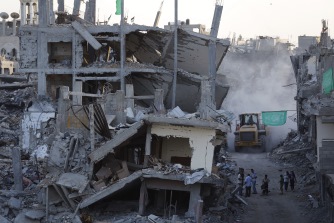
However, no particular intelligence capabilities are necessary to determine that Hamas would start reconstructing its military capabilities immediately after the ceasefire. This is what Hamas has done in the past, and one must assume it will do so now. Hamas is an organization whose rallying cry is armed resistance; it is therefore obvious that it will, without any delay, make every effort to rebuild it military capabilities, badly damaged in the 50 days of Operation Protective Edge. In this latest round of fighting, Hamas lost both of its main strategic capabilities: the long range missile threat, which was destroyed by Israel’s Iron Dome, and the offensive tunnels, almost all of which were destroyed by the IDF. Additional efforts, such as infiltrations from the sea and UAVs, either failed or were badly damaged.

Yet while Hamas accepted the ceasefire with virtually none of its many demands met, Israel, for its part, did not succeed in imposing on the terrorist organization one of the central demands presented by Prime Minister Netanyahu as an objective of the operation: the demilitarization of Gaza and the establishment of mechanisms that would deny Hamas the ability to reconstruct its force. However, the latter goal, disregarded after previous rounds of fighting, must be central to Israel’s demands in the negotiations on a long term arrangement, expected to begin in Cairo 30 days after the ceasefire began on August 26. Until an agreement is reached (and the chances it will deal effectively with force reconstruction are low), Hamas’ interest is to employ thousands of rocket manufacturers and thousands of tunnel diggers, and place them at the top of its list of salaried employees.

It is important to understand that the damage to Hamas was massive but not total. Accordingly, focus must now be on three areas related to Hamas’ future military force reconstruction: the smuggling tunnels (which Egypt has tackled), the manufacture of missiles and rockets, and the offensive tunnels.

1. The smuggling tunnels: Hamas had an estimated 800-1,000 smuggling tunnels. Egypt has destroyed most of them, but presumably several dozen have survived and Hamas will give preference to smuggling arms and money through them, as humanitarian aid, food, fuel, and even construction materials will in any case enter Gaza through Kerem Shalom under Israel’s auspices.

2. Arms production: Presumably 30-50 percent of this capability survived Israel’s attacks and has been reactivated at the highest possible rate, pending the availability of raw materials.

3. The offensive tunnels: Most of Hamas’ digging operations are likely currently directed at retrieving bodies and identifying members of the military branch buried in the rubble. Still, the operating assumption must be that one or two offensive tunnels were not discovered or destroyed outright, and that Hamas will make every effort to make them operable. Even if they failed to fulfill their intended purpose, the publicity the offensive tunnels garnered and impact they had on people’s imagination will drive Hamas to apply itself further to this means of terrorism. Even if much time passes before strategic capabilities can be dug, Hamas is interested in preserving and making use of the tunnels as a platform for carrying out pinpoint terrorist attacks. Such attacks would aim to be as deadly as possible and gain much media coverage, so as to puncture both the morale of the communities in the western Negev and the narrative of fortitude after Operation Protective Edge.

With this as background, what emerges is the following set of insights:

1. Hamas will make every effort to reconstruct its force and prepare for the next military round.

2. Hamas is not expected to be able to reconstruct its force massively any time soon. At this point Hamas is mostly concerned with damage assessment and rehabilitation. It is far from having the capabilities it had in early July 2014. However, Hamas has in the past demonstrated impressive force reconstruction skills, and therefore there is cause for concern in this regard.

3. Hamas has shown itself to be a learning organization. It will study its successes and strengthen its capabilities that proved themselves; it will also analyze its failures, and look for new ways of attacking Israel.

4. There is no doubt that Hamas is pleased with its success in targeting civilians and soldiers with mortar fire and will reinforce this aspect of its capabilities.

5. Hamas’ reconstruction efforts will be done covertly, hidden from Israeli intelligence. Presumably the Gaza civilian population will provide the defensive cover Hamas needs to do so.

6. Reconstruction will occur via external purchases and smuggling as well as via manufacturing within the Gaza Strip.

7. Placing Palestinian Authority government and security services in Gaza will not be enough to prevent Hamas’ reconstruction. For one, the damage to Hamas was insufficient; in addition, Abu Mazen has no interest in handling the issue. He prefers the strategy of political confrontation with Israel in international institutions.

Policy Recommendations

1. Intelligence organizations must sound alerts when Hamas transitions from the recovery stage to the force reconstruction stage, with emphasis on buildup components and details about the pace of reconstruction for each Hamas capability.

2. The political echelon must recognize the danger of Hamas’ current and future reconstruction and translate this understanding into concrete directives to the military, diplomatic, public relations, and legal establishments.

3. Preventing force reconstruction must head the agenda in the indirect talks in Cairo over a long term agreement. If the indirect talks do not result in an agreement that provides an effective response to reconstruction, Israel must formulate a strategy without Hamas’ consent, though coordinated with Egypt and the United States, that will deal optimally with Hamas’ future force reconstruction.

4. Israel must make sure to coordinate with Egypt increased efforts to block the dozens of smuggling tunnels left open between the Gaza Strip and the Sinai Peninsula.

5. Israel must convince its US and European allies that manufacturing strategic weapons and digging offensive tunnels are a causus belli for Israel, and that these are legitimate reasons for Israel to take military action in Gaza.

6. When formulating a plan for reconstructing the civilian and economic infrastructures of the Gaza Strip, it is necessary to establish an effective mechanism to prevent dual-use materials from falling into Hamas hands.

7. Israel must overtake Hamas in lesson-learning. There is nothing that prevents analysis and learning more than resting on one’s laurels. The IDF must define the areas in which it must improve, chiefly: initiative, innovation, surprise, deception, and time and intelligence management to acquire high quality goals.

Conclusion

The issue of Hamas’ force reconstruction must be brought back to center stage in the post-Operation Protective Edge era. The strategy now taking shape must ensure that any future military round against Hamas is postponed as much as possible, with Hamas’ strategic arsenal comprising capabilities Israel knows and for which it already has appropriate operational responses. The most difficult dilemma the political and military echelons will face, and which deserves a thorough debate, is: what constitutes a level of force buildup by Hamas that would justify proactive military action, and how can Israel prevent being lulled into a sense of security in the short term and not risk having to pay a much steeper price down the road.

The opinions expressed in INSS publications are the authors’ alone.

Publication Series INSS Insight
TopicsIsraeli-Palestinian RelationsOperation Protective Edge - July 2014
עברית

Events

All events
Iran, US, Israel, and the Global Jewish Community
10 March, 2026
12:00 - 13:00
Shutterstock

Related Publications

All publications
REUTERS
Alternatives for the Gaza Strip Following the Campaign Against Iran
As the campaign against Iran winds down, attention is expected to return to the Gaza Strip. In the meantime, Hamas is exploiting the strategic vacuum to rehabilitate its governance and military capabilities. Simultaneously, the Trump framework remains stalled, and the “Board of Peace” faces professional, operational, and budgetary difficulties in advancing its declared objectives. The issue of demilitarization remains trapped between Israel’s demand for the complete and immediate disarmament of Hamas and the organization’s stalling tactics. Israel faces three main alternatives: (1) Renewal of efforts to fully implement the Trump framework across the Strip, a course that carries the risk of “mock demilitarization” and depends on Hamas’s consent; (2) Gradual stabilization and reconstruction of areas cleared of Hamas while continuing to erode its control in areas still under its rule. This option is vulnerable to violent disruption and could entrench the Strip’s division; (3) A return to war and the reoccupation of the Gaza Strip, which would entail extremely heavy military, economic, and diplomatic costs for Israel. The key recommendation is to avoid perpetuating the status quo, which establishes Hamas’s rule, and instead adopt a proactive approach. Israel should allow the implementation of the Mladenov framework for gradual demilitarization, beginning with heavy weapons, while coordinating with the Trump administration regarding scenarios that would justify use of force. If Hamas obstructs the process, Israel should implement a differential alternative: the entry of a civilian committee and Palestinian police into “green zones” cleared of Hamas (alongside increasing Israeli security responsibility modeled on Judea and Samaria). Simultaneously, Hamas’s capabilities and governance in the “red zone” should be systematically degraded, including the gradual erosion of its territorial control. The alternative of returning to war and military occupation should remain a last-resort alternative, contingent on the formulation of an exit strategy and a designated body to assume civilian responsibility.
10/06/26
Anadolu via Reuters Connect
Israel's Post-Iran War Challenge: The Return of the Palestinian Issue to the International Agenda
When the focus shifts away from the war with Iran, the Palestinian issue is likely to return to the center of the agenda—and Israel must prepare accordingly
25/05/26
Majdi Fathi via Reuters Connect
Local Elections in the Palestinian Authority: Between Procedural Democracy and Clan Politics
What lessons can be drawn from the local elections held in Judea and Samaria and Gaza, looking toward future general elections?
18/05/26

Stay up to date

Registration was successful! Thanks.
  • Research

    • Topics
      • Israel and the Global Powers
      • Israel-United States Relations
      • Glazer Israel-China Policy Center
      • Russia
      • Europe
      • Antisemitism and Delegitimization
      • Iran and the Shi'ite Axis
      • The Campaign Against Iran and the Shiite Axis
      • Iran
      • Lebanon and Hezbollah
      • Syria
      • Yemen and the Houthi Movement
      • Iraq and the Iraqi Shiite Militias
      • Conflict to Agreements
      • Israeli-Palestinian Relations
      • Hamas and the Gaza Strip
      • Peace Agreements and Normalization in the Middle East
      • Saudi Arabia and the Gulf States
      • Turkey
      • Egypt
      • Jordan
      • Israel’s National Security Policy
      • Military and Strategic Affairs
      • Societal Resilience and the Israeli Society
      • Jewish-Arab Relations in Israel
      • Climate, Infrastructure and Energy
      • Terrorism and Low Intensity Conflict
      • Cross-Arena Research
      • Data Analytics Center
      • Law and National Security
      • Advanced Technologies and National Security
      • Foreign Information Manipulation and Interference
      • Economics and National Security
    • Projects
      • Preventing the Slide into a One-State Reality
      • India-Middle East-Europe Economic Corridor (IMEC)
  • Publications

    • All Publications
    • INSS Insight
    • Policy Research and Papers
    • Special Publication
    • Strategic Assessment
    • Technology Platform
    • Memoranda
    • Database
    • Posts
    • Books
    • Archive
  • About

    • Vision and Mission
    • History
    • Research Disciplines
    • Chairman of the Board
    • Board of Directors
    • Fellowship and Prizes
    • Internships
    • Annual Reports
    • Support
    • Privacy Policy and Terms of Use
  • Media

    • Communications
    • Video Gallery
    • Press Release
    • Podcast
  • Home

  • Events

  • Database

  • Team

  • Contact

  • Newsletter

  • עברית

INSS logo The Institute for National Security Studies, Strategic, Innovative, Policy-Oriented Research, go to the home page
40 Haim Levanon St. Tel Aviv, 6997556 Israel | Tel 03-640-0400 | Fax 03-744-7590 |
Developed by Daat ,Yael Group.
Accessibility Statement
This site is protected by reCAPTCHA and the Google Privacy Policy and Terms of Service apply.