


The “Gaza Envelope” Communities: A Case Study of Societal Resilience in Israel (2006–2016) | INSS
go to header go to content go to footer go to search
INSS logo The Institute for National Security Studies, Strategic, Innovative, Policy-Oriented Research, go to the home page
INSS
Tel Aviv University logo - beyond an external website, opens on a new page
  • Campus
  • Contact
  • עברית
  • Support Us
  • Research
    • Topics
      • Israel and the Global Powers
        • Israel-United States Relations
        • Glazer Israel-China Policy Center
        • Russia
        • Europe
        • Antisemitism and Delegitimization
      • Iran and the Shi'ite Axis
        • The Campaign Against Iran and the Shiite Axis
        • Iran
        • Lebanon and Hezbollah
        • Syria
        • Yemen and the Houthi Movement
        • Iraq and the Iraqi Shiite Militias
      • Conflict to Agreements
        • Israeli-Palestinian Relations
        • Hamas and the Gaza Strip
        • Peace Agreements and Normalization in the Middle East
        • Saudi Arabia and the Gulf States
        • Turkey
        • Egypt
        • Jordan
      • Israel’s National Security Policy
        • Military and Strategic Affairs
        • Israel's Security Strategy
        • Societal Resilience and the Israeli Society
        • Jewish-Arab Relations in Israel
        • Climate, Infrastructure and Energy
        • Terrorism and Low Intensity Conflict
      • Cross-Arena Research
        • Data Analytics Center
        • Law and National Security
        • Advanced Technologies and National Security
        • Foreign Information Manipulation and Interference
        • Economics and National Security
    • Projects
      • Preventing the Slide into a One-State Reality
      • India-Middle East-Europe Economic Corridor (IMEC)
  • Publications
    • -
      • All Publications
      • INSS Insight
      • Policy Research and Papers
      • Special Publication
      • Strategic Assessment
      • Technology Platform
      • Memoranda
      • Posts
      • Books
      • Archive
  • Database
    • Surveys
    • Spotlight
    • Maps
    • Dashboards
  • Events
  • Team
  • About
    • Vision and Mission
    • History
    • Research Disciplines
    • Chairman of the Board
    • Board of Directors
    • Fellowship and Prizes
    • Annual Reports
    • Internships
  • Media
    • Communications
    • Video gallery
    • Press Releases
  • Podcast
  • Newsletter
  • Campus
Search in site
  • Research
    • Topics
    • Israel and the Global Powers
    • Israel-United States Relations
    • Glazer Israel-China Policy Center
    • Russia
    • Europe
    • Antisemitism and Delegitimization
    • Iran and the Shi'ite Axis
    • The Campaign Against Iran and the Shiite Axis
    • Iran
    • Lebanon and Hezbollah
    • Syria
    • Yemen and the Houthi Movement
    • Iraq and the Iraqi Shiite Militias
    • Conflict to Agreements
    • Israeli-Palestinian Relations
    • Hamas and the Gaza Strip
    • Peace Agreements and Normalization in the Middle East
    • Saudi Arabia and the Gulf States
    • Turkey
    • Egypt
    • Jordan
    • Israel’s National Security Policy
    • Military and Strategic Affairs
    • Israel's Security Strategy
    • Societal Resilience and the Israeli Society
    • Jewish-Arab Relations in Israel
    • Climate, Infrastructure and Energy
    • Terrorism and Low Intensity Conflict
    • Cross-Arena Research
    • Data Analytics Center
    • Law and National Security
    • Advanced Technologies and National Security
    • Foreign Information Manipulation and Interference
    • Economics and National Security
    • Projects
    • Preventing the Slide into a One-State Reality
    • India-Middle East-Europe Economic Corridor (IMEC)
  • Publications
    • All Publications
    • INSS Insight
    • Policy Research and Papers
    • Special Publication
    • Strategic Assessment
    • Technology Platform
    • Memoranda
    • Posts
    • Books
    • Archive
  • Database
    • Surveys
    • Spotlight
    • Maps
    • Dashboards
  • Events
  • Team
  • About
    • Vision and Mission
    • History
    • Research Disciplines
    • Chairman of the Board
    • Board of Directors
    • Fellowship and Prizes
    • Internships
    • Annual Reports
    • Privacy Policy and Terms of Use
  • Media
    • Communications
    • Video gallery
    • Press Releases
  • Podcast
  • Newsletter
  • Campus
  • Contact
  • עברית
  • Support Us
bool(false)

Publications

Home Publications Memoranda The “Gaza Envelope” Communities: A Case Study of Societal Resilience in Israel (2006–2016)

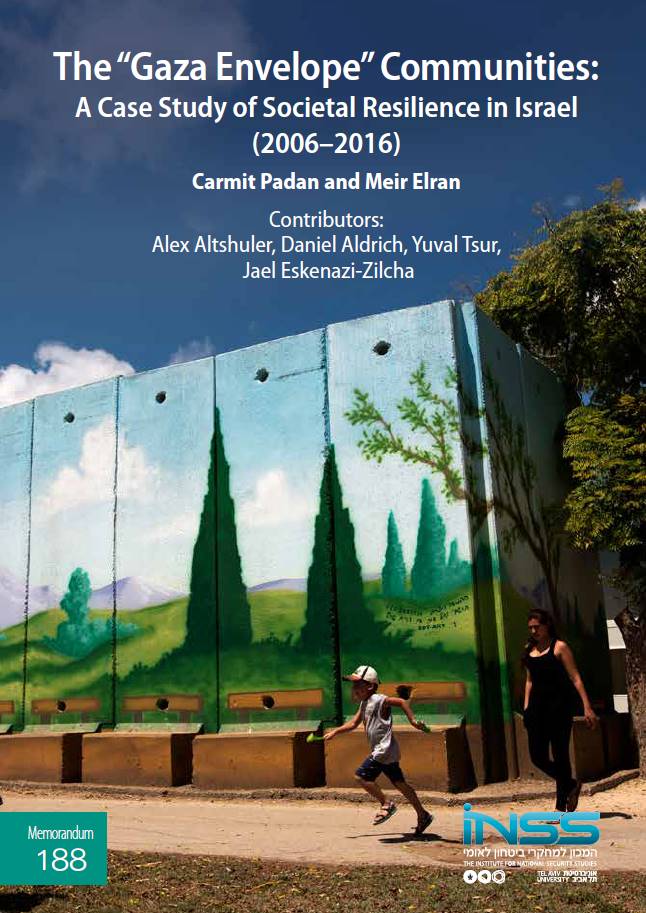
The “Gaza Envelope” Communities: A Case Study of Societal Resilience in Israel (2006–2016)

The Institute for National Security Studies, February 2019

Follow us on Google
עברית
Carmit Padan
Meir Elran

The goal of the research is to examine the phenomenon of societal resilience in the Israeli settlements in the western Negev, near the border with Gaza. All these settlements are exposed to similar security challenges; the period under review saw three rounds of intense fighting between 2008 and 2014 and a “routine of terror incidents” in the intervals between them. Ten years is a long enough time to develop the perspective required to gauge public efficacy and the organizational capacity of the communities during and following emergency situations. It is also long enough to allow the local residents to evaluate the physical and psychological resources available to them that are needed for coping with long-term instability and stress. Based on our rigorous investigation, the research also offers analytical tools for assessing the extent to which a community can return to normative functioning in its core missions following a major disruption and forecasting how long that process might take.


Contributors: Alex Altshuler, Daniel Aldrich, Yuval Tsur, Jael Eskenazi-Zilcha


This memorandum presents a case study on societal resilience in Israel by exploring the experiences of six communities in the security-challenged Gaza Envelope: one city, four kibbutzim and one moshav. On the basis of this comprehensive analysis, important strategic recommendations can be proposed, including :

1. Residents’ ability to determine the course of their own lives in emergency situations significantly affects their capacity to cope with the consequences of severe disruptions and to rapidly return to routine. A public self-sense of control during emergencies is found to enhance societal resilience at individual and communal levels.

2. The advancement of communal social capital and organizational resources during periods of relative calm will result in the community’s increased societal resilience in periods of tension. Close public cooperation and social cohesion testify to empowered social networks, which constitute important support constructs during emergencies.

3. Evacuating communities in time of peril should be considered as a legitimate option. It does not impede societal resilience and should be prepared in advance with the vision of a rapid return home to normal and enhanced communal functionality. This pattern of conduct represents a high level of resilience.

Though the study centers on specific communities, its findings can be applied in a much broader context of natural and manmade emergencies and localities.

This research was awarded with the "Inbar Fund – facing terrorism" prize.

==================================================

Contents

Preface

Introduction
Chapter 1: Conceptual and Policy-related Analysis of “Resilience”

Chapter 2: Functionality Indexes for Gauging Societal Resilience

Chapter 3: The Contribution of the Community Emergency and Resilience Teams to Societal Resistance

Chapter 4: The Resilience Centers in the Gaza Envelope

Chapter 5: The Contribution of the State to the Resilience of the Communities
Chapter 6: Recommendations to Promote Societal Resilience  in Israel

Conclusions

Notes

Authors and Contributors

The opinions expressed in INSS publications are the authors’ alone.
Publication Series Memoranda
TopicsMilitary and Strategic AffairsSocietal Resilience and the Israeli Society
עברית

Events

All events
Israel’s National Security Conference
27 July, 2026
10:00 - 14:00

Related Publications

All publications
YIFAT MAHAL (CC BY 4.0)
Strategic Alert: Jewish Terrorism and Nationalist Crime Are Accelerating the Breakdown of Israel’s State Institutions
Jewish terrorism has evolved from a local enforcement problem into a distinct strategic threat to the State of Israel and its democratic character. The destructive combination of inadequate enforcement, a lack of political backing for the security agencies, and the weakness of the judicial and law enforcement systems is creating a reality marked by lawlessness, non-recognition of state institutions, and the loss of the state’s monopoly on the use of force. The lack of a decisive Israeli response to this phenomenon constitutes evidence that it is a policy directed from above. This reality poses a multidimensional threat to Israel: a security threat—diverting the IDF’s attention and forces toward confronting Jewish terrorism at the expense of defense needs in other arenas, while subjecting the military to ongoing operational strain. In addition, the risk of a violent uprising in Judea and Samaria is growing, alongside the collapse of Palestinian stabilizing mechanisms; a governance and societal threat—weakening law enforcement systems, eroding respect for state-mindedness and allowing violence to seep dangerously into Israeli society in a manner that could paralyze the functioning of the state; and an international threat—Israel’s portrayal as an aggressive, oppressive, and racist state is undermining the legitimacy of its use of force, severely damaging its standing in the region and worldwide, and raising the risk of acute diplomatic isolation. We warn of a threat to Israel’s very ability to govern and function. As history teaches us, democracies that fail to restrain radical forces within them do not survive.
14/09/26
Reuters and GPO (modifies by INSS)
"The New Security Strategy" – Flawed Logic and a Threat to National Security
What does the new security strategy entail, as reflected in statements by Israel’s political leadership and actions on the ground, and why does it pose a threat to Israel's character and national security?
18/08/26
When Strength Becomes a Trap: A Structural Lens on Israel's Strategic Trajectory
This article applies Paul Kennedy’s thesis of imperial overstretch as a structural lens through which to examine Israel’s strategic trajectory in 2026. It does not contend that Israel is an empire, nor that decline is foreordained. Rather, it argues that the mechanism Kennedy identified, namely the tendency for strategic commitments to outgrow the productive base that must finance them, combined with the political incapacity of governing coalitions to redistribute burdens before the corrective window closes, operates at any scale; and that its early structural signatures are now visible in Israeli data. The analysis examines three historical cases: Habsburg Spain, apartheid South Africa, and the late Soviet Union, compared across seven structural dimensions, with each yielding a distinct implication for Israel. It then reviews the Israeli indicators in detail, with particular attention to the simultaneous narrowing of the productive base, the erosion of allied political capital documented in contemporary polling, and the transfer of the strategic burden from the foreign balance sheet to the domestic one. The argument is that the analytically and morally decisive variable is not strength itself, but the sustainability of strength; and that the central question for Israeli strategy is whether recalibration is undertaken voluntarily, from a position of strength, or imposed by crisis on terms one no longer controls.
16/08/26

Stay up to date

Registration was successful! Thanks.
  • Research

    • Topics
      • Israel and the Global Powers
      • Israel-United States Relations
      • Glazer Israel-China Policy Center
      • Russia
      • Europe
      • Antisemitism and Delegitimization
      • Iran and the Shi'ite Axis
      • The Campaign Against Iran and the Shiite Axis
      • Iran
      • Lebanon and Hezbollah
      • Syria
      • Yemen and the Houthi Movement
      • Iraq and the Iraqi Shiite Militias
      • Conflict to Agreements
      • Israeli-Palestinian Relations
      • Hamas and the Gaza Strip
      • Peace Agreements and Normalization in the Middle East
      • Saudi Arabia and the Gulf States
      • Turkey
      • Egypt
      • Jordan
      • Israel’s National Security Policy
      • Military and Strategic Affairs
      • Israel's Security Strategy
      • Societal Resilience and the Israeli Society
      • Jewish-Arab Relations in Israel
      • Climate, Infrastructure and Energy
      • Terrorism and Low Intensity Conflict
      • Cross-Arena Research
      • Data Analytics Center
      • Law and National Security
      • Advanced Technologies and National Security
      • Foreign Information Manipulation and Interference
      • Economics and National Security
    • Projects
      • Preventing the Slide into a One-State Reality
      • India-Middle East-Europe Economic Corridor (IMEC)
  • Publications

    • All Publications
    • INSS Insight
    • Policy Research and Papers
    • Special Publication
    • Strategic Assessment
    • Technology Platform
    • Memoranda
    • Database
    • Posts
    • Books
    • Archive
  • About

    • Vision and Mission
    • History
    • Research Disciplines
    • Chairman of the Board
    • Board of Directors
    • Fellowship and Prizes
    • Internships
    • Annual Reports
    • Support
    • Privacy Policy and Terms of Use
  • Media

    • Communications
    • Video Gallery
    • Press Release
    • Podcast
  • Home

  • Events

  • Database

  • Team

  • Contact

  • Newsletter

  • עברית

INSS logo The Institute for National Security Studies, Strategic, Innovative, Policy-Oriented Research, go to the home page
40 Haim Levanon St. Tel Aviv, 6997556 Israel | Tel 03-640-0400 | Fax 03-744-7590 |
Developed by Daat ,Yael Group.
Accessibility Statement
This site is protected by reCAPTCHA and the Google Privacy Policy and Terms of Service apply.