


Publications
INSS Insight No. 914, April 5, 2017
Follow us on Google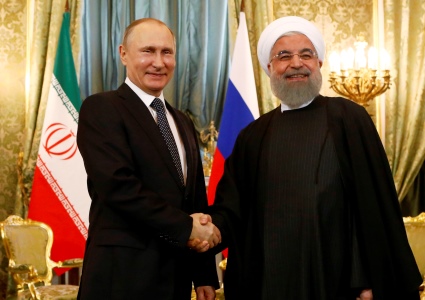
The highlight of Iranian President Hassan Rouhani’s first official visit to Russia on March 27-28, 2017 was a meeting with President Vladimir Putin. At a joint press conference, Putin stressed that “Iran is a good and reliable neighbor, as well as a stable partner for Russia,” and announced that the intention is to bring the relations to the level of a “strategic partnership.” There is no doubt that Rouhani’s visit to Moscow is an important milestone in the developing relations between Iran and Russia. However, it appears that ultimately, the driving force behind Russia’s ties to Iran is opportunistic more than strategic. For Israel, stronger ties between Iran and Russia represent a significant development with many uncertain future implications, assuming that Russia continues to see its relations with Israel as an important asset in connection with its role in the Syrian arena, and in a range of other contexts. In any event, Israel will have to consider its actions in Syria in light of the relations between Iran and Russia.
Iranian President Hassan Rouhani made his first official visit to Russia on March 27-28, 2017, accompanied by Foreign Minister Mohammed Javad Zarif and Iran’s Communications Minister, as well as a large economic delegation. The highlight of his visit was the meeting with President Vladimir Putin, during which the leaders discussed options for strengthening bilateral economic ties, trade, and investments. Noting the 70 percent growth in bilateral trade last year, President Rouhani stated that economic relations had moved from the stage of ordinary relations to long term projects. In a joint statement, Rouhani and Putin mentioned treaties in the fields of oil and gas, media and information technology, nuclear energy (construction has already started on one of two additional power stations in Bushehr), construction of a thermal power station in Bandar Abbas, and tourism. Indeed, an agreement was already signed eliminating the need for visas for tourist groups from Russia to Iran, concluded in discussions about possible full elimination of the need for visas to Iran by individual Russian visitors.
At a joint press conference, Putin stressed that "Iran is a good and reliable neighbor, as well as a stable partner for Russia," and was careful to mention the valuable cooperation of the two countries in the international arena. He underscored the joint achievements of Russia and Iran in the struggle against the Islamic State and Jabhat al-Nusra, the efforts to stabilize the Syrian arena by means of a ceasefire in wide areas of the country, and the fact that Iran, alongside Turkey and Russia, is a guarantor of the ceasefire. Finally, Putin announced that the intention is to bring the relations between Iran and Russia to the level of a "strategic partnership."
As to the sensitive issue of the nuclear agreement, the joint statement emphasized that the JCPOA is an international treaty adopted by the Security Council. It also stressed the commitment of all parties involved in the treaty to its full implementation, fulfillment of its requirements by Iran, and the fact that according to the NPT, Iran is permitted to use nuclear energy for peaceful purposes. In addition, the parties rejected the use of sanctions against countries and defined the measure as illegitimate – reflecting their opposition to the existing sanctions against Iran and Russia. In a loosely veiled hint to Israel, they asserted their support for the Middle East becoming a nuclear free zone. These statements, which were particularly important to Iran, are directed against President Trump, who even before he entered the White House raised ideas about canceling the JCPOA or reopening it in renewed negotiations, and should be seen as clear indications that Russia will not support such moves.
At the international level, Iran and Russia have similar views on many important issues. They have common geopolitical interests, both in the Middle East and in the Russian Commonwealth (CIS) – in the Caucasus, Central Asia, and the Caspian Sea region. In the international arena Russia identifies Iran as its main partner on the anti-Western front, where they share an interest in challenging the existing order. Thus, Rouhani’s visit marks the high point of a process of upgrading relations between these countries, which gained momentum after the nuclear treaty, when it was possible for the two countries to renew their military cooperation.
The first and most important expression of this development was the supply of the S-300 air defense missile system, which was suspended for a decade due to pressure from Israel and the United States, and has already become operational in Iran. Russia and Iran are also in talks about the purchase of other weapon systems, including Sukhoi-30 fighter plans and T90 tanks. Both states have been involved in the Syrian civil war from the start, and are cooperating in supporting the Bashar al-Assad regime. Since Russia's military involvement in the war (September 2015), they have worked as a military coalition, sharing the management of the fighting on the ground. This also explains why Russia sees Iran as an important component in any future settlement in Syria.
Rouhani's visit to Moscow (which followed visits by the President of Turkey and the Prime Minister of Israel) took place in a significant context: the joint military effort in Syria, which is the first of its kind for both Iran and Russia, has changed the military balance in favor of Assad, their ally. The talks to formulate a settlement in Syria, underway in Astana under Russian leadership, brought the representatives of the rebels against the Assad regime to agree to a ceasefire for the first time. Iran, alongside Turkey and with Russian leadership, was defined as a guarantor of the ceasefire. This status is extremely important for Iran, since it establishes its role in Syria, which it wishes to leverage to further its hold over the country – if and when an arrangement is reached that ends the civil war. In addition, with the entry of the Trump administration into the White House, and against a background of talks about strengthening American cooperation with Russia, Iran was worried by the possibility that Moscow would be ready to trade its relations with Tehran as a bargaining card with Washington. Therefore, the agreements reached during the visit regarding Iran's role in Syria, and in particular the strengthening of its relations with Russia, should in Tehran's view, reinforce Russia's commitment not to "trade in" its relations with Iran.
Rouhani's visit to Moscow, two months before the Iranian presidential elections and his prospective reelection to a second term of office, helps him against his domestic opponents. Rouhani has been the target of severe criticism in recent months, as the one who spearheaded the nuclear treaty and who saw the removal of sanctions and the opening of the Iranian market to Western investments as the main way of saving the Iranian economy. Critics point to the limited contribution of the lifting of sanctions to the Iranian economy, and to the Trump administration and the possibility discussed in Congress of imposing new sanctions against Iran as proof of this policy's failure. Rouhani’s visit to Moscow and the several economic treaties signed there thus balance the picture and undermine the accusations that he prefers the "non-credible" United States and Western countries over their allies. In other words, the visit to Moscow allows Rouhani to present a balanced policy and concrete achievements. Moreover, the Rouhani government was aware of the Russian complaint regarding the absence of significant economic projects benefiting Moscow, compared to the effort made to promote projects with European countries. The agreements achieved during Rouhani’s visit take the economic relations between Iran and Russia to a higher, long term level.
There is thus no doubt that Rouhani's visit to Moscow is a positive and important milestone in the developing relations between Iran and Russia. However, it appears that ultimately, the driving force behind Russia's ties to Iran is opportunistic more than strategic. Moreover, the more it appears that the civil war in Syria is nearing a decision, the more disputes may emerge: Russia and Iran are partners in the effort to save the Assad regime, but they have different perceptions regarding the future shape of Syria. Also, the rebels against Assad, mostly Sunnis, recoil from a future Iranian presence in Syria, and this hampers progress toward peace.
Within Russia there are conflicting attitudes to cooperation with Iran. Supporters see Iran as the main partner in the struggle against the West and praise the regime for its strong stance against the challenges posed by the West. They also clearly uphold Iran's right to promote its nuclear program and strengthen its position as a power. This camp includes portions of the security establishment, particularly nationalist, anti-Western elements that support the return of Russia to its status as a world power. On the other hand, others argue that the presence of Hezbollah and other Shiite militias, which were brought to Syria by Iran, does not serve the Russian interest.
In addition, Russia is experiencing some concern due to Israel, which has become a regional player of influence, particularly given its activity on Syrian soil against weapon shipments to Hezbollah, and a player that sees the intentions of Iran to remain in Syria as a threat to its security. Israeli conduct challenges Russian leadership, which is now looking for a suitable response. Iran for its part is suspicious of Russia's stance in this context, and in recent weeks criticism has been voiced in Iran of the Russian position, which continues to ignore what are allegedly Israeli attacks in Syria. This issue was likely discussed during Rouhani's visit to Moscow, in a Russian attempt to persuade the Iranians to make some concessions that could be presented to Israel as a basis for future understandings between Jerusalem and Moscow.
For Israel, stronger ties between Iran and Russia represent a significant development with many uncertain future implications, assuming that Russia continues to see its relations with Israel as an important asset in connection with its role in the Syrian arena, and in a range of other contexts. In any event, Israel will have to consider its actions in Syria in light of the relations between Iran and Russia.