


Publications
What do the conflicting trends in Israel reveal—Beijing's eroding image on the one hand, a surge in trade on the other?
INSS Insight No. 2215, November 17, 2026
Follow us on GoogleIsraeli public opinion toward China is diverging from trends observed in many countries around the world. While China’s image is improving in several Western countries, favorability toward China in Israel is declining markedly. Yet this deterioration in public perceptions has not been accompanied by a comparable decline in other areas of Israel-China relations, with trade continuing to expand. This reflects a gap between China’s place in the Israeli economy and how it is perceived as a global power and political actor. In Israel, expanding economic ties have not been accompanied by an improvement in China’s public image, and reservations about China do not necessarily lead to reduced economic and technological exposure to it.
Israel Diverges from Global Trends
In Pew Research Center surveys published in July 2026, the median share of respondents with a favorable view of China across the 37 countries surveyed was 51%, compared with 39% who held an unfavorable view. Favorability toward China also rose in Western countries. In Italy, for example, it increased from 31% in 2022 to 51% in 2026. In Spain, it rose by 17% in a single year, reaching 54% in 2026. Favorability toward China reached record highs in many countries, including Greece, Hungary, Mexico and Singapore. In the United States, as well, the share of respondents with a favorable view of China nearly doubled, from 14% in 2023 to 27% in 2026, although most Americans still view it unfavorably. China’s improving image coincides with a decline in the United States’ image. In a comparison across 36 countries, China had higher favorability ratings than the United States in 25 countries, while the United States led in only six.
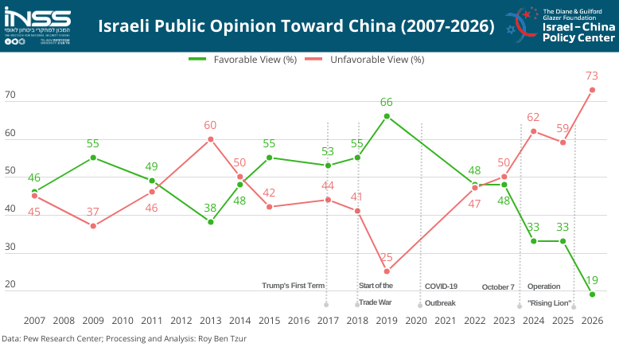
In Israel, by contrast, only 19% of respondents expressed a positive view toward China, while 73% viewed it unfavorably. This is the lowest level of favorability toward China recorded in Israel since Pew began polling on the subject in 2007, and the second-lowest among the countries surveyed in 2026, after Japan.
From Favorability to Skepticism: Israeli Public Opinion Before and During the War
Israeli attitudes toward China have shifted considerably over the past decade. The diplomatic and economic rapprochement that began in 2013 was accompanied by expanded investments, tourism, and cooperation, as well as China’s growing presence in Israeli public discourse as a source of economic and technological opportunities. At the same time, the share of Israelis with a favorable view of China rose from 38% in 2013 to 53% in 2017, reaching a high of 66% in 2019. Intensifying competition between the United States and China heightened sensitivity to Chinese involvement in Israel, while the COVID-19 pandemic interrupted many direct exchanges. By 2022, the share of respondents with a favorable view of China had fallen to 48%, where it remained in 2023.
Since October 7, public attitudes toward China have deteriorated more rapidly. Favorability fell to 33% in 2024 and remained unchanged in 2025 (the Pew survey was conducted in March 2025, before Operation "Rising Lion"). The "Swords of Iron" survey conducted by the INSS Data Analytics Center in September 2024 found that one-quarter of respondents said their view of China had worsened since October 7, compared with only 1% who reported a more positive change.
Since the outbreak of the "Swords of Iron" war, Beijing has increasingly expressed support for the Palestinians on international stages, refrained from explicitly condemning Hamas and other actors attacking Israel, and voiced harsh criticism of Israeli military operations. During June 2025 war between Israel and Iran, Beijing condemned Israeli strikes, describing them as a violation of Iran's sovereignty and expressed support for Tehran's right to defend its sovereignty and interests. China portrayed the broader regional escalation as stemming from the Israeli-Palestinian conflict, while placing limited weight to the responsibility of Iran and the groups it supports.
This is compounded by an accumulation of reports about China-based actors’ involvement in supplying dual-use materials and components to Iran and the Houthis. In April 2025, for instance, the United States imposed sanctions on a network operating in China and Iran selling materials used to produce missile propellant for the Islamic Revolutionary Guard Corps (IRGC). Similarly, in September 2025, sanctions were imposed on Houthi procurement networks, including companies based in China, for supplying materials and components used to manufacture missiles and unmanned aerial vehicles (UAVs). Although the surveys did not assess respondents' awareness of these developments, the drop in the share of respondents with a favorable view of China, from 33% in 2025 to 19% in 2026, occurred at a time when China’s position on Iran and Israeli military operations had become more tangible to the Israeli public.
A demographic breakdown reveals that China’s declining image is not uniform across Israeli society. INSS national security surveys conducted between 2024 and 2026 show a persistent gap between Jews and Arabs respondents. Among Jewish respondents, 50.5%–62% described China as an unfriendly or hostile country. Arab respondents had a more positive view: the share who saw China as a friendly country or an ally rose from 22% in September 2024 to 48% in April 2025, peaked at 53% in December, and stood at 43% in May 2026.
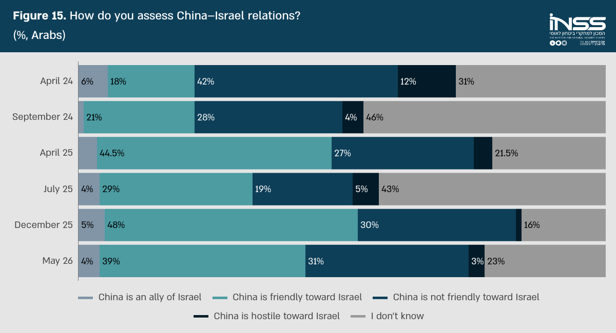
Source: National Security Survey findings, May 2026
The persistent gap between Jewish and Arab respondents in Israel may reflect differences in how these groups perceive China’s regional policies. Since October 2023, Beijing has consistently emphasized its support for the Palestinian position, criticized Israel’s military actions, and refrained from explicitly condemning Hamas. These messages may resonate more positively with the Arab public in Israel.
This pattern is consistent with a broader trend observed in public opinion across Arab countries after October 7, when favorability toward China rose in several Arab countries as favorability toward the United States fell sharply. These findings may also reflect a weakening of the United States’ standing and a growing perception of China as an alternative, rather than solely an expression of support for Beijing’s position toward the Palestinian issue.
A Comparative Perspective: Israeli Public Skepticism Is Not Limited to China
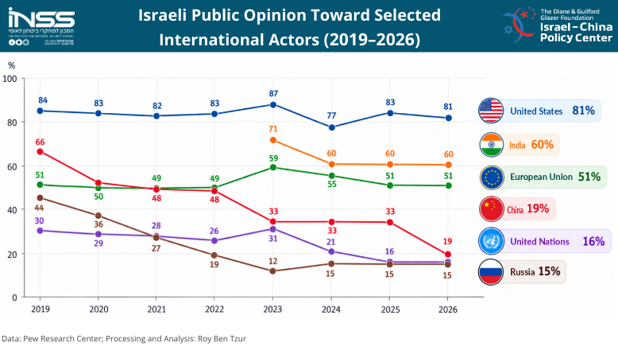
In recent years, favorable views among Israelis have also declined toward other international actors. Favorability toward Russia stood at 44% in 2019, dropped to 19% in 2022 and 13% in 2023, then leveled off at 15% in both 2024 and 2025. India remains far more popular, but it too has lost some public support: the share of respondents with a favorable view of India fell from 71% in 2023 to 60% in 2025, where it remained in 2026. Favorability toward the United Nations also dropped, from 31% in 2023 to 16% in 2025, while favorability toward the European Union declined more modestly, from 59% in 2023 to 51% in 2025. The reasons for declining favorability toward each of these actors differ, and it is difficult to determine how much each factor contributes to shaping public opinion. Still, the broad decline points to a wider trend of skepticism toward external actors.
The United States is a clear exception, retaining a positive standing. From 2019 to 2026, favorability toward the United States ranged from 77% to 87%, and stood at 81% in the most recent survey. The gap in Israeli favorable views of the United States and China stood at 62%, the largest margin in favor of the United States among the countries surveyed. A substantial gap was also evident in views of the leaders: 66% of Israelis expressed confidence that President Donald Trump would do the right thing in world affairs, compared with 10% for Xi Jinping.
Efforts to Improve Ties Amid a Negative Image
Since assuming office in late 2024, China's Ambassador to Israel, Xiao Junzheng, has pursued an intensive public diplomacy campaign to strengthen economic, technological, and social ties between the two countries. His activities include frequent meetings with representatives from civil society groups, the business sector, and the research community, alongside appearances in local media and the consistent use of friendly, conciliatory messaging. The embassy emphasizes innovation, trade, technology, and civilian cooperation, generally refraining from addressing the political disagreements that have intensified since the outbreak of the war.
This reflects two distinct layers of policy: on the political-diplomatic front, China seeks to safeguard its standing across the Arab and Muslim worlds and preserve its ties with the Palestinians and regional states; vis-à-vis Israel, it seeks to maintain the economic, technological, and diplomatic dividends of the bilateral relationship. So far, however, these efforts have not translated into any significant recovery in public opinion.
Investments Decline, Imports Grow
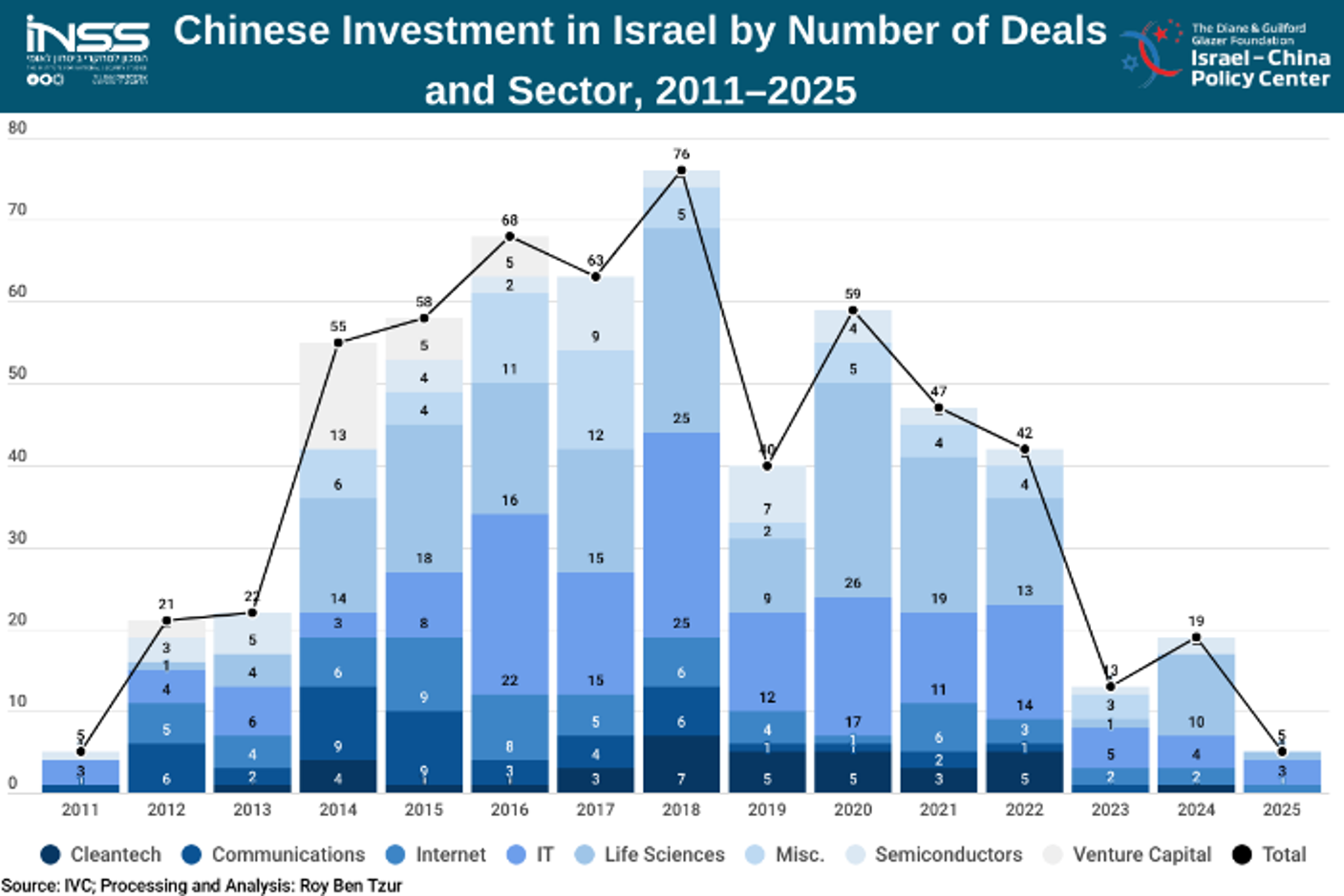
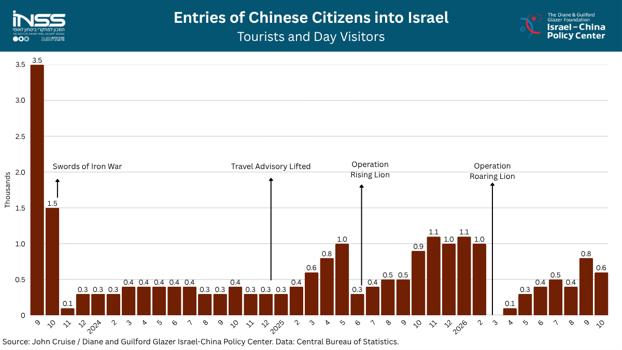
Alongside the shift in public opinion, several channels of engagement that had expanded over the previous decade have contracted dramatically. According to available data, the number of Chinese investment deals in Israel dropped from a peak of 76 in 2018 to 19 in 2024, and just five in 2025. The war accelerated a trend that began during the COVID-19 pandemic, when travel was significantly curtailed, disrupting direct contact among companies, officials, business leaders, and experts. Inbound tourism from China has likewise failed to return to pre-pandemic levels. According to tourism data, entries of Chinese citizens into Israel totaled 155,600 in 2019, compared with 23,200 in 2023 and 7,700 in 2025.
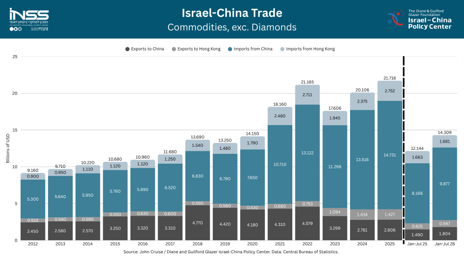
Despite the erosion of China's image and the decline in business ties, investments, and tourism, bilateral trade has continued to expand. In the first seven months of 2026, trade in goods (excluding diamonds and including Hong Kong) reached $14.31 billion—an increase of approximately 18% compared to the corresponding period last year. The bulk of this growth stemmed from imports from China, which rose by roughly 18% from $9.82 billion in the first seven months of 2025 to $11.55 billion during the same period in 2026. Israeli exports to China also increased by about 19% over that period, from $2.31 billion to $2.75 billion (from a multi-year perspective, however, exports peaked in 2022, when they totaled approximately $5.33 billion for the entire year).
The automotive market illustrates this trend. According to data from the Israel Vehicle Importers Association, the share of Chinese-manufactured vehicles in all new car deliveries rose from just 0.8% in 2020, reaching approximately 46.5% in the first nine months of 2026. A similar picture emerges when examining the market share of Chinese automotive brands in the first nine months of 2026, which stood at 44.4%. The narrow gap between these two figures indicates that the bulk of the increase stems from the expansion of Chinese brands themselves, rather than solely from foreign brands manufacturing vehicles in China.
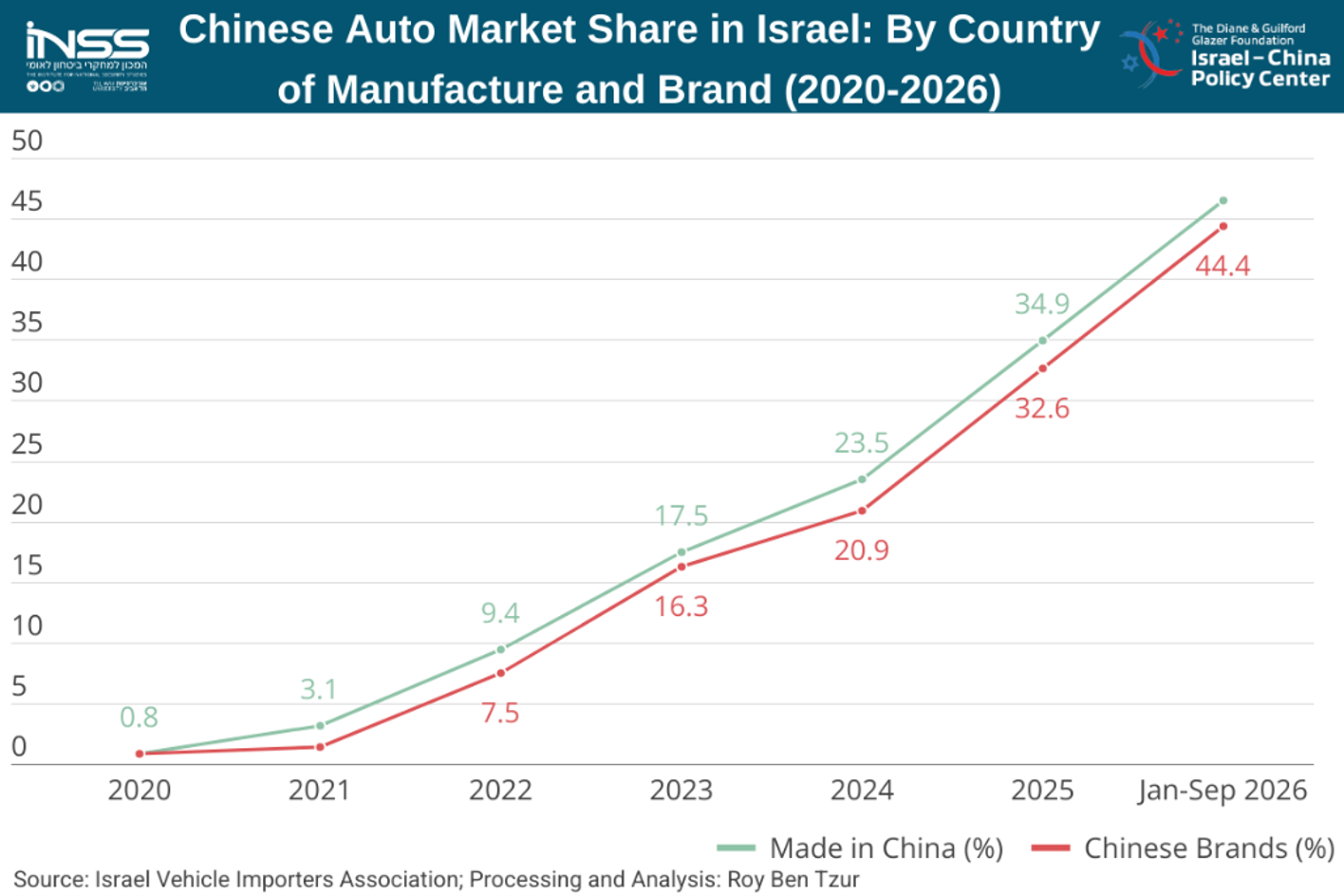
Chinese manufacturers benefit from market conditions in Israel that allow them to continually expand their market share. Unlike countries that have imposed targeted tariffs on vehicles made in China, Israel has not adopted a similar restriction. China’s negative political image among the public, therefore, does not negate the pricing and availability advantages available to importers and consumers.
At the same time, survey data show that Israelis favor stronger economic ties with the United States, although many also value maintaining strong ties with China. According to Pew surveys in 2025, 60% of Israelis preferred strong economic ties with the United States, compared to 4% who favored China. However, 31% responded that it was important to maintain strong ties with both countries. These figures highlight the gap between the public’s perception of China and its place in the Israeli economy. These findings suggest that a preference for strong economic ties with the United States does not necessarily translate into opposition to maintaining economic relations with China. Meanwhile, imports continue to expand, particularly the rapid influx of Chinese-made vehicles, consumer goods, and electronics, despite the sharp erosion in Beijing's image. The growing presence of Chinese goods does not signal recovery in relations as a whole, just as declining favorability is not reflected in consumption and import patterns.
Conclusion and Implications
China's deteriorating image in Israel, alongside declining investment and tourism on the one hand and expanding trade on the other, highlights the divergent trends across different dimensions of the bilateral relations. For Israel, this means that public suspicion of China cannot replace a systematic assessment of the risks associated with different forms of exposure to it. Declining investment and fewer direct exchanges do not eliminate risks that may also arise through imports, the use of technology, and supply chains. Conversely, a negative public image should not dictate policies for managing risk and reducing exposure; those policies should be based on professional security, diplomatic, and economic considerations. Public opinion and policymakers' perceptions can nevertheless influence how effectively such policies are implemented. Israel’s challenge, then, is to manage its relations with China by balancing three distinct considerations: public perceptions, economic interests, and national security considerations.