


Publications
The gains, disappointments, implications, and conclusions for Israel following Fatah’s highly anticipated conference
INSS Insight No. 2156, June 16, 2026
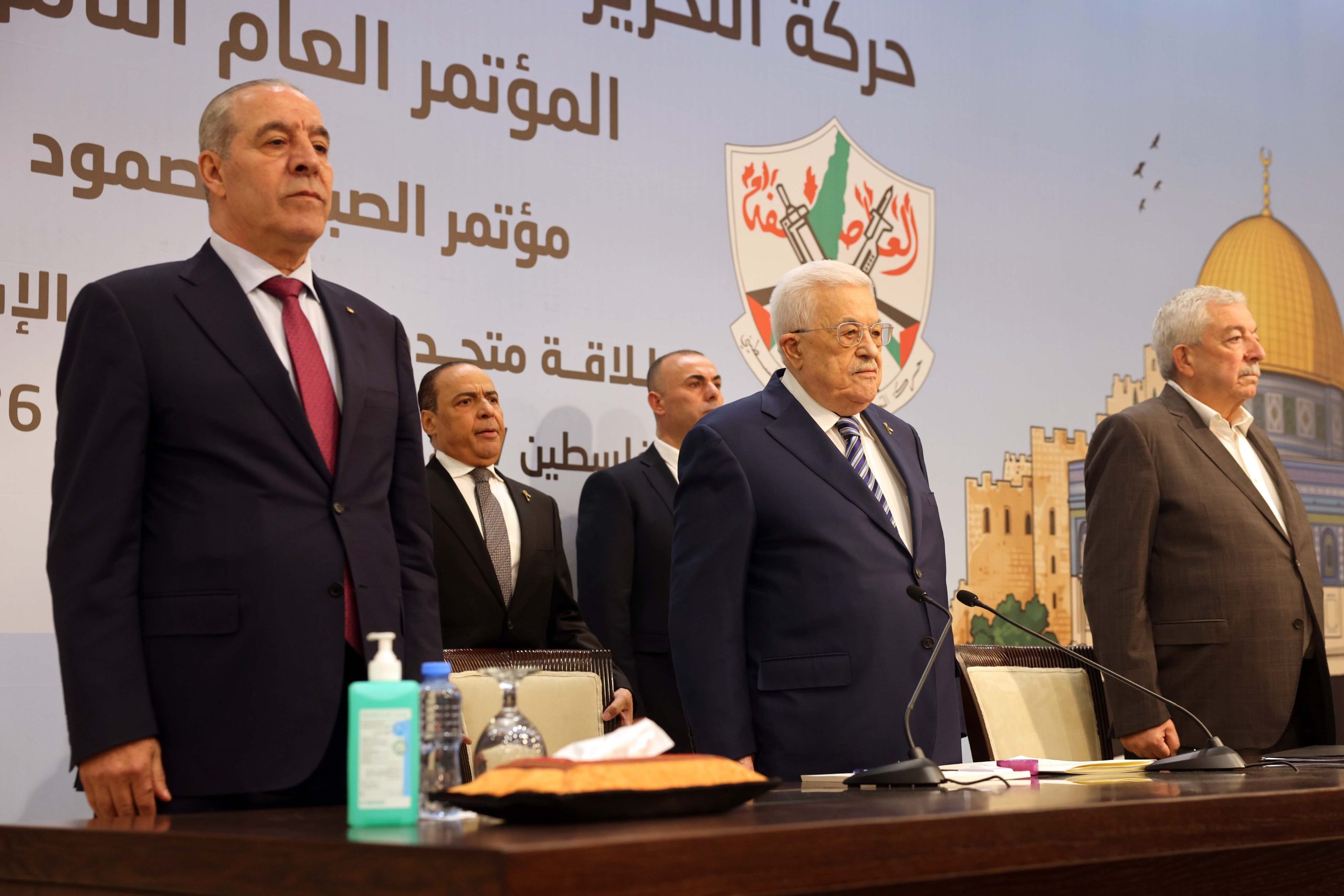
Follow us on GoogleFatah’s eighth conference convened last month following internal struggles, criticism of the organization’s leadership, and the departure of senior activists, all of which cast doubt on the ability to hold it. Yet its outcomes indicate that Palestinian Authority Chairman Mahmoud Abbas, with the help of his loyalists and institutional mechanisms, succeeded in convening a conference with a larger number of participants than in the past, conducting elections, and incorporating new and younger figures into the organization’s central institutions. The large number of candidates for these bodies demonstrated that it is still possible to mobilize support for Fatah’s ranks despite its weakness, and the fact that Abbas and his loyalists occupy most of the seats on its Central Committee indicates that his political line will remain in effect after the conference. However, the high expectations for ideological renewal, internal unity, and a reassessment of policy regarding the conflict with Israel — which intensified following the war in Gaza — were not met at the conference. The issue of unity, which was not advanced, stands at the center of the post-conference discourse, alongside the absence of Dahlan’s camp and the expectation that Hamas will converge under the umbrella of the PLO. In light of this, Israel must make the necessary distinction between these two organizations.
Fatah’s Eighth Conference convened on May 14–16 against the backdrop of high expectations, shaped by statements from commentators and veteran Fatah activists who, in the wake of the war launched by Hamas on October 7, 2023, hoped for a new direction, internal organizational introspection, renewal, and broader Palestinian unity.
Despite their criticism of Fatah — and even their disillusionment with it — these voices notably continued to view the organization as the appropriate national platform to lead the realization of these expectations. Their statements in this context included several key demands: the need to formulate a new political program distinct from that adopted by the Palestine Liberation Organization (PLO) over the past three decades, following a reassessment of the Oslo process and of the role of the Palestinian Authority and its security apparatuses; the revitalization of the PLO as a liberation organization encompassing all Palestinian factions; and the creation of a clear distinction between the PLO and the Palestinian Authority, as well as between Fatah and both of them.
According to these views, Fatah was perceived as an organization that should return to leading the national liberation effort and reverse what has been described in Palestinian public discourse as its transformation into a political party.
The conference, however, did not deliver the anticipated breakthrough, and these expectations were unmet. Instead of addressing these core issues, the conference focused on personnel changes and on staffing the organization’s two central institutions — the Central Committee and the Revolutionary Council — with new figures aligned with Mahmoud Abbas or with the political course he has pursued since his election to the presidency.
The conference was held across four locations: Ramallah, Gaza, Beirut, and Cairo, to which many Palestinians from the Gaza Strip had been displaced as a result of the war. From the perspective of Abbas and his loyalists, the conference was viewed as part of a prolonged reform process across all Palestinian institutions, adopted in an effort to meet the expectations of European sponsors. This process was preceded by municipal elections, the setting of dates for elections to the Legislative Council and the Palestinian National Council, as well as the establishment of a mechanism for replacing Abbas in the event of incapacity.
The conference attracted considerable attention despite criticism and the withdrawal of prominent activists within the organization, including Nasser al-Qedwa, Muhammad Ghuniem, and Ouni Mashani. In addition, the number of voting participants exceeded 2,500 — higher than in previous conferences and compared to approximately 1,500 participants in the previous conference in 2016. While many of these were recruits or newly registered members mobilized to support Abbas and his policies, the festive and competitive atmosphere they contributed to the conference should not be overlooked. Moreover, the fact that the conference took place during a period of war, in which the Palestinian issue has reached a historic low point, may indicate the continued standing of Fatah as an authentic Palestinian national organization, which, despite its weaknesses, many still fear losing.
The voting results for the organization’s institutions indicate the preservation — and even strengthening — of the system surrounding Abbas, including the “guard” around him that is perceived as continuing his path, despite widespread accusations of corruption. Abbas himself was once again elected unanimously, without competitors, as Chairman of Fatah, and more than half of the members of the Central Committee are now from his inner circle. Some are relatively new figures, adding a degree of renewal without challenging the existing balance of power.
At the same time, the absence of Mohammed Dahlan’s faction from the conference continues to cast a shadow over Fatah’s cohesion. This is a significant faction, and many view its absence as effectively the absence of representation for the Gaza Strip within Fatah. Dahlan and his people rejected Abbas’s conditions for their return to the organization, viewing them as an attempt to humiliate them. This may also help explain — at least in part —the sense of marginalization felt in the Gaza Strip regarding the election results.
The election process was accompanied by numerous allegations and suspicions of fraud, lack of transparency, and, in particular, organized efforts to secure the election of figures aligned with Abbas and his loyalists through pre-prepared lists. In this context, the case of Fares Cadoura, one of the prominent figures in Fatah, stood out: he claimed that he was not included in the Central Committee despite receiving more votes than Muhammad Shtayyeh, who was reportedly included in his place. Cadoura strongly criticized the conduct of the voting and vote-counting process. The failure to elect Husam Zomlot, the PLO envoy in London, who had run for a seat on the Central Committee, also raised many questions. As a result, other dissatisfied figures announced their departure from Fatah.
Among those elected, several key groups stood out. The first is the group of Abbas loyalists and members of the security-administrative establishment. Majed Faraj, head of the General Intelligence apparatus, and his businessman son Yasser were elected to the Central Committee. This was alongside Hussein al-Sheikh, who had felt his standing weakened on the eve of the conference but was compensated by being elected as Abbas’s deputy Chairman. Mahmoud al-Aloul, whose standing has declined, Ahmed Helles from Gaza, and others belonging to the inner circle of the current leadership also retained their positions. At the same time, the election of Yasser Abbas, Mahmoud Abbas’s son, continues to draw criticism even after the conference, due to concerns over nepotism and the potential transfer of power through inheritance within the Palestinian establishment.
A second group is that of “symbols of the struggle” — former prisoners and figures associated with the Intifada and armed struggle, including Zakaria Zubeidi from Jenin and Taisir Burdini from Gaza, who were released in one of the recent prisoner exchanges. Their election is seen as an attempt to compensate the prisoner constituency for the erosion of their status and the financial support previously provided by the Palestinian Authority, which has been reduced following pressure and sanctions from Israel. However, critics such as Nasser al-Qedwa argue that former prisoners are not suited for membership in the organization’s Central Committee, and that their inclusion may provide Israel with grounds to portray it as a body that includes “terrorists,” potentially limiting their ability to operate.
A third group that stood out at the current conference was that of women. The number of women who reached key positions in the organization’s institutions and were elected to top places is higher than in the past. Among the most prominent are Dalal Salameh from Nablus, a former member of the Central Committee; Laila Ghanam, Governor of Ramallah who is close to Abbas; as well as members of the Revolutionary Council Fadwa Barghouti, the wife of Marwan Barghouti — the popular prisoner who was elected first to the Central Committee; Dr. Dalal Erekat, daughter of Saeb Erekat, who previously led negotiations with Israel; and Hanan al-Wazir, daughter of Abu Jihad, one of Fatah’s founders. All three ranked among the top six out of the Council’s 80 members. Alongside their personal qualifications, it is difficult to ignore the weight of family and symbolic lineage that helped some of them secure their election.
The elections and the personal changes in the composition of Fatah’s Central Committee and Revolutionary Council were, in effect, the core focus of the conference. The high expectations that preceded it — reexamining adherence to the Oslo accords, outlining a new policy toward Israel, strengthening the status of the PLO (which some view as having been weakened through institutionalization and the abandonment of the spirit of struggle), and clarifying the hierarchy among the various institutions — were, in practice, sidelined.
Abbas addressed these issues in his opening speech but did not signal any shift from the positions he had expressed in the past. His remarks were largely directed at the international community in light of the recent war and the shift in perception it generated among many regarding conflict resolution and the inability to ignore Palestinian national institutions. He frequently used terms such as “international legitimacy,” “one weapon,” “one authority,” “two states,” and “elections” — phrases not typically associated with the leader of a liberation organization emerging from a war or a severe national crisis. This stands in contrast to past conferences, where the tone was more revolutionary and where the renunciation of armed struggle was framed as a temporary measure rather than a fundamental shift in the organization’s doctrine.
Abbas also emphasized the need to rebuild the Gaza Strip and assist the Palestinian people in the aftermath of the recent war, noting the high number of casualties and the ongoing suffering. The question of who will govern Gaza was central to his remarks. He asserted that no solution has a future without the PLO, the sole legitimate representative of the Palestinian people.
He described October 7 as a “glorious”/“serious” (Majida in Arabic) act, but argued that it must be judged by its outcomes. “The Palestinians,” he said, “were massacred, displaced, their cities destroyed because of this action, and they were left with nothing.” He avoided directly condemning Hamas in this forum, despite having criticized it on multiple occasions since the war for the “disaster” it had caused. This restraint likely reflects internal divisions within Fatah and the continued public support for Hamas within Palestinian society. The fragile balance Abbas attempted to strike in his speech reflects the deep ideological tensions and internal struggles that preceded the conference.
It appears that, from Abbas’s perspective — as well as from that of key figures in the Central Committee who are not from his inner circle — the issue is clear: the Oslo path remains preferable, despite the erosion of public confidence in it. In his characteristically ironic tone, Abbas remarked during his speech, “We want the treacherous Oslo accords.” This reflects an understanding that Oslo was not a marginal step, but one that granted global recognition to Palestinian institutions and firmly embedded the Palestinian issue in international awareness.
Jibril Rajoub, Secretary of the Central Committee, who has had disagreements with Abbas, expressed even more far-reaching views in his summary of the conference, which he described as a significant achievement. According to Rajoub, the Oslo path should continue, as developments since then demonstrate that “Palestine” has become firmly established as a state in international awareness, with many advocating for its establishment. He argued that the PLO is the sole representative of the Palestinian people, and that Hamas must come under its umbrella and declare its acceptance of the principles the PLO has set in its engagements with it.
According to Rajoub, Hamas must undergo a process of introspection and clarify what lessons it has drawn from the recent war, as it is inconceivable that the war has not left its mark on its political strategy. The message emerging from the statements of Abbas and Rajoub is that Fatah’s leadership views October 7 as a failure of Hamas’s approach and as a potential opportunity to reunify the Palestinian ranks under the longstanding umbrella of the PLO.
Following the conference — and after such a difficult war — the central question is whether Fatah can convince the Palestinian public that its path remains the correct one, or whether this conference was “a kind of funeral” (for Fatah), as described by Palestinian commentator Lamis Andoni, a Palestinian publicist based in Jordan. While the election of new and younger figures to the organization’s institutions reflects a positive development, it does not necessarily indicate public support for the organization or for the direction it has chosen to pursue. On the contrary, many of those disappointed by the conference results are angry, and some have even announced their departure from Fatah.
Nevertheless, Abbas and the organization’s leadership do not appear to be significantly influenced by these voices. Their priority was to preserve the status quo rather than raise controversial issues for debate and decision during a sensitive period. In effect, everything has been postponed to the “day after” Abbas/the war. At that point, the struggle will not focus solely on Israel and succession, but also on the nature of the Palestinian system, its sources of authority, its decision-makers, and the question of control over Gaza.
These developments may require Israel to reassess its approach to the Palestinian arena, clearly define its needs vis-à-vis the Palestinians, move away from treating all Palestinian power centers as a single entity, and prioritize those committed to coexistence over those who oppose it.