


Publications
An overview of China’s defense exports to the region and an assessment of the implications for Israel
INSS Insight No. 2125, March 30, 2026
Follow us on GoogleOver the past several decades, China has established itself as a global power in the political, economic, and military arenas, while advancing a broad strategic vision and its own set of global interests. The expansion of its international influence and its strategic development plans has increased both its security needs and its defense capabilities. Accordingly, recent years have seen a steady rise in China’s defense budget alongside significant military development. One of the central tools through which China promotes its force buildup and expands its international influence is defense exports. In recent years, Beijing has sought to expand its presence in defense export markets, which has enabled it to strengthen its domestic defense industry and develop indigenous technological capabilities while also deepening political, security, and economic ties with other countries. This article reviews the current picture of Chinese defense exports to the Middle East, based on the SIPRI database and other open sources. For the purpose of this analysis, the Middle East is defined as extending from Iran in the east to Egypt in the west, and from Turkey in the north to Yemen in the south.
Over the past several decades, China has established itself as a global power in the political, economic, and military arenas, while advancing a broad strategic vision and its own set of global interests. The expansion of its international influence and its strategic development plans have increased both its security needs and its defense capabilities. Accordingly, recent years have seen a steady rise in China’s defense budget alongside significant military development. In October 2017, at the opening of the 19th Congress of the Chinese Communist Party, Chinese President Xi Jinping presented a clear strategic goal: by 2035, China’s military and defense sector are expected to complete a comprehensive modernization process, and over the longer term—by 2049, the centennial of the founding of the People’s Republic of China—to have an armed force of a leading global power. This goal reflects China’s aspiration to position itself not only as a major economic power but also as a player capable of strategic influence in the international arena. One of the central tools through which China promotes its force buildup and expands its international influence is defense exports. In recent years, Beijing has worked to expand its presence in defense export markets, which enables it to strengthen its domestic defense industry and develop indigenous technological capabilities, while also deepening political, security, and economic ties with other countries.
This article, which updates a previous article from 2018, reviews the current state of Chinese defense exports to the Middle East, based on data from SIPRI and other open sources. Because SIPRI does not have access to data on actual defense transactions, it developed a unique index for calculating trends in defense exports known as the Trend-Indicator Value (TIV). SIPRI’s TIV metrics do not reflect the cost of arms deals and therefore should not be compared directly to monetary values. Their main use is as baseline data for calculating trends in arms deliveries over time and the scale of defense exports to or from particular countries. The analysis does not include small arms such as assault rifles, machine guns, and ammunition, nor cyber warfare capabilities, which are particularly difficult to track. The analysis also assumes that there are arms deals that SIPRI does not include in its data. For the purposes of this article, as in the previous one, the Middle East is defined as extending from Iran in the east to Egypt in the west, and from Turkey in the north to Yemen in the south.
Chinese defense exports to Middle Eastern countries began in the mid-1970s, and by the end of 2025 their cumulative volume reached only about 13.5 billion TIV. Most sales, totaling about 8.8 billion TIV, occurred in the 1980s—the most profitable decade for China in the Middle East—during which China exported large quantities of weapons to both sides in the Iran–Iraq War (see figure 1). In the 1990s, after the Cold War, the volume of Chinese defense exports to the Middle East fell to about 1.8 billion TIV, most of which went to Iran. This downward trend continued in the first decade of the 21st century, when the volume reached about 1.4 billion TIV, primarily to Iran and Egypt.
Figure 1.
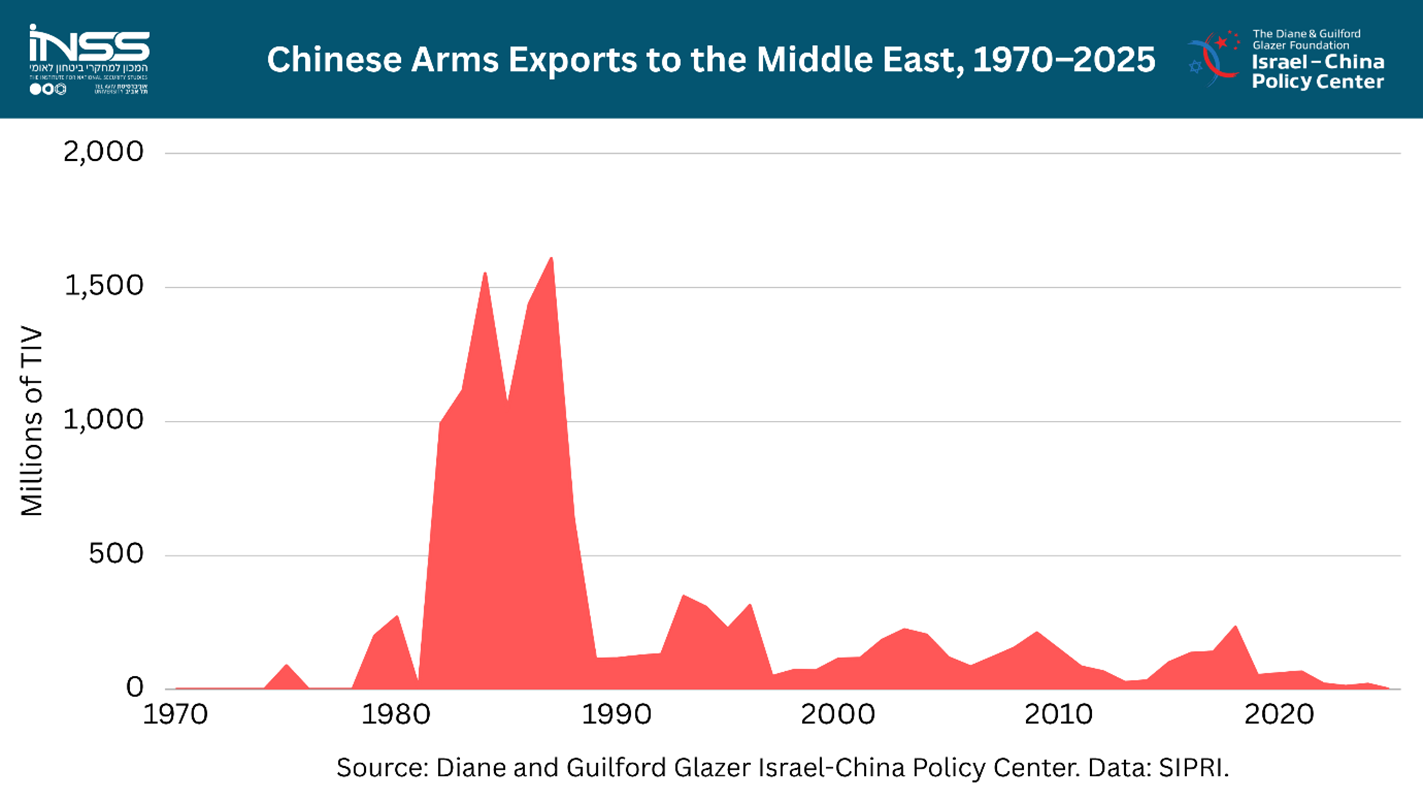
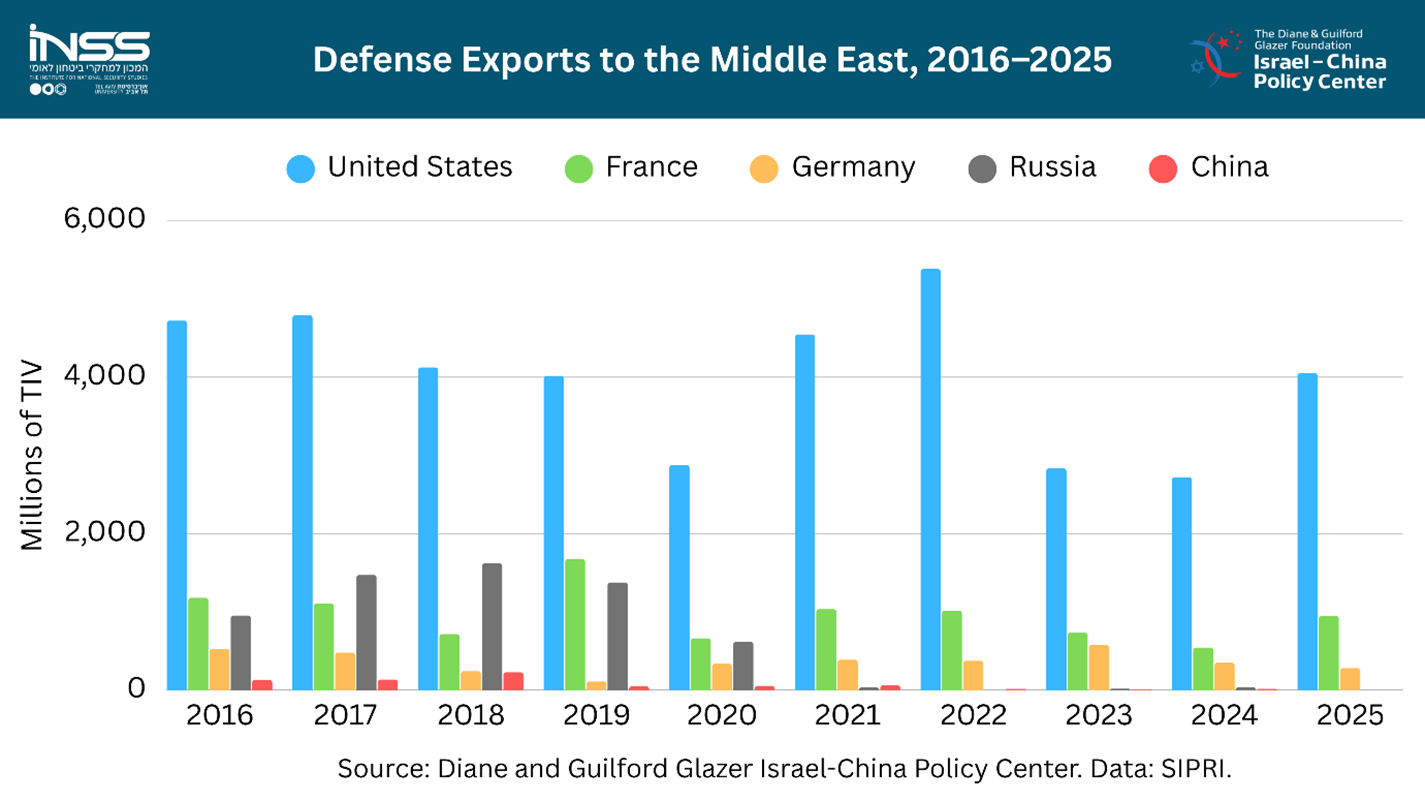
Despite China’s accelerated development in recent years, the current decade has also seen Chinese arms sales to the Middle East continue to decline (see figure 2). As of 2025, China ranks as the world’s fifth-largest arms exporter, having fallen behind Germany and France, and still far behind the United States. In 2021–2025, the total volume of Chinese global defense exports amounted to about 8.58 billion TIV, an 11% increase compared to the previous five-year period. Between 2016 and 2025, Chinese arms exports to the Middle East were estimated at about 732 million TIV—only about 4% of China’s total global defense exports in those years. By comparison, according to SIPRI, US arms exports to the Middle East (excluding Israel) during the same years were estimated at about 19.5 billion TIV, 170 times the total of Chinese sales.
Figure 2.
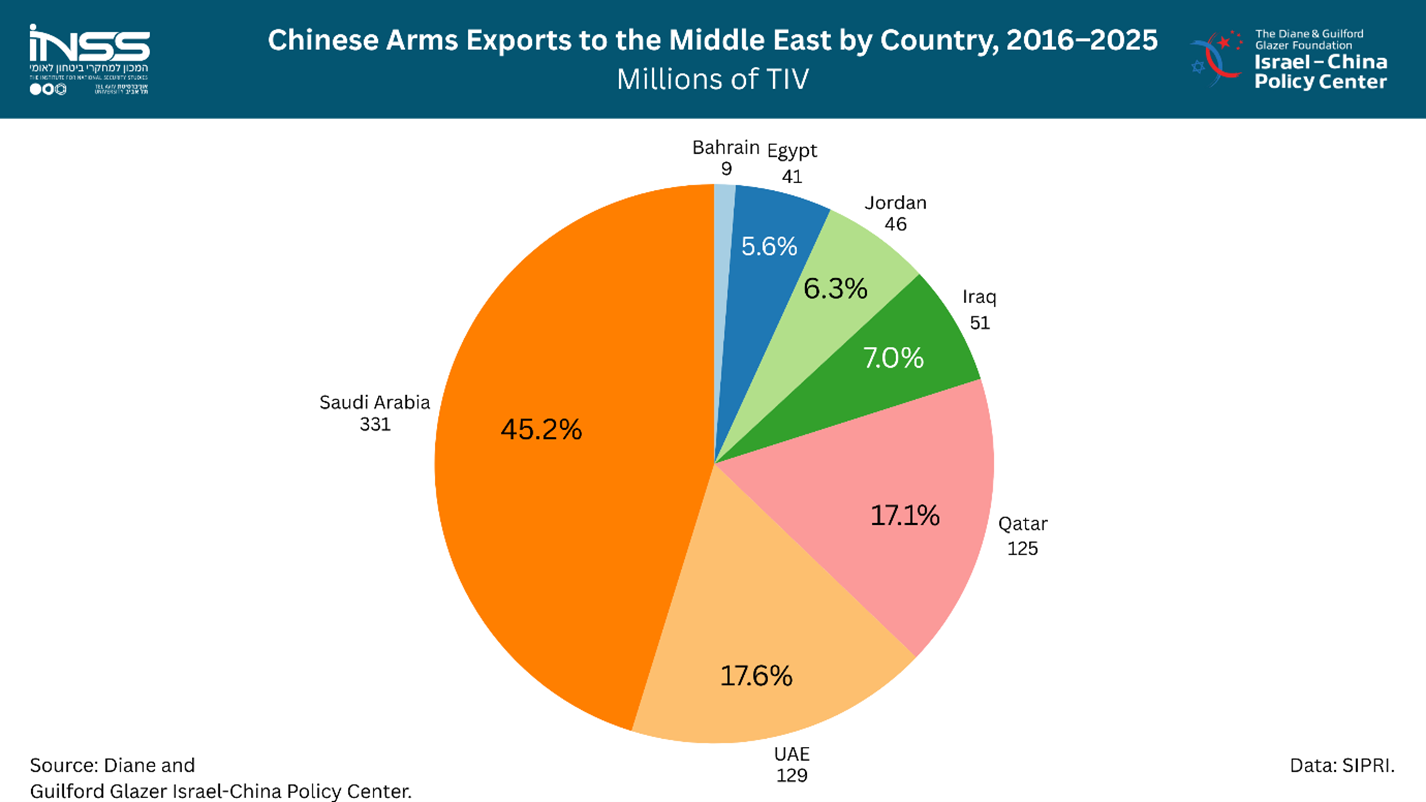
More than 80% of all Chinese defense exports to the Middle East between 2016 and 2025 went to the Gulf states (see figure 3), with Saudi Arabia as the leading customer, securing deals totaling about 330 million TIV (for comparison, Saudi deals with the United States during the same period are estimated at about 19.3 billion TIV). It appears that China directs its defense exports toward countries that maintain good ties with the United States, perhaps to capture a share of the American defense market, as these countries generally have substantial defense procurement budgets. In this context, it is worth noting the field of armed UAVs, which the United States refrained from exporting to the Middle East, allowing China to fill the gap. By contrast, SIPRI reported no defense transactions between China and countries embroiled in internal political conflict or in conflict with the United States—namely, Iran, Yemen, Lebanon, and Syria—perhaps out of concern about taking sides in conflicts and risking sanctions, terrorism, or international criticism.
Figure 3.
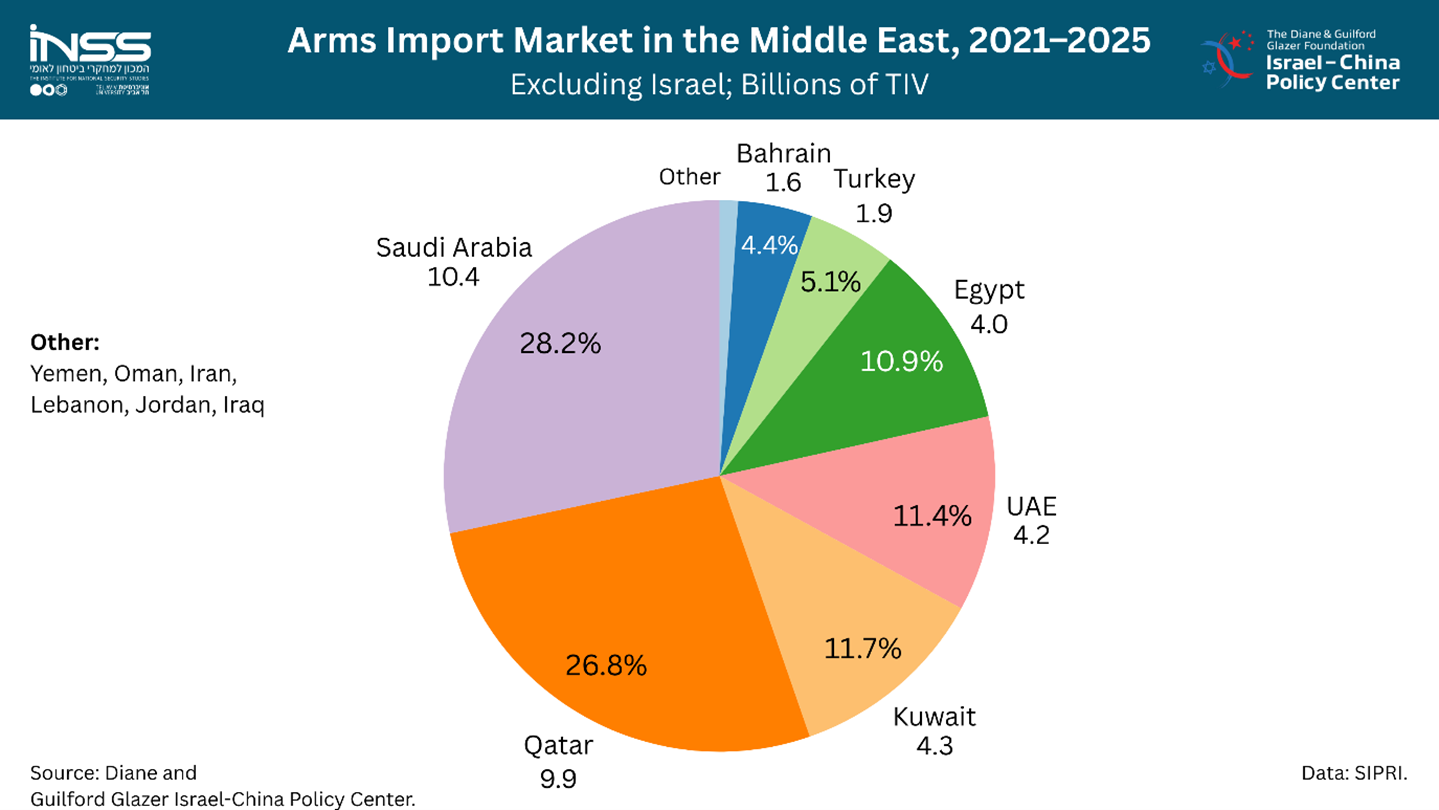
Between 2021 and 2025, defense imports in the Middle East totaled about 37 billion TIV. The leading countries in military procurement during this period were Saudi Arabia (about 10.4 billion TIV), Qatar (about 9.9 billion TIV), and Kuwait (about 4.3 billion TIV) (see figure 4).
Figure 4.
Saudi Arabia
According to SIPRI, Saudi procurement from China began in the 1980s, with the purchase of DF-3A ballistic missiles with a range of thousands of kilometers for 450 million TIV. The deal was conducted under a veil of secrecy and was disclosed only in 2014, when Saudi Arabia publicly displayed the missiles for the first time. In 2007, Saudi Arabia also purchased DF-21 ballistic missiles and PLZ-45 self-propelled artillery. A US report from 2022 stated that China is providing technological assistance to Saudi Arabia’s domestic missile program. Since 2010, Saudi Arabia has primarily purchased UAVs from China. Between 2017 and 2022, the Saudis received 50 Wing Loong-2 UAVs; in addition, a soft-kill anti-drone system, apparently the Silent Hunter, was observed in Saudi service. In March 2026, a $5 billion deal was reported for local production of the Wing Loong-3 UAV at a rate of about 48 aircraft per year, which would make Saudi Arabia the first customer in the world for this platform.
Iran
Defense cooperation between China and Iran since the 1980s has focused on the transfer of missile know-how, the construction of production infrastructure, and the development of Iran’s indigenous capabilities, including assistance to its nuclear program. Over the past decade, however, there has been a significant slowdown. In fact, since the JCPOA agreement in 2015, no arms deals between the two countries have been reported, despite the 25-year strategic cooperation agreement signed in March 2021, which did not alter the trend in defense exports. China has refrained from direct defense exports to Iran, which could have triggered tensions with the United States and harmed its relations with the Gulf states. In February 2026, it was reported that Iran was in advanced negotiations to purchase CM-302 cruise missiles—a report later denied by China. Reports concerning the sale of Chinese air defense systems have also not been substantiated as of this writing. At the same time, China assists Iran by supplying equipment and materials for the production of weapons. According to a US publication, during 2025 Iran imported about 1,000 tons of ammonium perchlorate from China, a powerful oxidizer used in the production of rocket propellant. Western assessments held that this quantity could be sufficient to produce solid fuel for several hundred ballistic missiles. Chinese deliveries to Iran of sodium perchlorate, a critical component in solid fuel for missiles, were also reported after Operation Rising Lion. Notably, after the current war, in which the United States and Israel are seeking to destroy Iran’s military production infrastructure, Iran could turn to China for help in rebuilding production infrastructure, acquiring materials, and perhaps even weapons systems, with payment potentially made in oil.
The United Arab Emirates
The United Arab Emirates is a major Chinese customer in the Middle East for various types of UAVs. Between 2013 and 2017, it purchased 25 Wing Loong-1 armed UAVs from China, and later in that decade it also acquired 15 units of the more advanced second model. Alongside these, the UAE also procured ground platforms such as the AR-3 rocket launcher and the AH-4 towed howitzer. Chinese combat systems in UAE service also gained operational experience in the confrontation with the Houthis, during which a number of Wing Loong-2 UAVs were shot down. These models were also supplied to Libya and Sudan in support of internal struggles there. The UAE also became the first country in the Middle East to purchase 12 L-15 trainer jets from China. The Dubai Airshow is considered one of China’s main venues for marketing new combat platforms.
Egypt
In the past decade, Egypt began a trend of procuring advanced UAVs of various types, including the CH-4B and the Wing Loong-1. Egypt manufactures the ASN-209 reconnaissance UAV domestically as part of an agreement signed with Xi’an Aisheng Technology. Other deals reported in recent years include electronic warfare systems as well as ten WJ-700 armed UAVs, although, at the time of this writing, it remains unclear whether they have been delivered. In early 2025, it was reported that Egypt was expected to purchase J-10C Chinese fighter aircraft. Subsequently, in a rare move, China’s Ministry of National Defense spokesperson Senior Colonel Wu Qian denied the existence of such a deal. Between 2016 and 2025, the volume of Chinese defense exports to Egypt stood at about 41 million TIV, six percent of China’s total defense exports to the entire Middle East during that period.
Terrorist Organizations
Iran has transferred some weapon systems developed using Chinese technology to Hezbollah and Hamas, which have been used in conflicts with Israel. For example, during the Second Lebanon War in the summer of 2006, an Iranian version of the Chinese C-802 missile fired from the Beirut coast struck the Israeli Navy’s missile corvette INS Hanit. During the Swords of Iron war, Hezbollah employed QW-18 shoulder-fired anti-aircraft missiles, while Hamas used a variety of small arms, the most prominent being the advanced Red Arrow 8L anti-tank missile. These weapons were almost certainly transferred or smuggled from Middle Eastern or African states to the terrorist organizations and were not sold directly by China.
Trends That Will Affect Chinese Defense Exports
- The implications of the war in the Middle East
The conflicts in the Middle East since the Swords of Iron war, as well as the escalation between Iran and its proxies and Israel and the United States, are expected to increase demand for defense imports into the region. States in the region are therefore compelled to strengthen their military capabilities, including the purchase of advanced systems to reinforce existing arrays or replace systems damaged in combat. The option of importing defense equipment from China may also serve Middle Eastern countries as a bargaining tool vis-à-vis the United States—the world’s leading arms exporter—in order to pressure it to lift restrictions on the sale of certain systems. This dynamic may be especially evident among the Gulf states and Egypt, which maintain deep security ties with Washington but at times experience fluctuations in the volume of military assistance for policy reasons. At the same time, it should be emphasized that the United States has previously warned its allies that procurement from China would harm their defense cooperation with Washington, and that American weapons systems would be unable to operate alongside Chinese communications systems—let alone Chinese weapons systems.
- The constraints of a “captive market”
The Middle East is a “captive market,” albeit one with a growing appetite. A “captive market” means that the militaries tend to be relatively homogeneous: The different branches of the armed forces use systems that are compatible with one another; military doctrines are based on these systems and their capabilities; and the logistical framework also relies on supplier countries for spare parts and training. Moreover, by their nature, force-building processes bind suppliers and customers in a deep and long-term economic and military commitment. As such, defense trade relations are often both drivers and expressions of political and strategic relations between the trading states. In this way, over recent decades, and especially after the decline in Russian defense exports, the West has dominated the Middle Eastern arms market. For example, the fighter aircraft market is saturated and highly competitive, and states with substantial budgets tend to prefer Western platforms. Therefore, China, which seeks to export the J-35 stealth fighter, is expected to compete mainly for customers with more limited resources, with Pakistan remaining a key potential customer amid reports of an offer to sell about 40 aircraft to be delivered in the coming years. In this context, it is worth noting that in February 2026, the Chinese defense attaché presented a tabletop model of the J-20 stealth fighter—China’s most advanced aircraft—as a gesture to a senior Iranian officer, perhaps to demonstrate to his host China’s military sophistication, even if there is currently no readiness to realize such deals in the foreseeable future.
- The UAV field as a growth engine for Chinese defense exports
The UAV field, and perhaps other autonomous systems as well, offers China a significant opportunity to expand its defense exports. Platforms from the Wing Loong and Cai Hong families have considerable export potential, have already been acquired by many countries in Asia and Africa, and some have gained operational experience. At domestic and international arms exhibitions, China continues to unveil new and advanced models that, even if their technical specifications are open to question, testify to technological development. If these are offered at an attractive price, they may strengthen China’s hold on the regional UAV market, particularly at the expense of UAV exporters including Israel, Turkey, and the United States. More broadly, in the field of unmanned systems—not only in the air—the traditional defense industries of the United States and Europe do not enjoy the built-in advantage they have, for example, in fighter aircraft, allowing new players, including China, to secure a significant market share. Military robotics applications are another area in which Chinese exports appear to have future potential.
- Penetration into markets at the expense of Russian industry
Another path for expanding Chinese defense exports stems from the relative weakening of the Russian defense industry due to the war in Ukraine. The strain on production lines and delays in deliveries to foreign customers are harming Moscow’s ability to maintain its standing in traditional markets. This situation creates a window of opportunity for Beijing to offer alternatives, sometimes at lower prices and with greater availability. In this context, one may note the radar and air defense market, where weapons systems have been sold to several states—including the FK-3 and FD-2000—as alternatives to Russian systems, such as the S-300. States dissatisfied with the performance of Russian systems may decide to shift eastward, and China’s aggressive marketing efforts at defense exhibitions, along with its claim that its systems equal or even surpass those of the West, contribute to this.
- The test of operational experience
In addition, the military clash between India and Pakistan in May 2025, as well as the conflict between Thailand and Cambodia later that year, attracted considerable attention from defense establishments worldwide because they were regarded as the first “trial by fire” for several weapons systems exported by Beijing—arms that had not yet been tested in operational combat conditions. This trial by fire—especially for the J-10 fighter aircraft and the PL-15 air-to-air missiles—may prove to be a turning point in China’s defense export efforts, which so far have not made a significant inroad into the fighter aircraft market. Concurrently, various reports negatively highlighted the performance of some Chinese systems on the battlefield, such as the FD-2000 air defense system in Pakistan and the VT-4 main battle tank in Thailand. Despite massive investments in research and development of military technology, the more Chinese technologies are perceived as performing well in battlefield outcome tests, the more this may impress hesitant customers or enable China to gain market share from other exporters.
Conclusion
Over the past decade, Chinese defense exports to the Middle East have shown a downward trend, even though, from a global perspective, Chinese defense exports increased in 2021–2025 compared to the previous five-year period. This gap may be explained by the characteristics of the Middle Eastern market as a captive market, where large arms deals and defense agreements entrench the United States as the dominant weapons supplier in the region, while it also remains the sole security guarantor. The United States is broadening its arms offerings to key regional partners while simultaneously conditioning its supply on pushing China out—certainly in the defense sphere—and thus narrowing China’s room for maneuver. At the same time, current changes in the Middle East may herald a shift if Beijing succeeds in exploiting the geopolitical situation that emerges after the war. For example, China may be able to fill gaps in certain weapons systems in the absence of available, mature, and reasonably priced Western or Russian alternatives.
Over the past decade, Chinese defense exports to the Middle East have focused mainly on the Gulf states, led by Saudi Arabia, which possess strong economic capabilities and close ties with the United States. This policy aims to penetrate established markets, in part through the supply of armed UAV systems—a field in which the United States imposed export restrictions, thereby creating an advantage for China. At the same time, China has continued to avoid direct defense exports to Iran, Yemen, Lebanon, and Syria to reduce political and economic risks, even though indirect support continues through the transfer of materials, components, and knowledge for the production of weapons. In addition, weapons also find their way to terrorist organizations through smuggling routes, and IDF soldiers encounter them in battle.
Taken together, these trends may reflect a cautious yet ambitious Chinese policy aimed at expanding its defense influence in the region while balancing strategic, political, and economic interests. China’s military-technological buildup and development require Israel to monitor the sale of Chinese-made weapons systems and their potential leakage into hostile hands. Israel should also pursue quiet but determined diplomacy with Beijing to persuade it not to transfer game-changing combat systems, especially after the current war, when Iran will need to rebuild its military and defense industries and may turn to Beijing for that purpose. At the same time, Israel should continue promoting cooperation with the United States and regional players while investing in innovation and preserving its technological advantage over its adversaries and in the evolving threat environment.