


Strategic Assessment
At the global level and in many individual regions, the last seven decades have been an uncharacteristically structured period of history. Underwritten by the United States, the international system was grounded in economically and politically liberal values. This era is now fading, while in parallel, other processes are unfolding and hastening the advent of a post-alliance era, which will be more brutal and trickier to navigate than the outgoing order. For Israel, there are at least two implications. First, Israel will have an interest in developing further its proven skills in terms of seizing strategic opportunities and hedging, which in turn means generating ever better horizon-scanning assets. Second, there will be value in placing added emphasis on proaction versus reaction.
There never was a global Leviathan,
and ever since recorded history began in the Middle East, the world has more
often than not been Hobbesian. Nevertheless, elements of order have figured
more or less lastingly or successfully in the struggle of all against all.
Regional or even global hegemony, transient coalitions, limited-purpose partnerships,
alliances along with de facto or de jure rules concerning the waging of war or
the use of the global (or non-global) commons are also as old as recorded
history. Simply, some epochs and regions have been more anarchic than others.
The post-Ottoman Middle East is a prominent and longstanding example of such
disorder.
At the global level and in many key individual regions, the last seven decades have been an
uncharacteristically structured period of history. A combination of hegemony
(American, Soviet), a dense network of global rules (from Bretton Woods to the
law of the sea), and an array of American-centric non-transactional permanent
defense alliances in war-riven Europe and Asia-Pacific has provided anchors to
the international system and has enabled the transformative economic and social
process known as globalization. Underwritten by the United States, this system
was grounded at least in theory and
quite often in practice in economically and politically liberal values, such as
those enshrined in the UN Universal Declaration of Human Rights (1948).
This era is now fading for well-known
reasons, while in parallel, albeit at different rhythms, other processes are
unfolding, the most prominent being the rise of China as an illiberal
superpower; the questioning of liberal values and of globalization within democratic
societies, most importantly in the US; and the unorthodox political and foreign
policy practices of the leader of the world’s key power.
These and other forces are hastening
the advent of what I call a post-alliance era. This prospect is already deeply
affecting the way Europeans and Asians are considering their future strategic,
military, and diplomatic choices. Even if the early stages of the process are
still halting and inconclusive, there is a broad understanding that this time,
it is very different, and that the future may look more like the pre-1914 past
than an extension of the post-1945 (or 1989) present. For countries operating
in regions that are not structured by the alliance system underwritten by the
US, the impact may not be so obvious: after all, in a perverse way, this is
simply the world catching up with the Middle East’s Hobbesian normal. That may
be true, but as we shall see, this new reality also shakes up the Middle
Eastern strategic sandbox.
I will define the post-alliance era
briefly, then draw some implications in terms of its basic operating system,
which I will call “predation,” and in closing draw some consequences for MENA in
general and Israel in particular.
The Post-Alliance World
Several distinguishing traits have
already emerged from the interaction between the system-breaking forces
referred to above. First, and this is hardly an original remark, this spells
the end of the liberal rules-based order as the endpoint of history as imagined
by the post-Hegelians of the early 1990s. However, it does not mean the end of
liberal features in the new era, since liberalism remains an intellectually and
politically coherent force contending with an inchoate mix of authoritarianism
and sovereignism, and it will continue to have an important following.
Second, transactionalism, which was
never entirely absent in the outgoing era, will become the default mode of
international relations among former allies, as between others. Each
transaction is made on an independent basis and must stand on its own feet
(strategically, politically, or economically, as the case may be), with the need
to generate a profit from day one. Short-termism and one-offs will be the rule.
This deal-making in turn places a heavy emphasis on bilateralism, given its
basic simplicity. Overall, this does not entirely preclude some forms of long term
purpose-designed agreement, such as the 1979 Camp David accords. But anything
heftier in terms of participants and time becomes an outcome that is close to impossible
to achieve. The Treaties of Westphalia or the Vienna Congress are once a
century (or two) exceptions in this regard.
Third, the new era will entrench
itself, even after Donald Trump leaves the White House. Once dissipated, trust
is always difficult to restore. Moreover, Trump’s drive to end foreign wars, his
attempts to reduce foreign commitments, especially in bloody MENA, and his
focus on China are widely shared, well beyond the confines of his own
electorate. Indeed, much of this evolution began to happen under President
Obama, leading from behind in
Libya, not abiding by his own red lines in Syria, and pivoting to Asia. If
anything, the ongoing Chinese priority in Washington will be sharpened and
deepened.
Finally,
the reversion to a norm works with the grain of history, unlike the uphill
attempt to reestablish an exceptional situation. In historical terms, it is the
seventy-year era of alliances that is the exception. This point is well made
every time NATO prides itself on being without precedent: yes indeed, but that
is not reassuring. The norm is what prevailed in previous centuries or millennia.
In historical terms, it is the seventy-year era of alliances that is the exception. This point is well made every time NATO prides itself on being without precedent: yes indeed, but that is not reassuring. The norm is what prevailed in previous centuries or millennia.
Predation and Predators: Take the Money
and Run
Short-termism, transience,
bilateralism, and the absence of incentives for long term ventures are not
absolute. Planet threatening contingencies such as an acceleration of global
warming or pandemics may yet provide some space for global action, although
America’s decision to leave the Paris Accords does not make that case. But
day-to-day and on most issues, that is what the new era will look like.
For many countries and their leaders
this is hardly a change, and some may even see it as welcome since it offers
new opportunities, as Putin of Russia and Erdogan of Turkey have discovered. Indeed,
in a world where there are fewer rules and no permanent alliances, not only
does opportunity for predation increase, but opportunism becomes mandatory:
take your chances now or else…
In the outgoing era, the US was a
guarantor of relational permanence and long term stability, not only toward its
direct allies, but more broadly, in setting bounds to the conduct or misconduct
of others. In an alliance-free world, the US will find it difficult not to
become a predator in its own right. Donald Trump’s transactional approach to
each and every security situation is the crude precursor of what will become
habitual: the US is ready to send troops to Saudi Arabia (if KSA pays); the US
will abide by NATO’s Article V to defend Estonia (if it has paid its dues); the
US withdraws its troops from Rojava because these 1200 soldiers and their
Kurdish cohorts somehow cost too much; and so on. We should not assume that
this is a passing phase, just because these mercenary quid pro quos come in the
guise of the incumbent President’s
histrionics.
This
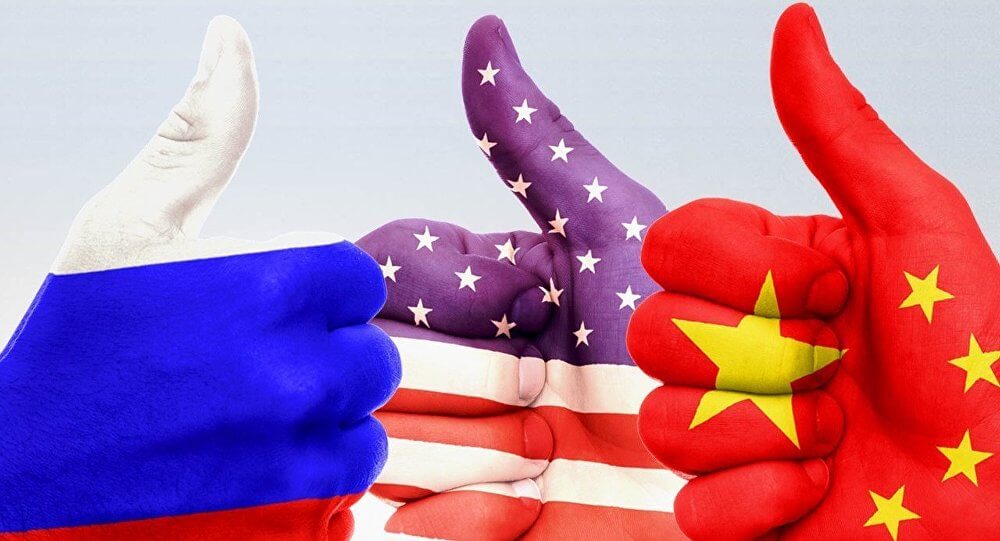
is a world in which three uber-predators will dominate the scene. A
strategically still cautious China has shown at the micro-level – think Angola,
Maldives, Montenegro, Malaysia - that it will eventually
prove to be an exceptionally unsentimental and grasping predator going after
much more consequential prey. Its “century of humiliation” at the hands of the
imperialist powers from the First Opium War onwards provides it with a rich
playbook to draw from.
Russia,
a power that has clearly expressed its dissatisfaction with post-Cold War order
inside and outside of Europe, is a skilled hand at predation and a master
at seizing opportunities. Its newfound political and military agility helps compensate
for its limited economic and demographic base, while its size, nuclear arsenal,
and location help put it in the “top three” league of predators.
The US, much more experienced than
China in orchestrating all forms of power, will prove to be an exceptionally
able predator once it moves
beyond the chaos of the current administration: what served for the good from
World War II onwards will simply be repurposed and redirected as a consequence.
This will be done all the more readily given the new forms of predation that
are joining those inherited from the pre-nuclear and pre-digital age.
The US, much more experienced than China in orchestrating all forms of power, will prove to be an exceptionally able predator once it moves beyond the chaos of the current administration
Cyberspace is one such area that
began to feature as a major arena for all types of operations nearly fifteen
years ago, with the first big DDOS attack against Estonia in 2007. Although much
of its physical and human infrastructure is substandard, the United States’s technological
base is at least holding its own vis-à-vis China as a source of digital
research and innovation.
Less obviously, interdependence
itself, which is often viewed as a pacifying element in international
relations, is increasingly weaponized, to use Henry Farrell’s and Abraham
Newman’s formula. Because the global financial and trading system is
dollar-centric, hardly any cross-border enterprise can escape America’s reach,
including in legal terms. It took the US decades to move from a piecemeal and
case-by-case approach to a tightly-integrated inter-agency policy in using its
power of seigniorage, broadly defined. The potential power of an integrated
onslaught became apparent early in this decade with the deployment of the full suite
of primary and secondary sanctions
against Iran during the nuclear negotiations of 2012-2015. Since then, the
toolbox has been improved further. Despite current Iranian complaints against a
European Union that fails to circumvent current American sanctions, the fact is
that few Chinese or Russian firms are ready to run the risk of being cut off
not only from the US market but from the world market as a whole, and Iran
knows it.
America’s
ability to weaponize interdependence relies heavily on its cyberspace capacity
to scoop up intelligence on the contenders it monitors, and on the corresponding
electronic trail of money and transactions. But what lends its unique weight is
the dominant position of the dollar, which happens to be both a reserve and
exchange currency, as well as the ultimate property of the US government. If
you are caught using it in a manner that the US objects to, no amount of
complaining about the extraterritorial reach of American law will help.
This weapon is also directed as a
matter of course at US allies through secondary sanctions, but allies too can become primary
targets. On the intelligence side, the US consistently keeps track of European
companies and states, both directly and through third parties.
The weaponization of interdependence also
leads to the spread of what used to be an unusual form of international conduct
between industrial powers, in the form of “legal hostages.” Is there a US
problem with Huawei? You see to it that Canada arrests the chairman’s daughter.
You have a problem with a Franco-American merger? You have DoJ put a French
executive in a high-security US jail. If you are Chinese and have an issue with
securing the intellectual property rights of a foreign company, in the old days
(5 years ago) you extracted all the information on the computer your moles had obtained.
Now you just arrest some guy and wait for the exchange. Old fashioned
hostage-taking and kidnapping as practiced by terrorist groups, criminal gangs,
or rogue states now has a variant in the halls of political and corporate power
of the industrialized word.
In this brave new world, the
countries facing the challenge of the “three predators” most acutely are
America’s European and Asia-Pacific allies.
Europe’s problem is both value-based
and structural. The EU as a collective does not simply obey the rule of law and
eschew the use of force: being a peace project governed by the rule of law is
its DNA. The EU is thus poorly equipped to deal with predators in a language
they can understand. Structurally, the Europeans find it very difficult on the
one hand to integrate the considerable powers of the Union, notably in trade
and competition policy that even Google and Facebook have learned to fear, and on
the other hand, tools of sovereignty in the hands of member states: defense,
diplomacy, cross-border taxation. And although France, for instance, has
substantial armed forces with serious projection capabilities and the political
will to use them, they are those of a country of 67 million, not of a
500-million strong continental bloc. There is no European army.
Asia’s problems are more basically
strategic. If Japan, South Korea, Australia, and Taiwan do not have nuclear
weapons and have Western-friendly policies, it is thanks to extended US
deterrence. If that deterrence is seen as fading, these countries will consider
(or as in the case of the latter three, re-consider) the nuclear option and engage
in China-friendly hedging, at US expense.
Hobbes in MENA
MENA will not, and indeed does not,
escape the consequences of the post-alliance order, as the events of October
2019 in Syria make clear. The US dropped one set of allies, the Kurds. Toward a
NATO ally, Turkey, it managed to simultaneously display weakness, exhibit
subservience, and proffer grave insults. Prompting a helter-skelter US military
retreat, Trump cleared the ground for Syrian regime forces, the Russian
military and PMCs, and ISIS 2.0. This is not
exactly an improvement over the questionable US strategic performance in MENA
under Bush the son and Obama.
It doesn’t get any better. MENA is
famously known as a region of “frenemies,” but not all frenemies are equal and alike.
For Israel in particular, since 1967 the relationship with the US has been much
more deeply grounded than any other: it is an alliance. And some frenemies are
longstanding enemies of Israel, such as Iran, which is viewed as the number one
strategic threat since the end of the Iran-Iraq War. In the new world, in which
the US is focused on China and is in no mood for MENA adventures, the “flavor”
of frenemies may change more quickly than in the past. By the same token, the
strategic positioning of frenemies vis-à-vis the Israeli interest will become
more volatile. This evolution may be sharpened by the possible transformation
of the US broad-spectrum, consensus support for Israel into a bone of partisan
contention.
This carries at least two
implications. First, Israel will have an interest in developing further its
proven skills in terms of seizing strategic opportunities and hedging, which in
turn means generating ever better horizon-scanning assets.
Second, there will be value in
placing added emphasis on proaction versus reaction. Developing relations with
partners that may not be immediately useful may be a wise investment. Future
relations with the EU and its member states should be viewed through that prism:
cultivating links for the long run rather than simply pursuing the current
grumpy and sterile exchange of mutual disagreeableness. And Europe means Europe
rather than dialogue with the leader of Hungary. Why? Because relations with a
revisionist and opportunistic Russia are a common factor between Europe and
Israel, as is the transformation of America’s positioning towards its allies,
and China’s growing penetration of MENA, including Israel, and Europe. These
common concerns may at certain moments create common interests and lead to
common actions, and if they don’t, nobody will be worse off for trying.
Developing relations with partners that may not be immediately useful may be a wise investment. Future relations with the EU and its member states should be viewed through that prism
The post-alliance world will be more
brutal and trickier to navigate than the outgoing order. Precisely because so
much will have to be improvised on the spur of the moment (or as a result of a
wild leader’s intemperate twitter feed), upstream investment in diplomacy and
an even greater emphasis on understanding the evolution of one’s frenemies will
be of the essence. In effect, the premium will be on planning and preparing for
the as-yet unknown and unpredicted.