


Strategic Assessment
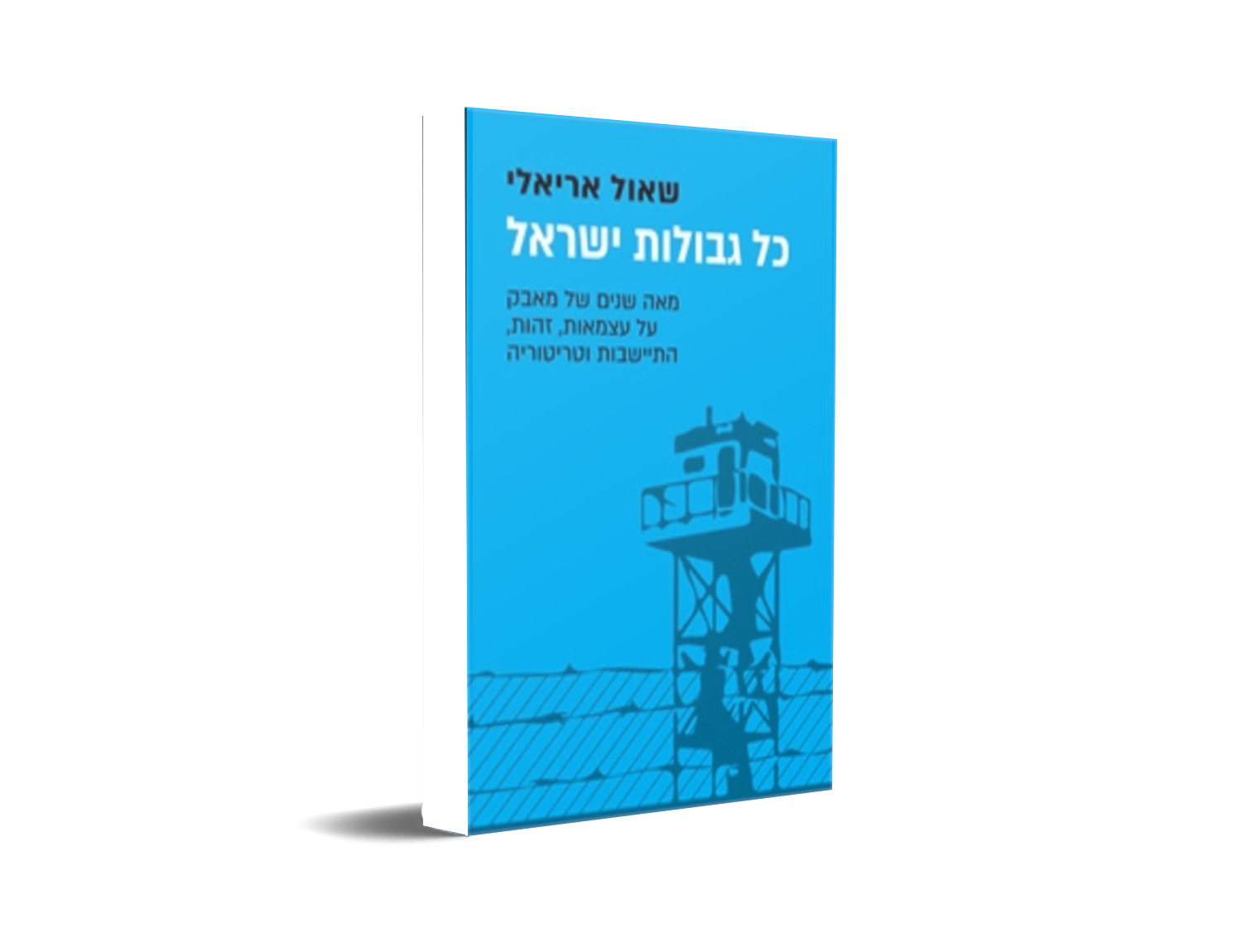
Drawing on extensive research and based on a wealth of data and testimony, this book by Dr. Shaul Arieli explores the debate about Israel’s borders as a process developing over time in light of “the reciprocal influence between geopolitical changes in the international, regional, and above all local system, and changes in the demographic-populated space.” The book consists of three main sections: the first discusses the definition of the term “border” in its practical application and includes related historical examples; the second part analyzes the various plans that have shaped the borders between Israel and Arab countries, and the territorial conflict between Israel and the Palestinians, with the focus on the rounds of talks between the parties and unilateral actions taken by Israel in this context; the third part is devoted to an analysis of the current status of the territorial conflict between Israel and the Palestinians, which is summarized by stressing “the need [for Israel] to separate from the Palestinians by unilateral or agreed actions in order to preserve Israel as a democratic state with a Jewish majority.”
- Book: All of Israel’s Borders
- By: Shaul Arieli
- Publisher: Books in the Attic
- Year: 2018
- pp: 442
Drawing on extensive research and based on a wealth of data and testimony, this book by Dr. Shaul Arieli explores the debate about Israel’s borders as a process developing over time in light of “the reciprocal influence between geopolitical changes in the international, regional, and above all local system, and changes in the demographic-populated space.” The book consists of three main sections: the first discusses the definition of the term “border” in its practical application and includes related historical examples; the second part analyzes the various plans that have shaped the borders between Israel and Arab countries, and the territorial conflict between Israel and the Palestinians, with the focus on the rounds of talks between the parties and unilateral actions taken by Israel in this context; the third part is devoted to an analysis of the current status of the territorial conflict between Israel and the Palestinians, which is summarized by stressing “the need [for Israel] to separate from the Palestinians by unilateral or agreed actions in order to preserve Israel as a democratic state with a Jewish majority.”
Indeed, Arieli’s decisive political-territorial conclusion is that separation from the Palestinians is the way to establish a border for Israel – preferably in the framework of an agreement, which will help stabilize the border. While adoption of the principles required for territorial negotiations is currently considered very unlikely given the political reality, both in Israel and among the Palestinians, it should nevertheless be recognized that a division of the disputed territory between the Mediterranean and the Jordan River that factors in security, demographic, and economic considerations will enable the State of Israel to implement the narrative and ethos underlying its establishment. In fact, Arieli contests the idea that after more than a century of conflict involving waves of violence and numerous victims, significant expansion of Jewish settlement in the West Bank territory, further erosion of the already low level of trust between the parties, repeated failure to finalize or implement any framework toward separation, and more than a decade of political stagnation, the parties have exhausted all possible ideas that can be formulated, put on the agenda, and deliberated about how to achieve a breakthrough in the relations between Israel and the Palestinians and promote physical separation.
A key term is “partition.” Once the borders between Israel and Egypt and Jordan, and in effect also between Israel and Syria and Lebanon, became clear and in some cases were even agreed and drawn in theory and in practice, the outstanding question refers to the partition of Mandatory Palestine, namely, the border between Israel and the West Bank. An accompanying term that explains why the borders between Israel and the Palestinians have not been demarcated until now (excluding the border between Israel and the Gaza Strip) is “dispute.” And the dispute continues, despite very significant changes that in the attitudes of Israel and the Palestinians regarding a desirable border.
Although it is doubtful whether the formula presented by Israel in the Annapolis Process (2008) is still relevant for the Israeli political scene of 2020, then there was clear acceptance by Israel of the territorial component – the 1967 lines – as the basis for a border with some territorial swaps, in other words “based on the 1967 lines.” It is not by chance that the “barrier” – the separation fence – was built on this basis, incorporating political considerations (UN Resolution 242), demographic considerations (specifically Israeli settlements on and to the east of the “seam line”), and security considerations (the need to protect these settlements, and the whole of Israel, from attacks). For their part, the Palestinians - and particularly the mainstream of the PLO/the Palestinian Authority, which in principle is Israel’s partner for any future/renewed talks – are no longer clinging officially to the “all or nothing” position, and this traditional stance has been replaced with the demand for a state within the 1967 borders.
The analysis of partition proposals and the controversies in the Israeli-Palestinian context follows a discussion of the concept of “border” between states and the considerations that throughout history have shaped borders according to historical, ethnic/demographic, and economic motifs; each case is presented with examples with their respective emphases. Like the analysis of the Israel/Palestinian conflict, this overview is formulated at an instrumental level, lacking any emotional or ideological element and stressing the multi-disciplinary and practical value of separation between distinct and hostile communities. Although the theoretical-historical survey does not go into details of the singular nature of the Israeli-Palestinian issue as a conflict between a state and a non-state entity over occupied territory, this is not a shortcoming, since Arieli’s research is dedicated specifically to this uniqueness.
The scope of the discussion on the Palestinian perspective toward the border issue is also fairly limited, mainly focusing on historical related changes at least at the declarative-political, if not the strategic level. However, the book describes nearly all of the Palestinian positions as reactive, in a way that rightly reflects both the gap in the balance of power between the parties and the author’s analysis and subsequent conclusions on the Israeli viewpoint and interests. Here too this is not a lapse but the expression of a conscious, reasoned, and methodological choice.

Although the text is comprehensive, readers will have to search for clarifications or turn to other sources to learn more about a number of topics. In the discussion of Jewish settlement in the West Bank, for example, the concept of “state land” is mentioned. It is precisely because of the conflict between Israel and the Palestinians and without the application of Israeli law and the political/ legal annexation of the territory or parts of it that the question arises: which state?
Moreover, while there is a border between Israel and the Gaza Strip, the political and institutional link between the Strip and the West Bank has undergone far reaching changes in recent years. It is not just a question of implementing a “safe passage” (which is reviewed specifically in the context of the Israeli proposal at the Annapolis talks), but also the actual ability to normalize relations between the rival camps in the Palestinian arena – Fatah and Hamas. In recent years it has seemed as if it is the geographical gap between the Strip and the West Bank, or in other words, Israel’s physical position in the middle, that has prevented bloody clashes between them.
Other key issues that must be resolved before any Israeli-Palestinian arrangement can be reached include the future of Jerusalem and the question of the Palestinian refugees. However, these are beyond the dilemma of the physical/functional border that is Arieli’s focus. He is aware of their importance, and they are mentioned in the epilogue under the heading “How to Get out of the Mess.” The same goes for the question of security arrangements. Indeed, the entire book is in part a reply to the question of which comes first – security arrangements before borders, or borders that take into account security considerations and imperatives.
It is possible to reject the idea of a separation between Israel proper and territories conquered in 1967 - which at present means the West Bank - with the argument of Israel’s ancestral right to the land or for reasons of strategic/security depth. The distinction between Israeli control of land in the West Bank as on the one hand deterministic and the manifestation of an advanced stage of a historical process, and on the other hand, as a response to a security need, is clarified very well in the first part of the book, before Arieli turns to a review of the plans regarding Israel’s border proposed over the years. Moreover, the fusion of the two different points of view is what has garnered significant support and hence shaped the political and practical preferences of many Jewish Israelis over recent decades. However, while to a large extent this dual focus explains the Israeli contribution to the ongoing political freeze, it does not nullify the logic underlying Arieli’s argument in the book’s conclusion, supported by the insights interwoven in its chapters. According to this argument, any proposed outline of an eastern border for the State of Israel has the clear potential to shape an improved national, security, political, and economic reality, and recognition of this fact should effect a change of attitudes in Israel, which is a condition for taking steps toward separation.
The delineation of the border is just one topic - though a critical one – among all the issues that Israel and the Palestinians must resolve if they wish to promote a negotiated agreement. However, in the efforts toward partition of the disputed area, the suggestion proposed by Arieli could be of great help. Its advantage is that it takes into account the demographic developments in the territory itself as well as the developments recorded in the relevant geopolitical arena in recent decades. No less significant is that it is guided by an effort to limit as far as possible any possible damage to the fabric of life and the welfare of people living on both sides of the border, in both the short and long terms.