


The Fatah-Hamas Reconciliation and the Israeli-Palestinian Negotiations | INSS
go to header go to content go to footer go to search
INSS logo The Institute for National Security Studies, Strategic, Innovative, Policy-Oriented Research, go to the home page
INSS
Tel Aviv University logo - beyond an external website, opens on a new page
  • Campus
  • Contact
  • עברית
  • Support Us
  • Research
    • Topics
      • Israel and the Global Powers
        • Israel-United States Relations
        • Glazer Israel-China Policy Center
        • Russia
        • Europe
        • Antisemitism and Delegitimization
      • Iran and the Shi'ite Axis
        • The Campaign Against Iran and the Shiite Axis
        • Iran
        • Lebanon and Hezbollah
        • Syria
        • Yemen and the Houthi Movement
        • Iraq and the Iraqi Shiite Militias
      • Conflict to Agreements
        • Israeli-Palestinian Relations
        • Hamas and the Gaza Strip
        • Peace Agreements and Normalization in the Middle East
        • Saudi Arabia and the Gulf States
        • Turkey
        • Egypt
        • Jordan
      • Israel’s National Security Policy
        • Military and Strategic Affairs
        • Societal Resilience and the Israeli Society
        • Jewish-Arab Relations in Israel
        • Climate, Infrastructure and Energy
        • Terrorism and Low Intensity Conflict
      • Cross-Arena Research
        • Data Analytics Center
        • Law and National Security
        • Advanced Technologies and National Security
        • Foreign Information Manipulation and Interference
        • Economics and National Security
    • Projects
      • Preventing the Slide into a One-State Reality
      • India-Middle East-Europe Economic Corridor (IMEC)
  • Publications
    • -
      • All Publications
      • INSS Insight
      • Policy Research and Papers
      • Special Publication
      • Strategic Assessment
      • Technology Platform
      • Memoranda
      • Posts
      • Books
      • Archive
  • Database
    • Surveys
    • Spotlight
    • Maps
    • Dashboards
  • Events
  • Team
  • About
    • Vision and Mission
    • History
    • Research Disciplines
    • Chairman of the Board
    • Board of Directors
    • Fellowship and Prizes
    • Annual Reports
    • Internships
  • Media
    • Communications
    • Video gallery
    • Press Releases
  • Podcast
  • Newsletter
  • Campus
Search in site
  • Research
    • Topics
    • Israel and the Global Powers
    • Israel-United States Relations
    • Glazer Israel-China Policy Center
    • Russia
    • Europe
    • Antisemitism and Delegitimization
    • Iran and the Shi'ite Axis
    • The Campaign Against Iran and the Shiite Axis
    • Iran
    • Lebanon and Hezbollah
    • Syria
    • Yemen and the Houthi Movement
    • Iraq and the Iraqi Shiite Militias
    • Conflict to Agreements
    • Israeli-Palestinian Relations
    • Hamas and the Gaza Strip
    • Peace Agreements and Normalization in the Middle East
    • Saudi Arabia and the Gulf States
    • Turkey
    • Egypt
    • Jordan
    • Israel’s National Security Policy
    • Military and Strategic Affairs
    • Societal Resilience and the Israeli Society
    • Jewish-Arab Relations in Israel
    • Climate, Infrastructure and Energy
    • Terrorism and Low Intensity Conflict
    • Cross-Arena Research
    • Data Analytics Center
    • Law and National Security
    • Advanced Technologies and National Security
    • Foreign Information Manipulation and Interference
    • Economics and National Security
    • Projects
    • Preventing the Slide into a One-State Reality
    • India-Middle East-Europe Economic Corridor (IMEC)
  • Publications
    • All Publications
    • INSS Insight
    • Policy Research and Papers
    • Special Publication
    • Strategic Assessment
    • Technology Platform
    • Memoranda
    • Posts
    • Books
    • Archive
  • Database
    • Surveys
    • Spotlight
    • Maps
    • Dashboards
  • Events
  • Team
  • About
    • Vision and Mission
    • History
    • Research Disciplines
    • Chairman of the Board
    • Board of Directors
    • Fellowship and Prizes
    • Internships
    • Annual Reports
    • Privacy Policy and Terms of Use
  • Media
    • Communications
    • Video gallery
    • Press Releases
  • Podcast
  • Newsletter
  • Campus
  • Contact
  • עברית
  • Support Us
bool(false)

Publications

Home Publications INSS Insight The Fatah-Hamas Reconciliation and the Israeli-Palestinian Negotiations

The Fatah-Hamas Reconciliation and the Israeli-Palestinian Negotiations

INSS Insight No. 542, April 27, 2014

Follow us on Google
עברית
Mark A. Heller
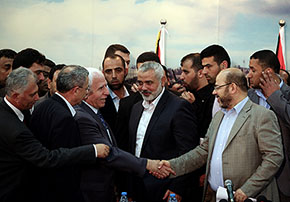
On Wednesday, April 23, 2014, representatives of Fatah and Hamas meeting in Gaza reached agreement on a long-sought reconciliation. That same evening, the Israeli government canceled a scheduled meeting of Palestinian and Israeli negotiators, and the following day, the government voted unanimously to suspend negotiations. The government argued that in his embrace of Hamas, Muhammad Abbas, the President of the Palestinian Authority and Chairman of the PLO and Fatah, had rejected peace. However, it is therefore not altogether clear why Israel, rather than initiating a suspension of negotiations after repeatedly insisting that Abbas commit himself to their continuation, did not instead exploit the reconciliation announcement to improve its standing in the international blame game that has been the main sub-text of the negotiations all along.

On Wednesday, April 23, 2014, representatives of Fatah and Hamas meeting in Gaza reached agreement on a long-sought reconciliation. That same evening, the Israeli government canceled a scheduled meeting of Palestinian and Israeli negotiators, and the following day, the government voted unanimously to suspend negotiations. The government argued that in his embrace of Hamas, Muhammad Abbas, the President of the Palestinian Authority and Chairman of the Palestinian Liberation Organization (PLO) and Fatah, had rejected peace. In fact, the nine months of negotiations preceding the Fatah-Hamas reconciliation (and, some might argue, the twenty years of on-again, off-again peace process with a Fatah leadership unconstrained by partnership with Hamas) had shown that Israel and Fatah, even operating on its own, are in any case exceedingly unlikely to reach an agreement that satisfies the minimal needs of the other’s center of political gravity. It is therefore not altogether clear why Israel, rather than initiating a suspension of negotiations after repeatedly insisting that Abbas commit himself to their continuation, did not instead exploit the reconciliation announcement to improve its standing in the international blame game that has been the main sub-text of the negotiations all along.

Although details – where the devil normally resides – were not announced, the main contours of the reconciliation agreement have been made public. Abbas will form a unity government of technocrats within five weeks, which will prepare for new presidential and parliamentary elections within six months; some reports also indicate plans to reconstitute the PLO, Israel’s formal negotiating partner. This agreement is the culmination of years of unsuccessful efforts to reconcile the two movements, first through discussions of reform of the PLO, and then through mediated negotiations to consolidate governance of the Palestinian Authority following the violent split between Fatah and Hamas in 2007. Those negotiations even produced two formal agreements (in Cairo, in 2011, and in Doha, in 2012), but all these reconciliation efforts ultimately crashed on the rocks of the struggle for power and control – especially over security agencies – even more than on differences over the approach to Israel.

It is not inconceivable that this latest agreement may have a longer life span than those that preceded it, largely because it provides an immediate response to the urgent needs of the parties: for Hamas, a mechanism to relieve the constrictions imposed by a hostile military-dominated government in Egypt, which sees Hamas as little more than an extension of the hated Muslim Brotherhood; for Fatah, a safety-valve to salvage the declining legitimacy of a President last elected eight years ago and under mounting pressure from a political challenge inside Fatah led by Muhammad Dahlan; for both, a way to use the popular cause of “national unity” to counter growing public disillusionment in the West Bank and Gaza with the suboptimal performance and petty rivalries of local governments. For these reasons, this effort at reconciliation may fare better than all those than came before.

Still, the historical record is not encouraging, and the practical, neuralgic implications of a unity government (such as the fate of Hamas prisoners in Fatah jails and the control of security agencies) have yet to be addressed. Most critically, if elections are actually held, each movement will have to decide whether, in the event of an electoral loss, it will voluntarily cede to the other the territory it now controls. It is thus entirely possible that political analyst and former Palestinian Authority official Ghassan Khatib may have been close to the truth when he told the New York Times, “The sides may be in need of a reconciliation, but neither side can afford success.”

But even if the reconciliation does succeed, it will make no appreciable difference to prospects for a comprehensive Israeli-Palestinian agreement, one way or the other. True, Hamas inside might conceivably entertain what Hamas outside has been unwilling to countenance (though the brief one-year experience of cohabitation in 2006-2007 does little to buttress that expectation). But it is Abbas himself  speaking for his own constituency  who has been unwilling or unable to accede to the condition that many (most?) Israelis consider the sine qua non of a definitive peace: recognition of Israel as the nation-state of the Jewish people, i.e., the principle of “two states for two peoples” embodied in the truly formative United Nations statement on the Israeli-Arab conflict, General Assembly Resolution 181 of 1947. Palestinian unity could, indeed, facilitate a peace agreement, but only if the result is that Hamas actually pushes Abbas to abandon his position on this issue, an outcome that is highly counterintuitive if not altogether hallucinatory.

In any case, what is critical for Israel is not whether every Palestinian faction endorses a putative agreement – after all, there are also some Israeli factions in the governing coalition that object to “two states for two peoples”  but rather whether the substantive content of that agreement meets Israel’s needs, and its implementation is conditioned on a serious ratification process, including an internationally-monitored “free and fair” Palestinian referendum. Until conditions emerge for a comprehensive agreement that can be put to such a test, there is no reason why a Palestinian government that includes Hamas should preclude ongoing conflict management arrangements (which Israel has jointly pursued with Hamas with respect to Gaza), including arrangements like the Temporary International Mechanism that facilitated the continuing funding and functioning of the PA in 2006-2007.

Since the developing Fatah-Hamas reconciliation process has no obvious implications for the Israeli-Palestinian negotiation process, the reasoning behind the Israeli government’s decision to initiate a formal suspension of negotiations is not self-evident. Rather than expose itself to the suspicion that it was grasping at an apparent opportunity to ease friction within the ruling coalition, the government could have shifted the onus to the other side, at the very least by forcing Hamas to redefine its approach to Israel and articulate more clearly its own approach to negotiations. After all, while a peace agreement is certainly a desideratum in the negotiations process, it may not be a realistic near-term objective, and it is certainly not the only objective. At this point, the aim of managing an unresolved conflict, including entrenching Israel’s international political standing, is just as vital. Challenging a potentially reformed PLO and PA that include major Hamas components to accommodate the international legitimacy embodied in the Quartet principles – recognition of Israel, renunciation of violence, and endorsement of existing Israeli-Palestinian agreements – could have more effectively promoted at least the second of Israel’s objectives, and perhaps even both of them.
The opinions expressed in INSS publications are the authors’ alone.
Publication Series INSS Insight
TopicsIsraeli-Palestinian Relations
עברית

Events

All events
Iran, US, Israel, and the Global Jewish Community
10 March, 2026
12:00 - 13:00
Shutterstock

Related Publications

All publications
Anadolu via Reuters Connect
Fatah’s Eighth Conference – Abbas’s Attempt to Leave a Final Mark
The gains, disappointments, implications, and conclusions for Israel following Fatah’s highly anticipated conference
16/06/26
REUTERS / Mohammed Salem
The Gaza Strip: Possible Directions for Breaking the Stalemate
How should Israel implement the necessary effort to disarm Hamas?
14/06/26
REUTERS
Alternatives for the Gaza Strip Following the Campaign Against Iran
As the campaign against Iran winds down, attention is expected to return to the Gaza Strip. In the meantime, Hamas is exploiting the strategic vacuum to rehabilitate its governance and military capabilities. Simultaneously, the Trump framework remains stalled, and the “Board of Peace” faces professional, operational, and budgetary difficulties in advancing its declared objectives. The issue of demilitarization remains trapped between Israel’s demand for the complete and immediate disarmament of Hamas and the organization’s stalling tactics. Israel faces three main alternatives: (1) Renewal of efforts to fully implement the Trump framework across the Strip, a course that carries the risk of “mock demilitarization” and depends on Hamas’s consent; (2) Gradual stabilization and reconstruction of areas cleared of Hamas while continuing to erode its control in areas still under its rule. This option is vulnerable to violent disruption and could entrench the Strip’s division; (3) A return to war and the reoccupation of the Gaza Strip, which would entail extremely heavy military, economic, and diplomatic costs for Israel. The key recommendation is to avoid perpetuating the status quo, which establishes Hamas’s rule, and instead adopt a proactive approach. Israel should allow the implementation of the Mladenov framework for gradual demilitarization, beginning with heavy weapons, while coordinating with the Trump administration regarding scenarios that would justify use of force. If Hamas obstructs the process, Israel should implement a differential alternative: the entry of a civilian committee and Palestinian police into “green zones” cleared of Hamas (alongside increasing Israeli security responsibility modeled on Judea and Samaria). Simultaneously, Hamas’s capabilities and governance in the “red zone” should be systematically degraded, including the gradual erosion of its territorial control. The alternative of returning to war and military occupation should remain a last-resort alternative, contingent on the formulation of an exit strategy and a designated body to assume civilian responsibility.
10/06/26

Stay up to date

Registration was successful! Thanks.
  • Research

    • Topics
      • Israel and the Global Powers
      • Israel-United States Relations
      • Glazer Israel-China Policy Center
      • Russia
      • Europe
      • Antisemitism and Delegitimization
      • Iran and the Shi'ite Axis
      • The Campaign Against Iran and the Shiite Axis
      • Iran
      • Lebanon and Hezbollah
      • Syria
      • Yemen and the Houthi Movement
      • Iraq and the Iraqi Shiite Militias
      • Conflict to Agreements
      • Israeli-Palestinian Relations
      • Hamas and the Gaza Strip
      • Peace Agreements and Normalization in the Middle East
      • Saudi Arabia and the Gulf States
      • Turkey
      • Egypt
      • Jordan
      • Israel’s National Security Policy
      • Military and Strategic Affairs
      • Societal Resilience and the Israeli Society
      • Jewish-Arab Relations in Israel
      • Climate, Infrastructure and Energy
      • Terrorism and Low Intensity Conflict
      • Cross-Arena Research
      • Data Analytics Center
      • Law and National Security
      • Advanced Technologies and National Security
      • Foreign Information Manipulation and Interference
      • Economics and National Security
    • Projects
      • Preventing the Slide into a One-State Reality
      • India-Middle East-Europe Economic Corridor (IMEC)
  • Publications

    • All Publications
    • INSS Insight
    • Policy Research and Papers
    • Special Publication
    • Strategic Assessment
    • Technology Platform
    • Memoranda
    • Database
    • Posts
    • Books
    • Archive
  • About

    • Vision and Mission
    • History
    • Research Disciplines
    • Chairman of the Board
    • Board of Directors
    • Fellowship and Prizes
    • Internships
    • Annual Reports
    • Support
    • Privacy Policy and Terms of Use
  • Media

    • Communications
    • Video Gallery
    • Press Release
    • Podcast
  • Home

  • Events

  • Database

  • Team

  • Contact

  • Newsletter

  • עברית

INSS logo The Institute for National Security Studies, Strategic, Innovative, Policy-Oriented Research, go to the home page
40 Haim Levanon St. Tel Aviv, 6997556 Israel | Tel 03-640-0400 | Fax 03-744-7590 |
Developed by Daat ,Yael Group.
Accessibility Statement
This site is protected by reCAPTCHA and the Google Privacy Policy and Terms of Service apply.