


Publications
INSS Insight No. 801, March 2, 2016
Follow us on Google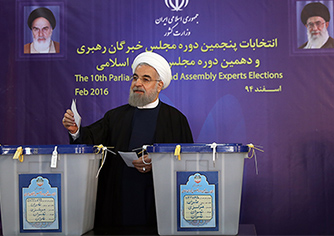
The February 26, 2016 elections for the Iranian parliament and Assembly of Experts constituted a first test of the leadership of President Hassan Rouhani since the signing of the JCPOA between Iran and the P5+1 and the subsequent lifting of sanctions. In light of the high voter turnout – which stood at approximately 60 percent, higher than the turnout in the last elections – the authorities were compelled to keep the polls open for a few hours after their scheduled closing times.
The element of “choice” in elections in Iran differs from the concept familiar to the West. Of the thousands of registered candidates, only those who successfully passed the vetting process of the Guardian Council (12 clerics appointed by the Supreme Leader) were permitted to run. The wide-scale disqualification during the approval process sparked a bitter public confrontation in Iran, led personally by Rouhani and his patron Ali Rafsanjani. This in turn forced the Guardian Council of the Constitution to reexamine the disqualifications and approve some of the disqualified candidates.
Even if the division of political groupings in Iran into conservatives, moderates, and reformists does not precisely reflect the personal characteristics of their members and has been ridiculed by the Supreme Leader, it nonetheless distinguishes between two major blocs within the Iranian political arena: the camp that endorses the policy led by Rouhani, with the public support of Rafsanjani, and the more extreme camp, led by the Revolutionary Guard with the partial support of the Supreme Leader. The two camps remain divided on a number of fundamental issues, from their attitude toward the nuclear agreement, to their attitude toward the United States, to the main elements of the economic policy that the state should pursue.
The election results indicate a significant change in the balance of power within the two particular institutions. The Assembly of Experts, which consists of 88 members elected for a term of eight years, is the body authorized to choose the Supreme Leader’s successor when the time comes. According to the surprising results, Rafsanjani, in first place, leads the list, with more than fifty percent of the members of the Assembly belonging to the moderate camp, which thus succeeded in significantly reducing the power of the extremist conservatives who had previously controlled the body. Moderates also won more than half of the 290 seats in the Majlis, the Iranian parliament, whose major powers include approving the appointment of ministers and the state budget, and the ability to summon the President and his ministers for hearings and hold votes of no-confidence in them.
As he promised the public on the eve of the 2013 elections, President Rouhani regards the nuclear agreement as of the utmost importance for lifting the sanctions and opening Iran to foreign investment. This worldview is not the product of sympathies for the West or a fondness of Western culture, but is rather an accurate reading of Iran’s economic situation and its impact on the public, particularly the younger generation, which has been the chief casualty of the country’s high unemployment rate, inflation, and international isolation. The extremist conservative camp, on the other hand, opposed what it sees as the concessions Iran accepted as part of the nuclear agreement. Today, this camp is increasingly concerned by the possibility that economic openness to the West could also lead to cultural penetration, which would have a particularly strong impact on the young generation and ultimately lead to a change in Iran’s revolutionary character. Supreme Leader Ali Khamenei, who holds similar views, has repeatedly emphasized the need to protect the country from Western influence, and continues to classify the United States as the principal enemy of the Islamic Republic of Iran.
Against this background, the recent elections were a vote of confidence for the policy of President Rouhani, with the results a clear statement by the young generation, which accounts for more than 60 percent of the Iranian electorate, of a desire to provide the President with the political tools he needs to make good on his electoral promise of “a better future.” In order to fulfill his promises, Rouhani is in need of a more moderate parliament that will enable him to move forward with the economic measures he plans to implement, which include reducing the Revolutionary Guard’s role in the economy, fighting the corruption that has assumed troubling dimensions in the country, and encouraging the foreign investment so desperately needed by the Iranian economy.
With regard to Israel, the major question remains whether the moderate camp’s electoral success under Rouhani’s leadership will lead to a change in Iran’s regional policy. The most influential element in this arena is the Revolutionary Guard, which is deeply involved in the fighting in Syria, responsible for relations with Hezbollah, and involved in the fighting in Iraq and the provision of aid to the Houthis in Yemen. President Rouhani has thus far not been greatly involved in these areas, and it is highly questionable whether he will be able to translate his increased strength in the internal Iranian arena into greater involvement in regional policy. One of the achievements that the West in general and the United States in particular had hoped to secure from the nuclear agreement was Iran’s integration into the region as a positive actor that would contribute to its stability, due especially to its central role in Syria, Iraq, Yemen, and Lebanon. Significantly, however, the Supreme Leader directed the negotiating team on the nuclear issue to refrain from engaging in dialogue on regional issues. He continues to support the positions of the Revolutionary Guard and the extremist conservatives in the political arena, who seek to increase Iranian power in the region in a manner that will help further what they regard as Iran’s foremost interest: reducing and ultimately terminating America’s influence and presence in the region.
That being the case, no changes in Iranian regional policy can be expected in the short term, as reflected in the statement by Iran’s ambassador to Lebanon regarding the provision of financial support to the families of Palestinian terrorists and families whose homes have been demolished. From Israel’s perspective, there is little difference between the positions of Iran’s radical camp toward Israel and those of the camp that is classified as “moderate.” Indeed, it was Rafsanjani himself who hinted that one nuclear bomb would be enough to destroy Israel. Still, in the medium and long terms, if Rouhani succeeds in promoting his economic agenda and openness to the West, which he regards as essential to an improvement in the country’s economic situation, Israel may be able to ask its allies in the West to use their influence to tone down Iran’s positions on the Israeli issue.
Overall, the pragmatic moderate-conservative camp in Iran secured an extremely impressive and significant electoral achievement in two ruling bodies. In the years to come, the Assembly of Experts will most likely be the body that decides who will be the country’s next leader, and its moderate majority will seek to select a leader that reflects its views. As a religious figure, Rouhani may regard himself as a suitable candidate for the position of Supreme Leader when the time comes. In the Majlis, the parliamentary majority secured by the moderate camp will enable it to advance its economic policy, guided by the goal of moving Iran down a path of development and progress after many years of sanctions that inflicted significant damage on the country.
The elections, however, should not be viewed as the final word in the political struggle between the major forces of power in Iran, which has yet to be decided. On the one hand, the electoral victory, along with the nuclear agreement and the lifting of sanctions, has strengthened Rouhani’s position in the upcoming presidential elections, which will be held next year. On the other hand, other difficult political struggles await him vis-à-vis the extremist conservatives, who have no intention of giving up their positions of power in the economic arena or their views on foreign policy and ideology, and who will seek to challenge him in the realms in which they still enjoy strong influence, with an emphasis on the regional arena – where they constitute the most central and influential element.