


National Technology Plan in Israel | INSS
go to header go to content go to footer go to search
INSS logo The Institute for National Security Studies, Strategic, Innovative, Policy-Oriented Research, go to the home page
INSS
Tel Aviv University logo - beyond an external website, opens on a new page
  • Campus
  • Contact
  • עברית
  • Support Us
  • Research
    • Topics
      • Israel and the Global Powers
        • Israel-United States Relations
        • Glazer Israel-China Policy Center
        • Russia
        • Europe
        • Antisemitism and Delegitimization
      • Iran and the Shi'ite Axis
        • The Campaign Against Iran and the Shiite Axis
        • Iran
        • Lebanon and Hezbollah
        • Syria
        • Yemen and the Houthi Movement
        • Iraq and the Iraqi Shiite Militias
      • Conflict to Agreements
        • Israeli-Palestinian Relations
        • Hamas and the Gaza Strip
        • Peace Agreements and Normalization in the Middle East
        • Saudi Arabia and the Gulf States
        • Turkey
        • Egypt
        • Jordan
      • Israel’s National Security Policy
        • Military and Strategic Affairs
        • Societal Resilience and the Israeli Society
        • Jewish-Arab Relations in Israel
        • Climate, Infrastructure and Energy
        • Terrorism and Low Intensity Conflict
      • Cross-Arena Research
        • Data Analytics Center
        • Law and National Security
        • Advanced Technologies and National Security
        • Foreign Information Manipulation and Interference
        • Economics and National Security
    • Projects
      • Preventing the Slide into a One-State Reality
      • India-Middle East-Europe Economic Corridor (IMEC)
  • Publications
    • -
      • All Publications
      • INSS Insight
      • Policy Research and Papers
      • Special Publication
      • Strategic Assessment
      • Technology Platform
      • Memoranda
      • Posts
      • Books
      • Archive
  • Database
    • Surveys
    • Spotlight
    • Maps
    • Dashboards
  • Events
  • Team
  • About
    • Vision and Mission
    • History
    • Research Disciplines
    • Chairman of the Board
    • Board of Directors
    • Fellowship and Prizes
    • Annual Reports
    • Internships
  • Media
    • Communications
    • Video gallery
    • Press Releases
  • Podcast
  • Newsletter
  • Campus
Search in site
  • Research
    • Topics
    • Israel and the Global Powers
    • Israel-United States Relations
    • Glazer Israel-China Policy Center
    • Russia
    • Europe
    • Antisemitism and Delegitimization
    • Iran and the Shi'ite Axis
    • The Campaign Against Iran and the Shiite Axis
    • Iran
    • Lebanon and Hezbollah
    • Syria
    • Yemen and the Houthi Movement
    • Iraq and the Iraqi Shiite Militias
    • Conflict to Agreements
    • Israeli-Palestinian Relations
    • Hamas and the Gaza Strip
    • Peace Agreements and Normalization in the Middle East
    • Saudi Arabia and the Gulf States
    • Turkey
    • Egypt
    • Jordan
    • Israel’s National Security Policy
    • Military and Strategic Affairs
    • Societal Resilience and the Israeli Society
    • Jewish-Arab Relations in Israel
    • Climate, Infrastructure and Energy
    • Terrorism and Low Intensity Conflict
    • Cross-Arena Research
    • Data Analytics Center
    • Law and National Security
    • Advanced Technologies and National Security
    • Foreign Information Manipulation and Interference
    • Economics and National Security
    • Projects
    • Preventing the Slide into a One-State Reality
    • India-Middle East-Europe Economic Corridor (IMEC)
  • Publications
    • All Publications
    • INSS Insight
    • Policy Research and Papers
    • Special Publication
    • Strategic Assessment
    • Technology Platform
    • Memoranda
    • Posts
    • Books
    • Archive
  • Database
    • Surveys
    • Spotlight
    • Maps
    • Dashboards
  • Events
  • Team
  • About
    • Vision and Mission
    • History
    • Research Disciplines
    • Chairman of the Board
    • Board of Directors
    • Fellowship and Prizes
    • Internships
    • Annual Reports
    • Privacy Policy and Terms of Use
  • Media
    • Communications
    • Video gallery
    • Press Releases
  • Podcast
  • Newsletter
  • Campus
  • Contact
  • עברית
  • Support Us
bool(false)

Publications

Home Publications Memoranda National Technology Plan in Israel

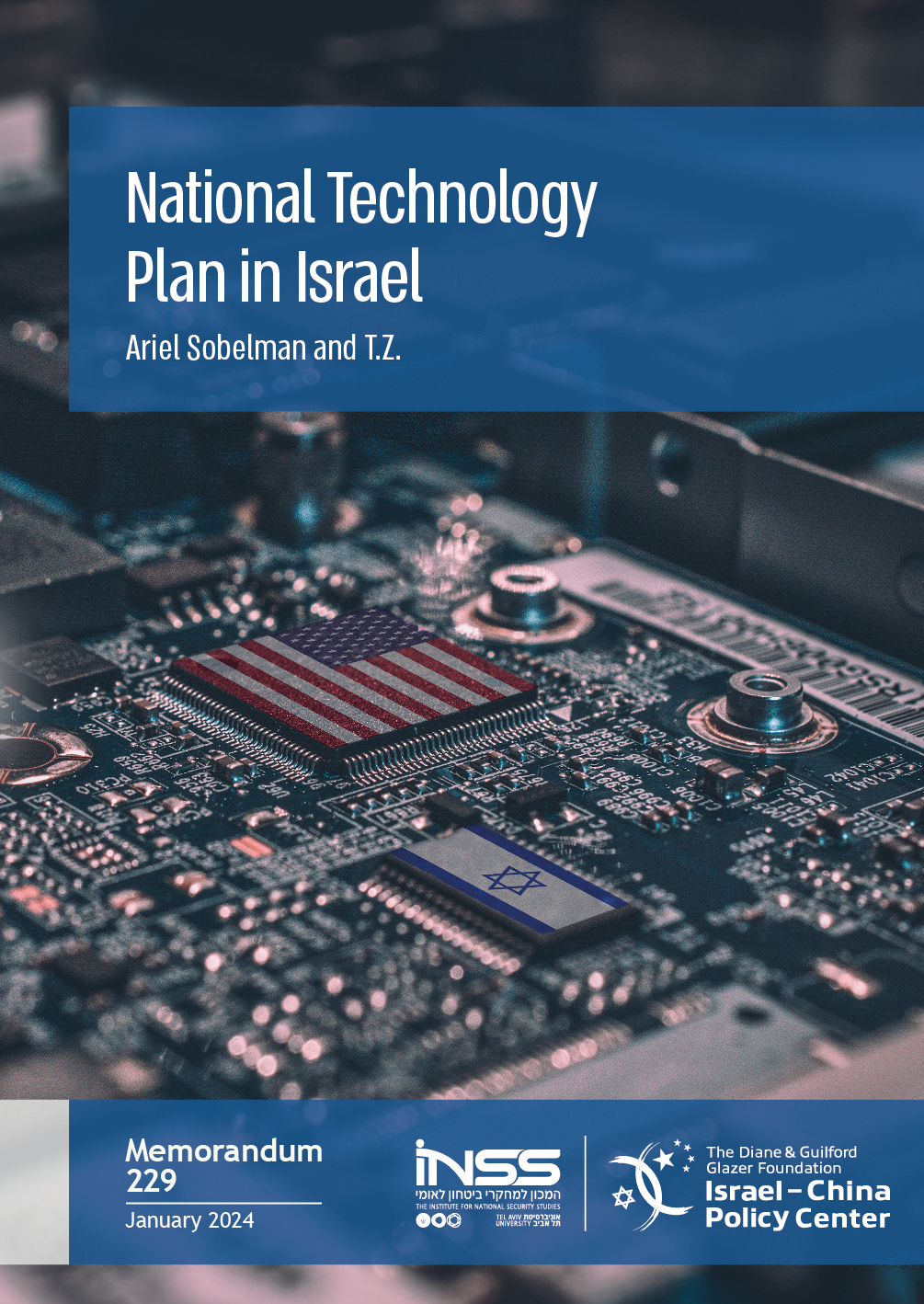
National Technology Plan in Israel

Memorandum 229, January 2024

Follow us on Google
עברית
Ariel Sobelman
TZ

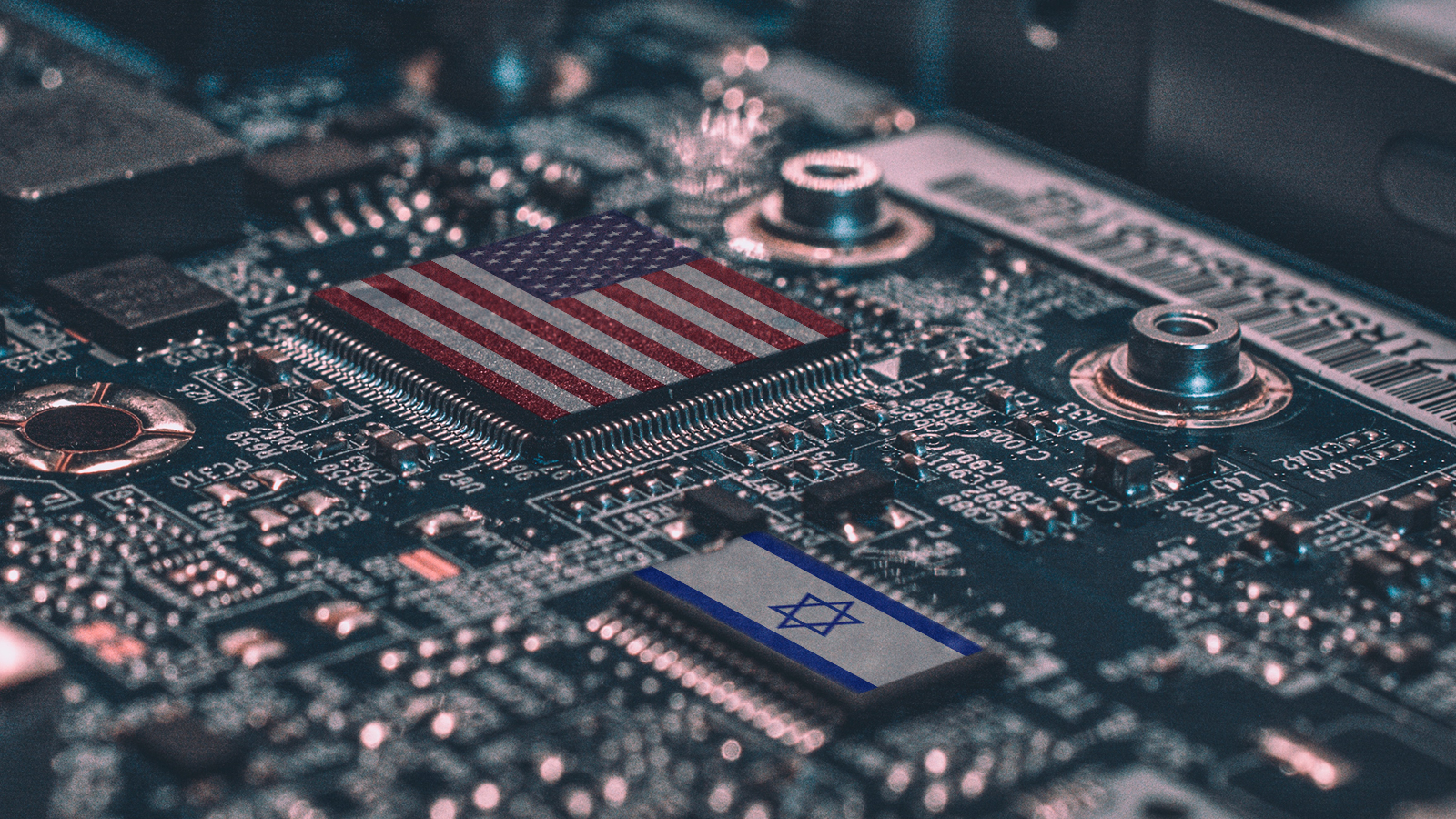
In recent years the technological struggle between the United States and China has intensified. Washington has increased its efforts to deny Beijing access to advanced technologies and has announced huge investments to accelerate technological research and development, in order to secure its status as the world’s strongest economic power. At the same, time, the United States is demanding that its partners join the fight and adopt a policy of restricting China’s research, development, and manufacturing capabilities in the field of advanced chips. Investment in technological research, development, and manufacture is a vital component and a relative advantage that Israel enjoys, but this is only a partial solution to the problem. Israel needs a national plan to cover all aspects of the development, manufacturing, and trade in chips. This memorandum presents alternative technological policies for Israel and calls for a discussion, as soon as possible, on national technological strategy.


Click here to download the full Memorandum

Table of Contents:

Globalization is one of the most significant phenomena of history and has been an irrefutable axiom since World War II. Today it is difficult to imagine how either individuals or countries could survive without international partnership and movement of goods. However, since the outbreak of the COVID-19 pandemic and the supply chain crisis that followed cracks have become obvious in the principles of global trade, and one of its clearest manifestations is the Great Power technological competition between the United States and China...
Read more

This memorandum is being submitted to readers in the middle of the Gaza War that broke out on October 7, 2023, as we were preparing for publication. Naturally, the war pushes aside academic engagement and long-term strategic issues as well. However, one of the main missions of the Institute for National Security Studies (INSS) at Tel Aviv University is precisely that, to ensure that the State of Israel prepares for the challenges it will face in all issues affecting its national security. This memorandum examines and studies what has come to be known as the “Chip War”—a titanic struggle between the United States and China for technological supremacy that has been raging for over three years around the globe and with tremendous impact on the State of Israel...
Read more

Since October 7, 2023, the State of Israel has been engaged in a war forced upon it by Hamas. This war is being waged not only in our own region, but also across the globe, in the western capitals, on campuses of prestigious universities, in the headquarters of the largest and most influential technology companies in the world; these entities have he power to directly and indirectly influence the narrative, the support for Israel, and the world’s governments in a way that ultimately would affect Israel’s room to maneuver in this war. In addition, it is impossible to disconnect the struggle from global contexts and from the competition of the superpowers. The INSS is committed to basic research on issues related to Israel’s national security even in times of war, with the understanding that when the war ends, the strategic challenges facing Israel will necessitate a knowledge base that will be available to policymakers and decision makers. This work touches on one of the main factors shaping the world order and will return to occupy the State of Israel once the fighting ends...
Read more

Globalization has been an irrefutable axiom since World War II. It is one of the most significant phenomena that has occurred in history, and it is difficult to imagine today how individuals and countries could survive without international partnership and movement of goods. However, since the outbreak of the COVID-19 pandemic and the supply chain crisis following it, cracks have emerged in the principles of global trade. One expression of these cracks is the technological struggle taking place between the United States and China. In October 2022, the United States publicized the CHIPS Act.1 The law includes a budgetary investment of $278.2 billion over ten years to accelerate technological research and development, and to ensure that the United States remains the strongest economic power in the world. Out of this total, a direct investment of $52 billion is planned, by subsidizing the establishment of semiconductor manufacturing plants in US territory, a field in which China has been trying to achieve a global advantage for a decade...
Read more

This section is dedicated to a discussion of whether Israel should formulate a policy regarding investment in technology in light of its needs and an assessment of future national security. The working assumption is that it is not Israel’s place to advance legislation on the level of the American or European legislation. However, given the global trends, Israel’s current situation, and the exponential pace of development of technology, the private sector and

market forces alone are insufficient for ensuring Israel’s standing as a hightech power over time; therefore, it is desirable and recommended to examine current government policy on the issue...

Read more

In the previous chapter, we discussed considerations that are meant to encourage decision-makers in Israel when planning a technology strategy and to examine investment in local technology production systems. In this section, we describe the current Israeli situation in the systemic context and the “displacement” that it is in. This section brings together the insights presented so far in a way that allows for discussing policy alternatives. The alternatives will be presented via the SWOT model, which helped us highlight the advantages and disadvantages of each alternative...
Read more

This memorandum has presented the emerging world order, at the center of which is the global technological competition between the great powers, in the context of the retreat from globalization and a return to models based on self-reliance, alliances, and coalitions. The supply-chain crisis demonstrated to the world the risk of relying on factories in countries with which cooperation is strategically sensitive, given the potential for instability in relations. Most technologically advanced countries have internalized the depth of the geostrategic changes and in the past year have examined the implications, each country according to its size, strength, geographic location, economy, and unique characteristics...
Read more

The opinions expressed in INSS publications are the authors’ alone.
Publication Series Memoranda
TopicsAdvanced Technologies and National SecurityIsrael-China Policy Center - The Diane and Guilford Glazer Foundation
עברית

Events

All events
Israel’s National Security Conference
27 July, 2026
10:00 - 14:00

Related Publications

All publications
Generated with AI
From Red to Blue-and-White: The Strategic Necessity of Developing the Israeli Drone Industry
Chinese-made drones pose a range of security, technological, and geopolitical challenges for Israel. What measures should Israel take to mitigate the risks involved?
07/07/26
Shutterstock
The Battle over Access to Artificial Intelligence: Israel’s Next Strategic Challenge
The restrictions recently imposed on Anthropic — including the U.S. administration’s directive to limit access to certain models for users and entities outside the United States on national security grounds[1] — constitute a significant milestone in the evolving relationship between technology, national security, and foreign policy. Whereas over the past decade, the discourse surrounding digital sovereignty has focused on issues such as privacy, data localization, regulation, and cloud infrastructure, recent developments point to a transition to a new phase in which access to advanced artificial intelligence capabilities is becoming a strategic asset in itself. In this reality, not only data or chips are becoming objects of government policy, but also the models themselves. This article argues that the Anthropic case is not an isolated incident but rather a manifestation of a broader trend, in which artificial intelligence is becoming a central component of national power. As a result, access to advanced models may in the future become a policy tool, a mechanism of geopolitical influence, and a means of advancing strategic interests. For Israel, this development necessitates a reassessment of its approach to technological sovereignty and its policies in the fields of artificial intelligence, computing, and infrastructure, as well as a rethinking of its broader security paradigm. [1] The directive conveyed to Anthropic on June 12 by the Trump administration required the company to terminate access to its Fable 5 and Mythos 5 models for all foreign users, including the company’s foreign employees, users outside the United States, and international clients. According to reports, the company was given a very short timeline to implement the directive, under the threat of civil and criminal sanctions in the event of non-compliance. At a later stage, a limited exemption was granted, allowing the use of Mythos 5 for a small number of critical infrastructure organizations within the United States, while Fable 5 remained restricted.  
01/07/26
Shutterstock
The Pentagon’s AI-First Doctrine and Its Implications for Modern Warfare: Lessons from the Conflict with Iran
How has the new US policy—under which AI is positioned as a foundational component in the chain of command, intelligence gathering, and the planning of complex operations—been reflected on the battlefield, and what conclusions should be drawn in Israel?
19/03/26

Stay up to date

Registration was successful! Thanks.
  • Research

    • Topics
      • Israel and the Global Powers
      • Israel-United States Relations
      • Glazer Israel-China Policy Center
      • Russia
      • Europe
      • Antisemitism and Delegitimization
      • Iran and the Shi'ite Axis
      • The Campaign Against Iran and the Shiite Axis
      • Iran
      • Lebanon and Hezbollah
      • Syria
      • Yemen and the Houthi Movement
      • Iraq and the Iraqi Shiite Militias
      • Conflict to Agreements
      • Israeli-Palestinian Relations
      • Hamas and the Gaza Strip
      • Peace Agreements and Normalization in the Middle East
      • Saudi Arabia and the Gulf States
      • Turkey
      • Egypt
      • Jordan
      • Israel’s National Security Policy
      • Military and Strategic Affairs
      • Societal Resilience and the Israeli Society
      • Jewish-Arab Relations in Israel
      • Climate, Infrastructure and Energy
      • Terrorism and Low Intensity Conflict
      • Cross-Arena Research
      • Data Analytics Center
      • Law and National Security
      • Advanced Technologies and National Security
      • Foreign Information Manipulation and Interference
      • Economics and National Security
    • Projects
      • Preventing the Slide into a One-State Reality
      • India-Middle East-Europe Economic Corridor (IMEC)
  • Publications

    • All Publications
    • INSS Insight
    • Policy Research and Papers
    • Special Publication
    • Strategic Assessment
    • Technology Platform
    • Memoranda
    • Database
    • Posts
    • Books
    • Archive
  • About

    • Vision and Mission
    • History
    • Research Disciplines
    • Chairman of the Board
    • Board of Directors
    • Fellowship and Prizes
    • Internships
    • Annual Reports
    • Support
    • Privacy Policy and Terms of Use
  • Media

    • Communications
    • Video Gallery
    • Press Release
    • Podcast
  • Home

  • Events

  • Database

  • Team

  • Contact

  • Newsletter

  • עברית

INSS logo The Institute for National Security Studies, Strategic, Innovative, Policy-Oriented Research, go to the home page
40 Haim Levanon St. Tel Aviv, 6997556 Israel | Tel 03-640-0400 | Fax 03-744-7590 |
Developed by Daat ,Yael Group.
Accessibility Statement
This site is protected by reCAPTCHA and the Google Privacy Policy and Terms of Service apply.