


Strategic Survey for Israel 2018-2019 | INSS
go to header go to content go to footer go to search
INSS logo The Institute for National Security Studies, Strategic, Innovative, Policy-Oriented Research, go to the home page
INSS
Tel Aviv University logo - beyond an external website, opens on a new page
  • Campus
  • Contact
  • עברית
  • Support Us
  • Research
    • Topics
      • Israel and the Global Powers
        • Israel-United States Relations
        • Glazer Israel-China Policy Center
        • Russia
        • Europe
      • Iran and the Shi'ite Axis
        • Iran
        • The Israel–Iran War
        • Lebanon and Hezbollah
        • Syria
        • Yemen and the Houthi Movement
        • Iraq and the Iraqi Shiite Militias
      • Conflict to Agreements
        • Israeli-Palestinian Relations
        • Hamas and the Gaza Strip
        • Peace Agreements and Normalization in the Middle East
        • Saudi Arabia and the Gulf States
        • Turkey
        • Egypt
        • Jordan
      • Israel’s National Security Policy
        • Military and Strategic Affairs
        • Societal Resilience and the Israeli Society
        • Jewish-Arab Relations in Israel
        • Climate, Infrastructure and Energy
        • Terrorism and Low Intensity Conflict
      • Cross-Arena Research
        • Data Analytics Center
        • Law and National Security
        • Advanced Technologies and National Security
        • Cognitive Warfare
        • Economics and National Security
    • Projects
      • Preventing the Slide into a One-State Reality
      • Contemporary Antisemitism in the United States
      • Perceptions about Jews and Israel in the Arab-Muslim World and Their Impact on the West
  • Publications
    • -
      • All Publications
      • INSS Insight
      • Policy Papers
      • Special Publication
      • Strategic Assessment
      • Technology Platform
      • Memoranda
      • Posts
      • Books
      • Archive
  • Database
    • Surveys
    • Spotlight
    • Maps
    • Dashboards
  • Events
  • Team
  • About
    • Vision and Mission
    • History
    • Research Disciplines
    • Chairman of the Board
    • Board of Directors
    • Fellowship and Prizes
    • Internships
  • Media
    • Communications
    • Video gallery
    • Press Releases
  • Podcast
  • Newsletter
  • Campus
Search in site
  • Research
    • Topics
    • Israel and the Global Powers
    • Israel-United States Relations
    • Glazer Israel-China Policy Center
    • Russia
    • Europe
    • Iran and the Shi'ite Axis
    • Iran
    • The Israel–Iran War
    • Lebanon and Hezbollah
    • Syria
    • Yemen and the Houthi Movement
    • Iraq and the Iraqi Shiite Militias
    • Conflict to Agreements
    • Israeli-Palestinian Relations
    • Hamas and the Gaza Strip
    • Peace Agreements and Normalization in the Middle East
    • Saudi Arabia and the Gulf States
    • Turkey
    • Egypt
    • Jordan
    • Israel’s National Security Policy
    • Military and Strategic Affairs
    • Societal Resilience and the Israeli Society
    • Jewish-Arab Relations in Israel
    • Climate, Infrastructure and Energy
    • Terrorism and Low Intensity Conflict
    • Cross-Arena Research
    • Data Analytics Center
    • Law and National Security
    • Advanced Technologies and National Security
    • Cognitive Warfare
    • Economics and National Security
    • Projects
    • Preventing the Slide into a One-State Reality
    • Contemporary Antisemitism in the United States
    • Perceptions about Jews and Israel in the Arab-Muslim World and Their Impact on the West
  • Publications
    • All Publications
    • INSS Insight
    • Policy Papers
    • Special Publication
    • Strategic Assessment
    • Technology Platform
    • Memoranda
    • Posts
    • Books
    • Archive
  • Database
    • Surveys
    • Spotlight
    • Maps
    • Dashboards
  • Events
  • Team
  • About
    • Vision and Mission
    • History
    • Research Disciplines
    • Chairman of the Board
    • Board of Directors
    • Fellowship and Prizes
    • Internships
    • Privacy Policy and Terms of Use
  • Media
    • Communications
    • Video gallery
    • Press Releases
  • Podcast
  • Newsletter
  • Campus
  • Contact
  • עברית
  • Support Us
bool(false)

Publications

Home Publications Strategic Survey for Israel Strategic Survey for Israel 2018-2019

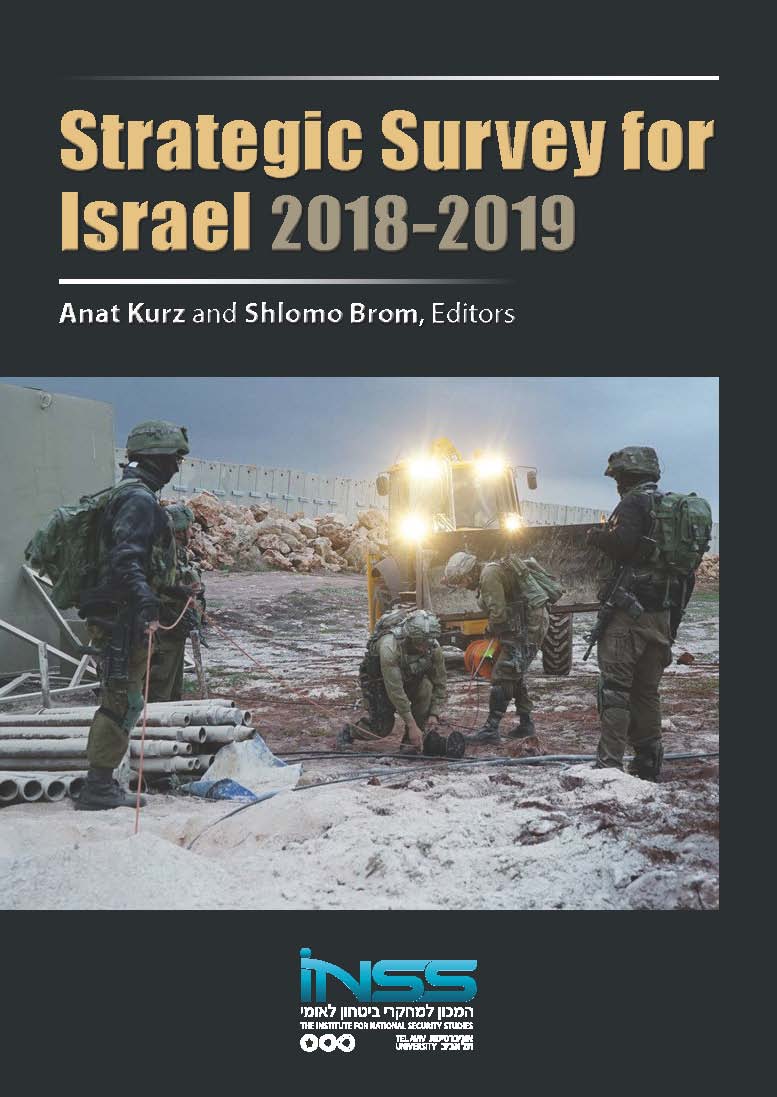
Strategic Survey for Israel 2018-2019

Strategic Survey for Israel 2018-2019, The Institute for National Security Studies, December 2018
עברית
Anat Kurz
Shlomo Brom

Strategic Survey for Israel 2018-2019, the latest volume in the annual series published by the Institute for National Security Studies (INSS), reviews a period marked by distinct changes in Israel’s close strategic environment as well as events in its more distant circle that likewise have had a direct impact on the challenges and opportunities before it. The unfolding dynamics and trends that derive from these developments bring with them threats to Israel’s national security, which could spell military escalation or a standstill fraught with risks. At the same time, this state of affairs includes opportunities for action and policy change that could help Israel face its security challenges and improve its regional and global strategic standing.


Strategic Survey for Israel 2018-2019, the latest volume in the annual series published by the Institute for National Security Studies (INSS), reviews a period marked by distinct changes in Israel’s close strategic environment as well as events in its more distant circle that likewise have had a direct impact on the challenges and opportunities before it. The unfolding dynamics and trends that derive from these developments bring with them threats to Israel’s national security, which could spell military escalation or a standstill fraught with risks. At the same time, this state of affairs includes opportunities for action and policy change that could help Israel face its security challenges and improve its regional and global strategic standing.

The articles in this volume explore the primary significance of the changes in the Middle East over the past year, and focus on the areas of intensifying friction in the region and their international context. Contrary to previous volumes in the Strategic Survey for Israel series, which raised many diverse issues, even those without immediate ramifications for Israel, this volume covers domestic and external events that have a clear and immediate impact on the country’s national security. Yet while this volume thus contains a smaller number of chapters than other books in the series, there is nevertheless a strong reference to previous volumes, reflecting the complexity of the combined challenges Israel will be forced to confront over the next year and probably beyond.

The first chapter looks at challenges stemming from Iran’s efforts to expand its influence in the Middle East, and focuses particularly on the implications of Tehran’s policies along Israel’s northern border. The analysis also deals with internal Iranian trends and their impact on Iran’s foreign policy. The second chapter presents an in-depth discussion about Israel’s northern border and the consequences of the involvement in Syria by regional powers and global superpowers. It covers moves designed to bring stability to the country and activity undertaken by Hezbollah, which involves its buildup in Syria and in Lebanon and the associated risk of escalation. Analysis of the northern theater includes emphasis on the role played by Russia in shaping the trends affecting Syria, and in turn, on Israel’s ability to combat, if not roll back, Iran’s increasing involvement in the country. Russian policy figures prominently among the political activity of the international elements that shape the challenges to Israel in its immediate vicinity, and thus the third chapter discusses the impact of global and superpower dynamics on the Middle East, and in particular, the military and political interests of Israel in its northern theater and its relationship with the Palestinians. The Israeli-Palestinian conflict, covered in the following chapter, is shaped significantly by the profound rift between the principal parties in the Palestinian sphere. The ensuing current reality should propel Israel to a series of moves that will create an improved political-military reality vis-à-vis the conflict arena. The fifth chapter, which focuses on Israel’s internal situation, maps different assessments of the impact that recent Israeli policies have on Israeli democracy, as the basis for a discussion about how to preserve Israel’s essence as a Jewish and democratic state.

Israel’s strategic environment has always been complex and involved multiple state and non-state actors. Therefore, identifying practical and implementable operational channels that could advance Israel’s vital interests and lead to clear and indisputable achievements has never been a simple task. The past year was no exception. Furthermore, as we approach 2019 it becomes evident that the past year has seen an increase in trends that will continue to involve threats to Israel’s vital interests, unless counter measures are employed. This demands rethinking the situation in a way that will reduce the impact of these negative trends.

The final chapter in this volume, written by INSS Director Major General (ret.) Amos Yadlin, is dedicated to policy recommendations regarding processes that Israel can address in order to best meet political and security challenges or to preserve and fortify strategic advantages. Among the military recommendations: preparation, in coordination with the United States, for a situation in which Iran ceases to comply with vital clauses of the nuclear agreement or moves to break out to a nuclear weapon; continued efforts to prevent the transfer of effective weaponry to Hezbollah while the window of opportunity to do so in Syria remains open; vigilance in monitoring the signs that this window is closing, which will force a re-examination of the ways to combat the organization’s buildup; continued limited military action in Syria aimed at preventing further Iranian entrenchment there; and preparation for a military escalation in Gaza, alongside willingness to explore an agreement with Hamas that guarantees that this theater remains calm. Among the political recommendations: maximal use of the window of opportunity for independent and coordinated efforts in the Palestinian arena, while stopping the movement toward the reality of one state; proactive measures to strengthen ties with various elements of American Jewry; and continued dialogue with American groups that oppose US policies in a way that does not jeopardize Israel’s relationship with the US administration.

Special thanks to the authors of the chapters, members of the INSS research staff. As with previous volumes, significant contributions to the writing and publication of the volume were made by Moshe Grundman, INSS Director of Publications, and Judith Rosen, editor of INSS English publications. To them we extend our gratitude and appreciation.

Anat Kurz and Shlomo Brom

December 2018

==============================================================================

Contents

Preface

Iran: Facing a Year of Decisions and Changes
Sima Shine and Raz Zimmt

The Northern Arena at a Crossroads
Udi Dekel and Anat Ben Haim

International Upheaval and the Middle East
Eldad Shavit

The Palestinian Theater: A Crisis Arena with Opportunities for Israel
Udi Dekel

Is Israeli Democracy at Risk?
Pnina Sharvit Baruch

Conclusion: Strategic Assessment and Policy Recommendations
Amos Yadlin

Contributors

The opinions expressed in INSS publications are the authors’ alone.
Publication Series Strategic Survey for Israel
TopicsIranIsrael-United States RelationsIsraeli-Palestinian RelationsLebanon and HezbollahMilitary and Strategic AffairsRussiaSyriaSocietal Resilience and the Israeli Society
עברית

Events

All events
Israel–U.S. Relations: An Alliance in Transition?
22 December, 2025
13:00 - 16:00

Related Publications

All publications
The Second “Imposed War”: The Israel–Iran War and Its Implications for Iran’s National Security
The 12-day war between Iran and Israel in June 2025 marked the sharpest escalation to date in the ongoing confrontation between the two states. Despite its relatively short duration, the war had a destabilizing effect on the Islamic Republic due to the success of Israel’s opening strike, the decision of the United States to join the campaign, and the damage sustained by Iran’s critical strategic systems—notably its nuclear program and long-range missile arsenal. Since the end of the war, Iran has engaged in an ongoing process of drawing lessons from the serious gaps revealed in the Islamic Republic’s deterrence and defense capabilities. The Iranian leadership is certainly aware of the need for improvements and adjustments to its national security doctrine; yet for now, this does not appear sufficient to produce a fundamental shift in Iranian strategy. It seems that Iran prefers to make adjustments within the existing framework by finding acceptable solutions to the gaps exposed rather than introducing major changes to its overall strategy. In any event, the new reality in Iran created by the war is characterized by instability, and it is doubtful whether the current status quo can endure for long. This is exacerbated by the growing possibility of a miscalculation between Iran and Israel that would lead to renewed clashes, or high-risk decisions by Iran on both the nuclear issue and on the regional front. This memorandum seeks to examine the lessons that Iran is drawing from the war and its implications in four main areas: the nuclear program, strategic military systems, the regional arena, and the domestic arena—and to assess how the war has influenced Iran’s national security concept. In addition, it includes a set of policy recommendations intended to block, or at least delay, Iran’s efforts to rebuild its strategic capabilities, foremost among them the nuclear program, and the pro-Iranian axis in the region, and to reduce as much as possible the risk of renewed fighting.
20/12/25
Aircraft Under the Radar: Mechanisms of Evading Sanctions in Iran’s Aviation Sector
Despite being subjected to one of the harshest sanctions regimes in the world, Iran has succeeded in building a sophisticated, law-evading mechanism to support its aviation industry, which reflects the broader principles of the shadow economy it has developed. This article maps the operational architecture of that mechanism, based on using front and shell companies in countries with little transparency, layered ownership registries, bursts of activity designed to complete transfers within short timeframes, and flight-path planning that includes fictitious emergency landings to allow aircraft to quietly enter Iran. The article describes how Iran’s aviation sector—significantly harmed by sanctions—has shifted from a civilian transportation tool to a core component of the regime’s economic and security strategy, enabling it to continue functioning, finance its regional proxies, and project resilience in the face of international pressure. The aviation industry represents only one link in a much larger apparatus designed to evade sanctions in the trade of oil, gold, and dual-use technologies; yet the aviation sector clearly demonstrates the method: a sophisticated integration of state, market, and underground networks that operate in regulatory gray zones and disrupt efforts to globally enforce the sanctions.
17/12/25
Iranian Supreme Leader'S Office via ZUMA Press Wire
The Deadlock Surrounding Iran’s Nuclear Program
The solution to the crisis surrounding the Iranian nuclear program is nowhere in sight, and the ticking clock is forcing Tehran to make fateful decisions
09/12/25

Stay up to date

Registration was successful! Thanks.
  • Research

    • Topics
      • Israel and the Global Powers
      • Israel-United States Relations
      • Glazer Israel-China Policy Center
      • Russia
      • Europe
      • Iran and the Shi'ite Axis
      • Iran
      • The Israel–Iran War
      • Lebanon and Hezbollah
      • Syria
      • Yemen and the Houthi Movement
      • Iraq and the Iraqi Shiite Militias
      • Conflict to Agreements
      • Israeli-Palestinian Relations
      • Hamas and the Gaza Strip
      • Peace Agreements and Normalization in the Middle East
      • Saudi Arabia and the Gulf States
      • Turkey
      • Egypt
      • Jordan
      • Israel’s National Security Policy
      • Military and Strategic Affairs
      • Societal Resilience and the Israeli Society
      • Jewish-Arab Relations in Israel
      • Climate, Infrastructure and Energy
      • Terrorism and Low Intensity Conflict
      • Cross-Arena Research
      • Data Analytics Center
      • Law and National Security
      • Advanced Technologies and National Security
      • Cognitive Warfare
      • Economics and National Security
    • Projects
      • Preventing the Slide into a One-State Reality
      • Contemporary Antisemitism in the United States
      • Perceptions about Jews and Israel in the Arab-Muslim World and Their Impact on the West
  • Publications

    • All Publications
    • INSS Insight
    • Policy Papers
    • Special Publication
    • Strategic Assessment
    • Technology Platform
    • Memoranda
    • Database
    • Posts
    • Books
    • Archive
  • About

    • Vision and Mission
    • History
    • Research Disciplines
    • Chairman of the Board
    • Board of Directors
    • Fellowship and Prizes
    • Internships
    • Support
    • Privacy Policy and Terms of Use
  • Media

    • Communications
    • Video Gallery
    • Press Release
    • Podcast
  • Home

  • Events

  • Database

  • Team

  • Contact

  • Newsletter

  • עברית

INSS logo The Institute for National Security Studies, Strategic, Innovative, Policy-Oriented Research, go to the home page
40 Haim Levanon St. Tel Aviv, 6997556 Israel | Tel: 03-640-0400 | Fax: 03-744-7590 | Email: info@inss.org.il
Developed by Daat A Realcommerce company.
Accessibility Statement
This site is protected by reCAPTCHA and the Google Privacy Policy and Terms of Service apply.
No audio version available for this podcast