President Putin Visits Egypt | INSS
go to header go to content go to footer go to search
INSS logo The Institute for National Security Studies, Strategic, Innovative, Policy-Oriented Research, go to the home page
INSS
Tel Aviv University logo - beyond an external website, opens on a new page
  • Campus
  • Contact
  • עברית
  • Support Us
  • Research
    • Topics
      • Israel and the Global Powers
        • Israel-United States Relations
        • Glazer Israel-China Policy Center
        • Russia
        • Europe
        • Antisemitism and Delegitimization
      • Iran and the Shi'ite Axis
        • Operation Roaring Lion
        • Iran
        • Lebanon and Hezbollah
        • Syria
        • Yemen and the Houthi Movement
        • Iraq and the Iraqi Shiite Militias
      • Conflict to Agreements
        • Israeli-Palestinian Relations
        • Hamas and the Gaza Strip
        • Peace Agreements and Normalization in the Middle East
        • Saudi Arabia and the Gulf States
        • Turkey
        • Egypt
        • Jordan
      • Israel’s National Security Policy
        • Military and Strategic Affairs
        • Societal Resilience and the Israeli Society
        • Jewish-Arab Relations in Israel
        • Climate, Infrastructure and Energy
        • Terrorism and Low Intensity Conflict
      • Cross-Arena Research
        • Data Analytics Center
        • Law and National Security
        • Advanced Technologies and National Security
        • Foreign Information Manipulation and Interference
        • Economics and National Security
    • Projects
      • Preventing the Slide into a One-State Reality
  • Publications
    • -
      • All Publications
      • INSS Insight
      • Policy Papers
      • Special Publication
      • Strategic Assessment
      • Technology Platform
      • Memoranda
      • Posts
      • Books
      • Archive
  • Database
    • Surveys
    • Spotlight
    • Maps
    • Dashboards
  • Events
  • Team
  • About
    • Vision and Mission
    • History
    • Research Disciplines
    • Chairman of the Board
    • Board of Directors
    • Fellowship and Prizes
    • Internships
  • Media
    • Communications
    • Video gallery
    • Press Releases
  • Podcast
  • Newsletter
  • Campus
Search in site
  • Research
    • Topics
    • Israel and the Global Powers
    • Israel-United States Relations
    • Glazer Israel-China Policy Center
    • Russia
    • Europe
    • Antisemitism and Delegitimization
    • Iran and the Shi'ite Axis
    • Operation Roaring Lion
    • Iran
    • Lebanon and Hezbollah
    • Syria
    • Yemen and the Houthi Movement
    • Iraq and the Iraqi Shiite Militias
    • Conflict to Agreements
    • Israeli-Palestinian Relations
    • Hamas and the Gaza Strip
    • Peace Agreements and Normalization in the Middle East
    • Saudi Arabia and the Gulf States
    • Turkey
    • Egypt
    • Jordan
    • Israel’s National Security Policy
    • Military and Strategic Affairs
    • Societal Resilience and the Israeli Society
    • Jewish-Arab Relations in Israel
    • Climate, Infrastructure and Energy
    • Terrorism and Low Intensity Conflict
    • Cross-Arena Research
    • Data Analytics Center
    • Law and National Security
    • Advanced Technologies and National Security
    • Foreign Information Manipulation and Interference
    • Economics and National Security
    • Projects
    • Preventing the Slide into a One-State Reality
  • Publications
    • All Publications
    • INSS Insight
    • Policy Papers
    • Special Publication
    • Strategic Assessment
    • Technology Platform
    • Memoranda
    • Posts
    • Books
    • Archive
  • Database
    • Surveys
    • Spotlight
    • Maps
    • Dashboards
  • Events
  • Team
  • About
    • Vision and Mission
    • History
    • Research Disciplines
    • Chairman of the Board
    • Board of Directors
    • Fellowship and Prizes
    • Internships
    • Privacy Policy and Terms of Use
  • Media
    • Communications
    • Video gallery
    • Press Releases
  • Podcast
  • Newsletter
  • Campus
  • Contact
  • עברית
  • Support Us
bool(false)

Publications

Home Publications INSS Insight President Putin Visits Egypt

President Putin Visits Egypt

INSS Insight No. 665, February 22, 2015

עברית
Ephraim Kam
Zvi Magen
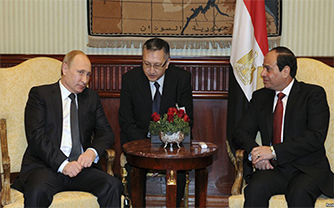
On February 9-10, 2015, Russian President Vladimir Putin visited Egypt for the first time since 2005, when Mubarak was still in power. The most significant outcome of this visit, which reflects the notable improvement in bilateral relations over the last two years, was the signing of a memorandum of understanding on Russian aid for the construction of a nuclear reactor in western Egypt. The two sides also signed additional economic and commercial agreements, testifying to the significant increase in trade between the countries. Russia is clearly interested in expanding these relations as much as possible, especially militarily, which have been frozen since 1974. But chances are slim that Russian-Egyptian cooperation will reach the scope that characterized their relations in the era of the Soviet Union and before Egypt turned to the West.

On February 9-10, 2015, Russian President Vladimir Putin visited Egypt for the first time since 2005, when Mubarak was still in power. The most significant outcome of this visit, which reflects the notable improvement in bilateral relations over the last two years, was the signing of a memorandum of understanding between the two governments on Russian aid for the construction of a nuclear reactor in western Egypt. The two sides also signed additional economic and commercial agreements, testifying to the significant increase in trade between the countries in recent years. Indeed, prior to Putin’s visit, there were mutual visits by senior officials: in November 2013, Russia’s defense and foreign ministers visited Egypt together – a first visit of this sort; and in February 2014 Egypt’s defense minister (a post then held by Sisi) and foreign minister paid a return visit to Moscow. Sisi visited Moscow again in August 2014, this time as president.

An issue still unclear after Putin’s visit to Cairo is that of an arms deal. After the November 2013 visit by Russia’s defense and foreign ministers, there were unofficial reports, particularly from the Russian side, that Russia would supply Egypt with arms in the amount of $3-3.5 billion; the deal reportedly included MiG 29 fighter jets, Mi 35 military helicopters, and advanced long range aerial defense systems. The deal was supposed to be financed by Saudi Arabia and the UAE, but so far there has been no official word that the deal has gone into effect or even been finalized. During Putin’s visit, too, rumors emerged – again, mostly from the Russians – that the deal had been initialed, but the official statements issued by both parties mentioned nothing on the subject.

The series of mutual visits reflects converging Russian and Egyptian interests. For Egypt, closer relations with Russia are largely an outgrowth of the friction between the Sisi regime and the US administration. Some in the Egyptian leadership are angry at Obama’s interference in internal Egyptian matters early on in the Arab Spring, when the administration publically called on Mubarak to resign. Moreover, the Egyptian leadership leveled harsh criticism at the administration’s reservations about the ouster of the Muslim Brotherhood regime and former President Morsi by the Supreme Military Council in mid-2013. Sisi loyalists feel that the US administration preferred the Muslim Brotherhood regime because it had been elected in free, democratic elections, and that the administration failed to understand that the majority of Egyptians supported the ouster of Morsi and his government because of their failed policies. Above all, the Egyptian anger stemmed from the mid-2013 US decision to suspend some of the military aid as well as the delivery of F-16 fighter jets and Apache helicopters to Egypt, and to cancel scheduled joint military maneuvers. Sisi declared that he would not forget these steps taken by the US administration.

In June 2014, approximately one year later and one year after Sisi was elected president, Secretary of State John Kerry visited Cairo to try to improve relations between the nations. During his visit, Kerry announced that Egypt had just witnessed “an historic election” for president, thus providing the imprimatur for the Muslim Brotherhood’s ouster and Sisi’s legitimacy. Both before and after the visit, the US administration announced it was releasing all the military aid to Egypt and delivering the planes and helicopters held back since Morsi was toppled. Nonetheless, a certain amount of tension remains in US-Egypt relations. The administration has continued to criticize the Egyptian regime for jailing journalists and suppressing political dissent, and for other human rights violations. Furthermore, the administration is skeptical of the regime’s claims that the Muslim Brotherhood is associated with terrorist acts, and has called for Sisi to enter into a dialogue with the organization. Therefore, the sense in the Egyptian leadership is that the support of the Obama administration is partial at best, particularly because it does not understand Egyptian internal affairs or the constraints involved in fighting the Muslim Brotherhood and jihadist organizations. By contrast, from the outset Russia unreservedly supported the Sisi regime, displayed understanding for its internal security measures, and took steps to improve relations. Therefore, and also to show the US administration that the Sisi administration does not rely on it exclusively, the Egyptian regime has moved to expand its relations with Russia.

Moscow’s interest in expanding cooperation with Egypt, including the supply of weapons of a scope not previously provided by Russia to a Middle East state, is not only economic. Russia seeks to play an active role in order to refashion its status as an important regional actor. This is likewise essential to Russia in the context of its complex, even problematic international position, given its conflict with the West, aggravated by the Ukraine crisis that has occupied a central spot on the international agenda for the past year. Russia’s attempts to increase its active presence in the Middle East are designed both to entrench its regional status and to serve as leverage in its expanding conflict with the West. In other words, the Russian attempt to open another front in the Middle East is partly intended to exploit its regional achievements to ease the pressure coming from the West regarding Eastern Europe. Concurrently, renewed status in the Middle East is designed to compensate Russia for the erosion of its position in the region, a consequence of several developments: the continued weakening of Syria, Russia’s staunchest ally in the Middle East; the ambivalent behavior of Iran, which is now holding direct talks with the West, mostly in an attempt to resolve the nuclear crisis, while also conducting talks with Russia; and the loss of strongholds in the Arab world in the aftermath of the Arab Spring. Therefore, the renewal of dialogue with Egypt and the upgrade in bilateral relations are, for Russia, a serious political-strategic achievement.

As part of its re-entrenchment in the Middle East, Russia has, after a long cold spell, also managed to improve relations with most of the Sunni nations – including  Saudi Arabia, the Gulf States, Jordan, Lebanon and some North African states – despite the close relations with Syria, Iraq and Iran. In December 2014, after years of tension between Russia and Turkey, Putin visited Ankara, and in January 2015, Russian Defense Minister Sergei Shoygu visited Iran. Russia is now trying to organize a conference in Moscow for the warring parties in Syria. Furthermore, as part of his recent visit to the Middle East, Putin was supposed to have included Israel and the Palestinian Authority on his itinerary, but the plan was postponed until after the upcoming Israeli parliamentary election in March. All the while, Russia must maneuver through the power struggles in the Middle East between Shiites and Sunnis and must also take into account the battle waged by the US-led international coalition against ISIS, regarding which Russia has yet to adopt a clear policy, notwithstanding the direct threat that radical Islam poses to it. Therefore, it may be that developing a relationship with so central a player as Egypt can buy Russia an advantage as it strives to promote its goals in the Middle East and on the global arena.

The extent to which relations between Russia and Egypt expand from this point onwards depends primarily on Egypt. Russia is clearly interested in expanding these relations as much as possible, especially militarily, which have been frozen – including weapons supplies – since 1974. But chances are slim that Russian-Egyptian cooperation will reach the scope that characterized their relations in the era of the Soviet Union and before Egypt turned to the West. It is more likely that Egypt will prefer to maintain its strategic alliance with the United States: since the 1980s, Egypt has depended on US weapons and relations with the US military, and it has no interest in disrupting this vital relationship or endangering the US military and civilian aid packages. Russia, despite its recent successes in the Middle East, is far from having a status on a par with that of the West, both regionally and globally. Therefore, Egypt is, at least for now, emphasizing the expansion of economic, commercial, and technological ties with Russia, including the nuclear field. Hence it seems that even if Egypt does decide to buy Russian arms, it will prefer to engage in a relatively small deal that would not spur the US administration to respond by reducing the military ties.
The opinions expressed in INSS publications are the authors’ alone.
Publication Series INSS Insight
TopicsEgyptIsrael-United States RelationsRussia
עברית

Events

All events
Iran, US, Israel, and the Global Jewish Community
10 March, 2026
12:00 - 13:00
Shutterstock

Related Publications

All publications
The Egyptian Agenda and Relations with Israel in the Shadow of the War in the Gaza Strip
The main foreign policy issue that has preoccupied Egypt recently has been the war in the Gaza Strip. Egypt’s policy toward the war in particular, and toward Israel in general, should be assessed in light of two central factors: first, the prolonged war and its severe consequences in the Gaza Strip—an area that directly borders Egypt; and second, the war’s contribution to the growing prominence of the Palestinian issue on Egypt’s national agenda, which resonates deeply within Egyptian public opinion. In this sense, this current situation is unprecedented in the 45 years of peace between Egypt and Israel. The war has posed a significant test for Egyptian–Israeli relations. At the same time, Egypt’s leadership has had to consider its domestic political and economic agenda—already burdened with challenges—as it formulated its policy toward both the war and Israel. Understanding these two dimensions—Egypt’s position on the Palestinian issue and its internal challenges—helps explain Egypt’s policy toward Israel and the likely implications for relations between the two countries. The analysis and insights presented in this article are based on official statements, as well as commentary and reporting by Egyptian analysts and journalists during the period under review.
23/11/25
shutterstock
The Muslim Brotherhood’s Influence Campaign in Egypt
What means does the Muslim Brotherhood use to influence the Egyptian regime, and what are the implications of these actions?
30/09/25
The Gulf States Buy Influence in Egypt and Jordan
The massive acquisitions by the wealthy Gulf states in Egypt and Jordan have given them a significant foothold in both countries — a development that also impacts Israel, presenting both opportunities and risks
09/07/25

Stay up to date

Registration was successful! Thanks.
  • Research

    • Topics
      • Israel and the Global Powers
      • Israel-United States Relations
      • Glazer Israel-China Policy Center
      • Russia
      • Europe
      • Antisemitism and Delegitimization
      • Iran and the Shi'ite Axis
      • Operation Roaring Lion
      • Iran
      • Lebanon and Hezbollah
      • Syria
      • Yemen and the Houthi Movement
      • Iraq and the Iraqi Shiite Militias
      • Conflict to Agreements
      • Israeli-Palestinian Relations
      • Hamas and the Gaza Strip
      • Peace Agreements and Normalization in the Middle East
      • Saudi Arabia and the Gulf States
      • Turkey
      • Egypt
      • Jordan
      • Israel’s National Security Policy
      • Military and Strategic Affairs
      • Societal Resilience and the Israeli Society
      • Jewish-Arab Relations in Israel
      • Climate, Infrastructure and Energy
      • Terrorism and Low Intensity Conflict
      • Cross-Arena Research
      • Data Analytics Center
      • Law and National Security
      • Advanced Technologies and National Security
      • Foreign Information Manipulation and Interference
      • Economics and National Security
    • Projects
      • Preventing the Slide into a One-State Reality
  • Publications

    • All Publications
    • INSS Insight
    • Policy Papers
    • Special Publication
    • Strategic Assessment
    • Technology Platform
    • Memoranda
    • Database
    • Posts
    • Books
    • Archive
  • About

    • Vision and Mission
    • History
    • Research Disciplines
    • Chairman of the Board
    • Board of Directors
    • Fellowship and Prizes
    • Internships
    • Support
    • Privacy Policy and Terms of Use
  • Media

    • Communications
    • Video Gallery
    • Press Release
    • Podcast
  • Home

  • Events

  • Database

  • Team

  • Contact

  • Newsletter

  • עברית

INSS logo The Institute for National Security Studies, Strategic, Innovative, Policy-Oriented Research, go to the home page
40 Haim Levanon St. Tel Aviv, 6997556 Israel | Tel: 03-640-0400 | Fax: 03-744-7590 | Email: info@inss.org.il
Developed by Daat ,Yael Group.
Accessibility Statement
This site is protected by reCAPTCHA and the Google Privacy Policy and Terms of Service apply.