


The Road to the White House: The Establishment, the Populists, and What They Mean for Israel | INSS
go to header go to content go to footer go to search
INSS logo The Institute for National Security Studies, Strategic, Innovative, Policy-Oriented Research, go to the home page
INSS
Tel Aviv University logo - beyond an external website, opens on a new page
  • Campus
  • Contact
  • עברית
  • Support Us
  • Research
    • Topics
      • Israel and the Global Powers
        • Israel-United States Relations
        • Glazer Israel-China Policy Center
        • Russia
        • Europe
        • Antisemitism and Delegitimization
      • Iran and the Shi'ite Axis
        • The Campaign Against Iran and the Shiite Axis
        • Iran
        • Lebanon and Hezbollah
        • Syria
        • Yemen and the Houthi Movement
        • Iraq and the Iraqi Shiite Militias
      • Conflict to Agreements
        • Israeli-Palestinian Relations
        • Hamas and the Gaza Strip
        • Peace Agreements and Normalization in the Middle East
        • Saudi Arabia and the Gulf States
        • Turkey
        • Egypt
        • Jordan
      • Israel’s National Security Policy
        • Military and Strategic Affairs
        • Israel's Security Strategy
        • Societal Resilience and the Israeli Society
        • Jewish-Arab Relations in Israel
        • Climate, Infrastructure and Energy
        • Terrorism and Low Intensity Conflict
      • Cross-Arena Research
        • Data Analytics Center
        • Law and National Security
        • Advanced Technologies and National Security
        • Foreign Information Manipulation and Interference
        • Economics and National Security
    • Projects
      • Preventing the Slide into a One-State Reality
      • India-Middle East-Europe Economic Corridor (IMEC)
  • Publications
    • -
      • All Publications
      • INSS Insight
      • Policy Research and Papers
      • Special Publication
      • Strategic Assessment
      • Technology Platform
      • Memoranda
      • Posts
      • Books
      • Archive
  • Database
    • Surveys
    • Spotlight
    • Maps
    • Dashboards
  • Events
  • Team
  • About
    • Vision and Mission
    • History
    • Research Disciplines
    • Chairman of the Board
    • Board of Directors
    • Fellowship and Prizes
    • Annual Reports
    • Internships
  • Media
    • Communications
    • Video gallery
    • Press Releases
  • Podcast
  • Newsletter
  • Campus
Search in site
  • Research
    • Topics
    • Israel and the Global Powers
    • Israel-United States Relations
    • Glazer Israel-China Policy Center
    • Russia
    • Europe
    • Antisemitism and Delegitimization
    • Iran and the Shi'ite Axis
    • The Campaign Against Iran and the Shiite Axis
    • Iran
    • Lebanon and Hezbollah
    • Syria
    • Yemen and the Houthi Movement
    • Iraq and the Iraqi Shiite Militias
    • Conflict to Agreements
    • Israeli-Palestinian Relations
    • Hamas and the Gaza Strip
    • Peace Agreements and Normalization in the Middle East
    • Saudi Arabia and the Gulf States
    • Turkey
    • Egypt
    • Jordan
    • Israel’s National Security Policy
    • Military and Strategic Affairs
    • Israel's Security Strategy
    • Societal Resilience and the Israeli Society
    • Jewish-Arab Relations in Israel
    • Climate, Infrastructure and Energy
    • Terrorism and Low Intensity Conflict
    • Cross-Arena Research
    • Data Analytics Center
    • Law and National Security
    • Advanced Technologies and National Security
    • Foreign Information Manipulation and Interference
    • Economics and National Security
    • Projects
    • Preventing the Slide into a One-State Reality
    • India-Middle East-Europe Economic Corridor (IMEC)
  • Publications
    • All Publications
    • INSS Insight
    • Policy Research and Papers
    • Special Publication
    • Strategic Assessment
    • Technology Platform
    • Memoranda
    • Posts
    • Books
    • Archive
  • Database
    • Surveys
    • Spotlight
    • Maps
    • Dashboards
  • Events
  • Team
  • About
    • Vision and Mission
    • History
    • Research Disciplines
    • Chairman of the Board
    • Board of Directors
    • Fellowship and Prizes
    • Internships
    • Annual Reports
    • Privacy Policy and Terms of Use
  • Media
    • Communications
    • Video gallery
    • Press Releases
  • Podcast
  • Newsletter
  • Campus
  • Contact
  • עברית
  • Support Us
bool(false)

Publications

Home Publications INSS Insight The Road to the White House: The Establishment, the Populists, and What They Mean for Israel

The Road to the White House: The Establishment, the Populists, and What They Mean for Israel

INSS Insight No. 793, February 4, 2016

Follow us on Google
עברית
Oded Eran
The strength of insurgent populism is the headline story to date in the United States presidential campaign, and is relevant for Israel’s strategy in its US public diplomacy. Overall, populism is less predictable than elite politics, which favors continuity and stability in approach. Elite politics in recent decades have coalesced around support for a close US-Israel relationship. For Israel and its supporters, this is a signal achievement. Populism, however, could be more disruptive. For Israel and its supporters, therefore, the best response appears to be harnessing their traditional agility in US politics and building bridges with the populist standard-bearers without harming ties with the establishment. At a time of a sustained partisan gap in attitudes toward Israel, balance between elite and populist politics is particularly important among Democrats.

While the results from the February 1 2015 Iowa caucuses did not produce unequivocal indications as to how the US presidential race will develop in the two parties, the primary season now underway bears some lessons for Israel. While Hillary Clinton technically won by the narrowest of margins, this was far from the commanding lead she enjoyed a few weeks ago. On the other hand, her rival, Sen. Bernie Sanders of Vermont, failed to win in a state where Barack Obama made his name on the national level in the 2008 campaign. On the Republican side, the victory of Sen. Ted Cruz of Texas is also a change from what the polls and media headlines indicated for weeks: that Donald Trump is the front runner.

For both Democrats and Republicans, the race has shaped up as a contest between the establishment and insurgent populists. Clinton – former first lady, senator, and secretary of state – entered the race as the establishment favorite, with significant advantages in name-recognition, endorsements, and fundraising. Sanders, a Jewish, 74-year-old Brooklyn native and self-described "democratic socialist," does not have the profile of the typical US presidential contender. However, he has connected with grassroots Democrats through a full-throated critique of what he calls control by the "billionaire class" of key US political and economic institutions. That populist message helped Sanders in Iowa and is expected to boost him again next week in New Hampshire. After that, though, the campaign moves to states in the South where non-white voters comprise a larger share of the Democratic electorate. Among those voters, Clinton is stronger, and Sanders would need to generate support quickly and make African-American leaders identify with his agenda in order to stay competitive. Sanders would likely benefit from further revelations on Clinton and her use in office of a private email server.

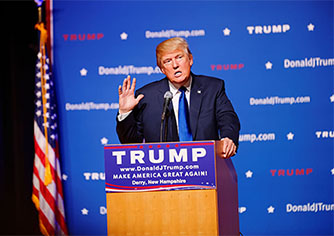
The Republican counterpart in the establishment-versus-populist narrative is found in the populist banner waved for months most strongly by Donald Trump. However, the billionaire developer and reality television celebrity failed to meet expectations in Iowa voting, raising the question of whether his political balloon has burst. Instead, the Republican caucuses were won by Cruz, a hardline conservative with strong support among evangelical Christians. Cruz's message is less purely populist than Trump's, but it still poses a challenge to the Republican establishment that for both ideological and personal reasons opposes Cruz. Among the establishment, the leading candidate is Sen. Marco Rubio of Florida. Republican leaders believe that as a young face and a Latino, Rubio could broaden the party's appeal while also being a levelheaded, reliable leader. As it stands, the race is developing into a three-way contest: Rubio (from the establishment) facing Cruz (the conservative hardliner) and Trump (the populist).

The strength of insurgent populism is the headline story to date in the presidential campaign, and that rise is relevant for Israel's strategy in its US public diplomacy. US populists of both right and left have drawn strength from the persistent stagnation of median income, which has not grown in thirty years. Across the political spectrum, American commentators agree that the country's economic system has failed the middle class. Sanders sees the solution in changing tax policy and providing free higher education. Trump sees the solution in cracking down on illegal immigration and firming up trade deals. Both, though, agree on the core problem: elites who have, for their own ends, sold out tens of millions of middle-class Americans.

This debate is fundamentally an internal domestic one, but it could have an impact on US foreign policy. On the one hand, Trump has drawn a line from elites' laxity on illegal immigration to their incompetence in negotiating trade deals to their weakness in challenging foes abroad. This reasoning led to his stepped-up rhetoric after the terror attacks in Paris and San Bernardino, his calls to "bomb the hell out of" ISIS, and to ban Muslim visitors. For Trump, populism leads to a more muscular foreign policy, at least rhetorically.

American populism, though, has often not led in that direction. Looking ahead, elites might need to explain in more direct terms why US intervention in the Middle East, for example, helps middle class incomes. Populism can lead to a less involved America abroad, a feeling that the often abstract "national interests" at stake in foreign entanglements are outweighed by the more direct needs of "nation-building at home." Populism could, over time, evolve in this direction.

Overall, populism is less predictable than elite politics, which favors continuity and stability in approach. Elite politics in recent decades have coalesced around support for a close US-Israel relationship. For Israel and its supporters, this is a signal achievement. Populism, however, could be more disruptive. Among Democrats, populism could fuse with what already is eroding support for Israel. Uneasiness with Israel and resentment of elites could fuse together into a David-and-Goliath narrative of wrongdoing by Israel and the American political elites supporting it. Sanders has not taken this position, at least not in its extreme. Still, the long term risk remains.

On the Republican side, this strain of populism surfaced even in Donald Trump's appearance before the Republican Jewish Coalition, where he said attendees would not support him "because I don’t want your money." Trump blurred the lines of whether Jews – and, by extension, Israel – are insiders in the battle against Islam or outsider elites for the white working class whose support Trump seeks. This is a familiar trope for nervous Diaspora Jewish thinking: populism boiling over into resentment (or scapegoating) of Jews or the Jewish state. In post-World War II America, it has failed, time and again, to materialize. The possibility, though, is there – as is the risk that the unpredictable Trump could make some unanticipated, drastic move to Israel's detriment.

For Israel and its supporters, the best response appears to be harnessing their traditional agility in US politics and building bridges with the populist standard-bearers without harming ties with the establishment. This was the dilemma faced by Prime Minister Benjamin Netanyahu in December 2015 in agreeing to meet with Trump on the candidate’s planned visit to Israel. The Prime Minister was presumably relieved when Trump canceled, saving Netanyahu from the choice between Trump and the establishment. Netanyahu, as well as Israel writ large, needs to keep ties to the establishment and the populist camps.

Still, at a time of a sustained partisan gap in attitudes toward Israel, balance between elite and populist politics is particularly important among Democrats. Fortunately for Israel, this election's populist hero is Sanders, who does not share the hostility toward Israel likely felt by many in his base of supporters. In coming years, Israel and its supporters might not be so lucky. A future Democratic – or even a Republican – populist might try to slay the sacred cow of the US-Israel relationship, among the whole herd of elitist sacred cows. Over time, this could erode US public support toward Israel, taking a toll on the special relationship.

This is hypothetical for now, and the candidates on today's stage are uniformly supportive, However, Israeli should but not be complacent, and should attempt to shoulder more public support in order to keep those scenarios unrealized.

The opinions expressed in INSS publications are the authors’ alone.
Publication Series INSS Insight
TopicsIsrael-United States Relations
עברית

Events

All events
Israel’s National Security Conference
27 July, 2026
10:00 - 14:00

Related Publications

All publications
From Military Force to Economic Isolation: The New Phase in Trump's Iran Policy
The complete guide to the Trump administration’s economic campaign against Iran—and the implications for Israel
27/08/26
The U.S.–Saudi Nuclear Agreement: Opportunities, Risks, and Policy Recommendations
The complete guide to the nuclear deal signed between Washington and Riyadh — and policy recommendations for Israel
29/07/26
The Crisis in Hormuz: The American Strategy, Trump's Dilemmas, and the Implications for Israel
Escalation in the Gulf: What is the current state of the intensifying conflict between Iran and the United States, what is driving Trump’s strategy, and how should Israel act as long as it remains outside the conflict?
26/07/26

Stay up to date

Registration was successful! Thanks.
  • Research

    • Topics
      • Israel and the Global Powers
      • Israel-United States Relations
      • Glazer Israel-China Policy Center
      • Russia
      • Europe
      • Antisemitism and Delegitimization
      • Iran and the Shi'ite Axis
      • The Campaign Against Iran and the Shiite Axis
      • Iran
      • Lebanon and Hezbollah
      • Syria
      • Yemen and the Houthi Movement
      • Iraq and the Iraqi Shiite Militias
      • Conflict to Agreements
      • Israeli-Palestinian Relations
      • Hamas and the Gaza Strip
      • Peace Agreements and Normalization in the Middle East
      • Saudi Arabia and the Gulf States
      • Turkey
      • Egypt
      • Jordan
      • Israel’s National Security Policy
      • Military and Strategic Affairs
      • Israel's Security Strategy
      • Societal Resilience and the Israeli Society
      • Jewish-Arab Relations in Israel
      • Climate, Infrastructure and Energy
      • Terrorism and Low Intensity Conflict
      • Cross-Arena Research
      • Data Analytics Center
      • Law and National Security
      • Advanced Technologies and National Security
      • Foreign Information Manipulation and Interference
      • Economics and National Security
    • Projects
      • Preventing the Slide into a One-State Reality
      • India-Middle East-Europe Economic Corridor (IMEC)
  • Publications

    • All Publications
    • INSS Insight
    • Policy Research and Papers
    • Special Publication
    • Strategic Assessment
    • Technology Platform
    • Memoranda
    • Database
    • Posts
    • Books
    • Archive
  • About

    • Vision and Mission
    • History
    • Research Disciplines
    • Chairman of the Board
    • Board of Directors
    • Fellowship and Prizes
    • Internships
    • Annual Reports
    • Support
    • Privacy Policy and Terms of Use
  • Media

    • Communications
    • Video Gallery
    • Press Release
    • Podcast
  • Home

  • Events

  • Database

  • Team

  • Contact

  • Newsletter

  • עברית

INSS logo The Institute for National Security Studies, Strategic, Innovative, Policy-Oriented Research, go to the home page
40 Haim Levanon St. Tel Aviv, 6997556 Israel | Tel 03-640-0400 | Fax 03-744-7590 |
Developed by Daat ,Yael Group.
Accessibility Statement
This site is protected by reCAPTCHA and the Google Privacy Policy and Terms of Service apply.