Egypt’s Reported Acquisition of the S-300VM Air Defense System | INSS
go to header go to content go to footer go to search
INSS logo The Institute for National Security Studies, Strategic, Innovative, Policy-Oriented Research, go to the home page
INSS
Tel Aviv University logo - beyond an external website, opens on a new page
  • Campus
  • Contact
  • עברית
  • Support Us
  • Research
    • Topics
      • Israel and the Global Powers
        • Israel-United States Relations
        • Glazer Israel-China Policy Center
        • Russia
        • Europe
        • Antisemitism and Delegitimization
      • Iran and the Shi'ite Axis
        • Operation Roaring Lion
        • Iran
        • Lebanon and Hezbollah
        • Syria
        • Yemen and the Houthi Movement
        • Iraq and the Iraqi Shiite Militias
      • Conflict to Agreements
        • Israeli-Palestinian Relations
        • Hamas and the Gaza Strip
        • Peace Agreements and Normalization in the Middle East
        • Saudi Arabia and the Gulf States
        • Turkey
        • Egypt
        • Jordan
      • Israel’s National Security Policy
        • Military and Strategic Affairs
        • Societal Resilience and the Israeli Society
        • Jewish-Arab Relations in Israel
        • Climate, Infrastructure and Energy
        • Terrorism and Low Intensity Conflict
      • Cross-Arena Research
        • Data Analytics Center
        • Law and National Security
        • Advanced Technologies and National Security
        • Foreign Information Manipulation and Interference
        • Economics and National Security
    • Projects
      • Preventing the Slide into a One-State Reality
  • Publications
    • -
      • All Publications
      • INSS Insight
      • Policy Papers
      • Special Publication
      • Strategic Assessment
      • Technology Platform
      • Memoranda
      • Posts
      • Books
      • Archive
  • Database
    • Surveys
    • Spotlight
    • Maps
    • Dashboards
  • Events
  • Team
  • About
    • Vision and Mission
    • History
    • Research Disciplines
    • Chairman of the Board
    • Board of Directors
    • Fellowship and Prizes
    • Internships
  • Media
    • Communications
    • Video gallery
    • Press Releases
  • Podcast
  • Newsletter
  • Campus
Search in site
  • Research
    • Topics
    • Israel and the Global Powers
    • Israel-United States Relations
    • Glazer Israel-China Policy Center
    • Russia
    • Europe
    • Antisemitism and Delegitimization
    • Iran and the Shi'ite Axis
    • Operation Roaring Lion
    • Iran
    • Lebanon and Hezbollah
    • Syria
    • Yemen and the Houthi Movement
    • Iraq and the Iraqi Shiite Militias
    • Conflict to Agreements
    • Israeli-Palestinian Relations
    • Hamas and the Gaza Strip
    • Peace Agreements and Normalization in the Middle East
    • Saudi Arabia and the Gulf States
    • Turkey
    • Egypt
    • Jordan
    • Israel’s National Security Policy
    • Military and Strategic Affairs
    • Societal Resilience and the Israeli Society
    • Jewish-Arab Relations in Israel
    • Climate, Infrastructure and Energy
    • Terrorism and Low Intensity Conflict
    • Cross-Arena Research
    • Data Analytics Center
    • Law and National Security
    • Advanced Technologies and National Security
    • Foreign Information Manipulation and Interference
    • Economics and National Security
    • Projects
    • Preventing the Slide into a One-State Reality
  • Publications
    • All Publications
    • INSS Insight
    • Policy Papers
    • Special Publication
    • Strategic Assessment
    • Technology Platform
    • Memoranda
    • Posts
    • Books
    • Archive
  • Database
    • Surveys
    • Spotlight
    • Maps
    • Dashboards
  • Events
  • Team
  • About
    • Vision and Mission
    • History
    • Research Disciplines
    • Chairman of the Board
    • Board of Directors
    • Fellowship and Prizes
    • Internships
    • Privacy Policy and Terms of Use
  • Media
    • Communications
    • Video gallery
    • Press Releases
  • Podcast
  • Newsletter
  • Campus
  • Contact
  • עברית
  • Support Us
bool(false)

Publications

Home Publications INSS Insight Egypt’s Reported Acquisition of the S-300VM Air Defense System

Egypt’s Reported Acquisition of the S-300VM Air Defense System

INSS Insight No. 637, December 2, 2014

עברית
Zvi Magen
Yiftah Shapir
Even if no contract has yet been signed, Egypt and Russia are holding talks on the purchase of the S-300VM air defense system, considered to be of a higher quality than the systems previously supplied to the Middle East. The perception is that such a weapon would upset the balance of power in the region in a regional conflict and in the event of a conflict with Israel and the West. • Concluding the deal with Egypt helps improve Russia’s standing internationally, particularly because it involves delivery of new, high quality weapons, which may have been the Egyptian condition for the entire deal. It may also serve as an example for other countries in the Middle East and thereby challenge US interests in the region. • Egypt today is not in conflict with Israel, yet entry of systems into the region could have precedent-setting consequences that go beyond the operational significance.

On November 12, 2014 the Russian media, including the TASS news agency’s website, reported that S-300VM air defense systems were supplied to Egypt. The information was attributed to the deputy director of the Russian federal agency for technical-military cooperation, who noted that Venezuela was the first country to purchase this system and that Egypt was the second. Two days later, TASS issued a denial, asserting that “no contract has yet been signed.” Yet despite the denial, the original announcement, attributed to a high ranking official, presumably had some basis. In fact, even if no contract has yet been signed, Egypt and Russia are holding talks on purchase of the system, information reinforced by an announcement from the factory that manufactures the chassis for the system to the effect that production of twelve units “for a foreign customer” has been completed.

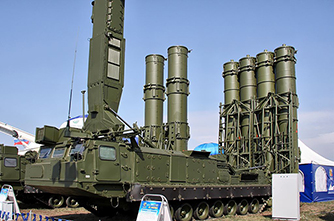
The system in question is the S-300VM, whose export version is known as Antei-2500 and SA-23 in the West. This system should not be confused with the various models of the S-300 system (S-300P/PMU1/PMU2 also known as SA-10/SA-20 in the West), which were offered at one time to Iran and Syria. The S-300V system was developed in the 1980s by the Antei corporation for the Soviet land forces, and for this reason, all its components are mounted on tracked vehicles. The advanced system includes a large number of elements, such as command vehicles, several kinds of radar for different tasks, four types of launchers, and two different types of interceptors. The standard interception range is up to 200 km, although an expanded model boasts an interceptor with a range of 300 km. The system also excels in its anti-ballistic-missile capabilities. In its previous versions (S-300V, or SA-12 Gladiator, to the West) it already had anti-ballistic-missile capabilities, and according to reports, these have been improved in the newer models.

Because of its attributes, the air defense system in question is considered to be of a higher quality than the systems previously supplied to the Middle East. The perception is that such a weapon would upset the balance of power in the region in a regional conflict and in the event of a conflict with Israel and the West. Indeed, in recent years, Russia has refrained from supplying similar systems to states in conflict (in particular, the S-300PMU-1/PMU-2), even after it had signed contracts to deliver them, as in the case of Syria and Iran. When these promises were broken, Iran brought international legal pressure to bear on Russia. The reasons for the failure to supply these systems were connected to the international sanctions, endorsed by Russia, at least with respect to Iran, and to consideration of Israeli interests, which is apparently based on mutual understandings on a variety of issues. In that case, why is Russia changing its approach, specifically with Egypt?

For many years prior to its decision to sign a large weapons deal with Russia, Egypt was oriented toward the United States, militarily, politically, and economically. The current turnabout reflects Egypt’s interest in changing the balance of its relations with the two superpowers and reducing its exclusive dependence on the United States. Egypt, like a number of countries in the Middle East, has felt challenged by US criticism of the rise of its current leadership to power. For Russia, this agreement constitutes a significant political-strategic achievement as well as an economic achievement. Beyond the clear interest in expanding defense exports, the main Russian consideration is to renew the dialogue with Egypt and strengthen its foothold in the Middle East vis-à-vis Egypt and other actors in the region. Russia’s breakthrough on the Egyptian front makes a significant contribution to a strengthened regional status and advancement of interests against the West in the global conflict, which of late has intensified. Indeed, there is increased Russian activity in the Middle East against the backdrop of the Ukrainian crisis, which figures at the top of the international agenda. Russia also sees the situation that has emerged in the Middle East, along with the overall strategic importance of the region, as an opportunity to start another confrontation arena alongside the one that has developed in Eastern Europe, in order to offset the pressures confronting it from the international arena.

Therefore, concluding the deal with Egypt helps improve Russia’s standing internationally, particularly because it involves delivery of new, high quality weapons, which may have been the Egyptian condition for the entire deal. It may also serve as an example for other countries in the Middle East and thereby challenge US interests in the region.

Recently, the possibility of Egyptian-Russian cooperation has been mentioned in the context of delivering MiG-35 aircraft to Egypt. However, this cooperation is not very likely, partly because of the heavy doctrinal and logistical significance of having Russian fighter jets in the Egyptian air force, which several decades ago, and with much effort, began to use American equipment. With the air defense systems, the situation is different. Egypt has not abandoned its old Soviet-made air defense systems, and in the past decade has even undertaken to upgrade the old SA-3 systems. Thus, the odds that Egypt will receive the S-300VM systems are higher than in the case of the combat aircraft.

As for the significance for Israel, an interceptor with a range of 200 km could barely reach Israeli territory from the western side of the Suez Canal. Nevertheless, if interceptors with a range of 300 km are delivered, or if the systems are deployed in the Sinai Peninsula, they could threaten Israel’s entire airspace.

Furthermore, Egypt’s longstanding and still current primacy as a regional axis between the superpowers is an important factor. Often, decisions by the largest Arab state concerning a strategic alliance with one of the superpowers, especially during the Cold War, gave rise to events with far reaching consequences. Consider the Czech arms deal in 1955, which was one of the factors in the Suez crisis, or Egypt’s arming itself with anti-aircraft weapons during the War of Attrition, which had decisive importance in the Yom Kippur War. In contrast, the Egyptian reversal following the 1973 war brought Egypt closer to the United States and ultimately enabled the signing of the Israeli-Egyptian peace treaty. Despite the difference between the geopolitical situation today and that which existed in the past, in view of Egypt’s critical role in the region, its moves should be taken very seriously.

Egypt today is not in conflict with Israel, yet entry of systems into the region could have precedent-setting consequences beyond the operational significance. The trend could spread to conflict states. Presumably Russia took Israel into account and that on this issue it does not intend to go beyond Egypt in a deal that not really jeopardize Israel’s interests. However, it is difficult to predict whether this Israeli-Russian understanding will be maintained over time.

The opinions expressed in INSS publications are the authors’ alone.
Publication Series INSS Insight
TopicsEgyptRussia
עברית

Events

All events
Iran, US, Israel, and the Global Jewish Community
10 March, 2026
12:00 - 13:00
Shutterstock

Related Publications

All publications
The Egyptian Agenda and Relations with Israel in the Shadow of the War in the Gaza Strip
The main foreign policy issue that has preoccupied Egypt recently has been the war in the Gaza Strip. Egypt’s policy toward the war in particular, and toward Israel in general, should be assessed in light of two central factors: first, the prolonged war and its severe consequences in the Gaza Strip—an area that directly borders Egypt; and second, the war’s contribution to the growing prominence of the Palestinian issue on Egypt’s national agenda, which resonates deeply within Egyptian public opinion. In this sense, this current situation is unprecedented in the 45 years of peace between Egypt and Israel. The war has posed a significant test for Egyptian–Israeli relations. At the same time, Egypt’s leadership has had to consider its domestic political and economic agenda—already burdened with challenges—as it formulated its policy toward both the war and Israel. Understanding these two dimensions—Egypt’s position on the Palestinian issue and its internal challenges—helps explain Egypt’s policy toward Israel and the likely implications for relations between the two countries. The analysis and insights presented in this article are based on official statements, as well as commentary and reporting by Egyptian analysts and journalists during the period under review.
23/11/25
shutterstock
The Muslim Brotherhood’s Influence Campaign in Egypt
What means does the Muslim Brotherhood use to influence the Egyptian regime, and what are the implications of these actions?
30/09/25
The Gulf States Buy Influence in Egypt and Jordan
The massive acquisitions by the wealthy Gulf states in Egypt and Jordan have given them a significant foothold in both countries — a development that also impacts Israel, presenting both opportunities and risks
09/07/25

Stay up to date

Registration was successful! Thanks.
  • Research

    • Topics
      • Israel and the Global Powers
      • Israel-United States Relations
      • Glazer Israel-China Policy Center
      • Russia
      • Europe
      • Antisemitism and Delegitimization
      • Iran and the Shi'ite Axis
      • Operation Roaring Lion
      • Iran
      • Lebanon and Hezbollah
      • Syria
      • Yemen and the Houthi Movement
      • Iraq and the Iraqi Shiite Militias
      • Conflict to Agreements
      • Israeli-Palestinian Relations
      • Hamas and the Gaza Strip
      • Peace Agreements and Normalization in the Middle East
      • Saudi Arabia and the Gulf States
      • Turkey
      • Egypt
      • Jordan
      • Israel’s National Security Policy
      • Military and Strategic Affairs
      • Societal Resilience and the Israeli Society
      • Jewish-Arab Relations in Israel
      • Climate, Infrastructure and Energy
      • Terrorism and Low Intensity Conflict
      • Cross-Arena Research
      • Data Analytics Center
      • Law and National Security
      • Advanced Technologies and National Security
      • Foreign Information Manipulation and Interference
      • Economics and National Security
    • Projects
      • Preventing the Slide into a One-State Reality
  • Publications

    • All Publications
    • INSS Insight
    • Policy Papers
    • Special Publication
    • Strategic Assessment
    • Technology Platform
    • Memoranda
    • Database
    • Posts
    • Books
    • Archive
  • About

    • Vision and Mission
    • History
    • Research Disciplines
    • Chairman of the Board
    • Board of Directors
    • Fellowship and Prizes
    • Internships
    • Support
    • Privacy Policy and Terms of Use
  • Media

    • Communications
    • Video Gallery
    • Press Release
    • Podcast
  • Home

  • Events

  • Database

  • Team

  • Contact

  • Newsletter

  • עברית

INSS logo The Institute for National Security Studies, Strategic, Innovative, Policy-Oriented Research, go to the home page
40 Haim Levanon St. Tel Aviv, 6997556 Israel | Tel: 03-640-0400 | Fax: 03-744-7590 | Email: info@inss.org.il
Developed by Daat ,Yael Group.
Accessibility Statement
This site is protected by reCAPTCHA and the Google Privacy Policy and Terms of Service apply.