


India’s Elections: Beyond the Promise of Narendra Modi | INSS
go to header go to content go to footer go to search
INSS logo The Institute for National Security Studies, Strategic, Innovative, Policy-Oriented Research, go to the home page
INSS
Tel Aviv University logo - beyond an external website, opens on a new page
  • Campus
  • Contact
  • עברית
  • Support Us
  • Research
    • Topics
      • Israel and the Global Powers
        • Israel-United States Relations
        • Glazer Israel-China Policy Center
        • Russia
        • Europe
        • Antisemitism and Delegitimization
      • Iran and the Shi'ite Axis
        • The Campaign Against Iran and the Shiite Axis
        • Iran
        • Lebanon and Hezbollah
        • Syria
        • Yemen and the Houthi Movement
        • Iraq and the Iraqi Shiite Militias
      • Conflict to Agreements
        • Israeli-Palestinian Relations
        • Hamas and the Gaza Strip
        • Peace Agreements and Normalization in the Middle East
        • Saudi Arabia and the Gulf States
        • Turkey
        • Egypt
        • Jordan
      • Israel’s National Security Policy
        • Military and Strategic Affairs
        • Israel's Security Strategy
        • Societal Resilience and the Israeli Society
        • Jewish-Arab Relations in Israel
        • Climate, Infrastructure and Energy
        • Terrorism and Low Intensity Conflict
      • Cross-Arena Research
        • Data Analytics Center
        • Law and National Security
        • Advanced Technologies and National Security
        • Foreign Information Manipulation and Interference
        • Economics and National Security
    • Projects
      • Preventing the Slide into a One-State Reality
      • India-Middle East-Europe Economic Corridor (IMEC)
  • Publications
    • -
      • All Publications
      • INSS Insight
      • Policy Research and Papers
      • Special Publication
      • Strategic Assessment
      • Technology Platform
      • Memoranda
      • Posts
      • Books
      • Archive
  • Database
    • Surveys
    • Spotlight
    • Maps
    • Dashboards
  • Events
  • Team
  • About
    • Vision and Mission
    • History
    • Research Disciplines
    • Chairman of the Board
    • Board of Directors
    • Fellowship and Prizes
    • Annual Reports
    • Internships
  • Media
    • Communications
    • Video gallery
    • Press Releases
  • Podcast
  • Newsletter
  • Campus
Search in site
  • Research
    • Topics
    • Israel and the Global Powers
    • Israel-United States Relations
    • Glazer Israel-China Policy Center
    • Russia
    • Europe
    • Antisemitism and Delegitimization
    • Iran and the Shi'ite Axis
    • The Campaign Against Iran and the Shiite Axis
    • Iran
    • Lebanon and Hezbollah
    • Syria
    • Yemen and the Houthi Movement
    • Iraq and the Iraqi Shiite Militias
    • Conflict to Agreements
    • Israeli-Palestinian Relations
    • Hamas and the Gaza Strip
    • Peace Agreements and Normalization in the Middle East
    • Saudi Arabia and the Gulf States
    • Turkey
    • Egypt
    • Jordan
    • Israel’s National Security Policy
    • Military and Strategic Affairs
    • Israel's Security Strategy
    • Societal Resilience and the Israeli Society
    • Jewish-Arab Relations in Israel
    • Climate, Infrastructure and Energy
    • Terrorism and Low Intensity Conflict
    • Cross-Arena Research
    • Data Analytics Center
    • Law and National Security
    • Advanced Technologies and National Security
    • Foreign Information Manipulation and Interference
    • Economics and National Security
    • Projects
    • Preventing the Slide into a One-State Reality
    • India-Middle East-Europe Economic Corridor (IMEC)
  • Publications
    • All Publications
    • INSS Insight
    • Policy Research and Papers
    • Special Publication
    • Strategic Assessment
    • Technology Platform
    • Memoranda
    • Posts
    • Books
    • Archive
  • Database
    • Surveys
    • Spotlight
    • Maps
    • Dashboards
  • Events
  • Team
  • About
    • Vision and Mission
    • History
    • Research Disciplines
    • Chairman of the Board
    • Board of Directors
    • Fellowship and Prizes
    • Internships
    • Annual Reports
    • Privacy Policy and Terms of Use
  • Media
    • Communications
    • Video gallery
    • Press Releases
  • Podcast
  • Newsletter
  • Campus
  • Contact
  • עברית
  • Support Us
bool(false)

Publications

Home Publications INSS Insight India’s Elections: Beyond the Promise of Narendra Modi

India’s Elections: Beyond the Promise of Narendra Modi

INSS Insight No. 551, May 19, 2014

Follow us on Google
עברית
Hriday Sarma
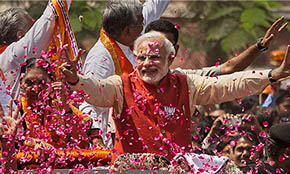
With the recent end of the long-running 2014 parliamentary elections in India, the winds of change may hit the Asian giant’s relationship with Israel. For the first time in a decade, the Hindu nationalist Bharatiya Janata Party (BJP) is returning to power, having scored a decisive victory in the preliminary voting tally. The BJP’s charismatic leader, Narendra Modi, is a strong supporter of Israel, and his personality and presence might transform Indian-Israeli relations. For Israeli policymakers, the clear recommendation is to seek out Modi, welcome his election, and engage him in efforts to find ways to deepen and expand ties with this important rising power. The less obvious but equally important recommendation is to maintain support for Israel across the Indian political spectrum.

With the recent end of the long-running 2014 parliamentary elections in India, the winds of change may hit the Asian giant’s relationship with Israel. For the first time in a decade, the Hindu nationalist Bharatiya Janata Party (BJP) is returning to power, having scored a decisive victory in the preliminary voting tally. The BJP’s charismatic leader, Narendra Modi, is a strong supporter of Israel, and his personality and presence might transform Indian-Israeli relations. The open question is whether Modi’s personal inclinations can overcome the limits of India’s geopolitics.

Modi’s rise has been spectacular, and to a certain extent, controversial. In 2002, Hindus killed between 900 and 2,000 Muslims during riots in the state of Gujarat where Modi served as chief minister. Many left wing politicians and some parts of the public pointed a finger at Modi for what they viewed as his administration’s insufficient response. In 2005, the United States even revoked Modi’s visa because of his connection with the riots. For years, Modi was persona non grata in many Indian circles and in many Western countries. Then, in 2010, an Indian Supreme Court-appointed Special Investigation Team largely exonerated Modi for involvement in the riots. Yet even during the years of controversy, Modi was able to emerge as the chief architect of his state by boosting the GDP of Gujarat over the years; Gujarat’s compound annual rate of GDP growth was 13.4 percent under Modi, far outpacing that of India overall at 7.8 percent during the same period. Furthermore, Modi has continued to strive to make Gujarat a “global business hub,” with considerable success. A key ingredient in the success story was a policy of encouraging foreign direct investment in Gujarat, including a great deal from Israel.

Contacts with Israel have been particularly important for Modi. In recent years, Modi has visited Israel, staying with the head of the India-Israel chamber of commerce and meeting with Israeli businessmen and entrepreneurs. Gujarat has continued to be the world’s leading center for diamond-cutting, positioning it at an important point in the supply chain of a signature Israeli industry. Modi sought to expand the relationship beyond diamonds and to forge ties with Israel's state of the art h-tech sector in the fields of micro- and drip irrigation, biotechnology, and others. Israel’s ports company is also a key player in a consortium building a deep-water port in Gujarat. Modi has likewise shown interest in pushing forward the Indian-Israeli free trade agreement currently under consideration.

For the Indian public, though, Modi’s most important achievement was in raising living standards in Gujarat at a time when the overall Indian economy stuttered. That, coupled with perceived lackluster leadership in the rival Indian National Congress-ruled states in the country such as New Delhi and Assam, made Modi well-positioned for India’s recent parliamentary elections. The last of India’s voters went to the polls on May 12, 2014, and preliminary results were released on May 16. The results made it official: Modi and the BJP will form the new national government.

The victory by Modi presents opportunities but also challenges for Israel. On the one hand, Modi’s strength of personality and charisma positions him as a potential opinion leader for hundreds of millions in India’s rising middle class. That rising middle class is a key part of the rising middle classes of Asia that will become the pillar of global economic and political power in coming decades. In a best-case scenario, Modi could not only be an Asian Stephen Harper, and like the Canadian Prime Minister, an outspoken friend of Israel on the international stage; he could expand the Indian-Israeli relationship with immediate economic and political benefits for Israel and prime Indian public opinion to be well-disposed toward Israel into the longer term.

At the same time, that rosy scenario will likely need to come to terms with geopolitical realities. To the Indian establishment, Iran is a strategic partner that churns out oil that India needs and sits astride Afghanistan, Pakistan, and Central Asia, traditional invasion routes into the subcontinent. The Gulf states are home to millions of Indian workers whose remittances power the economy in the state of Kerala and elsewhere. The politics of the United Nations also limit the benefits of diplomatic support for Israel, with Arab and Muslim states controlling dozens of votes and Israel commanding only one. Unlike Stephen Harper’s Canada, India is a developing country in a difficult security neighborhood. Narendra Modi may not have the freedom to pursue a full-fledged pro-Israel agenda.

Within these limits, though, Indian policy could shift somewhat. During the term of the last BJP prime minister, Atal Bihari Vajpayee, the tune from New Delhi changed for the better. Modi could reignite that spark and even go a bit further, given his personal investment in this relationship. For Israeli policymakers, the clear recommendation is to seek out Modi, welcome his election, and engage him in efforts to find ways to deepen and expand ties with this important rising power.

The less obvious but equally important recommendation is to maintain support for Israel across the Indian political spectrum. On balance, the BJP has traditionally been more supportive of Israel, but in recent decades most Congress politicians have also shown goodwill. Just as bipartisan support has shielded the US-Israel relationship from the increasing partisanship of Washington, so too continued outreach to all major players in Indian politics could build an important foundation for a relationship that could prove ever more important  and hopefully, ever closer  in the decades to come. The rise of Narendra Modi is Israel’s opportunity. Balancing that with a relationship with the wider Indian political spectrum is Israel’s challenge.
The opinions expressed in INSS publications are the authors’ alone.
Publication Series INSS Insight
TopicsIndia
עברית

Events

All events
Israel’s National Security Conference
27 July, 2026
10:00 - 14:00

Related Publications

All publications
Shutterstock
India, Japan, and Swords of Iron: Asia’s Strategic Importance
How do these economic giants view Israel’s war against Hamas, and why should Israel invest public diplomacy efforts in Indian and Japanese audiences?
09/11/23
Shutterstock
The Technology Initiative between India and the United States: A New Era, Against the Backdrop of China’s Growing Power
Notwithstanding their numerous ideological differences, and against the background of the competition with China, Washington and New Delhi have launched a technology initiative. What lies behind this far-reaching initiative?
18/06/23
Strategic Analysis for Israel 2023
Read the INSS Strategic Analysis for 2023
23/02/23

Stay up to date

Registration was successful! Thanks.
  • Research

    • Topics
      • Israel and the Global Powers
      • Israel-United States Relations
      • Glazer Israel-China Policy Center
      • Russia
      • Europe
      • Antisemitism and Delegitimization
      • Iran and the Shi'ite Axis
      • The Campaign Against Iran and the Shiite Axis
      • Iran
      • Lebanon and Hezbollah
      • Syria
      • Yemen and the Houthi Movement
      • Iraq and the Iraqi Shiite Militias
      • Conflict to Agreements
      • Israeli-Palestinian Relations
      • Hamas and the Gaza Strip
      • Peace Agreements and Normalization in the Middle East
      • Saudi Arabia and the Gulf States
      • Turkey
      • Egypt
      • Jordan
      • Israel’s National Security Policy
      • Military and Strategic Affairs
      • Israel's Security Strategy
      • Societal Resilience and the Israeli Society
      • Jewish-Arab Relations in Israel
      • Climate, Infrastructure and Energy
      • Terrorism and Low Intensity Conflict
      • Cross-Arena Research
      • Data Analytics Center
      • Law and National Security
      • Advanced Technologies and National Security
      • Foreign Information Manipulation and Interference
      • Economics and National Security
    • Projects
      • Preventing the Slide into a One-State Reality
      • India-Middle East-Europe Economic Corridor (IMEC)
  • Publications

    • All Publications
    • INSS Insight
    • Policy Research and Papers
    • Special Publication
    • Strategic Assessment
    • Technology Platform
    • Memoranda
    • Database
    • Posts
    • Books
    • Archive
  • About

    • Vision and Mission
    • History
    • Research Disciplines
    • Chairman of the Board
    • Board of Directors
    • Fellowship and Prizes
    • Internships
    • Annual Reports
    • Support
    • Privacy Policy and Terms of Use
  • Media

    • Communications
    • Video Gallery
    • Press Release
    • Podcast
  • Home

  • Events

  • Database

  • Team

  • Contact

  • Newsletter

  • עברית

INSS logo The Institute for National Security Studies, Strategic, Innovative, Policy-Oriented Research, go to the home page
40 Haim Levanon St. Tel Aviv, 6997556 Israel | Tel 03-640-0400 | Fax 03-744-7590 |
Developed by Daat ,Yael Group.
Accessibility Statement
This site is protected by reCAPTCHA and the Google Privacy Policy and Terms of Service apply.