


Publications
INSS Insight No. 510, January 26, 2014
Follow us on Google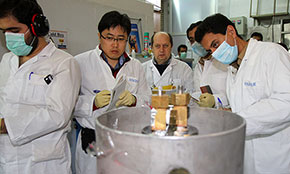
On January 20, 2014, IAEAinspectors visited Natanz and Fordow to verify that Iran began implementing theinterim deal with the P5+1 by halting its enrichment of uranium at thesefacilities to 20 percent. The last two months were spent rehashing the terms ofwhat had ostensibly already been decided in late November in Geneva, althoughthe different versions of the agreement that were released by Washington andTehran at the time immediately revealed that the two states were not on thesame page, which did not bode well for the continued process. The dispute overthe correct interpretation of what was decided is still far from over, asevidenced by Iranian accusations days before implementation began that the“Summary” of the understandings released by the White House was “a unilateraland one-sided interpretation” of what had been agreed. It is also unclear whythe White House chose to release only a summary, rather than the full text ofthe new understandings.
On January 20, 2014, IAEA inspectors visited Natanz and Fordow to verify that Iran began implementing the interim deal with the P5+1 – two months after the deal was first announced in late November 2013 – by halting its enrichment of uranium at these facilities to 20 percent. The last two months were spent rehashing the terms of what had ostensibly already been decided in late November in Geneva, although the different versions of the agreement that were released by Washington and Tehran at the time immediately revealed that the two states were not on the same page, which did not bode well for the continued process. The dispute over the correct interpretation of what was decided is still far from over, as evidenced by Iranian accusations days before implementation began that the “Summary” of the understandings released by the White House was “a unilateral and one-sided interpretation” of what had been agreed. It is also unclear why the White House chose to release only a summary, rather than the full text of the new understandings.
The interim deal – known as the Joint Plan of Action (JPA) – was never meant to be more than an arrangement that would freeze Iran’s problematic nuclear activities for the duration of the continued negotiations over a comprehensive deal, in return for a limited amount of sanctions relief to Iran. The comprehensive deal is the goal; the interim deal was only meant to create the correct atmosphere for getting there.
Nonetheless, the interim deal has already taken on a life of its own. It has created new facts on the ground, or more precisely, new realities and new perceptions of reality. These include an already improving economic situation in Iran due to the anticipation of sanctions relief over the coming months. There is also a sense – despite US protestations to the contrary – that the US may be somewhat less determined to deal harshly with companies that cross the sanctions line, because the underlying message is strong US interest in continued diplomatic engagement with Iran.
On the nuclear front, the critical issue of Iran’s right to continue R&D on new generations of centrifuges – a major point of contention in discussions between Iran and the P5+1 over the past two months – seems to have been resolved in Iran’s favor. Iran believes that the JPA secures its right to work on any aspect of advanced centrifuge research and development that it chooses. This is evident in a series of Iranian statements, most recently by Rouhani when he said there would be no restrictions on Iran’s civilian nuclear program, including R&D.
The role of the IAEA in pressing to clarify the possible military dimensions (PMD) of Iran’s nuclear program – which was manifested most starkly over the course of 2012-2013 in its repeated demands to conduct inspections at Parchin – is not clear according to the JPA. Is it still the mandate of the IAEA to pursue these clarifications, or is the decision now under the purview of the Iran-P5+1 Joint Commission set up by the JPA? This issue cannot remain unresolved, because continued investigation of the military dimensions of Iran’s nuclear program – not mentioned as part of the JPA – is of crucial importance. If this dimension is not uncovered, Iran can continue to claim that it has done no wrong. Moreover, because the PMD remain outside the JPA, activities intended for the development and manufacturing of nuclear explosive devices and the subsequent development of warheads can proceed unhindered during implementation of the JPA.
According to the White House “Summary,” the Joint Commission will monitor the implementation of the JPA. This means that Iran itself will now have a direct role in the determination of whether it is complying or not with the terms of this understanding. This raises concerns over whether there is any realistic possibility of ever proclaiming that Iran has not fulfilled the terms of the agreement and that stronger measures – such as additional sanctions – are necessary.
On the enrichment front, while the JPA does not explicitly note Iran’s right to enrich uranium, it clearly defines the terms for Iran’s continued enrichment to 5 percent, in contradiction to the UNSC resolutions that demand suspension. For Iran, this is important de facto recognition of what it views as its right. Moreover, the JPA is valid for six months only, but can be extended, if both sides agree. What happens if no agreement is reached, but there is no comprehensive deal either? Can Iran go back to its pre-JPA activities?
The situation regarding 20 percent enrichment deserves special attention. Although this stockpile was ostensibly to be rendered “unusable,” the reality is somewhat different. Until November 2013, Iran produced some 400 kilograms of 20 percent UF6. The JPA states that from the existing uranium enriched to 20 percent, Iran would retain half as working stock of 20 percent oxide for fabrication of fuel for the Tehran Research Reactor (TRR). It would dilute the remaining 20 percent UF6 to no more than 5 percent.
The White House “Summary” states that the dilution of half of Iran’s stockpile of near-20 percent uranium hexafluoride must be completed in three months, and conversion of the rest of that material to oxide in six. This means that only half of the UF6 stock would be diluted. Since about half of the originally produced UF6 was transferred to the UCF to be transformed into an oxide form, this means that only some 100 kilograms of the remaining UF6 stock would be diluted, and 100 kilograms would remain. This amount would be added to the some 200 kilograms previously transferred to the UCF, and presumably converted to oxide. Therefore, following the dilution process, some 300 kilograms of UF6 equivalent of 20 percent enriched uranium would remain in various oxide forms. This amount could be reconverted into UF6 and be available for further enrichment, if so desired. Therefore, the “Summary’s” dismissal of the oxide form as “not suitable for further enrichment” is inaccurate. In fact, this amount, if reconverted and then enriched to 90 percent, could be sufficient for one nuclear explosive device.
Beyond these new realities on the ground, what has transpired over the past two months of haggling over the terms for implementing the JPA has had the side effect of reshaping and redefining the relative strengths and positions of the two main actors in the current dynamic – Iran and the United States. This is a dynamic that will now feed back into the process, and have its own impact on the prospects for success through the next phase of negotiations, due to commence sometime in February. Over the past months the US has demonstrated its eagerness to move forward on the interim deal regardless of how Iran has reacted to developments. Indeed, US rhetoric has seemed consistently determined to avoid offending Iran. Iran, meanwhile, has had no qualms about insulting the US, whether through its statements regarding the deal – claiming that the agreement on implementation indicates the surrender of the West to Iran, that the agreement can be reversed in a day, and that Iran under no circumstances will agree to destroy any centrifuges – through direct name calling, or through symbolic acts such as Foreign Minister Zarif placing a wreath on the grave of arch-terrorist Imad Mughniyeh in Lebanon. All of this will not work in America’s favor at the negotiations table, as it projects relative US weakness in standing up to Iran.
Combined with the relaxed sanctions and interpretations on the nuclear front that enable Iran to retain critical components of its program, this US-Iran trend serves to further chip away at American leverage in negotiations over the only deal that really matters: the comprehensive deal that must prevent Iran from moving toward a military nuclear capability.