


Publications
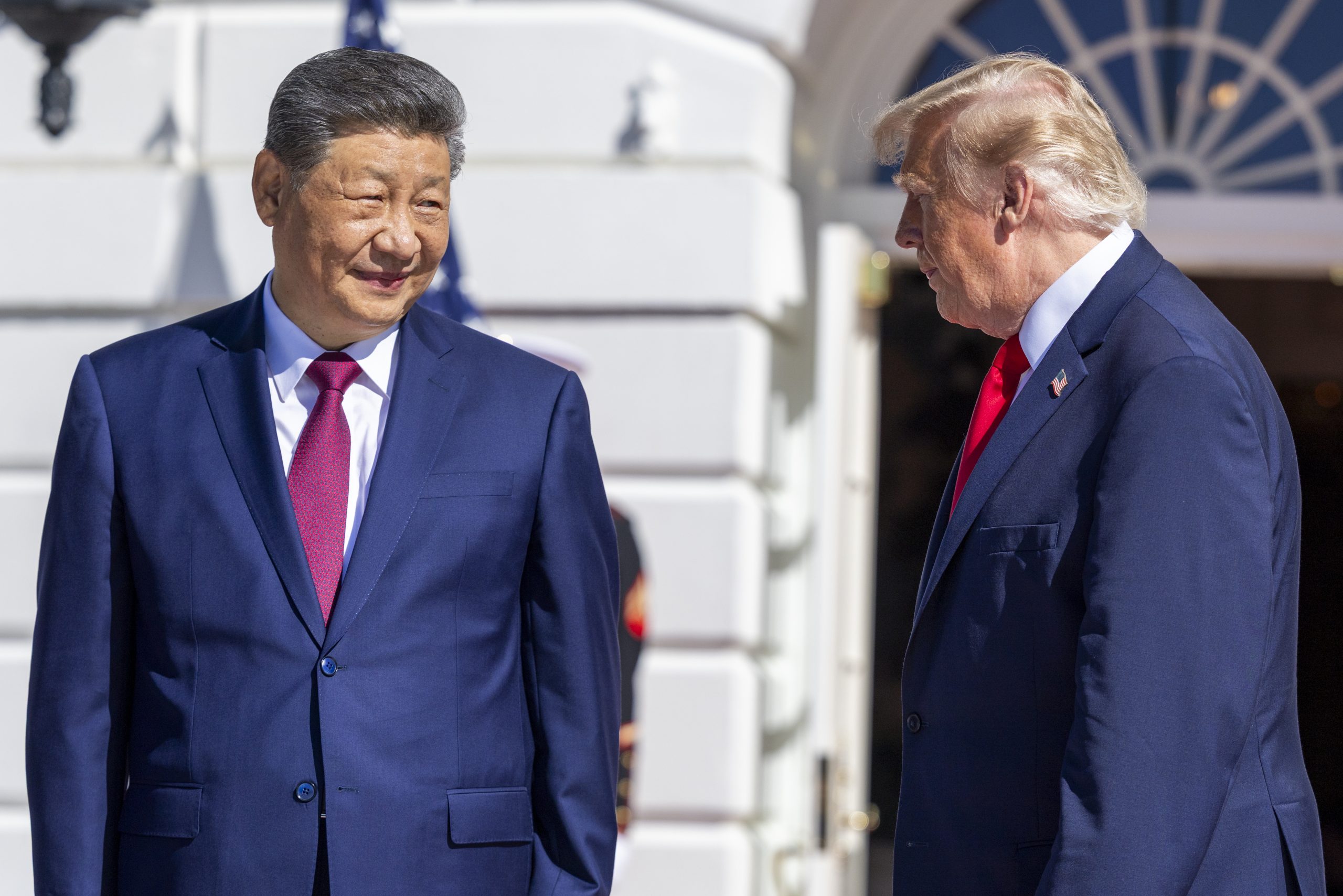
What can be learned from the meeting between the Chinese president and his American counterpart regarding relations between the two powers — and what conclusions must Israel draw?
INSS Insight No. 2208, November 3, 2026
Follow us on GoogleBetween September 23 and 25, Chinese President Xi Jinping made a state visit to Washington—his second meeting this year with President Donald Trump. The visit was marked by elaborate ceremony and modest deliverables that buy both leaders time ahead of their upcoming political challenges: a brief extension of the trade war truce, new dialogue mechanisms, a joint statement on Iran, and the scheduling of two additional meetings before the year’s end. The two superpowers are managing their rivalry through a differentiated approach: agreeing where possible, issuing statements where convenient, and sidestepping mines that cannot be resolved or agreed upon. In the weeks since the summit, competition in the technology sector has intensified, and arms supplies to Taiwan under a previous deal have resumed. On the Iranian front, China’s commitment appears to be largely declaratory, and it is doubtful that Beijing will exert real pressure on Tehran or even halt the assistance it provides. Israel must recognize that advanced technology lies at the heart of the powers’ competition, that the room for agreement on this issue is limited and shrinking, and that sensitivities are only intensifying.
The Framework: Stability, Respect, Fairness, and Reciprocity
During their meeting in Beijing in May, Chinese President Xi Jinping and US President Donald Trump agreed on "constructive strategic stability relations." At their meeting in Washington this past September, the formula was expanded to "constructive, strategic, and stable relations based on respect, fairness, and reciprocity." "Fairness" and "reciprocity" are foundational concepts for the Trump administration, which remains concerned about the trade deficit and what it views as China's unfair practices. "Respect" is a Chinese addition, interpreted by Foreign Minister Wang Yi as respect for China's sovereignty, regime, and core interests—a definition that bolsters both the regime's domestic prestige and its foreign policy, with particular emphasis on Taiwan. Beijing placed the formula at the top of the eight “outcomes and understandings” it published after the summit, underscoring its importance from China’s perspective.
Official statements likewise reflected this divergence: the White House highlighted purchases of American coal, US military presence in the Indo-Pacific, and a call for trilateral nuclear arms control; China’s Foreign Ministry cited a military memorandum of understanding on communications and crisis prevention, which does not appear in the US version.
The summit’s outcomes included verbal deliverables (the formula for bilateral relations and the statement on Iran); substantive ones (an extension of the trade-war truce and lists of tariff reductions); procedural ones (councils, dialogue on artificial intelligence, channels for preventing military friction, and follow-up meetings); and symbolic ones (the welcoming ceremony and its protocol, the loan of a pair of pandas to the Atlanta Zoo, and the narrative of the US–China alliance during World War II).
Trade and Economy: An Extension and Mechanisms Instead of Deals
The ceasefire in the trade war was extended by two months, through January 10. The Trade Council approved lists for tariff reductions on "non-sensitive" goods totaling $30 billion for each side. But according to US Trade Representative Jamieson Greer, the tariff reductions have evidently not yet begun. The White House announced that China would import 10 million tons of coal a year in 2027 and 2028, but Beijing has not confirmed the quantity. The trade and investment councils were activated, and an agricultural working group was established.
Between the May and September summits, the emphasis thus shifted from procurement commitments to mechanisms, even as earlier commitments remained only partly fulfilled. According to FDD, China bought about half of the 25 million tons of soybeans it had promised to purchase, and a deal for 200 Boeing aircraft has yet to materialize. The White House itself noted that work to restore rare-earth supplies to the United States is ongoing—meaning China continues to hold on to this strategic lever over Washington. Meanwhile, during trade talks with the European Union in October, Beijing pledged to continue supplying Europe with rare earth supplies and said it would continue approving export licenses for the EU regardless of the truce's outcome with the United States. Beijing is thus using this leverage selectively with different partners.
Artificial Superintelligence: Yes to Dialogue, No to Advanced Chips and Restraints on Progress
Agreements on artificial superintelligence remain limited to dialogue—with the next round scheduled for November—and a channel for reporting incidents. The White House statement makes no mention of export controls on semiconductor chips. Trade Representative Greer clarified that export controls pertaining to national security had been taken off the agenda in advance.
President Trump introduced the term "superintelligence" in place of "artificial intelligence," to which Beijing merely responded that it "respects" the choice. The day after the summit, Trump remarked that he does not want to "integrate" AI efforts with China, as the United States leads the field. On September 29, Trump convened executives of the leading AI companies, who signed a voluntary charter for self-regulation, and on October 4, he established a "Superintelligence Task Force" led by the Director of National Intelligence and reporting directly to the president.
These agreements thus reflect the superpowers' recognition of the potential risks posed by artificial superintelligence and the necessity of managing them through dialogue. According to a report, professional teams are holding regular talks on the details of the incident framework, with the aim of presenting cooperation in this area as an outcome of the leaders’ planned meeting in Shenzhen. Some have likened the risks of AI to those posed by nuclear weapons. In this respect, the powers are willing to engage in dialogue, while resisting any arms-control-style limitations on frontier capabilities.
Taiwan: China Declares, the United States Holds Its Ground
Xi called on the United States to continue adhering to what he termed the "correct position" of opposing Taiwan's independence, whereas standard US phrasing limits itself to not supporting it. Taiwan is not mentioned in the official statements issued by the White House or the Chinese Foreign Ministry, and the US ambassador to Beijing clarified that US policy has not changed. A new $14 billion arms package for Taiwan has been on hold since May, serving as a bargaining chip for Trump, while Taiwan is pressing for it to move forward. A senior administration official noted that Trump approved a record $11 billion deal in December, and Taiwan’s representative in Washington said that relations remained strong. However, in the week after the visit, on October 2, the first two F-16s from a deal approved in 2019 landed in Taiwan, after waiting in Hawaii until the summit concluded. According to a press report, the Pentagon will station liaison officers at Taiwan's Ministry of National Defense through 2028. US officials now assess that a Chinese invasion of Taiwan before 2028 is unlikely.
Iran: A Statement Without a Commitment
Both sides declared that Iran must abide by its commitment not to develop nuclear weapons and that transit fees should not be levied in international waterways—wording that was also affirmed in the US fact sheet. According to the US ambassador to China, Xi assured Trump that "changes have been made" to China's assistance to Iran, but China made no commitment to take any concrete action. The sanctioned Iranian airline Mahan Air continues to land in China, even as regional states have closed their airspace to it. There was no explicit mention of China’s assistance to Iran in purchasing oil, supplying dual-use materials for its missile industry, or the alleged provision of surface-to-air missiles and satellite intelligence support for Iranian strikes against American targets. This is despite a Wall Street Journal report that the geospatial intelligence Iran used in an attack in Jordan that killed three Americans came from China, and that China sent Iran roughly 1,300 shipments of components for drones and missiles in the first half of the year. Furthermore, no reference was published regarding China's demand to link its assistance to Iran to American concessions on Taiwan. Meanwhile, tensions in the Gulf continue to rise: Iran is attacking vessels near the Strait of Hormuz, and Trump said he might intensify strikes after the midterm elections and that future talks on Iran’s nuclear disarmament involving Russia and China were possible.
Additional Topics
According to the Chinese Foreign Ministry, the respective militaries will sign a memorandum of understanding on communications and crisis prevention. The leaders also welcomed cooperation on drug enforcement, a key issue on Trump’s presidential agenda. The White House reported that Russia and North Korea were also discussed, but no agreements were reached.
History, too, served as an arena for diplomatic competition during the visit. Both sides invoked the US–China alliance during World War II, prompting protests in Taiwan over what it called China’s rewriting of history. According to reports, the itinerary prepared by the hosts for Xi included a visit to the US National Archives and an exhibit of documents, including the 1951 Treaty of San Francisco. In that treaty, Japan renounced sovereignty over Taiwan without specifying which sovereign entity would assume control of it; neither the People's Republic of China nor the Republic of China was a party to the agreement. The treaty is therefore used to argue that Taiwan’s status remains unresolved, a position China vehemently opposes. Following objections from the Chinese delegation, documents related to China were removed, and the visit to the archives focused on the founding documents of the United States.
Ceremony and Protocol
Trump went to great lengths to accord lavish honors to his guest, personally greeting Xi on the tarmac at Joint Base Andrews, a gesture not extended to a foreign guest in Washington since 1962. By contrast, when Trump visited China in May, he was welcomed by China’s vice president. Trump’s welcome for Xi also featured a thunderous flyover by bombers and stealth aircraft—a somewhat heavy-handed display of military power. Republican senators criticized the excessive honors shown to Xi.
Trump also hosted Xi at a state dinner attended by dozens of leaders of US technology companies. A group of Chinese executives arrived in Washington separately from the delegation but ultimately did not attend the dinner, either because of coordination problems or to avoid unnecessary awkwardness while Chinese companies are under US sanctions.
On the sidelines of the visit, questions were also raised regarding the health of the visiting leader, who has refrained from designating a successor. According to the Wall Street Journal, requests from the Chinese delegation for extended rest breaks for Xi—including skipping a working lunch—shortened the leaders’ meeting time. Videos of the Chinese president on the aircraft stairs and on the steps of the National Archives also prompted speculation about his physical stability.
The Political Clocks
Both leaders have good reason to shape their summit meeting as they did. Trump is looking ahead to the midterm elections on November 3. Extending the trade-war truce pushes its expiration to two months after the elections, while lower tariffs on consumer goods, agricultural products, and coal appeal to his support base. Xi is preparing for the 21st Party Congress in fall 2027, where he is expected to secure a fourth term. Each side is buying time, while assessing that time works in its favor.
The next tests will come at the upcoming summits—APEC in November and the G20 in December—when rare-earth supplies, fulfillment of procurement commitments, and US countermeasures will be put to the test ahead of the truce’s expiration on January 10 or its possible extension. Trump is slated to travel to Shenzhen following the ASEAN summit in Manila on November 16. In Beijing, the Fifth Plenum of the Central Committee convened in October to address party discipline—another step in the preparations for the Party Congress.
Implications for Israel
The summit between the leaders of the superpowers did not address Israel, but it shapes Israel’s environment and room for maneuver. Israel’s relations with China have always been a derivative of US–China relations, and the same is true today. Specifically, Israel should pay attention to two issues of central importance to it, both of which featured at the latest summit.
In the technology sphere, the space for consensus between the powers is narrow, and both are hardening their positions on core issues. Subordinating the artificial intelligence portfolio to the Director of National Intelligence makes it clear that Washington regards it as an unambiguous matter of national security. US sensitivity toward technology ties with China, including those of Israel, is expected to continue rising.
On the Iran issue, agreement between the powers is positive, but so far it is only declaratory. China meanwhile remains a channel through which sanctioned Iran can circumvent restrictions, and a potential source of support for rebuilding its military industries and its arsenal of threats against Israel.
In light of this, first, Israel must conduct itself with utmost sensitivity in all dealings with China involving semiconductors, artificial intelligence, cyber, and digital technologies, as well as investment, and ensure advance coordination with the United States. Second, it should develop a working channel with the new US bodies dealing with artificial intelligence and position itself as a partner of the United States in the competition. Third, Israel should not count on China to pressure Iran, but should maintain a channel of dialogue with Beijing and ensure that its positions are heard there, as well as in Washington.