


Publications
How has the anti-Israeli influence campaign linked to the Muslim Brotherhood changed following the end of the war in Gaza?
INSS Insight No. 2102, February 23, 2026
Follow us on GoogleThe end of the war in Gaza in October 2025 posed a fundamental challenge to foreign influence campaigns that had operated against Israel during the fighting, including the ISNAD campaign, which is affiliated with the Muslim Brotherhood. These campaigns—relying on a sense of urgency, heightened public attention, and intense emotional mobilization—were now required to adapt to a new reality in which public discourse gradually returned to political, social, and economic issues. In this context, maintaining relevance and influence requires adjustment and change. This article examines how ISNAD is responding to this new reality and identifies a shift from a short-term wartime strategy to an ongoing socio-cognitive struggle, referred to as “sociological warfare.”
In recent years, the ISNAD influence campaign has operated against Israel as a civilian, non-state, volunteer campaign identified with the Muslim Brotherhood movement. The campaign is led by Ezzeldeen Devidar, an Egyptian regime opponent living in exile, who has defined it as the “digital arm of the resistance.” During the war in Gaza, ISNAD functioned as a wartime influence campaign, calling for increased public pressure in Israel to end the fighting while amplifying pro-Hamas messaging within the Israeli discourse. The strategy included broad recruitment of activists posing as Israelis, a high operational pace, and “flooding” social media networks.
The end of the fighting posed a challenge for ISNAD, as the central objective that had unified its activities—exerting public pressure to end the war—lost its relevance. At the same time, there was a noticeable decline in activist activity and engagement, alongside increased awareness of exposure and infiltration risks that complicated its operations. This article examines how ISNAD has responded to this new reality and identifies a shift from a short-term wartime strategy to an effort to establish an ongoing socio-cognitive campaign aimed at weakening and ultimately eliminating Israel.
This article analyzes the campaign’s activity during the period between October 2025, when a ceasefire in the Gaza Strip was declared, and January 2026. Changes in activity were assessed through various Telegram channels affiliated with ISNAD, Devidar’s X account, and a range of fake X accounts also associated with ISNAD. It should be noted that ISNAD also operates a campaign directed at Arab states and is involved in campaigns targeting the West; however, this article focuses solely on the campaign directed against Israel. In addition, while ISNAD operates on other social media platforms, this article addresses the campaign only on X.
“Sociological Warfare”: A New Phase of the Campaign
Following the announcement of a ceasefire in the Gaza Strip, statements began appearing on the campaign’s channels regarding a transition to a new phase. On ISNAD’s Telegram channel, it was stated that “our ultimate goal is to resist the Israeli occupation intellectually and culturally. We will provide you with the tools to refute Israeli lies and publish the facts, becoming a strong and influential voice in exposing the crimes of the occupation.” On his X account, Devidar outlined his strategic plan: The first axis was violent struggle, which took place over the past two years; the subsequent axes involve creating internal conflict within Israel by dismantling social cohesion and isolating Israel globally from its allies and from the Jewish diaspora.
Within this framework, ISNAD has shifted from focusing on a defined strategic objective—namely, influencing concrete policy decisions led by ending the war—to adopting a broader strategic goal: the sustained undermining of Israeli society from within. The weakening and even elimination of Israel are not new objectives in Arab discourse; however, the civilian social media campaign represents a new development, reflected in the adoption of the concept of “sociological warfare” (الحرب السيسيولوجية); that is, a long-term struggle in the social, cultural, and cognitive arenas. Unlike event-driven cognitive warfare, sociological warfare is perceived as a cumulative effort that does not seek rapid resolution but rather the gradual erosion of social cohesion, trust in state institutions, and a shared sense of future.
Adopting this concept enables ISNAD to detach the justification for its activities from the wartime context that led to its establishment. In the absence of active military confrontation, the campaign presents itself as part of a broad and ongoing struggle against Israel, one that does not depend on the intensity of fighting but on the internal state of Israeli society. In doing so, the campaign seeks to create strategic continuity, maintain long-term relevance, and provide its activists with a scope of activity not limited to a specific security event.
The Campaign’s Narratives
The transition to a new strategy has not remained only at the conceptual level but has been translated into a new narrative framework aimed at the sustained undermining of the foundations of social cohesion in Israel. Unlike wartime periods—the October 7 war with Hamas and the 12-day war between Israel and Iran—during which messaging focused directly on developments in the combat arenas, recent months have seen a shift in the hierarchy and prioritization of messages.
At the top of the list is a narrative of delegitimizing Israel’s leadership and institutions. The campaign focuses on portraying the government, and especially the prime minister, as corrupt, dangerous, and even as internal enemies of Israeli citizens. This narrative goes beyond political criticism and, at times, as during the war, slips into verbal incitement against Israel’s leadership. It seeks to undermine the very legitimacy of governing authority and erode public trust in democratic institutions, which are foundational to social cohesion.
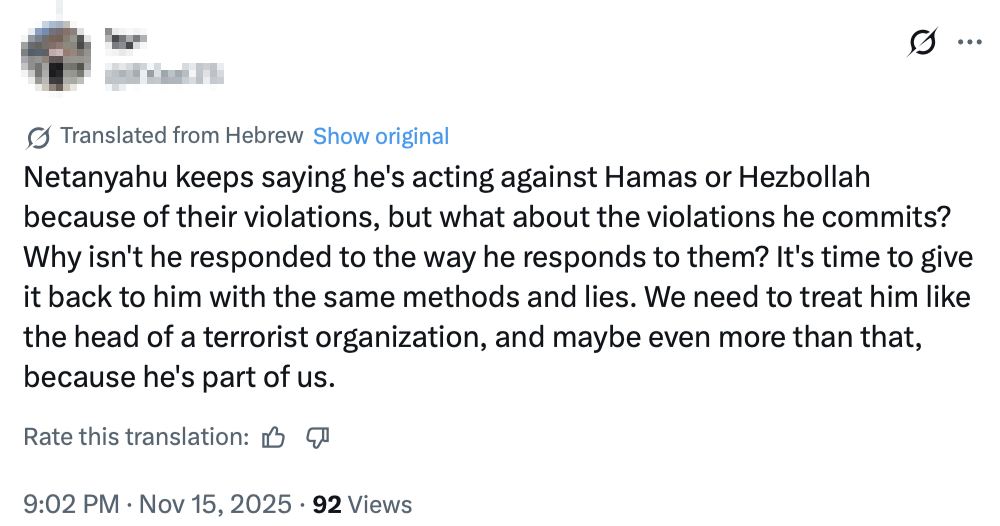
Another narrative involves escalating calls for civic action against the government. ISNAD promotes messages of civil disobedience, revolution, and even civil war. While such calls previously appeared mainly in Iranian campaigns, their emergence within the ISNAD campaign marks a shift from merely attempting to influence public opinion to advocating for political and social action.
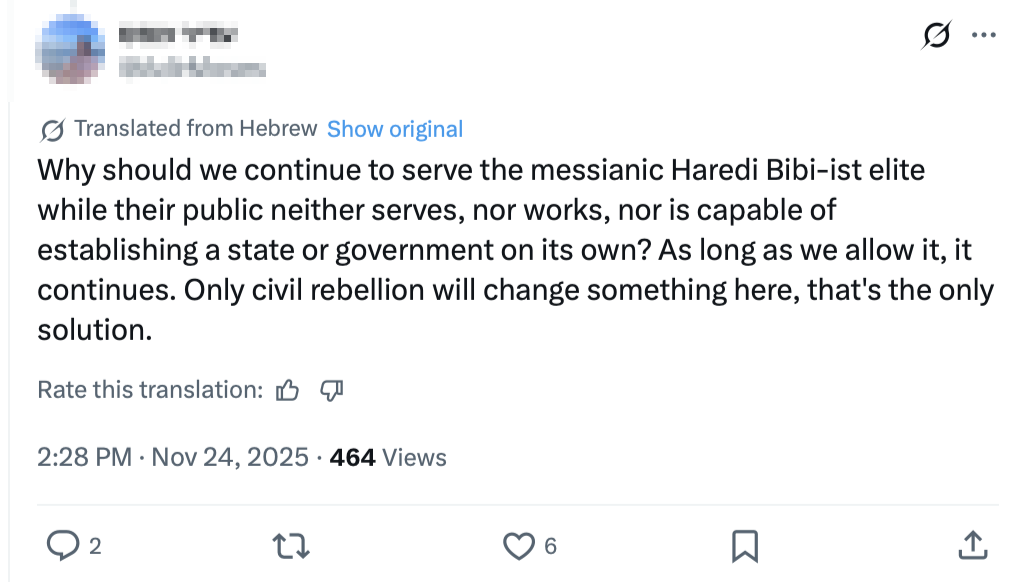
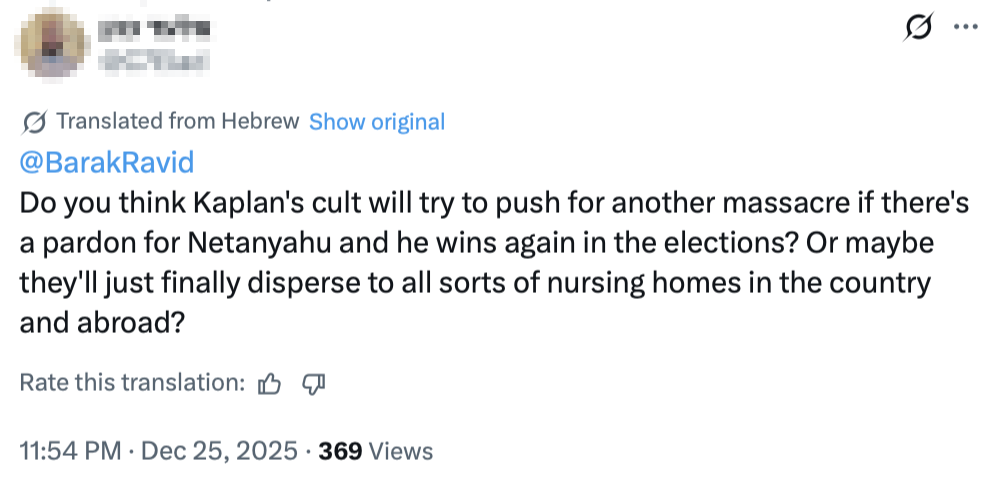
A further narrative involves fostering polarizing discourse across political camps. Within this framework, extreme messages are disseminated that frame various groups as internal threats, delegitimize them, and question their loyalty to the state. The emergence of pungent messaging targeting groups from across the political spectrum indicates an operational logic that does not seek to persuade one camp at the expense of another but rather to deepen internal polarization.
In addition, the campaign promotes narratives of despair and encourages emigration. These messages emphasize a “lack of future,” Israel’s international isolation, and its economic and social erosion, presenting immigration as a solution. This narrative serves the sociological strategy by aiming to gradually erode a sense of commitment and social solidarity and undermine the willingness to continue investing in the national project. It should be noted that the encouragement of despair has appeared in the past, but its strategic context has now shifted.
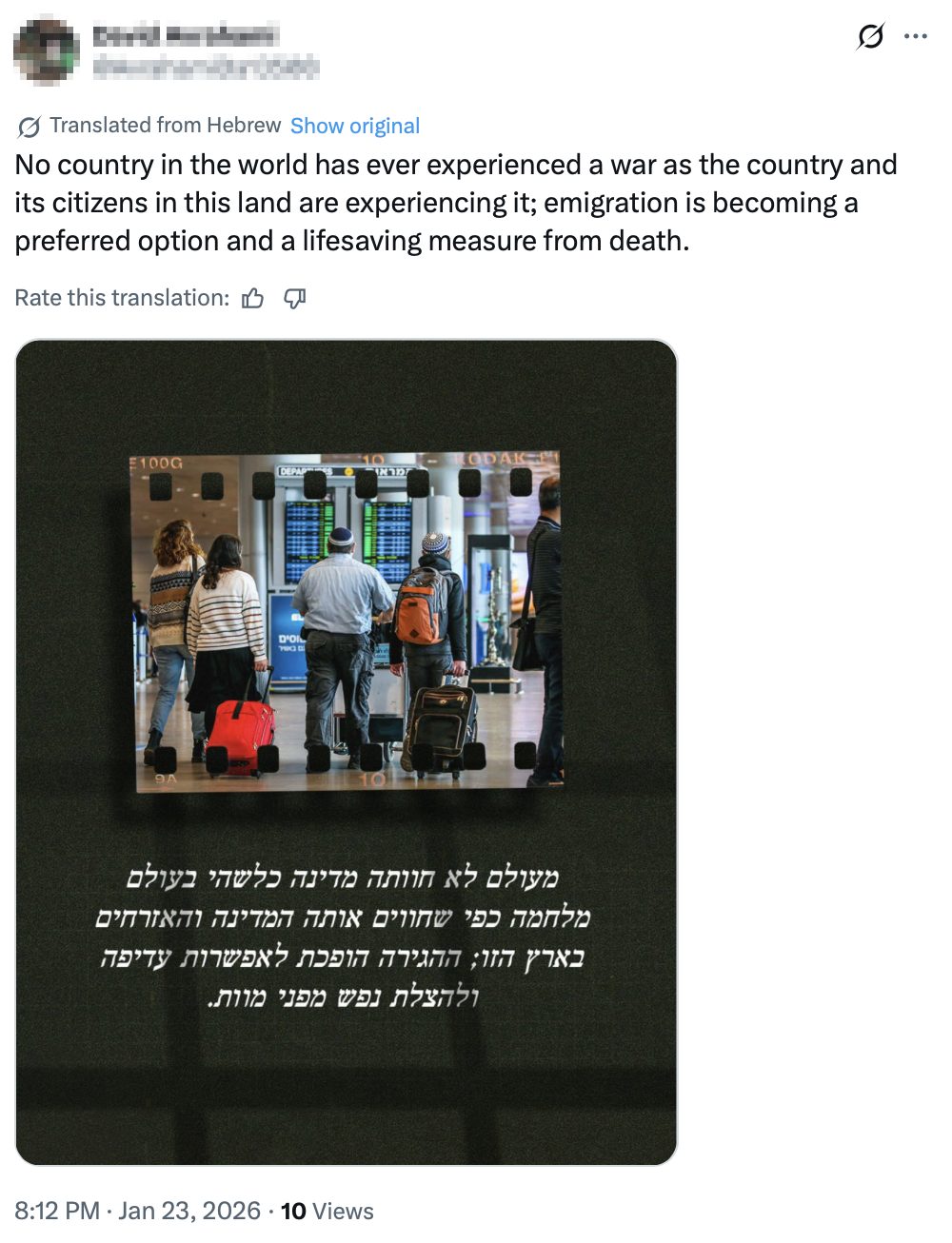
Additional messaging addresses Israel’s international isolation, portraying it as a state facing growing delegitimization internationally, emphasizing criticism, sanctions, and diplomatic pressure as evidence of declining status. This narrative reinforces those of despair and disintegration, strengthening the claim that continuing to live in Israel entails increasing political, economic, and social costs.
Changes in Operational Patterns: Modus Operandi and Organizational Structure
Alongside the strategic and narrative shift, ISNAD has also made adjustments to its organizational structure and operational patterns. The campaign, which was previously relatively open and anonymous, now seeks to close ranks, reduce infiltration, and increase internal control. This trend stems from the campaign’s assessment of growing threats, particularly concerns about infiltration by hostile actors and countermeasures by digital platforms. In this sense, the digital arena is perceived by campaign leaders as a hostile battlefield, where the ability to operate requires increased investment in protection and the removal of suspected infiltrators.
Several changes in the campaign’s organizational structure are also evident. The campaign is organized into designated units with distinct responsibilities, including influence, support, and defense units. This division reflects an attempt to separate efforts to disseminate messages from internal security, oversight, and enforcement efforts. While the structure does not indicate a transition to a fully closed or centralized organization, it suggests an ongoing process of institutionalization, as the campaign adopts characteristics of an organization, such as division of labor, operational procedures, recruitment based on specific skills, designated units, and uniform organizational language. Overall, ISNAD’s structure reflects the tension between preserving flexibility and openness and the need for control, discipline, and operational resilience in what is perceived as a hostile digital arena.
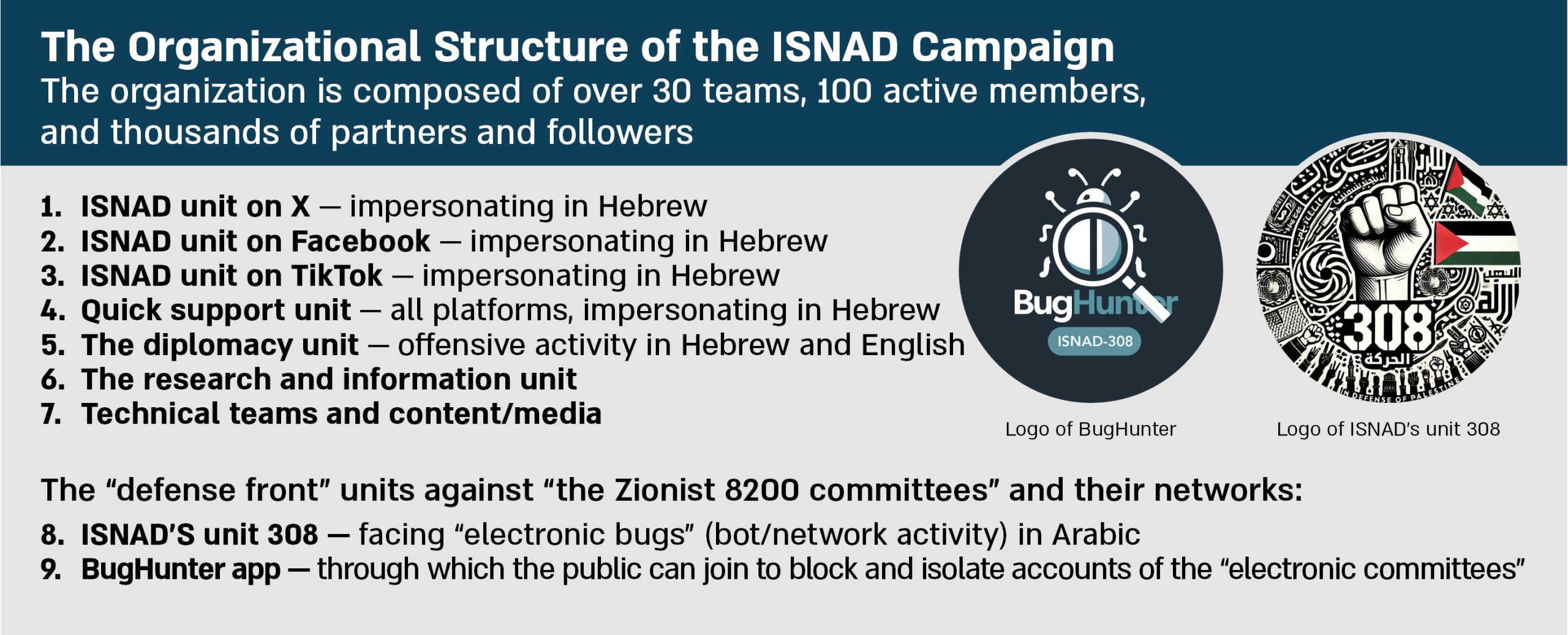
Thus, a gradual shift can be identified from anonymous mass recruitment to a more selective model emphasizing identity verification (including mandatory ID submission), separation between units, and disciplinary procedures. This shift is also reflected in the establishment of “Unit 308,” described as a dedicated body responsible for internal defense, including identifying non-authentic accounts (not belonging to ISNAD) and monitoring activity perceived as hostile to the campaign in the digital arena. Through these measures, ISNAD seeks to reduce its vulnerability, increase control, and strengthen internal discipline and activist loyalty.
These steps are further reinforced by the development of an application called BugHunter, intended to centralize and formalize the campaign’s internal defense efforts. The platform enables volunteers to systematically report accounts, content, and activities perceived as hostile or indicative of infiltration, disruption, or exposure attempts, and to serve as an internal alert and monitoring mechanism. Within this framework, volunteers are required not only to disseminate messages but also to take an active role in defensive efforts: identifying anomalies, proactive reporting, and drawing attention to suspicious activity.
These measures have gained added urgency due to the launch of new features on X that reveal additional information about account origins and increase the likelihood of revealing inauthentic activity. The ISNAD campaign perceives platform-level changes not merely as technical limitations but as systemic changes requiring organizational adaptation, learning, and further internal consolidation and institutionalization processes.
A concrete indication of this professionalization and reduced anonymity is also found in the indictment filed against an Israeli citizen suspected of operating within the campaign. According to the indictment, the defendant acted as part of a Telegram group affiliated with the ISNAD network and participated in training and activities related to the design, proofreading, and editing of media for dissemination on social networks using various fictitious profiles. Her activity extended beyond content distribution to participation in the media production and sorting apparatus itself, including extensive communication with campaign operatives abroad. This case indicates the infiltration of campaign activity from within Israel and reflects a functional division of roles within the campaign.
Accounts associated with ISNAD share several characteristics. One is a generic name, often consisting of a first name and surname that are both first names in Israel. Another characteristic is the presence of a user bio, which authentic Israeli accounts typically lack. In addition, these accounts display a disproportionate number of posts and followers. The tone and intensity of messaging may also indicate whether an account represents an authentic presence or not.
Conclusion and Recommendations
With the end of the war in Gaza, the ISNAD campaign appears to be undergoing a process of strategic, narrative, and operational transformation. It has shifted from a short-term wartime model characterized by “flooding the network” and anonymous mass recruitment toward a prolonged socio-cognitive struggle focused on division, delegitimization, and gradual social erosion. Simultaneously, the campaign seeks to close ranks and adopt a more cautious, security-oriented operational approach. The campaign poses a risk to Israeli society by blurring the distinction between authentic and orchestrated expression online, and over time it may contribute to polarization and the normalization of increasingly extreme or destabilizing ideas within public discourse.
At this stage, there is insufficient data to assess the campaign’s measurable impact on public discourse. Nevertheless, its visibility and resonance in mainstream Israeli media appear lower compared to the period of the October 7 war.
Recommendations
- For the state: Non state influence campaigns should be treated as a significant threat to social resilience, as they seek to exploit internal polarization for strategic purposes. The state should prepare accordingly, including through counter-legislation.
- For the security establishment: The connection between terrorist organizations, political movements (such as the Muslim Brotherhood), and digital influence operations should be examined as part of ongoing intelligence assessments.
- For the public: Awareness should be developed regarding the cumulative cognitive influence of foreign campaigns that masquerade as Israeli discourse and operate over time, not only during times of crisis.
- For the media and influencers: The phenomenon should be covered with critical examination of sources, identities, and operational patterns as part of efforts to reduce the campaign’s cumulative influence on the public.
The authors wish to thank the Kav HaHaredi for its assistance in writing this article.