


Publications
How did antisemitic narratives enter the public discourse in the United States during Operation Roaring Lion, and how should Israel respond?
INSS Insight No. 2126, April 14, 2026
Follow us on GoogleThis article examines antisemitic narratives prominent among extremists on both the right and the left in the United States during the US–Israeli military operation in Iran (“Roaring Lion” / “Epic Fury”). These narratives, which are intertwined with the legitimate domestic American debate over the necessity and objectives of the war, accuse Israel of dragging the United States into a war that contradicts American national interests while illegitimately controlling the government. The article concludes with a recommendation that Israel adopt a combined strategy of engagement with the political leadership in the United States alongside moderate public diplomacy, emphasizing Israel’s strategic value and its contribution to US national security. In conclusion, it proposes leveraging the close security cooperation between the countries while exposing overt antisemitic discourse to strengthen relations with political moderates in the United States.
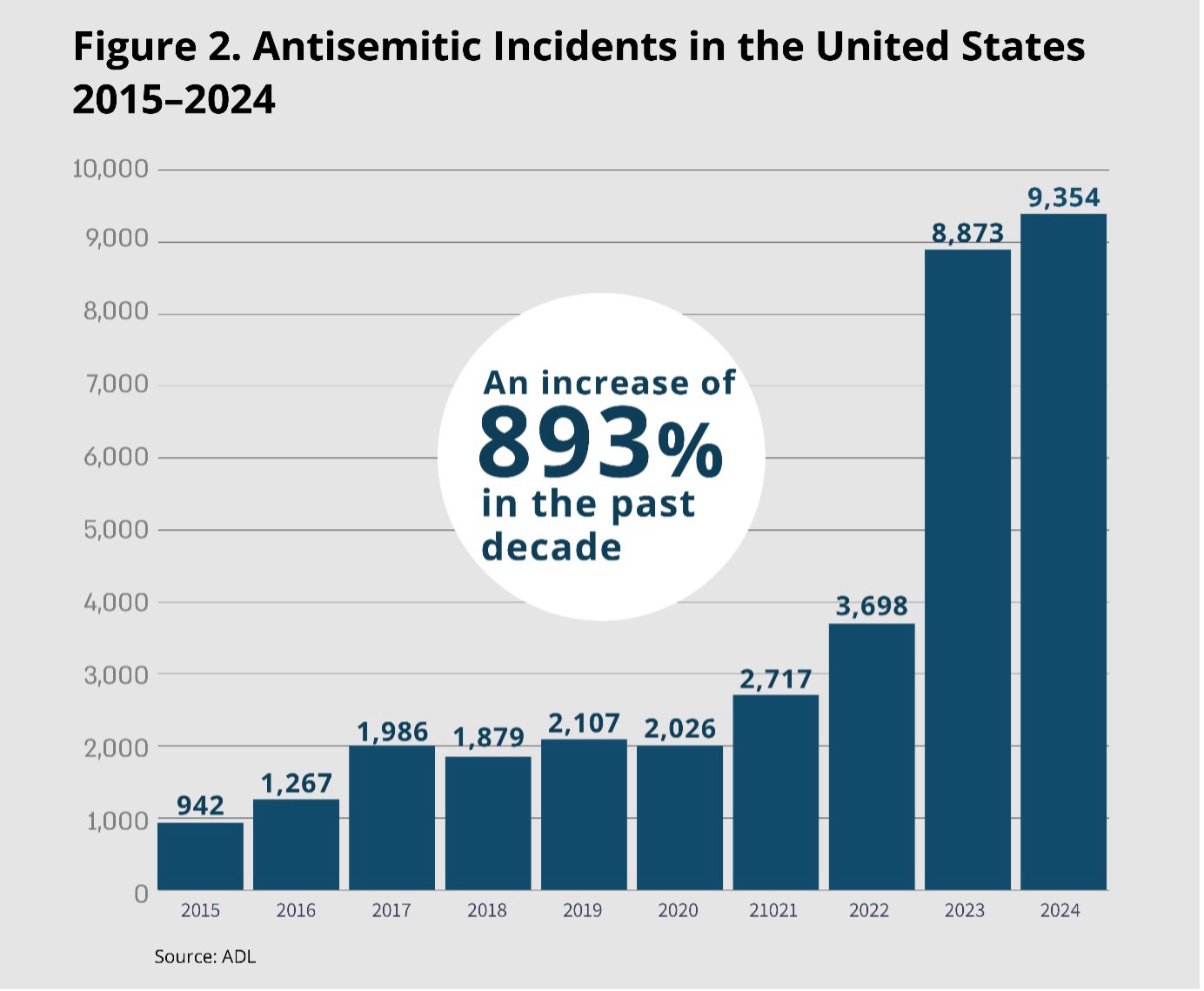
For decades, bipartisan American support for Israel has been one of the most important assets for Israel’s national security and a cornerstone of the “special relationship” between the two countries. However, over the years, support for Israel has shifted from a bipartisan consensus issue to a point of contention between the parties, primarily in the context of the Israeli–Palestinian conflict and against the backdrop of increasing political polarization in the United States. This trend is evident not only at the political extremes but also within the mainstream of both parties. At the beginning of the millennium, Israel was far less of a partisan issue than it is today. Israel enjoyed favorable ratings of 75% and 60% among Republicans and Democrats, respectively, a much smaller gap than that measured fifteen years later. By 2015, while 80% of Republicans expressed favorable views of Israel, only 60% of Democrats did so.
The decline in support for Israel and the growing criticism of it have intensified in recent years, especially since the outbreak of the “Swords of Iron” war, leaving far fewer areas of agreement between Democrats and Republicans on this issue. Today, polarization is more pronounced: 83% of Republicans express favorable views of Israel, compared to only 33% of Democrats. In other words, Republican support for Israel has increased over time, while Democratic support has declined. These figures suggest that support for Israel has become a defining issue within the conservative wing of American politics. In contrast, opposition to it has, to some extent, become a central component of the progressive agenda.
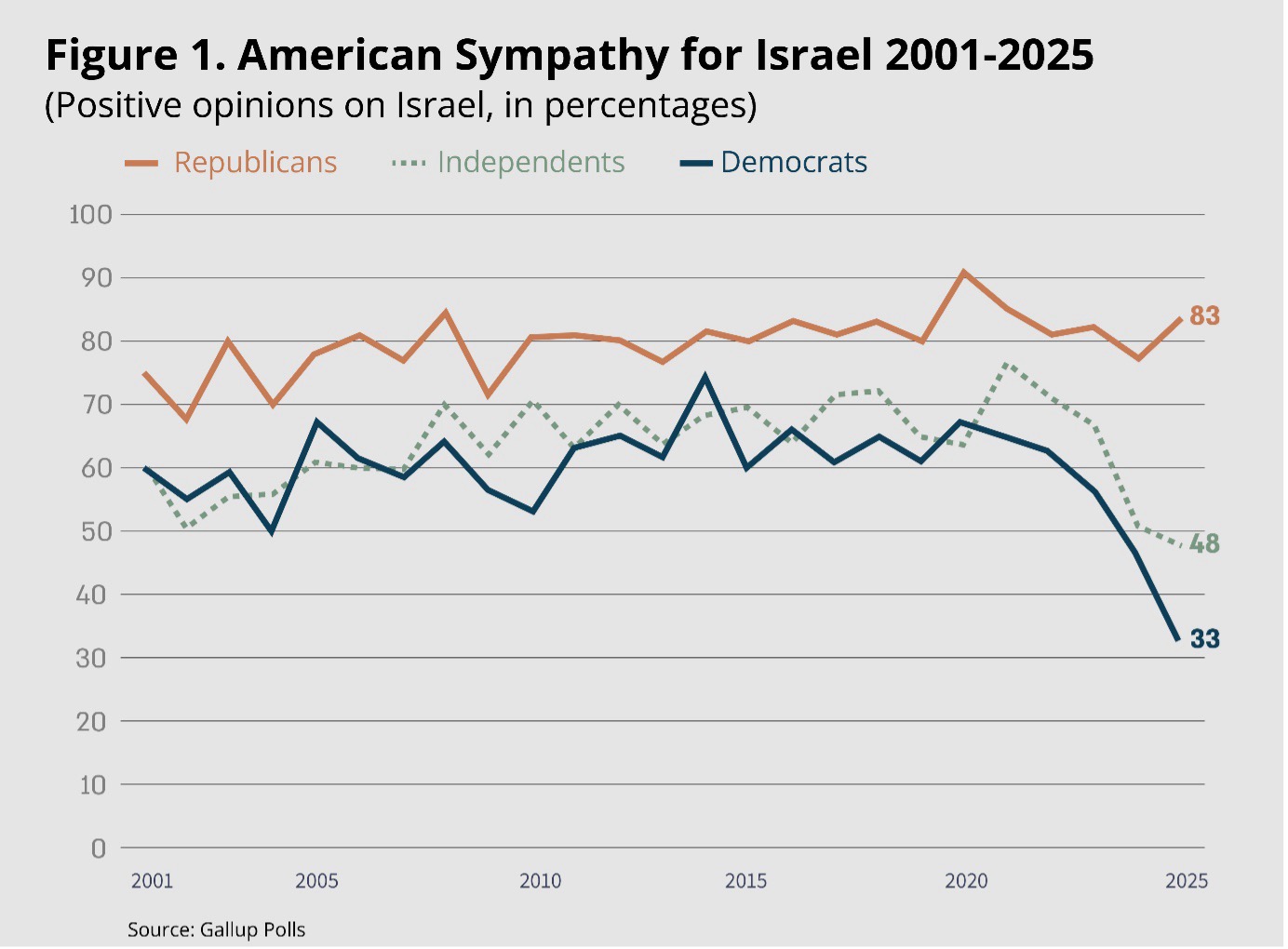
These trends reflect not only a significant erosion in Israel’s standing within American public opinion but also a deterioration in the status and security of Jews, both as a community and as individuals. In recent years, there has been a significant rise in antisemitism in the West in general, and in the United States in particular. According to surveys by the Anti-Defamation League (ADL), antisemitic incidents in the United States increased by 36% in 2022 compared to 2021. Following Hamas’s October 7, 2023, attack, antisemitic incidents surged by approximately 400%. Over the past decade, the number of antisemitic incidents has risen by nearly 900%—a significant increase even when accounting for the possibility of greater awareness and reporting.
In this context, antisemitic attitudes and the conspiracy theories associated with them have found fertile ground, gaining traction among growing segments of the population. Surveys and studies by the ADL and the Fighting Online Antisemitism (FOA) movement demonstrate how these theories have spread both online and offline.
Significant differences between the two political parties have also long been evident in their approaches to the Iranian threat, shaping their respective attitudes toward Israel. Democratic President Barack Obama signed the nuclear agreement with Iran (JCPOA) in 2015, despite strong opposition from Israel, including a controversial speech opposing the deal by Prime Minister Benjamin Netanyahu before the US Congress—drawing sharp criticism from Democrats. The agreement was also controversial among the American public, with a stark gap in support between Republicans (14%) and Democrats (59%). Republican President Donald Trump, who succeeded Obama, withdrew from the agreement in 2018 with public support from Israel.
These trends have shaped American public attitudes toward the recent US–Israeli campaign against Iran. Whereas in the past, divisions largely followed party lines, the issue now appears to be contested even within the Republican Party. While approximately 84% of Republicans supported the campaign, voices on the party’s margins, particularly among the far-right and isolationists, opposed the operation, joining broader opposition within the Democratic Party. However, alongside legitimate debate in US public and political discourse over the necessity, benefits, and costs of the war, voices have emerged on both ends of the political spectrum, right and left alike, justifying their opposition with arguments that cross the threshold of legitimacy by incorporating clear antisemitic tropes and motives.
The central claim that Israel dragged the United States into a war that does not serve American interests is not inherently illegitimate. However, extreme antisemitic actors have exploited this argument to condemn both Israel and the relationship between the two countries. These claims were reinforced by statements from US Secretary of State Marco Rubio and Speaker of the House Mike Johnson, who said that Israel had decided to strike Iran, potentially endangering American soldiers, and that the United States acted in response to protect them. Although Rubio retracted this statement the following day, the message had already gained traction across wide segments of the American public.
Israel likely had significant influence on US policy toward Iran, including its decision to launch this campaign. However, it is clear that Israel cannot dictate US policy and certainly not decisions about going to war. In the bilateral relationship, the United States naturally exerts far greater influence over Israel than vice versa. Nevertheless, this reality has not prevented the spread of conspiracy theories claiming that Israel and Jews not only influence but also control the US government.
The conspiracy theory most closely associated with the war in Iran is a broader one known as “Zionist Occupied Governments” (ZOG). According to this theory, Western governments prioritize Israeli interests over those of their own citizens, effectively rendering them “occupied” by “Zionists.” The term “Zionists” replaces “Jews,” as it is socially less acceptable to accuse Jews directly. This theory was prominently reflected—although not explicitly named—in a recent interview between conservative media figure Tucker Carlson and US Ambassador to Israel Mike Huckabee, during which Carlson stated outright that the United States prioritizes Israeli interests over those of its own citizens. In a subsequent episode of Carlson’s podcast recorded after the outbreak of the war, Carlson went further, entertaining the idea that the United States launched the operation to help Israel destroy the Dome of the Rock and rebuild the Third Temple in its place, citing videos of low-ranking Israeli soldiers and fringe rabbis circulating on social media. Carlson is not a marginal figure in American public discourse; his podcast consistently ranks among the most popular and widely listened to podcasts in the United States and has featured senior officials, including the vice president and senators. Moreover, President Trump hosted Carlson at the White House just days before the strike on Iran and later took the time to sharply criticize him for opposing the operation and for making extreme statements.
This conspiracy theory was not the only one to emerge in the wake of the current operation, although it has been the most widespread. One of Carlson’s interviewees, social media influencer Nick Fuentes, who has expressed admiration for Nazi ideas and figures, claimed that Israel inflated casualty figures of protesters murdered while protesting against the Iranian regime in order to attract media attention to the issue. According to Fuentes, these numbers of those murdered, later cited by President Trump, were intended to drag the United States into war. Another media personality known for spreading unfounded conspiracy theories, Candace Owens, whose content is often disseminated by Iranian state media, went further, declaring that the reports were part of a Jewish psychological warfare campaign aimed at facilitating further Israeli “land theft.” Iranian officials and media also questioned the authenticity of the protests themselves, alleging that the Mossad was behind them. Far-right American social media accounts and accounts linked to Russia later amplified these accusations, which effectively legitimized the killing of protesters.
These theories gained institutional reinforcement with the resignation of Joe Kent, head of the US National Counterterrorism Center, in protest of the military campaign in Iran. While resignations over US involvement in the Middle East are not unusual and are within the legitimate policy discourse, Kent’s case stood out due to the claims he made in his resignation letter. In the letter, he accused Israel of dragging the United States into the war with Iraq and even blamed it for his wife’s death in a terrorist attack during the Syrian civil war. Within a day of his resignation, Kent was interviewed on Carlson’s podcast. Although the accusations he made in his resignation letter surprised many observers, they should be viewed in the context of earlier criticism of his ties to the American far right. More striking, however, was the support he received from Senator Bernie Sanders, a leader of the American far left. In a clear manifestation of the “horseshoe theory,” both the far right and far left converged around a narrative blaming Israel for the war in Iran, largely ignoring their deep ideological differences on other issues.
Additional conspiracy theories also emerged from the left side of the political spectrum. One of the most prominent theories linked the Jeffrey Epstein scandal to the operation in Iran, dubbed by its proponents “Operation Epstein Fury,” a play on the US name for the operation “Epic Fury.” According to this claim, the operation was designed to divert public attention from the release of the Epstein-related documents in the United States. This theory ties Israel to the Epstein affair in various ways, from referencing his Jewish identity to alleging that he was employed by the Mossad to gather compromising information on global elites. Alongside this, some left-wing actors promote versions of the ZOG theory, without naming it, and go further by claiming that Israel is a common enemy of all nations and citizens, and is the foundation of global imperialism—echoing historical accusations that Jews are responsible for all the world’s ills, from globalization through Communism and to imperialism.
Most of these theories remain confined to the fringes of the far right and far left. However, like antisemitic claims throughout history, they are built on two key elements: a grain of truth and a vibrant public discourse. In the context of the war in Iran, extremists exploit Israel’s legitimate interest in American involvement and support, as well as the shared Israeli–American interest in countering Iran and the active public debate in the United States, to distort legitimate criticism into antisemitic conspiracy narratives.
It is already clear that Israel faces three main objectives in addressing this issue: pushing antisemitic discourse beyond the boundaries of legitimate public debate; reinforcing the messaging about Israel’s strategic value and its contribution to US national security; and countering claims that Israel dragged the United States into the campaign against its interests.
Regarding the first objective, there is no reason to assume that purveyors of antisemitism will cease their efforts to normalize such discourse. The main tension, especially in democratic societies such as the United States and Israel, lies in the strength and extent of the tools used to combat hate speech and antisemitism and their potential harmful impact on freedom of expression. If Israel and its supporters are perceived as using legal means to suppress legitimate criticism by labeling it antisemitic, further backlash and increased negative perceptions of Israel are likely to occur. Moreover, attempts to deny Israel’s interest in US action risk being unconvincing, as the Israeli interest is clear and has been reiterated many times by officials. Therefore, Israel should emphasize that while US policy decisions align with its interest in removing Iran’s nuclear and ballistic threat, this is a shared interest and not solely an Israeli one. At the same time, Israel should not ignore the normalization of antisemitic discourse in the public sphere. Although Israel has limited direct influence over US public discourse, it possesses a key asset: its relationships with the mainstream leadership of both political parties. Thus, Israel should work with moderate elements in both parties to ensure clear opposition to antisemitic rhetoric and to encourage the condemnation of public figures and influencers who amplify it. This approach requires Israel to reserve accusations of antisemitism strictly for clear cases to ensure that such claims are taken seriously.
Regarding the second objective, Israel must also address the drift of the moderate mainstream toward extremist fringes. It should engage in discourse that is not confrontational or antagonistic toward moderate elements in both parties, instead emphasizing Israel’s value to the United States in order to help stem this drift. Highlighting this value should form the basis of a public diplomacy campaign focused on shared interests in the Middle East and the contributions of bilateral cooperation to the United States, while first and foremost emphasizing the independence of US decision-making.
Such a campaign should stress that the United States led the campaign against Iran in accordance with its own interests, while Israel, as a loyal ally, assisted in the achievement of US-defined objectives. It should highlight the uniqueness of the strategic partnership and the importance of operational coordination between the two countries. Furthermore, it should underscore the implausibility of claims that a country of Israel’s size, and even as a close ally, could compel the US government to undertake actions against its will. The campaign could also leverage President Trump’s statement that Iran is developing missiles capable of reaching US territory. In addition, given that the IDF and Israeli Air Force use American-made weapons systems and aircraft, Israeli operations can serve as combat proof of the effectiveness and operational superiority of US military equipment.
Regarding the third objective, and particularly in light of weakening ties with Democratic leaders and constituencies, Israel must address claims that it acted to sabotage US–Iran negotiations. Israel should highlight Iran’s continued refusal to dismantle its nuclear and ballistic capabilities and to cease exporting terrorism—factors that threaten regional and global security. Israel should emphasize that Iran’s ongoing military buildup, combined with the failure of diplomatic efforts, left no alternative but to launch the operation. At the same time, Israel should make clear that its desired end state is not regional hegemony or prolonged conflict but rather a new reality that enables security arrangements and strengthens regional cooperation.
Finally, it is important to consider not only the challenges posed by this campaign, particularly in terms of antisemitism and Israel’s declining standing in the United States, but also the opportunities it presents. In contrast to the extremist fringes in both parties, the US administration views Israel as a strategic asset. US Secretary of War Pete Hegseth has repeatedly praised Israel as a capable and loyal ally that helps the United States achieve its objectives. This cooperation is reflected, among other things, in operational coordination between the militaries and security establishments of the two countries—coordination that some describe as unprecedented. These dynamics may contribute to improving relations and reinforcing Israel’s special status within the American political system, contrary to the broader trend of declining popular support. At the same time, the current moment may present an opportunity to address antisemitism. The explicit and widespread nature of antisemitic rhetoric heard in recent weeks can be leveraged to promote an honest discussion about its dangers and the ways in which the United States and Israel can work together to address it.