


The Ceasefire in Syria: Behind the Scenes and Current Implications | INSS
go to header go to content go to footer go to search
INSS logo The Institute for National Security Studies, Strategic, Innovative, Policy-Oriented Research, go to the home page
INSS
Tel Aviv University logo - beyond an external website, opens on a new page
  • Campus
  • Contact
  • עברית
  • Support Us
  • Research
    • Topics
      • Israel and the Global Powers
        • Israel-United States Relations
        • Glazer Israel-China Policy Center
        • Russia
        • Europe
      • Iran and the Shi'ite Axis
        • Iran
        • The Israel–Iran War
        • Lebanon and Hezbollah
        • Syria
        • Yemen and the Houthi Movement
        • Iraq and the Iraqi Shiite Militias
      • Conflict to Agreements
        • Israeli-Palestinian Relations
        • Hamas and the Gaza Strip
        • Peace Agreements and Normalization in the Middle East
        • Saudi Arabia and the Gulf States
        • Turkey
        • Egypt
        • Jordan
      • Israel’s National Security Policy
        • Military and Strategic Affairs
        • Societal Resilience and the Israeli Society
        • Jewish-Arab Relations in Israel
        • Climate, Infrastructure and Energy
        • Terrorism and Low Intensity Conflict
      • Cross-Arena Research
        • Data Analytics Center
        • Law and National Security
        • Advanced Technologies and National Security
        • Cognitive Warfare
        • Economics and National Security
    • Projects
      • Preventing the Slide into a One-State Reality
      • Contemporary Antisemitism in the United States
      • Perceptions about Jews and Israel in the Arab-Muslim World and Their Impact on the West
  • Publications
    • -
      • All Publications
      • INSS Insight
      • Policy Papers
      • Special Publication
      • Strategic Assessment
      • Technology Platform
      • Memoranda
      • Posts
      • Books
      • Archive
  • Database
    • Surveys
    • Spotlight
    • Maps
    • Dashboards
  • Events
  • Team
  • About
    • Vision and Mission
    • History
    • Research Disciplines
    • Board of Directors
    • Fellowship and Prizes
    • Internships
    • Newsletter
  • Media
    • Communications
    • Video gallery
    • Press Releases
  • Podcast
  • Newsletter
  • Campus
Search in site
  • Research
    • Topics
    • Israel and the Global Powers
    • Israel-United States Relations
    • Glazer Israel-China Policy Center
    • Russia
    • Europe
    • Iran and the Shi'ite Axis
    • Iran
    • The Israel–Iran War
    • Lebanon and Hezbollah
    • Syria
    • Yemen and the Houthi Movement
    • Iraq and the Iraqi Shiite Militias
    • Conflict to Agreements
    • Israeli-Palestinian Relations
    • Hamas and the Gaza Strip
    • Peace Agreements and Normalization in the Middle East
    • Saudi Arabia and the Gulf States
    • Turkey
    • Egypt
    • Jordan
    • Israel’s National Security Policy
    • Military and Strategic Affairs
    • Societal Resilience and the Israeli Society
    • Jewish-Arab Relations in Israel
    • Climate, Infrastructure and Energy
    • Terrorism and Low Intensity Conflict
    • Cross-Arena Research
    • Data Analytics Center
    • Law and National Security
    • Advanced Technologies and National Security
    • Cognitive Warfare
    • Economics and National Security
    • Projects
    • Preventing the Slide into a One-State Reality
    • Contemporary Antisemitism in the United States
    • Perceptions about Jews and Israel in the Arab-Muslim World and Their Impact on the West
  • Publications
    • All Publications
    • INSS Insight
    • Policy Papers
    • Special Publication
    • Strategic Assessment
    • Technology Platform
    • Memoranda
    • Posts
    • Books
    • Archive
  • Database
    • Surveys
    • Spotlight
    • Maps
    • Dashboards
  • Events
  • Team
  • About
    • Vision and Mission
    • History
    • Research Disciplines
    • Board of Directors
    • Fellowship and Prizes
    • Internships
    • Privacy Policy and Terms of Use
  • Media
    • Communications
    • Video gallery
    • Press Releases
  • Podcast
  • Newsletter
  • Campus
  • Contact
  • עברית
  • Support Us
bool(false)

Publications

Home Publications INSS Insight The Ceasefire in Syria: Behind the Scenes and Current Implications

The Ceasefire in Syria: Behind the Scenes and Current Implications

INSS Insight No. 803, March 11, 2016
עברית
Zvi Magen
Udi Dekel
Vera Michlin-Shapir
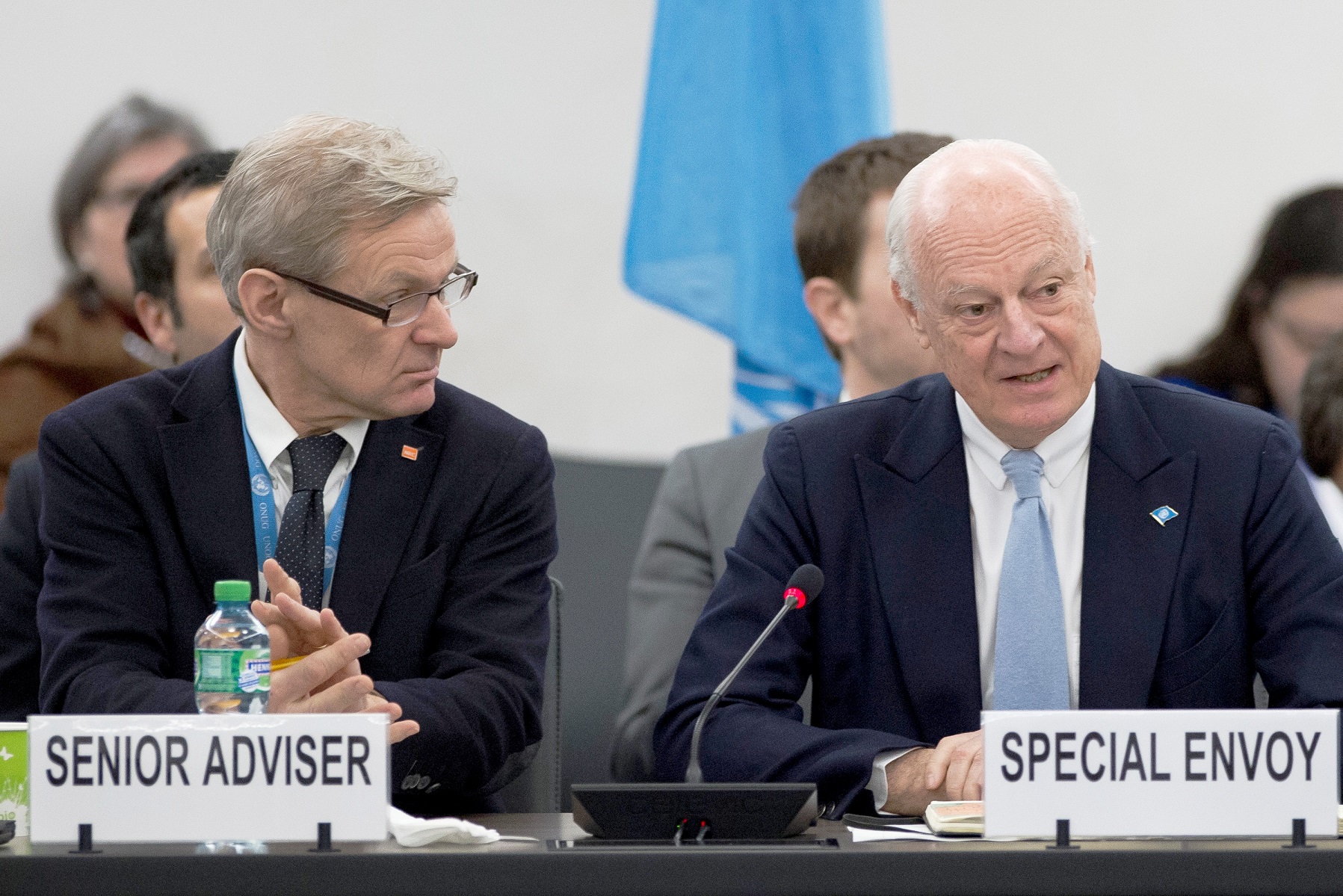
Jan Egeland (l), Senior Adviser to UN Special Envoy for Syria Staffan de Mistura (r), in a meeting with the International Syria Support Group (ISSG) during the talks in Geneva, February 25, 2016. Photo: Jean-Marc Ferre / United Nations / AFP
On February 27, 2016, a ceasefire went into effect in Syria between the forces of the Assad regime and the opposition. The understandings underpinning the ceasefire rely on the agreement between Russia and the United States, which are determined to promote a broader settlement in Syria. To maintain the ceasefire, they will need to restrain the other actors involved in the crisis. It is important for the United States to focus on fighting the Islamic State, and the key question is whether or not it will be able to join forces with Russia in this effort, with the Islamic State being one of the actors in the Syrian arena with an interest in violating the ceasefire. Israel has chosen to remain uninvolved in the events in Syria and therefore has had no influence on the ceasefire. At the same time, Israel has notably maintained proper relations with Russia and tactical coordination with the Russians vis-à-vis Syrian airspace, though not at the expense of its strategic relations with the United States.

On February 27, 2016, a ceasefire went into effect in Syria between the forces of the Assad regime and the opposition. The ceasefire was achieved after the United States and Russia reached understandings regarding the terms of the agreement; Bashar al-Assad and the representatives of the opposition who took part in the contacts accepted its terms; and the ceasefire was grounded in a UN Security Council resolution. The Islamic State, Jabhat al-Nusra, and other jihadist rebel groups are not party to the ceasefire, and Russia and the United States have agreed that they would continue fighting them in cooperation with one another. In actuality, the ceasefire was reached as a result of the combined efforts of the two superpowers currently engaged in leading the campaign for a political solution to the Syrian crisis. All the other actors are dependent on the assistance of these two powers and are subject to their influence.

In order to translate its military achievements in the Syrian arena into achievements in the realm of international politics, Russia worked intensively to advance the ceasefire along two parallel channels. The first channel was operational – specifically, a joint air and ground offensive against rebel forces aimed at exhausting them, carried out by a pro-Assad coalition including Iran, Syrian military forces that are loyal to Assad, Hezbollah, and Shiite militias. The severe damage sustained by the rebel forces is what brought them to the negotiating table. The second channel focused on advancing a political process, primarily vis-à-vis the United States, but also Saudi Arabia.

Moscow sought to promote the political dialogue while it enjoyed the upper hand on the military battlefield and was able to dictate the outcome of the process. Russia translated its achievements on the ground into a political roadmap for a cessation of hostilities and the establishment of a transitional period toward a solution to the conflict within 18 months. Russian policy with regard to the Syrian crisis was also motivated by Russia’s aspiration to promote its standing within the international arena and reduce the Western foreign and economic pressure leveled against it following its actions in Ukraine. In this context, Moscow led the joint offensive of the forces of the pro-Assad coalition in an effort to demonstrate its determination and to create pressure on the West and on Turkey by means of a massive flight of refugees toward Turkey from the embattled areas. It is unclear whether Russia received anything in return from the contacts that took place behind the scenes between Washington and Moscow, such as an easing of the Western sanctions.

For its part, the United States strove to achieve a ceasefire in order to prevent the pro-Assad coalition from furthering its military achievements and transforming them into facts on the ground that would bolster the continued rule of Bashar al-Assad. In addition, the United States is interested in halting the wave of refugees fleeing to Europe from Syria in order to ease the pressure on its European allies. However, it has no effective military means of responding to the crisis in Syria, in light of its unwillingness to send ground forces into the campaign, and the powerlessness of the Sunni Arab countries in this context, which are having difficulty mobilizing ground forces to fight in Syria.

Russia initiated a crisis in late January and early February 2016 surrounding the Geneva talks (Geneva III) with the goal of reaching a more desirable arrangement in Syria. The talks collapsed early on following the onset of the pro-Assad coalition’s ground offensive in the Aleppo region. During the same period, a meeting took place between Vladislav Surkov, personal advisor to Vladimir Putin, and Victoria Nuland, Assistant US Secretary of State for European and Eurasian Affairs. The meeting apparently dealt, inter alia, with the easing of the economic pressure on Russia, and marked a narrowing of the gap between the two countries. The decisive stage of the negotiations between the two powers appears to have occurred in February during the Munich Security Conference, where communication focused on a ceasefire in Syria and a reduction of the international pressure on Russia. In tandem with the feverish contacts regarding Syria conducted by Russian Minister of Foreign Affairs Sergey Lavrov, Russian Prime Minister Dmitry Medvedev conducted talks with European leaders with the aim of bringing an end to the economic and political pressure on Russia. The two issues were not formally connected, but it can be assumed that the Russians emphasized the linkage. At the same time, both Russia and the West flexed their muscles by means of large military exercises conducted by both sides, as well as a declaration regarding a NATO buildup in Europe. The contacts continued after the Munich Conference in what Putin’s spokesman referred to as “closed bilateral talks,” and were concluded one week after the conference in a phone conversation between President Putin and President Obama. The content of these talks has not been leaked, but presumably they involved discussion of the major bones of contention between the two powers.

Thus far, despite local violations, primarily by jihadist rebel groups not included in the ceasefire, but by Assad forces as well, the ceasefire is holding and serving to advance the interests of the superpowers both on the battlefield and in the global political arena. According to open sources, the terms of the ceasefire are consistent with the Russian plan of action: completion of the second phase of its intervention in the Syrian crisis, whose thrust is the advancement of the political process. Now, Russia must restrain President Assad, who may feel that he has been curbed on a political level during the successful offensive of the forces supporting him on the battlefield, and may find it difficult to come to terms with the inclusion in the ceasefire of rebel groups, which he refers to as “terrorist elements,” and accept the immunity they have achieved.

For its part, Iran expressed no opposition to the ceasefire, perhaps due to the heavy losses suffered by the Quds forces of the Revolutionary Guard in the fighting in Syria and to its desire to lower its profile temporarily in this arena. Saudi Arabia supported the ceasefire in order to secure a break in the fighting for the rebel groups it supports and to renew the supply of equipment and weapons to their forces. Turkey likewise supported the ceasefire in order to stop the gains of the Kurdish underground in northern Syria, as well as to avoid a direct confrontation with the United States, which supports the Kurdish forces. Russia and the United States can be expected to attempt to make the most of the suspension in the fighting to shape a future settlement for Syria before the fragile ceasefire collapses.

The major strength of the understandings underpinning the ceasefire is their reliance on the agreement between Russia and the United States, which are determined to promote a broader settlement in Syria – in light of both the difficulty of marking an end game and a sense of fatigue from dealing with the crisis – while capitalizing on the erosion within warring parties. To maintain the ceasefire, they will need to restrain the other actors involved in the crisis, each in its own camp. It is important for the United States to focus on fighting the Islamic State, and the key question is whether or not it will be able to join forces with Russia in the fighting, with the Islamic State being one of the many different actors in the Syrian arena with an interest in violating the ceasefire.

Israel has chosen to remain uninvolved in the events in Syria and therefore has had no influence on the establishment and maintenance of the ceasefire. At the same time, Israel has notably maintained proper relations with Russia and tactical coordination with the Russians vis-à-vis Syrian airspace, though not at the expense of its strategic relations with the United States. Still, the ceasefire could nonetheless have negative implications for Israel, as the situation that has taken shape on the ground serves to strengthen the pro-Assad coalition and Iranian dominance in Syria. In addition, under the current conditions Israel will find it difficult to decide to carry out airstrikes to thwart the transfer of advanced weapons from Syria to Hezbollah without being accused of violating the ceasefire or creating friction with Russia (which has deployed an S-400 advanced air defense system in Syria, covering both Lebanese and Syrian skies). Moreover, the longer the ceasefire lasts and the more Hezbollah is relieved from the burden of fighting in Syria, the more time it will have to challenge Israel in the north and in the international terrorism arena.

The opinions expressed in INSS publications are the authors’ alone.
Publication Series INSS Insight
TopicsIsrael-United States RelationsRussiaSyria
עברית

Events

All events
Iran in Africa: Global Reach Regional Impact and Israeli Implications
26 October, 2025
14:00 - 17:00

Related Publications

All publications
Darla Khazei/INSTARimages
Muslim Leaders in the United States Since October 7: From Criticism of Zionism to Intensified Anti-Israel Messaging
How has anti-Israel discourse among Muslim leaders in the United States changed since the start of the war in Gaza?
02/11/25
Trump’s Initiative for the Gaza Strip: Risks and Opportunities
How does Trump’s initiative for the Gaza Strip create new opportunities for Israel to change the security and political reality, and what challenges might stand in its way?
30/09/25
Shutterstock
A Strategic Threat: Israel’s Deteriorating Standing in the United States
How is the damage to Israel’s standing among the American public—on both the right and the left—manifested, and can the deterioration still be stopped?
03/09/25

Stay up to date

Registration was successful! Thanks.
  • Research

    • Topics
      • Israel and the Global Powers
      • Israel-United States Relations
      • Glazer Israel-China Policy Center
      • Russia
      • Europe
      • Iran and the Shi'ite Axis
      • Iran
      • The Israel–Iran War
      • Lebanon and Hezbollah
      • Syria
      • Yemen and the Houthi Movement
      • Iraq and the Iraqi Shiite Militias
      • Conflict to Agreements
      • Israeli-Palestinian Relations
      • Hamas and the Gaza Strip
      • Peace Agreements and Normalization in the Middle East
      • Saudi Arabia and the Gulf States
      • Turkey
      • Egypt
      • Jordan
      • Israel’s National Security Policy
      • Military and Strategic Affairs
      • Societal Resilience and the Israeli Society
      • Jewish-Arab Relations in Israel
      • Climate, Infrastructure and Energy
      • Terrorism and Low Intensity Conflict
      • Cross-Arena Research
      • Data Analytics Center
      • Law and National Security
      • Advanced Technologies and National Security
      • Cognitive Warfare
      • Economics and National Security
    • Projects
      • Preventing the Slide into a One-State Reality
      • Contemporary Antisemitism in the United States
      • Perceptions about Jews and Israel in the Arab-Muslim World and Their Impact on the West
  • Publications

    • All Publications
    • INSS Insight
    • Policy Papers
    • Special Publication
    • Strategic Assessment
    • Technology Platform
    • Memoranda
    • Database
    • Posts
    • Books
    • Archive
  • About

    • Vision and Mission
    • History
    • Research Disciplines
    • Board of Directors
    • Fellowship and Prizes
    • Internships
    • Support
    • Privacy Policy and Terms of Use
  • Media

    • Communications
    • Video Gallery
    • Press Release
    • Podcast
  • Home

  • Events

  • Database

  • Team

  • Contact

  • Newsletter

  • עברית

INSS logo The Institute for National Security Studies, Strategic, Innovative, Policy-Oriented Research, go to the home page
40 Haim Levanon St. Tel Aviv, 6997556 Israel | Tel: 03-640-0400 | Fax: 03-744-7590 | Email: info@inss.org.il
Developed by Daat A Realcommerce company.
Accessibility Statement
This site is protected by reCAPTCHA and the Google Privacy Policy and Terms of Service apply.