


Strategic Assessment

Conspiracy theories play a major role in Russia’s contemporary political culture, and in the Putinist regime, they have been harnessed to justify the invasion of Ukraine and the repression of Russian citizens. Key to these justifications is the way that conspiracy theories portray Russia as an alternative to a corrupt and Machiavellian West, an enemy who is the absolute Other. In practice, this narrative makes it possible to identify enemies, whether external or internal, according to shifting political needs and circumstances. Since the narrative also frees Russian politics from the constraints of historical facts, the regime has been able to frame the Russia–Ukraine war as a continuation of the Second World War and as the moral struggle of light against dark.
Keywords: Russia, the Russia–Ukraine War, conspiracy theories, the West.
INTRODUCTION
Vladimir Putin’s rise to power in 2000 changed Russian state identity in dramatic ways. Especially notable has been his development of ideological tenets that position Russia as an alternative to the West and shape both domestic and foreign policy. An early sign of this process came during the Munich Security Conference of 2007, when Putin’s speech signaled his country’s more isolationist trajectory.
That trajectory has become increasingly pronounced. With the annexation of Crimea in 2014, and even more so with the outbreak of war against Ukraine in 2022, the narrative of East-West antagonism became a major justification for military action and a key mechanism for developing a new security outlook. The Putinist regime has framed the war in Ukraine as an ideological struggle in which Russia must defend its traditional values and way of life against the existential threat posed by the West. Within this narrative, Ukraine is a state that has capitulated to the West and fallen under its destructive influence (Snegovaya & McGlynn, 2025, pp. 6–7; Soroka, 2022, p. 14).
The construction and expression of Putinist ideology is inseparable from war. That ideology’s core, which has become axiomatic to Russia’s political discourse, is that the West seeks Russia’s strategic defeat and therefore wages a continuous war on military, intelligence, cultural, and diplomatic fronts. This contemporary distrust of the West is different from its older form, which can be traced back to the late eighteenth century (Martin, 2003). While older suspicions were rooted in intellectual and cultural discourse, current ones are rooted in politics and security. The centrality of this new distrust to current Russian policy is evident in the proliferation of conspiracy theories that cast the West as the root of all evil.
This article investigates these conspiracy theories as well as their use by the Putinist regime. The first part begins with the broader context: the nature of conspiracy theories and their migration from the margins to the political mainstream in many different countries. The focus then shifts to the role of conspiracy theories in Russian history, with particular attention to the Soviet period and the 1990s. This is followed by a look at the distinctive features of contemporary Putinist conspiracy narratives: the growing recourse to the concept of Russophobia, along with the inclusion of religious and ahistorical elements that reflect the strengthening relationship between church and state over the past decade. The second part of the article examines the “Western enemy” and discusses some of the geopolitical and human consequences of Putinist conspiratorial politics.
PART I – CONSPIRACY THEORIES: DEFINITION AND DISCUSSION
In the political context, a conspiracy is a secret plot involving two or more actors who plan one or more of the following: the seizure of power or economic control, the violation of rights and agreements, the concealment of vital information, and the reshaping of institutions and systems (Douglas & Sutton, 2023, p. 272; Keeley, 1999). By advancing claims about these sorts of plots and the powerful actors who allegedly orchestrate them, conspiracy theories provide explanatory frameworks for major political events. Conspiracies have also been defined more loosely—not as necessarily structured schemes, but as a paranoid mode of thinking and acting that one adopts or abandons, either intentionally or unintentionally (Borenstein, 2019, p. 130).
The field of social psychology has produced a substantial body of research on conspiracy theories. Since the 1990s in particular, scholars have focused on the characteristics that define these theories, the reasons people believe them, their impact on the social and political order, and the mechanisms through which they spread. More recent studies identify the psychological, demographic, and political factors behind the worldwide proliferation of conspiracy theories and assess how the phenomenon has contributed to a shift from normative, institutional politics to more extreme modes of influence.[1] Other studies highlight how authoritarian leaders use conspiracy theories to mobilize support and legitimacy, deflect blame, attack opponents, and undermine democratic institutions (Alper et al., 2025; Ren et al., 2022).
The worldwide spread of conspiracy theories in recent decades is related to events such as 9/11, the global financial crisis, the COVID-19 pandemic, and the Hamas assault on Israel on October 7, 2023. These sorts of dramatic events generate a wide range of claims about cover-ups, hidden agendas, and secret plots that capture the public imagination. Social media has played a decisive role in the dissemination of these claims. The underlying mechanisms of social media enable not only passive consumption but also a sense of agency among users, who experience the ongoing reinterpretation of content through comments and the constant reintegration of content into new and varied contexts. In addition, although the internet has dramatically expanded access to information, it has also made it difficult for users to assess the reliability of that information. Here there exists much fertile ground for conspiracy theories to thrive (Stano, 2020). Interestingly, although conspiracy theories naturally proliferate on social media and other parts of the internet, they have also gained visibility in the official media channels of various countries (Byford, 2014, p. 83).
In terms of their content, conspiracy theories generally express opposition to trends or groups. Hyper-capitalism, globalization, supranational institutions, and elites, whether economic, military, or political, have all been targets. These expressions take different local forms. In Eastern Europe during the 1990s, conspiracy theories identified the hidden machinations behind the collapse of the Soviet Union; in many Muslim-majority countries today, conspiracy theories evoke the large-scale scheming of Jewish villains. In sub-Saharan Africa, conspiracy theories concerning the nature and origins of AIDS were recently widespread, posing a significant obstacle to the success of public health programs (Byford, 2014).
Both laymen and scholars often dismiss conspiracy theories as marginal and their adherents as extremist. Nonetheless, recent research has demonstrated the importance of conspiracy theories in shaping the global political order. The first and second presidential terms of Donald Trump illustrate how conspiracy theories can be harnessed for political ends. Trump has promoted numerous conspiracy theories, including some that target individual political rivals. Two of his best-known theories concern QAnon and the deep state, both of which evoke networks of subversive actors, generally associated with the American left, who cause moral and political harm to the existing order. Trump has also advanced conspiratorial claims that cast doubt on vaccines and climate change (Hellinger, 2019).
A similar process has unfolded in Russia in recent years. For a long time, conspiracy theories were marginal to Putinist political culture; in general, Putin invoked them only at politically liminal moments—election campaigns, the mass protests of 2011–2012, the annexation of Crimea in 2014. After the invasion of Ukraine in 2022, however, the pattern shifted, and conspiracy theories became an integral part of political discourse. Ever since then, narratives alleging Western plots against Russia have grown increasingly prominent.
Conspiracy Theories in the Soviet Union and Russia in the 1990s
Conspiratorial thinking had a long history in the Soviet Union. Most dramatically and violently, during the Great Purge of the 1930s, the political opponents of Joseph Stalin were accused of plotting to overthrow the Soviet regime and subsequently executed in show trials. In the following decades, and particularly during the Cold War, the narrative evolved into a binary struggle between a communist Eastern bloc and a liberal West (Yablokov, 2020, p. 896). At the same time, the KGB, which had been reestablished in 1954 under Nikita Khrushchev, became increasingly fearful of Western interference. The trigger was a series of crises: the Hungarian Revolution of 1956, which briefly ousted Soviet control; the Cuban Missile Crisis of 1962; the bread protests within the Soviet Union, also in 1962; and the Prague Spring of 1968. The shock of these crises to the post-Stalinist regime, along with the role that the West was perceived to have played, led the KGB to embrace Stalinist-style “master plots” that reduced complex events to the logic of secret conspiracies (Hoover Institute, 2025).
The Soviet Union’s collapse in 1991 left an enormous ideological vacuum in the former Eastern bloc, including Russia. Especially because it came along with rising crime and an economic crisis that pushed many into poverty, this vacuum fostered conspiracy theories that targeted the United States. The appeal of such theories is easy to see: they helped to mediate a complex reality for a public that had lost its ideological footing, and they provided the reassurance of clear culprits during a period of political, economic, and ideological instability.[2] The narratives reflected the anxieties and hardships of Russia in the 1990s and underscored the new position of the United States as the sole global superpower. At the same time, conspiracy theories associated with the so-called New World Order gained prominence, attributing chaos in states and everyday life to global political and economic elites (Yablokov, 2020, p. 895).
These conspiracy theories were often influenced by the French far right, which has a long tradition of national-cultural isolationism and is sharply critical of the United States. Alexander Dugin, a Russian far-right philosopher who became a prominent cultural figure within the Putinist regime, drew inspiration from French writers who considered the United States a symbol of decadence and corruption. His works interpret the role of the United States in the Yugoslav conflicts and Operation Desert Storm as a sign of things to come: the subjugation of Russia and the elimination of its global standing. Dugin offered a similar interpretation for subsequent American actions that challenged or criticized Russia. These were part of a project to construct a “new world order” by deliberately targeting Russia (Dugin, 1992; Technicolor Dreams, 2017; Yablokov, 2020, p. 900).
The theories that emerged during the 1990s often had a religious dimension. Key figures, including clerics, writers, and academics such as Metropolitan Ioann Snychev and Tatyana Gracheva, suggested that the Antichrist was responsible for the suffering of Russia and its people. In this mode of thinking, the Antichrist was the West, especially the United States; the crisis was moral and spiritual; and the only possible response was a strong, centralized regime grounded in a clear ideology. These theories spread through various media outlets and the increasingly popular internet (Borenstein, 2019, p. 107; Dolińska-Rydzek, 2022, pp.7–8).
The collapse of the Soviet Union had also left the security apparatus in a state of disarray, and the response of Russian leaders led to a further entrenchment of conspiracy theories. Unlike East Germany, which eliminated the Stasi, Boris Yeltsin proved reluctant to dismantle the KGB. His decision led to the reorganization of the KGB into four separate agencies, as well as the integration of the KGB into broader processes of liberalization. Yeltsin intentionally decentralized authority among the new agencies, the KGB opened parts of its archives, and KGB commanders gave frequent interviews on television.
In the decades that followed, Putin returned the authority of the security services to a centralized agency, the Federal Security Service (FSB), the primary successor to the KGB. Putin expanded this agency’s remit and granted it a much larger role in government than the KGB had played under the Soviet system (Soldatov & Borogan, 2010).[3] During this period, conspiratorial thinking embedded itself within both the FSB and the broader state institutions.
Putin’s personal history helps to explain his approach to the security apparatus and its growing tendency to conspiratorial thinking. As a KGB officer for approximately sixteen years, he matured professionally within the milieu of Soviet intelligence and was strongly influenced by the institutional legacy of Yuri Andropov, who headed the KGB until 1982. Andropov had been the ambassador to Hungary during the 1956 uprising, and those events left a deep impression. He is often associated with what has been termed the “Hungarian complex”: he tended to interpret any dissent or protest as a sign of state weakness (Marten, 2017).
The history of conspiratorial theories in Russia helps to explain their prominence in the country’s approach to its war with Ukraine. Conspiratorial thinking provides the political and moral justification for waging total war, for escalating militarily against Europe, and for repressing Russia’s own civilians. More deeply and broadly, conspiracy theories cultivate a collective identity that is grounded in the notion of civilizational superiority. Such an identity galvanizes people against the perceived enemy.
Russophobia: Fear and Hatred of Russia
Central to conspiratorial Putinist discourse is the concept of Russophobia, which is essentially a meta-narrative that encompasses any anti-Russian sentiment or activity. The concept offers a ready-made framework for defining the enemy, who always plots against Russia in pursuit of domination, destruction, and destabilization (Borenstein, 2019, pp. 100–116, 132). Russophobia requires no substantiation through evidence or argument, and its reasoning is circular. Why do enemies seek to harm Russia? Because they hate it. Why do they hate it? Because they are Russophobic. From this sort of thinking, Russia emerges as a perpetual victim—as well as a formidable power with global influence, since the presumed hostility becomes a measure of how important Russia is perceived to be (Borenstein, 2022).
The concept of Russophobia, which has a long intellectual history, experienced a revival in the Soviet Union during the 1980s. The word itself was the title of a samizdat pamphlet published in 1982 by the dissident and prize-winning mathematician Igor Shafarevich. In that work as well as his subsequent writings, Shafarevich emphasized the distinctiveness of Russia and its people, whom he considered to be endowed with a special mission. But Russian culture and identity are undermined by the malyi narod (literally “small people”), a small group that promotes ideological transformations alien to Russian society. As a result, Russia is a perpetual outsider to history, the Russian soul is constrained under successive oppressive regimes (Sakwa & Horvath, 2005), and the Russian people are a perpetual scapegoat (Borenstein, 2022, p. 125). More specifically, Shafarevich identified Jews as the malyi narod and held them responsible for the October Revolution and the collapse of the Soviet Union, two events that he considered to have radically disrupted Russia’s proper course.
In this context, it is worth noting that the contemporary discourse of Russophobia bears striking similarities to The Protocols of the Elders of Zion. As research on antisemitism, and particularly on the Protocols, has shown, Jews have often been made to embody anxiety about modernity. In Putinist Russia, perceived enemies are cast in a similar way: they destroy time-honored values, erode the traditional family, and favor the material over the spiritual, especially as expressed in financial greed (Borenstein, 2019). Shafarevich’s ideas contribute to the parallels: his framework allows the Putinist regime to map onto Russophobia the cultural and moral meanings that are historically associated with antisemitism.
Russophobia was formally endorsed under the rule of Vladimir Putin. The process unfolded gradually, alongside Russia’s political crises with the West as well as the mainstreaming of conspiracy theories in political discourse, a phenomenon that accelerated in 2012 during Putin’s third presidential term. Numerous examples illustrate the trend. In 2016, the Ministry of Culture of the Russian Federation initiated a study on “technologies of de-Russification and Russophobia” and funded it with a budget of 1.9 million rubles. The project’s scholars were to examine Russophobia within the context of global systems of phobia and to produce practical recommendations for countering the phenomenon. According to the explicit rationale for the project, “the intensification of Russophobic discourse is a reaction to the revival of Russian nationalism” (RBK, 2016). A late-2023 report by the Russian Ministry of Foreign Affairs assessed levels of Russophobia worldwide (TASS, 2023), and a search of major Russian academic databases, including CyberLeninka and eLibrary.ru, turns up titles such as Russophobia as a Component of Modern Geopolitical Confrontation: Global and Regional Dimensions (Pashkovsky et al., 2025) and British Scholarship on the Second World War as a Tool of Information and Psychological Confrontation with Russia (Il’ichev, 2024). Such titles demonstrate the entrenchment of Russophobia within current scholarship.
The logic of Russophobia has also found expression at the official rhetorical level. On July 26, 2025, Russian Foreign Ministry spokesperson Maria Zakharova proposed an international day devoted to combating Russophobia. “[T]here should already be an international day devoted to the fight against Russophobia,” she declared. “…[U]nder the banners of Russophobia, the terrorist regime in Kyiv is being armed. Under the banners of Russophobia, children are being killed.” Zakharova blamed the West for these developments (RIA Novosti, 2025), mirroring Russia’s broader attempt to portray itself as a victim of Western Europe’s contemporary political culture.[4]
In its construction of victimhood, present-day Russophobia differs from other systems of phobias. While individuals are the primary victims of antisemitism, Islamophobia, or homophobia, they play a negligible role in Russophobic discourse (Borenstein, 2019, pp. 101–103). When authorities portray Russia as the victim of the West, they are not referring to ethnic Russians who are subjected to discrimination on the basis of their identity, but rather to the entirety of the state. In other words, the ethnic dimension within Russophobic discourse is marginal. What matters to the narrative is Russia’s perception of its national prestige, historical grandeur, and rightful role at the center of geopolitics. Accordingly, in recent years—and with particular intensity since Russia’s invasion of Ukraine in 2022—Russophobia has dominated Russian discourse on identity and statehood and has been increasingly framed as one of the principal threats to the country’s sovereignty.
Conspiracy Theories in Putinist Russia
Alongside the institutionalization of Russophobia, a salient feature of the conspiracy theories that are currently promoted by the regime is their growing detachment from historical facts. This tendency appears most clearly in the prevalence of religious motifs, especially apocalyptic ones like the previously mentioned association of the West with the Antichrist.
Beginning in the 1960s, researchers argued that the displacement of religion from the public sphere entailed a secularization of religious and apocalyptic narratives. According to the argument, divine or demonic forces were replaced by individuals or groups, miracles were replaced by secrets, and religious insights were replaced by hidden truths that only the privileged could access (Darwin et al., 2011; Dolińska-Rydzek, 2022, pp. 5–7; Hagemeister, 2006, p. 252).
The recent increase of religious motifs can be explained by the coincidence of two factors: alongside the mainstreaming of conspiracy theories came the regime’s increasing alignment with the Church. This alignment, which began with the election of Patriarch Kirill in 2009 and intensified during Putin’s third presidential term, has led to a Manichaean conception of politics and history. Reality is divided into good and evil, light and dark, Christ and Antichrist, with no nuance or complexity. Within this binary framework, the enemy is the absolute Other—immoral, dark, and cruel, its evil often portrayed in terms of decadence and indulgence. In late December 2025, for example, Putin declared that Europe possesses no civilization, only degeneration (degradatsiia), and asserted that “the administration of Joe Biden and the European piglets sought to dismantle Russia in a short time, in pursuit of profit” (RBK, 2025c). In March that same year, Russian Foreign Minister Sergey Lavrov claimed that the West lacks values, “apparently believes only in Satan,” and seeks to undermine consensus within the Organization for Security and Co-operation in Europe (RT, 2025).
By emphasizing an overarching moral and even theological struggle between good and evil, religious-apocalyptic motifs promote an ahistorical perspective. In 2018, Putin issued a revealing warning to adversaries who might consider nuclear weapons: “the aggressor must know that retaliation is inevitable, that he will be destroyed, and that we will be the victims of aggression. We will go to heaven as martyrs, while they will simply perish. They will not have time to repent” (Reuters, 2018). Since boundaries between past and present also become blurred, the regime has a great deal of freedom to interpret historical and political events opportunistically, according to its ideological imperatives (Dolińska-Rydzek, 2022).
This ahistoricity and interpretive flexibility are vividly exemplified in Putin’s address on February 21, 2023, to the Federal Assembly of Russia, the country’s parliament; the speech marked one year since the invasion of Ukraine:
The West—pardon my lack of politeness—does not care. It does not care on whom it places its bets in the struggle against us, in the struggle against Russia. The only thing that matters is that there is someone to fight against us, and therefore anyone can be used. As we have seen, this is indeed the case: terrorists, neo-Nazis, even the devil—pardon the expression—can be used, as long as they carry out its will and serve as a weapon against Russia. The anti-Russia project [Ukraine] is, in essence, part of a policy of revenge against our country, aimed at creating zones of instability and conflict directly along our borders. Then—back in the 1930s—as now: the intention is the same, to direct aggression eastward, to ignite war in Europe, and to eliminate competitors by using others (Presidential Address to the Federal Assembly, 2023).
Putin portrays the West as bitter, hate-driven, and fundamentally irrational, intent on destroying Russia by way of the eternal devil, the World War II Nazis, and the current-day Ukraine. The West’s alleged desire for Russia’s downfall is a constant across time, and against that backdrop, World War II becomes an expression of the West’s anti-Russian aggression, carried out through Nazi Germany. This narrative pays no attention to the Molotov–Ribbentrop Pact, the multiethnic composition of the Red Army in which Russians fought alongside Ukrainians, or the Soviet Union’s participation in the Allied coalition against the Axis powers. Such historical facts would interfere with the ideological justification of the Russia–Ukraine war.
With this altered temporality, the Putinist regime can present the war in Ukraine as preventive, with Russia compelled to fight in the interest of defending itself and safeguarding its political sovereignty and normative autonomy. By depicting Ukraine as a direct continuation of Nazi Germany, the Russian regime can also frame the conflict as a total war of good against evil.
Part II – MANIFESTATIONS OF THE “WESTERN ENEMY” AND POLITICAL IMPLICATIONS
Russophobia’s overarching conspiratorial framework has enabled the Putinist regime to advance a wide array of theories concerning the “Western enemy,” who may be a foreign or domestic actor. This section of the article looks at the various representations of the Western enemy, highlights the role that conspiracy theories play in its construction, and analyzes the political implications of this conspiratorial framing.
Foreign Enemies
The Putinist regime has identified geopolitical and supranational entities, as well as specific countries, as foreign enemies. Most prominent in this category today are NATO and the countries of Europe; since Trump became president, the United States has receded somewhat from its former position, in the regime’s view, as the embodiment of the West.
NATO: Russia frequently justifies its invasion of Ukraine in 2022 as a preventive act of self-defense against NATO’s expansion. Since then, the Putin administration has repeatedly identified that expansion as a major threat. Putin himself has often made that claim. At the St. Petersburg International Economic Forum (PMEF-2025) in June 2025, for example, he remarked, “Since the early 1990s, we have witnessed five waves of NATO expansion—one could even say six. Our calls to refrain from this have fallen on deaf ears” (RBK, 2025a). Russia’s foreign minister, Sergey Lavrov, made a similar assertion on October 28, 2025, at the International Eurasian Security Conference in Minsk: “NATO’s expansion has not paused for a single moment” (TASS, 2025).[5] To some Russian officials, NATO is not merely a military alliance, but an actor seeking to intervene in Russian elections and other domestic political processes, and ultimately to destabilize or topple the Russian government through diplomatic, economic, and military means, including offensive cyber operations (RG.RU, 2025).
NATO has indeed expanded over the three decades since the collapse of the Soviet Union. Nonetheless, Putin’s attitude about the Alliance and its enlargement has not been consistent over time. In the early years of his leadership, his stance was relatively accommodating; he even expressed interest in the possibility of Russia’s joining NATO (Hoffman, 2000). In 2002, when NATO announced the accession of Estonia, Latvia, and Lithuania, Putin reacted with restraint—and with no hint whatsoever that he might consider military action to prevent their entry. Similarly, when he was asked about the prospect of Ukraine’s accession, he answered that the matter was for Ukraine alone to decide (Kremlin, 2001).
Furthermore, even after Putin signaled a shift to isolationism in his speech at the 2007 Munich Security Conference, Russia continued to cooperate with NATO on multiple occasions. In 2009, Putin provided diplomatic and military support to George W. Bush for the global counterterrorism campaign: Russia facilitated the establishment of U.S. military bases in Uzbekistan and Kyrgyzstan as part of NATO’s engagement in Afghanistan (Person & McFaul, 2022). This relatively favorable attitude toward NATO persisted during the presidency of Dmitry Medvedev. At the 2010 NATO summit in Lisbon, Medvedev declared an end to hostility between Russia and the Alliance and shared a vision of renewed cooperation, which included the possibility of collaborating on missile defense systems (Kremlin, 2010; Person & McFaul, 2022). Additionally, the NATO–Russia Council, which was established in 2002, continued to deal with a range of security issues until March 2017—that is, even after Russia’s annexation of Crimea in 2014 (TASS, 2017).
This factual record suggests that political and ideological motives underlie Russia’s effort to project a historical consistency in its distrust of NATO. Most prominently, for the purpose of justifying the war against Ukraine, the Putinist system requires adversaries. This need is clearly reflected in the timing of critical narratives over the past decades—narratives that often emerge retroactively and in response to prompts from Ukraine, including the Orange Revolution in 2004 and the events of the Euromaidan in 2014. At such moments, Ukraine indicated its aspiration to disengage from Russian influence and to integrate itself into the community of Western democracies. It is telling that in 2014, after a wave of protests led to the ousting of Ukraine’s pro-Russian president Viktor Yanukovych, Russia used NATO’s expansion as one of its justifications for invading eastern Ukraine and annexing Crimea. Similarly, even without any immediate prospect of Ukraine joining NATO on the eve of the 2022 war, Putin has continued to insist that the allegedly impending accession forced him into what he consistently frames as a preventive strike—namely, the invasion of Ukraine.
The claim that NATO’s growth forced Putin’s hand in Ukraine is particularly incongruous. Aside from his mild response to the accession of the Baltic states, he has responded with relative restraint even to the Alliance’s expansion during the Russia–Ukraine war. Finland’s accession in April 2023 added approximately 1,300 kilometers to NATO’s direct land border with Russia, essentially doubling its length—and yet Putin issued no more than a declaratory response. His reaction underscores the political function of his NATO-threat narrative.
The specific conspiracy theories regarding NATO are numerous. Prime among them is the notion that the Alliance seeks to weaken Russia by establishing military bases along its borders—most significantly, in terms of the current war, in Ukraine. Other claims involve alleged plans to attack Russia in the near future, and even assertions that NATO is already fighting Russia in Ukraine. In September 2022, the Russian Channel One program Vremia Pokazhet claimed that “in the broader picture, Ukrainian soldiers are there for appearances—for filming and posting videos on TikTok—while the majority of the fighting forces are in fact NATO troops” (BBC, 2022).
Europe and the United States: Putin originally identified the United States as the principal embodiment of Western evil, but ever since Donald Trump’s presidency led to a rapprochement between the two countries, Europe has become Russia’s primary adversary. (Gamburg & Mil-Man, 2025). This repositioning helps to explain why, over the past year, Russian officials and pro-government figures have portrayed Europe and NATO as the central threat to Russia’s security.
Illustrations abound. On October 16, 2025, Alexander Bortnikov, who heads the Federal Security Service, accused NATO, and particularly the United Kingdom, of engineering and manning Operation Spiderweb (Radio Svoboda, 2025), a June 2025 drone attack that damaged four of Russia’s military bases and no fewer than forty of its bombers. Next, a pro-establishment military blogger, Alexander Kots, claimed that the United Kingdom was preparing further attacks against critical Russian infrastructure and leading what he described as the “Kyiv bloc” (Kotsnews, 2025).
Another example is a cartoon that was published on April 16, 2025, on the website of Russia’s Foreign Intelligence Service. Europe is personified by Ursula von der Leyen, whose body is shaped like a swastika and whose clawed hands and feet drip with blood. The predatory figure is opposed on either side by Russia and the United States, represented much more sedately by their flags. The cartoon accompanies a text that attributes totalitarian tendencies to Europe and faults it as a persistent driver of international instability. Particular emphasis is placed on France’s historical role in shedding blood and establishing violent regimes. In this framing, Europe seeks to provoke a global crisis and even aspires to world domination (Press Office of the SVR of Russia, 2025).
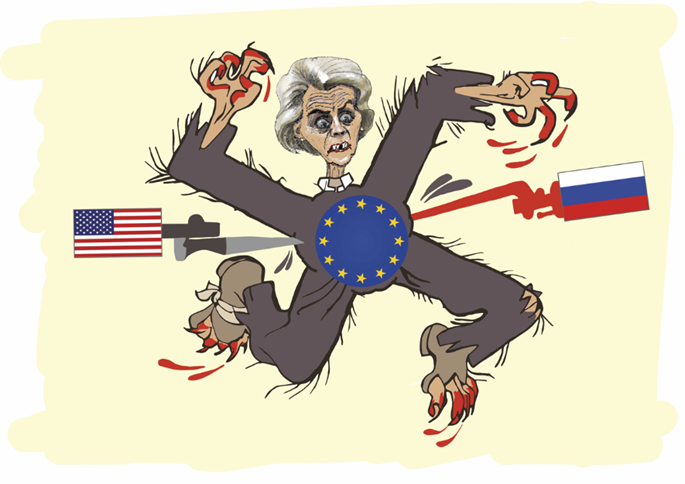
The conspiratorial character of these representations reinforces the perception that Europe is nefariously scheming against Russia. The involvement of intelligence services in promoting such narratives—often in lieu of engaging in genuine counterterrorism—demonstrates the extent to which Russia is mobilizing its resources to transform Putinist propaganda into a new political reality
Domestic Enemies
The framing of the West as Russia’s inveterate foe provides a convenient way to delegitimize anyone with views that the regime opposes. This group is broad and fluid, encompassing not only Putin’s political rivals but also cultural figures and ordinary citizens. All of these individuals are said to collude with the West.
Political rivals: This group, which Putin labels “Western enemies”, is relatively small, since Putin has managed to suppress much of the domestic opposition during his twenty-five years in power. At the time of this writing, many of his political rivals are outside the country, in jail, or no longer alive.
Alexei Navalny is a prime example of a political opponent whom the regime attempted to delegitimize as an agent of the West. In addition to leading the opposition against Putin, Navalny founded the Anti-Corruption Foundation to expose the abuses of the Russian government. In late 2020 the Kremlin’s spokesperson, Dmitry Peskov, announced the discovery of links between Navalny and CIA agents (RIA Novosti, 2020)—a statement made as Navalny lay in a German hospital after suddenly falling ill on his way to an election campaign event in Tomsk, and as international criticism steadily grew over the all-but-certain poisoning. Navalny’s subsequent decision to return to Russia was likewise framed by state-controlled media as evidence that he was cooperating with Western intelligence services (RIA Novosti, 2021).
The same tactic has been recently used against Mikhail Khodorkovsky, an outspoken political opponent of Putin who is the former head of the Yukos Oil Company. Khodorkovsky also heads the Russian Anti-War Committee, which supports Russian émigrés and advocates sanctions against Russia. In addition, the Committee has submitted a list of candidates for participation in the Platform for Dialogue with Russian Democratic Forces, a project of the Parliamentary Assembly of the Council of Europe. Although many members of the Russian Anti-War Committee are viewed in the West as legitimate opposition figures with whom dialogue is possible, the Putinist regime has attempted to discredit them as Western-led enemies of the state. On October 14, 2025, the Federal Security Service, after a purported investigation, issued an official accusation against the board of the Russian Anti-War Committee, and especially against Khodorkovsky as its chief representative. The FSB labeled the Committee as a terrorist organization that was planning the violent takeover of Russia. Alleged activities include recruiting volunteers for the Ukrainian armed forces and developing plans for an armed overthrow of the Russian government (FSB.RU, 2025). Welcoming the decision on his Telegram channel, Andrey Lugovoy, a member of the State Duma, asserted that members of the Russian Anti-War Committee were being financed by Western intelligence services. He described the Committee’s recommendation of candidates for the Platform for Dialogue with Russian Democratic Forces as “only a drop in the ocean of their Russophobic activities” (Lugovoy, 2025).[6]
Foreign agents: Other internal enemies, in the eyes of the regime, include figures in the public, cultural, and media spheres. Members of this group are labelled “foreign agents” (inoagenty) and alleged to receive support from foreign actors, primarily Western, in order to influence public opinion and shape the political environment in Russia.
“Foreign agent” first appeared in Russian legislation in 2012, when the term applied exclusively to nongovernmental organizations; in subsequent years, the term was gradually broadened to include media outlets, individuals, and unregistered public associations as well. In December 2022, with the growing hostilities in Ukraine, it became easier to apply the label without providing proof. A “foreign agent” was any individual or organization deemed to be under foreign influence and engaged in political activity or public dissemination of messages and materials—and political activity could refer, among other things, to participating in protests, criticizing the regime on social media, or providing financial support for such activities.
The regime’s rhetoric and action against these “foreign agents” have escalated along with the war in Ukraine, and especially with the intensification of anti-West conspiracy narratives during the same period. Since any identification with Western norms is seen to undermine Russia’s own value system, anyone associated with democratic and liberal values is subject to labeling as an alien or traitor to the state. The restrictions that such an individual faces have steadily expanded. These include a prohibition on receiving any form of state support, whether direct financial assistance or funding for cultural and research activities (2023); a ban on holding any type of public office (2024); an obligation to channel all assets and income through designated ruble accounts (December 2024); and exclusion from educational or outreach activities (2025). Moreover, by the end of 2025, approximately 33 percent of those included on the list faced the potential of criminal prosecution (Verstka, 2025).[7]
As of May 2025, the registry encompassed more than 1,000 organizations and individuals. Included are independent media outlets such as Meduza and the television channel Dozhd (TV Rain), along with the Committee against Torture, the Anti-Corruption Foundation, and the Levada Center, which engages in nongovernmental research and polling. Among the listed individuals are journalists Ekaterina Gordeeva and Yuri Dud’; musicians Zemfira, Monetochka, and Noize MC; former prime minister Mikhail Kasyanov; opposition figures Ilya Yashin and Vladimir Kara-Murza; and former State Duma members Dmitry and Gennady Gudkov. An additional registry of individuals has been established by the Russian Ministry of Justice. This list is not public, but citizens may contact the Ministry of Justice to see whether they are included (RBK, 2025b).
The LGBTQ+ community: Russia can be characterized as a profoundly homophobic state that has inflicted significant harm on its LGBTQ+ community. Since 2013, members of the community have been increasingly marginalized by a series of legislative restrictions that have come in tandem with the broader turn toward isolationism. Persecution reached a peak with a 2017 campaign of violence in Chechnya under the administration of Ramzan Kadyrov. Dozens of gay men were reportedly detained, tortured, and executed, and Russian authorities remained largely indifferent.
Greater repression of the LGBTQ+ community has coincided with the war in Ukraine, and this is no accident: Russia’s pre-existing homophobia has been absorbed into the regime’s conspiratorial narrative. Any visible expression of LGBTQ+ identity has been effectively criminalized. Films and works of literature are subject to stringent censorship, and organizations and social venues are shut down, often through the physical force of law enforcement. Members of the LGBTQ+ community face discrimination in employment and live under the constant threat of denunciation and fines of up to two million rubles for purported “LGBT propaganda.” Reports also indicate that LGBTQ+ individuals, especially in Chechnya, are being sent to the front lines as a punitive measure (DW, 2024).
But the repression and stigmatization extend beyond the persecution of individuals. Within the regime’s ideological framework, LGBTQ+ identity is framed as inherently Western, and therefore not only a betrayal of Russia’s conservative values and distinct civilization, but also an instrument within the broader hybrid war that the West is allegedly waging against Russia (Parlamentskaia Gazeta, 2022). The state accordingly seeks to delegitimize LGBTQ+ identity as a social and cultural phenomenon, and since the outbreak of the war, the regime has increasingly portrayed the community’s members as part of a Western-led global movement that aims to undermine the Russian system. In particular, the community is alleged to target the institution of the family, which the regime has worked to define as strictly heteronormative. In 2020, new amendments to the Russian Constitution described the state as the protector of “family, motherhood, fatherhood, and childhood” and the guardian of marriage as the union between a man and a woman (Article V114).
This conspiratorial framing culminated in a November 2023 decision by Russia’s Supreme Court to designate the LGBTQ+ community as an extremist organization posing a threat to the state. According to the ruling, “The views of this movement are based on hatred toward tradition, religion, and longstanding cultural values” (BBC, 2024). Since then, any affiliation with the LGBTQ+ community has been construed as an offense against the state, punishable by up to twelve years of imprisonment under Article 282.2 of the Criminal Code.
The same framing is applied to opponents of the regime who are accused of supporting the LGBTQ+ community. One example is Maria Pevchikh, a journalist and board chair of the Anti-Corruption Foundation that Navalny founded. Pevchikh was accused by State Duma member Andrey Lugovoy of being a “professional Russophobe” who received funding from Western intelligence agencies. Among the evidence he cited, along with her emigration from Russia, her British citizenship, and her opposition to the war with Ukraine, was her support for LGBTQ+ rights (Lugovoy, 2024). In a similar manner, government officials and propagandists have referred to the armed forces of Ukraine and Western states as “LGBT armies” (see, for example, Lugovoy, 2023).
CONCLUSION
The conspiracy theories that play a central role in the Putinist regime portray a strong and stable Russia that is a civilization unto itself, with a distinctive and conservative way of life; the West is the evil Other, a perpetual foe that seeks Russia’s defeat through any available means.
The growth of this type of thinking in contemporary Russia has parallels in other countries, including the United States, where conspiracy theories have likewise migrated from the margins to the political mainstream. The broader social and cultural reasons for this trend lie beyond the scope of this article, but it is clear that the internet and social media have been major catalysts. Online platforms not only facilitate the spread of conspiratorial narratives, but also offer a sense of agency as users discuss, adapt, reinterpret, and augment the material they find.
In Russia, the sharp increase in conspiracy theories is linked to the war in Ukraine, which has entailed the mobilization of the public, both ideologically and materially, and the promotion of cohesion against a perceived enemy. The growing prominence of Russophobia, which encompasses any anti-Russian sentiment or activity, can be understood in this context. Russophobia not only provides a conceptual framework for identifying the enemy but also enables the regime to depict Russia as the victim of the West. Within this narrative, the regime’s own aggressions, from the invasion of Ukraine to the violent suppression of domestic dissent, turn into acts of self-defense.
The regime’s increasing alignment with the Church has infused conspiratorial thinking with religious and ahistorical elements. Russia becomes the bearer of truth, and the West’s struggle against the country becomes a metaphysical attack of dark against light. The requirements of this narrative eclipse historical fact. Putin’s 2023 address to the Federal Assembly portrayed World War II as a conflict that the West waged, by means of the Nazis, against Russia. From this premise, it is a short step to labeling the Ukrainian government as neo-Nazi and asserting that it operates under Western direction.
The notion of the West has itself become an umbrella concept that encompasses any and all actors who are identified as enemies. As a result, the regime can shift the focus of its animosity in accordance with changing political needs and circumstances. The United States was once seen as the archetype of the West, but that view has receded with Donald Trump’s second presidential term, which has brought a renewal of contacts with Putin and a more confrontational American posture toward Europe. The principal Western adversary has been increasingly identified with Europe and NATO. In the domestic sphere, the wide net of the West sweeps in political opponents, public and cultural figures, and members of the LGBTQ+ community. These individuals and associated organizations are delegitimized as agents of foreign powers who prosecute war against Russia on many different fronts at the same time.
The pervasiveness of conspiracy theories in Putinist Russia points to a broader question: are they symptoms that the country is in the middle of a deeper political transformation? Hannah Arendt drew attention to the relationship between ideology and political regimes, and particularly to the role of ideology in the formation of totalitarian systems. According to Arendt, three characteristics of ideologies make them particularly useful to totalitarian governments: they provide an all-encompassing explanation of past and present while claiming predictive certainty about the future, they furnish a kind of “sixth sense” that enables the regime to ascribe hidden meaning to every public event and to presume the existence of concealed intentions, and their methods of proof derive from a single axiom from which all other explanations are deduced (Arendt, 2010, pp. 675–700). Conspiracy theories in Russia today may be understood—and deserve further study—as a vehicle for the dissemination of such totalizing ideological frameworks.
Sources
Alper, S., Varol, O., & Yilmaz, O. (2025). Conspiracy theories as instruments of power: The case of conspiracy beliefs in the wake of the 2023 earthquakes in Türkiye. Political Psychology, 00, 1-20. https://doi.org/10.1111/pops.70106
Arendt, H. (1968). The origins of totalitarianism. Harcourt Brace Jovanovich. [Hebrew Translation: Zertal, Idith; Hakibbutz Hameuchad Publishing House Ltd.; 2010].
BBC (2022, September 21). War in Ukraine: Fact-checking Russian claims that Nato troops are fighting in Ukraine. https://tinyurl.com/4eza7hzn
BBC (2024, January 23). Tsenzura, reidy, donosy. Kak rossiiskie vlasti borolis' s LGBT-dvizheniem posle priznaniia ego ekstremistskim. [Censorship, raids, and denunciations: How Russian authorities cracked down on the LGBT movement after labeling it extremist].
Borenstein, E. (2019). Plots against Russia: Conspiracy and fantasy after socialism. Cornell University Press.
Borenstein, E. (2022). Everybody hates Russia: On the uses of conspiracy theory under Putin. Social Research, 89(3), 811–829. https://doi.org/10.1353/sor.2022.0055
Byford, J. (2014). Beyond belief: The social psychology of conspiracy theories and the study of ideology. In C. Antaki & S. Condor (Eds.), Rhetoric, ideology and social psychology: Essays in honour of Michael Billig (pp. 83–93). Taylor & Francis Group.
Darwin H., Neave N., & Holmes J. (2011). Belief in conspiracy theories. The role of paranormal belief, paranoid ideation and schizotypy. Pers. Individ. Differ. 50(8),1289–1293. https://doi.org/10.1016/j.paid.2011.02.027
Dolińska-Rydzek, M. (2022). The Antichrist and his plot against Russia: Conspiracy theories and eschatology. Colloquia Humanistica, 11, Article 2745. https://doi.org/10.11649/ch.2745
Douglas, K.M., Uscinski, J. E., Sutton, R. M., Cichocka, A., Nefes, T., Ang, C.S., & Deravi, F. (2019). Understanding conspiracy theories. Political Psychology, 40(1), 3–35. https://doi.org/10.1111/pops.12568
Douglas, K.M., & Sutton, R.M. (2023). What are conspiracy theories? A definitional approach to their correlates, consequences, and communication. Annual Review of Psychology, 74, 271–298. https://doi.org/10.1146/annurev-psych-032420-031329
Dugin, A. (1992). Geopolitika yugoslavskogo konflikta [The geopolitics of the Yugoslav conflict]. Elementy, (2), 20–25.
DW (2024, September 5). Vlasti Chechni otpravliaiut zaderzhannykh geev voevat' v Ukrainu. [Chechen authorities are sending detained gay men to fight in Ukraine].
FSB.RU (2025, October 14). FSB Rossii vozbuzhdeno ugolovnoe delo v otnoshenii ex-glavy kompanii IuKOS Mikhaila Khodorkovskogo i chlenov Antivoennogo komiteta Rossii. [The Russian FSB has initiated a criminal case against former Yukos CEO Mikhail Khodorkovsky and members of the ‘Anti-War Committee of Russia'].
Gamburg, Y. & Mil-man A. (September 29, 2025). Europe as the Last Obstacle on Russia’s Path to Victory in Ukraine? INSS Insight No. 2038. https://tinyurl.com/4ytadpzd
Hagemeister, M. (2006). The Protocols of the elders of Zion and the myth of a Jewish conspiracy in post-Soviet Russia. In J. Herman, S. Rock, & E. Timms (Eds.), Nationalist myths and modern media: Contested identities in the age of globalization (pp. 243–256). Palgrave Macmillan.
Hellinger, D.C. (2019). Conspiracies and conspiracy theories in the age of Trump. Palgrave Macmillan.
Hoffman, D. (2000, March 5). Putin says 'why not?' to Russia joining NATO. The Washington Post. https://tinyurl.com/32vy4scy
Hoover Institution (2025, May 23). At home with the KGB: A new history of the Soviet security service [Video]. YouTube. https://tinyurl.com/btybktdk
Il’ichev, A.V. (2024). British scholarship on the Second World War as a tool of information and psychological confrontation with Russia. Konfliktologiia/ nota bene(1).
DOI:10.7256/2454-0617.2024.1.70157
Judt, T. (2005). Postwar: A history of Europe since 1945. Penguin Press [Hebrew translation: Giron, Gershon; Magnes Press and Dvir; 2009].
Keeley, B.L. (1999). Of conspiracy theories. The Journal of Philosophy, 96(3), 109–126.
Kotsnews (2025, October 16). FSB: Operatsiiu "Pautina" organizovali britantsy. [FSB: Operation ‘Web’ was organized by the British].[Telegram post]
Kremlin (2001, July 25). Answers to journalists’ questions during a Joint News Conference with Ukrainian President Leonid Kuchma. https://tinyurl.com/3pnk2ybb
Kremlin (2010, November 20). News conference following NATO-Russia Council meeting. https://tinyurl.com/47s4tr39
Lugovoy Andrey (2023, January 18, 10:45). [Post claiming the creation of militarized LGBT units in Poland]. [Telegram Post].
Lugovoy Andrey (2024, May 29, 14:35). [Post alleging British influence and anti-government activism by Maria Pevchikh]. [Telegram post].
Lugovoy Andrey (2025, October 14, 16:06). [Statement on the initiation of criminal proceedings against members of the “Anti-War Committee of Russia"]. [Telegram post].
Martin, A.M. (2003). The invention of "Russianness" in the late 18th-early 19th century. Ab Imperio, 2003(3), 119-134. DOI:10.1353/imp.2003.0133
Marten, K. (2017). The ‘KGB state’and Russian political and foreign policy culture. The Journal of Slavic Military Studies, 30(2), 131-151. https://doi.org/10.1080/13518046.2017.1270053
Mearsheimer, J.J. (2014). Why the Ukraine crisis is the West's fault: the liberal delusions that provoked Putin. Foreign Affairs, 93(5), 77-89. https://tinyurl.com/4h23pspp
Nera, K., Wagner-Egger, P., Bertin, P., Douglas, K.M., & Klein, O. (2021). A power-challenging theory of society, or a conservative mindset? Upward and downward conspiracy theories as ideologically distinct beliefs. Eur. J. Soc. Psychol. 51(4–5),740–757. https://doi.org/10.1002/ejsp.2769
Parlamentarskaia gazeta (2022, October 17). Khinshtein nazval LGBT instrumentom gibridnoi voiny protiv Rossii. [Khinshtein called LGBT an instrument of hybrid warfare against Russia].
Pashkovsky, P.I., Kryzhko, E.V., & Kryzhko L.A. (2025). Russophobia as a component of modern geopolitical confrontation: Global and regional dimensions. Russian Journal of Regional Studies, 33(1), 33-47. DOI:10.15507/2413-1407.033.202501.033-047
Person, R., & McFaul, M. (2022). What Putin fears most. Journal of Democracy, 33(2), 18–27. DOI:10.1353/jod.2022.0015
Poslanie Prizidenta Federal'nomu Sobraniiu. [Presidential Address to the Federal Assembly]. (2023, February 21).
Press-biuro SVR Rossii (2025, April 16). Evrofashism, kak i 80 let nazad – obshchii vrag Moskvy i Vashingtona.[Eurofascism, as 80 years ago, is the common enemy of Moscow and Washington].
Radio Svoboda (2025, October 16). Glava FSB obvinil Britaniiu v prichastnosti k operatsii "Pautina" [FSB chief accuses Britain of involvement in Operation ‘Web’].
RBK (2016, July 1). Minkul'tury zakazalo issledovanie o rossiefobii za 1.9 mln rub. [Russia’s Ministry of Culture has commissioned a study on Russophobia worth 1.9 million rubles].
RBK (2025a, June 20). Putin zaiavil o shesti volnakh rasshireniia NATO s kontsa 1990-kh. [Putin says NATO has expanded in six waves since the late 1990s].
RBK (2025b, August 22). Inoagenty v Rossii: kto eto, poniatie, reestr i posledstviia statusa. [Foreign agents in Russia: definition, register, and consequences].
RBK (2025c, December 17). Putin ob"iasnil, pochemu Rossiia ne stala chlenom "tsivilizovannogo zapada". [Putin explained why Russia did not become part of the ‘civilized West’].
Ren, Z.B., Carton, A.M., Dimant, E., & Schweitzer, M.E. (2022). Authoritarian leaders share conspiracy theories to attack opponents, galvanize followers, shift blame, and undermine democratic institutions. Current Opinion in Psychology, 46, 101388. DOI: 10.1016/j.copsyc.2022.101388
Reuters (2018, October 19). 'Aggressors will be annihilated, we will go to heaven as martyrs,' Putin says. The Moscow Times. https://tinyurl.com/ytuuhtak
RIA Novosti (2020, October 1). V Kremle zaiavili o rabote sotrudnikov TsRU s Naval'nym. [The Kremlin said that CIA operatives had worked with Navalny].
RIA Novosti (2021, January 14). Pochemu Naval'nyi toropitsia vernut'cia v Rossiiu. [Why Navalny is hurrying back to Russia].
RIA Novosti (2025, July 26). Zakharova predlozhila sozdat' mezhdunarodnyi den' bor'by s rusofobiei. [Zakharova suggests establishing an international day against Russophobia].
RG.RU (2025, October 29). Vasilii Piskarev: Popytki Zapada okazat' davlenie na izberatelei v RF budut usilivat'sia. [Vasily Piskarev: Attempts by the West to influence voters in Russia will intensify].
RT (2025, March 11). Lavrov predlozhil, chto Zapad verit tol'ko v Satanu. [Lavrov claims the West believes only in Satan]. [Telegram post] Dzen.Ru.
Sakwa, R., & Horvath, R. (2005). The invention of Russophobia. In R. Horvath, The legacy of Soviet dissent: Dissidents, democratization and radical nationalism in Russia (pp. 130–159). Routledge.Snegovaya, M., & McGlynn, J. (2025). Dissecting Putin’s regime ideology. Post-Soviet Affairs, 41(1), 42-63. https://doi.org/10.1080/1060586X.2024.2386838
Soldatov, A., & Borogan, I. (2010). The new nobility: The restoration of Russia’s security state and the enduring legacy of the KGB. PublicAffairs.
Soroka, G. (2022). International relations by proxy? The Kremlin and the Russian Orthodox Church. Religions, 13(3), 208. https://doi.org/10.3390/rel13030208
Stano, S. (2020). The internet and the spread of conspiracy content. In M. Butter & P. Knight (Eds.), Routledge handbook of conspiracy theories (Vol. 1, pp. 483–496). Routledge.
TASS (2017, July 12). Sovet Rossiia – NATO. Dos'e. [Russia–NATO Council: Dossier].
TASS (2023, December 28). V MID Rossii anonsirovali doklad ob urovne rusofobii v mire. [Russian Foreign Ministry to present a report on the global level of Russophobia].
TASS (2025, October 28). Lavrov: rasshirenie NATO ne prekrashchaetsia na minutu vopreki obiazatel'stvam. [Lavrov: NATO expansion hasn’t stopped for a minute, despite its commitments].
Technicolor Dreams (2017, August 16). Alexandr Dugin: “Osoboe mnenie”, 08/08/2008 [Alexander Dugin: "Dissenting Opinion" 08/08/2008].
YouTube. https://tinyurl.com/54xbnzub
Verstka (2025, December 23). Kazhdyi tretii "inostrannyi agent" okazalsia pod ugolovnym presledovaniem k kontsu 2025 goda. [By the end of 2025, one in three ‘foreign agents’ had come under criminal investigation].
Yablokov, I. (2020). Conspiracy theories in Putin’s Russia: The case of the New World Order. In M. Butter & P. Knight (Eds.), Routledge handbook of conspiracy theories (pp. 894–913). Taylor & Francis Group.
__________________
[1] For a literature review on this topic, see Douglas and Sutton (2023).
[2] On the sense of agency that conspiracy theories provide to politically disempowered groups, see, for example, Douglas and Sutton (2023) and Nera et al. (2021).
[3] At the same time, the organization, which wielded immense power and authority during the final decades of Soviet rule, remained pointedly subject to the supervision and guidance of the Communist Party. The Politburo, the party’s executive body, was determined to maintain its authority over security matters after the trauma of the Stalinist purges (Soldatov & Borogan, 2010, p. 9).
[4] On the cult of victimhood in Europe and the centrality of antisemitism within it, see Judt (2009), especially pp. 963–966.
[5] It is important to note that this narrative is also found among Western scholars; see, for example, Mearsheimer (2014).
[6]The career of Andrei Lugovoy illustrates the FSB’s influence over the state, a point made earlier in this article. Lugovoy initially served in the KGB and later in the FSB in a variety of positions, until his retirement from the organization in 1996. In 2007, the United Kingdom placed him on its wanted list for his suspected involvement in the murder of Alexander Litvinenko, an FSB officer who had fled to England after refusing to participate in the planned assassination of the oligarch Boris Berezovsky, a strenuous critic of Putin’s regime. Litvinenko died of poisoning with polonium-210 in 2006, and Lugovoy has been a member of the State Duma since 2007.
[7] Since 2021, an addition to the criminal code, Article 330.1, allows for the imprisonment of “foreign agents” for up to five years if they violate the restrictions imposed on them (Verstka, 2025). Despite all this legislation, Putin maintains that the Russian regime does not persecute “foreign agents” and claims that he is merely following the model of the United States, where he alleges that laws against foreign agents are much stricter.