


The Attack in the Golan Heights: Is an Israel-“Axis” Conflict Expected? | INSS
go to header go to content go to footer go to search
INSS logo The Institute for National Security Studies, Strategic, Innovative, Policy-Oriented Research, go to the home page
INSS
Tel Aviv University logo - beyond an external website, opens on a new page
  • Campus
  • Contact
  • עברית
  • Support Us
  • Research
    • Topics
      • Israel and the Global Powers
        • Israel-United States Relations
        • Glazer Israel-China Policy Center
        • Russia
        • Europe
      • Iran and the Shi'ite Axis
        • Iran
        • The Israel–Iran War
        • Lebanon and Hezbollah
        • Syria
        • Yemen and the Houthi Movement
        • Iraq and the Iraqi Shiite Militias
      • Conflict to Agreements
        • Israeli-Palestinian Relations
        • Hamas and the Gaza Strip
        • Peace Agreements and Normalization in the Middle East
        • Saudi Arabia and the Gulf States
        • Turkey
        • Egypt
        • Jordan
      • Israel’s National Security Policy
        • Military and Strategic Affairs
        • Societal Resilience and the Israeli Society
        • Jewish-Arab Relations in Israel
        • Climate, Infrastructure and Energy
        • Terrorism and Low Intensity Conflict
      • Cross-Arena Research
        • Data Analytics Center
        • Law and National Security
        • Advanced Technologies and National Security
        • Cognitive Warfare
        • Economics and National Security
    • Projects
      • Preventing the Slide into a One-State Reality
      • Contemporary Antisemitism in the United States
      • Perceptions about Jews and Israel in the Arab-Muslim World and Their Impact on the West
  • Publications
    • -
      • All Publications
      • INSS Insight
      • Policy Papers
      • Special Publication
      • Strategic Assessment
      • Technology Platform
      • Memoranda
      • Posts
      • Books
      • Archive
  • Database
    • Surveys
    • Spotlight
    • Maps
    • Dashboards
  • Events
  • Team
  • About
    • Vision and Mission
    • History
    • Research Disciplines
    • Chairman of the Board
    • Board of Directors
    • Fellowship and Prizes
    • Internships
  • Media
    • Communications
    • Video gallery
    • Press Releases
  • Podcast
  • Newsletter
  • Campus
Search in site
  • Research
    • Topics
    • Israel and the Global Powers
    • Israel-United States Relations
    • Glazer Israel-China Policy Center
    • Russia
    • Europe
    • Iran and the Shi'ite Axis
    • Iran
    • The Israel–Iran War
    • Lebanon and Hezbollah
    • Syria
    • Yemen and the Houthi Movement
    • Iraq and the Iraqi Shiite Militias
    • Conflict to Agreements
    • Israeli-Palestinian Relations
    • Hamas and the Gaza Strip
    • Peace Agreements and Normalization in the Middle East
    • Saudi Arabia and the Gulf States
    • Turkey
    • Egypt
    • Jordan
    • Israel’s National Security Policy
    • Military and Strategic Affairs
    • Societal Resilience and the Israeli Society
    • Jewish-Arab Relations in Israel
    • Climate, Infrastructure and Energy
    • Terrorism and Low Intensity Conflict
    • Cross-Arena Research
    • Data Analytics Center
    • Law and National Security
    • Advanced Technologies and National Security
    • Cognitive Warfare
    • Economics and National Security
    • Projects
    • Preventing the Slide into a One-State Reality
    • Contemporary Antisemitism in the United States
    • Perceptions about Jews and Israel in the Arab-Muslim World and Their Impact on the West
  • Publications
    • All Publications
    • INSS Insight
    • Policy Papers
    • Special Publication
    • Strategic Assessment
    • Technology Platform
    • Memoranda
    • Posts
    • Books
    • Archive
  • Database
    • Surveys
    • Spotlight
    • Maps
    • Dashboards
  • Events
  • Team
  • About
    • Vision and Mission
    • History
    • Research Disciplines
    • Chairman of the Board
    • Board of Directors
    • Fellowship and Prizes
    • Internships
    • Privacy Policy and Terms of Use
  • Media
    • Communications
    • Video gallery
    • Press Releases
  • Podcast
  • Newsletter
  • Campus
  • Contact
  • עברית
  • Support Us
bool(false)

Publications

Home Publications INSS Insight The Attack in the Golan Heights: Is an Israel-“Axis” Conflict Expected?

The Attack in the Golan Heights: Is an Israel-“Axis” Conflict Expected?

INSS Insight No. 658, January 27, 2015
עברית
Omer Einav
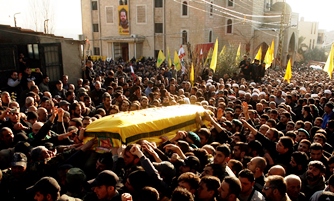
The attack in the Golan Heights near Quneitra on January 18, 2015, which killed Hizbollah operatives and Iranian Revolutionary Guards al-Quds Force commanders, was attributed to Israel. Iran and Hizbollah appear to be seeking an appropriate violent response to restore deterrence and signal to Israel that they will not accept a change in the rules of the game, but without this leading to war. A January 19 headline in the Lebanese daily as-Safir read: “More than a Response, Less than a War.” The axis has a number of possible responses of varying degrees of intensity, some of which were implemented in the past. Israel’s starting point must be that this incident is part of the conflict against the Iran-Hizbollah axis, which will not exercise restraint in the face of targeted killings of its officials. It remains to be seen how Iran and Hizbollah will choose to reshape the rules of the game given the conditions dictated to them from within and without.

In the background to the attack in the Golan Heights near Quneitra on January 18, 2015 are last year’s air strikes in Syria on convoys of weapons sent to Hizbollah by Iran. With the most recent attack, however, which was attributed to Israel and killed Hizbollah operatives and Iranian Revolutionary Guards al-Quds Force commanders, Hizbollah, Iran, and Syria have apparently perceived a change by Israel of the rules of the game. Thus, this attack, which was actually a targeted killing of a symbolic figure, Jihad Mughniyeh, and Mohammad Ali Allah-Dadi, a senior Iranian Quds Force officer, marked a new standard in the tension between Israel on the one hand, and Hizbollah and Iran on the other. The attack on Hizbollah and Iran on Syrian soil gave the recent incident a broader meaning than that attached to previous events in the conflict arena between Israel and the Iran-Syria-Hizbollah axis. Much attention, therefore, is now focused on predicting Hizbollah’s response, in coordination with Iran or separately, and assessing the considerations that will guide the “axis” response.

Apparently in the eyes of Iran and Hizbollah, the attack crossed a red line and thus demands a high price of Israel. From time to time Israel is perceived as violating the rules of the game formulated after the civil war broke out in Syria, implying that Hizbollah’s deterrence, widely accepted as a given since the Second Lebanon War, is eroding. Israel has attacked the organization several times, including the assassination of Imad Mughniyeh in 2008, the killing of Hassan Lakkis in Beirut in 2013, and the recent strike. These targeted strikes join numerous operations attributed to Israel against arms shipments to Hizbollah in Syrian territory and the exposure of a spy ring within Hizbollah that is suspected of collaborating with Israel.

Hizbollah’s responses to these events were relatively weak. They included one significant response, the attack in Burgas, Bulgaria in July 2012, along with failed attempts to launch further attacks abroad and pinpoint strikes in the northern Golan Heights and Shab’a Farms during 2014. Against this background, it is reasonable to assume that the organization and its Iranian patron believe that they must restore deterrence against Israel so as not to abandon the principle of attacking Israel, which in their view understands only the language of force, and act in accordance with the spirit of muqawama (resistance). To them, continued relative restraint will encourage Israel to continue the trend toward escalation and erode Hizbollah’s position as the leader of the resistance. This assessment concerning Hizbollah’s intentions is supported by explicit statements in recent months by Secretary General Hassan Nasrallah, as well as declarations by Hizbollah spokesmen following the latest strike, made in order to gain legitimacy for a response.

However, a dramatic response by Hizbollah and Iran would entail tangible risks of deterioration into war, a development that none of the parties involved – Hizbollah, Iran, Syria, or Israel – desire. Not only is Hizbollah mired in a long war in Syria, particularly in the struggle against the Islamic State (IS) on Syrian and Iraqi soil, which is stretching its capabilities over several arenas; it must also contend with problems at home, namely, the domestic situation in Lebanon.

Indeed, the domestic tension in Lebanon is forcing Hizbollah to avoid unnecessary additional turmoil. Hizbollah recently launched a dialogue with opponents in the Future Movement, in an attempt to defuse the Sunni-Shiite tension in Lebanon and end the political crisis regarding the lack of a president in Lebanon since May 2014. Despite the inherent animosity between the parties, the talks were launched out of the recognized need to stabilize the country, given the wave of refugees from Syria, the infiltration of Salafist jihadi elements into Lebanon, and the deterioration of domestic security. The Islamic State and Jabhat al-Nusra aspire to expand the boundaries of the fighting beyond Syria’s border into Lebanon and to bring Lebanon into the cycle of violence. If they succeed, this will realize the Lebanese nightmare. Nasrallah must also take into account this threatening possibility if he chooses to risk a confrontation with Israel, which incurs potential for severe damage. Moreover, Hizbollah’s unreserved support for the Bashar al-Assad regime in Syria has strengthened the ties between them. For this reason, any action against Israel could lead to an Israeli response against the axis that would damage the government in Damascus and weaken it against its enemies at home.

Thus several days after suffering a painful and humiliating blow, operationally and in terms of collective organizational consciousness, Hizbollah is planning its moves, making the expected threats, garnering legitimacy, and preparing its response. What, however, is at work under the surface? What contacts are there between Iran and Hizbollah, and what logic will dictate the course of action of the axis? Tehran is undoubtedly paying close attention to the question of whether Israel knew about the presence of the Iranian officer and his assistants in the convoy that was attacked and how the information affected the decision to attack. In addition, Iran’s considerations are broader than Hizbollah’s Lebanese-Syrian angle and focus on its position regionally and internationally. Decision makers in Tehran must take into account the struggle for regional hegemony against Saudi Arabia; the lack of Western resistance – which seemingly implies legitimacy – to Iranian footholds in Iraq, Syria, Lebanon, and other places via Shiite and other groups, which are proxies for Iran; and the negotiations on the nuclear issue. When these weighty issues are factored into a system of considerations, the result will be a decision translated into a mode of action: who will act, when, where, and in what format. In any case, it appears that this time, there is coordinated action by the Iran-Hizbollah axis, while Syria exerted limited influence, even though the incident took place on its territory.

The considerations of the axis are also evidenced by its defiant policy: For the first time, the Iranians are not concealing their presence in the Golan Heights, which until now was an improbable scenario. Hizbollah is permitting itself freedom of action and a high profile on the Golan Heights and is working to establish an infrastructure in the region for attacks on Israel – not to protect Damascus, but out of a sense of power and freedom from the need to take into account the considerations of the Assad regime, whether it backs this activity or not. As the axis sees it, if Israel permits itself to operate freely in the Golan Heights while aiding the anti-Assad rebels on various levels, then the situation will change and the Golan Heights, an area of chaos without governance, will become the main arena of struggle between the axis and Israel. This is the place to design new rules of the game.

Iran and Hizbollah appear to be seeking an appropriate violent response to restore deterrence and signal to Israel that they will not accept the change in the rules of the game, but without this leading to war. A January 19 headline in the Lebanese daily as-Safir put it well: “More than a Response, Less than a War.” The axis has a number of possible responses of varying degrees of intensity, some of which were implemented in the past and some of which have not yet been put into action. These include an air strike using unmanned aerial vehicles; a naval strike; an attack on IDF forces and camps in the northern sector, including high trajectory fire; cyber warfare; a pinpoint strike on the Israeli-Lebanese border (the Blue Line); or an attack in the international arena.

For its part, Israel could influence the axis response in a number of ways. Israel is already working to significantly improve the components of defense in the north and to lower the profile of its moves so as to deny Hizbollah attractive operational opportunities. It appears that Israel’s leading objective, aside from peace and quiet and security, is not to allow Iran and Hizbollah to establish a foothold for control and terror infrastructures in the Golan Heights. At the same time, a new connection, perhaps irrevocable, has been created between southern Lebanon and the Golan Heights, primarily because Hizbollah’s sector of operations has expanded and Assad is increasingly dependent on the organization. Hence a new equation: action by Hizbollah from Syrian territory can lead to an Israeli response in Lebanese territory, or conversely, action by Hizbollah from Lebanese territory can cause damage to regime assets in Syria. Messages of this type could affect Hizbollah and Iran’s considerations when they come to attack Israeli targets, and even more so if they attempt to turn the Golan Heights into an isolated arena of conflict unconnected to southern Lebanon.

In conclusion, the Israeli starting point must be that this incident is part of the conflict against the Iran-Hizbollah axis, which will not exercise restraint in the face of targeted killing of its officials. The balance of deterrence and the equilibrium between the parties is on the verge of being upset, and it remains to be seen how Iran and Hizbollah will choose to reshape the rules of the game given the conditions dictated to them from within and without. As for Israel, it must show resolve and not be deterred by escalation if in fact it has an interest in preventing the establishment of an Iranian-Hizbollah foothold in the Golan Heights, which would be a platform for attacking Israel at a time and in circumstances that suit the axis.
The opinions expressed in INSS publications are the authors’ alone.
Publication Series INSS Insight
TopicsIranLebanon and HezbollahSyria
עברית

Events

All events
Israel–U.S. Relations: An Alliance in Transition?
22 December, 2025
13:00 - 16:00

Related Publications

All publications
The Second “Imposed War”: The Israel–Iran War and Its Implications for Iran’s National Security
The 12-day war between Iran and Israel in June 2025 marked the sharpest escalation to date in the ongoing confrontation between the two states. Despite its relatively short duration, the war had a destabilizing effect on the Islamic Republic due to the success of Israel’s opening strike, the decision of the United States to join the campaign, and the damage sustained by Iran’s critical strategic systems—notably its nuclear program and long-range missile arsenal. Since the end of the war, Iran has engaged in an ongoing process of drawing lessons from the serious gaps revealed in the Islamic Republic’s deterrence and defense capabilities. The Iranian leadership is certainly aware of the need for improvements and adjustments to its national security doctrine; yet for now, this does not appear sufficient to produce a fundamental shift in Iranian strategy. It seems that Iran prefers to make adjustments within the existing framework by finding acceptable solutions to the gaps exposed rather than introducing major changes to its overall strategy. In any event, the new reality in Iran created by the war is characterized by instability, and it is doubtful whether the current status quo can endure for long. This is exacerbated by the growing possibility of a miscalculation between Iran and Israel that would lead to renewed clashes, or high-risk decisions by Iran on both the nuclear issue and on the regional front. This memorandum seeks to examine the lessons that Iran is drawing from the war and its implications in four main areas: the nuclear program, strategic military systems, the regional arena, and the domestic arena—and to assess how the war has influenced Iran’s national security concept. In addition, it includes a set of policy recommendations intended to block, or at least delay, Iran’s efforts to rebuild its strategic capabilities, foremost among them the nuclear program, and the pro-Iranian axis in the region, and to reduce as much as possible the risk of renewed fighting.
20/12/25
Aircraft Under the Radar: Mechanisms of Evading Sanctions in Iran’s Aviation Sector
Despite being subjected to one of the harshest sanctions regimes in the world, Iran has succeeded in building a sophisticated, law-evading mechanism to support its aviation industry, which reflects the broader principles of the shadow economy it has developed. This article maps the operational architecture of that mechanism, based on using front and shell companies in countries with little transparency, layered ownership registries, bursts of activity designed to complete transfers within short timeframes, and flight-path planning that includes fictitious emergency landings to allow aircraft to quietly enter Iran. The article describes how Iran’s aviation sector—significantly harmed by sanctions—has shifted from a civilian transportation tool to a core component of the regime’s economic and security strategy, enabling it to continue functioning, finance its regional proxies, and project resilience in the face of international pressure. The aviation industry represents only one link in a much larger apparatus designed to evade sanctions in the trade of oil, gold, and dual-use technologies; yet the aviation sector clearly demonstrates the method: a sophisticated integration of state, market, and underground networks that operate in regulatory gray zones and disrupt efforts to globally enforce the sanctions.
17/12/25
Iranian Supreme Leader'S Office via ZUMA Press Wire
The Deadlock Surrounding Iran’s Nuclear Program
The solution to the crisis surrounding the Iranian nuclear program is nowhere in sight, and the ticking clock is forcing Tehran to make fateful decisions
09/12/25

Stay up to date

Registration was successful! Thanks.
  • Research

    • Topics
      • Israel and the Global Powers
      • Israel-United States Relations
      • Glazer Israel-China Policy Center
      • Russia
      • Europe
      • Iran and the Shi'ite Axis
      • Iran
      • The Israel–Iran War
      • Lebanon and Hezbollah
      • Syria
      • Yemen and the Houthi Movement
      • Iraq and the Iraqi Shiite Militias
      • Conflict to Agreements
      • Israeli-Palestinian Relations
      • Hamas and the Gaza Strip
      • Peace Agreements and Normalization in the Middle East
      • Saudi Arabia and the Gulf States
      • Turkey
      • Egypt
      • Jordan
      • Israel’s National Security Policy
      • Military and Strategic Affairs
      • Societal Resilience and the Israeli Society
      • Jewish-Arab Relations in Israel
      • Climate, Infrastructure and Energy
      • Terrorism and Low Intensity Conflict
      • Cross-Arena Research
      • Data Analytics Center
      • Law and National Security
      • Advanced Technologies and National Security
      • Cognitive Warfare
      • Economics and National Security
    • Projects
      • Preventing the Slide into a One-State Reality
      • Contemporary Antisemitism in the United States
      • Perceptions about Jews and Israel in the Arab-Muslim World and Their Impact on the West
  • Publications

    • All Publications
    • INSS Insight
    • Policy Papers
    • Special Publication
    • Strategic Assessment
    • Technology Platform
    • Memoranda
    • Database
    • Posts
    • Books
    • Archive
  • About

    • Vision and Mission
    • History
    • Research Disciplines
    • Chairman of the Board
    • Board of Directors
    • Fellowship and Prizes
    • Internships
    • Support
    • Privacy Policy and Terms of Use
  • Media

    • Communications
    • Video Gallery
    • Press Release
    • Podcast
  • Home

  • Events

  • Database

  • Team

  • Contact

  • Newsletter

  • עברית

INSS logo The Institute for National Security Studies, Strategic, Innovative, Policy-Oriented Research, go to the home page
40 Haim Levanon St. Tel Aviv, 6997556 Israel | Tel: 03-640-0400 | Fax: 03-744-7590 | Email: info@inss.org.il
Developed by Daat A Realcommerce company.
Accessibility Statement
This site is protected by reCAPTCHA and the Google Privacy Policy and Terms of Service apply.
No audio version available for this podcast