


On the Brink of Nuclear Terror? A Threat and Response Balance Sheet | INSS
go to header go to content go to footer go to search
INSS logo The Institute for National Security Studies, Strategic, Innovative, Policy-Oriented Research, go to the home page
INSS
Tel Aviv University logo - beyond an external website, opens on a new page
  • Campus
  • Contact
  • עברית
  • Support Us
  • Research
    • Topics
      • Israel and the Global Powers
        • Israel-United States Relations
        • Glazer Israel-China Policy Center
        • Russia
        • Europe
        • Antisemitism and Delegitimization
      • Iran and the Shi'ite Axis
        • The Campaign Against Iran and the Shiite Axis
        • Iran
        • Lebanon and Hezbollah
        • Syria
        • Yemen and the Houthi Movement
        • Iraq and the Iraqi Shiite Militias
      • Conflict to Agreements
        • Israeli-Palestinian Relations
        • Hamas and the Gaza Strip
        • Peace Agreements and Normalization in the Middle East
        • Saudi Arabia and the Gulf States
        • Turkey
        • Egypt
        • Jordan
      • Israel’s National Security Policy
        • Military and Strategic Affairs
        • Israel's Security Strategy
        • Societal Resilience and the Israeli Society
        • Jewish-Arab Relations in Israel
        • Climate, Infrastructure and Energy
        • Terrorism and Low Intensity Conflict
      • Cross-Arena Research
        • Data Analytics Center
        • Law and National Security
        • Advanced Technologies and National Security
        • Foreign Information Manipulation and Interference
        • Economics and National Security
    • Projects
      • Preventing the Slide into a One-State Reality
      • India-Middle East-Europe Economic Corridor (IMEC)
  • Publications
    • -
      • All Publications
      • INSS Insight
      • Policy Research and Papers
      • Special Publication
      • Strategic Assessment
      • Technology Platform
      • Memoranda
      • Posts
      • Books
      • Archive
  • Database
    • Surveys
    • Spotlight
    • Maps
    • Dashboards
  • Events
  • Team
  • About
    • Vision and Mission
    • History
    • Research Disciplines
    • Chairman of the Board
    • Board of Directors
    • Fellowship and Prizes
    • Annual Reports
    • Internships
  • Media
    • Communications
    • Video gallery
    • Press Releases
  • Podcast
  • Newsletter
  • Campus
Search in site
  • Research
    • Topics
    • Israel and the Global Powers
    • Israel-United States Relations
    • Glazer Israel-China Policy Center
    • Russia
    • Europe
    • Antisemitism and Delegitimization
    • Iran and the Shi'ite Axis
    • The Campaign Against Iran and the Shiite Axis
    • Iran
    • Lebanon and Hezbollah
    • Syria
    • Yemen and the Houthi Movement
    • Iraq and the Iraqi Shiite Militias
    • Conflict to Agreements
    • Israeli-Palestinian Relations
    • Hamas and the Gaza Strip
    • Peace Agreements and Normalization in the Middle East
    • Saudi Arabia and the Gulf States
    • Turkey
    • Egypt
    • Jordan
    • Israel’s National Security Policy
    • Military and Strategic Affairs
    • Israel's Security Strategy
    • Societal Resilience and the Israeli Society
    • Jewish-Arab Relations in Israel
    • Climate, Infrastructure and Energy
    • Terrorism and Low Intensity Conflict
    • Cross-Arena Research
    • Data Analytics Center
    • Law and National Security
    • Advanced Technologies and National Security
    • Foreign Information Manipulation and Interference
    • Economics and National Security
    • Projects
    • Preventing the Slide into a One-State Reality
    • India-Middle East-Europe Economic Corridor (IMEC)
  • Publications
    • All Publications
    • INSS Insight
    • Policy Research and Papers
    • Special Publication
    • Strategic Assessment
    • Technology Platform
    • Memoranda
    • Posts
    • Books
    • Archive
  • Database
    • Surveys
    • Spotlight
    • Maps
    • Dashboards
  • Events
  • Team
  • About
    • Vision and Mission
    • History
    • Research Disciplines
    • Chairman of the Board
    • Board of Directors
    • Fellowship and Prizes
    • Internships
    • Annual Reports
    • Privacy Policy and Terms of Use
  • Media
    • Communications
    • Video gallery
    • Press Releases
  • Podcast
  • Newsletter
  • Campus
  • Contact
  • עברית
  • Support Us
bool(false)

Publications

Home Publications INSS Insight On the Brink of Nuclear Terror? A Threat and Response Balance Sheet

On the Brink of Nuclear Terror? A Threat and Response Balance Sheet

INSS Insight No. 814, April 13, 2016

Follow us on Google
עברית
Emily B. Landau
Shimon Stein
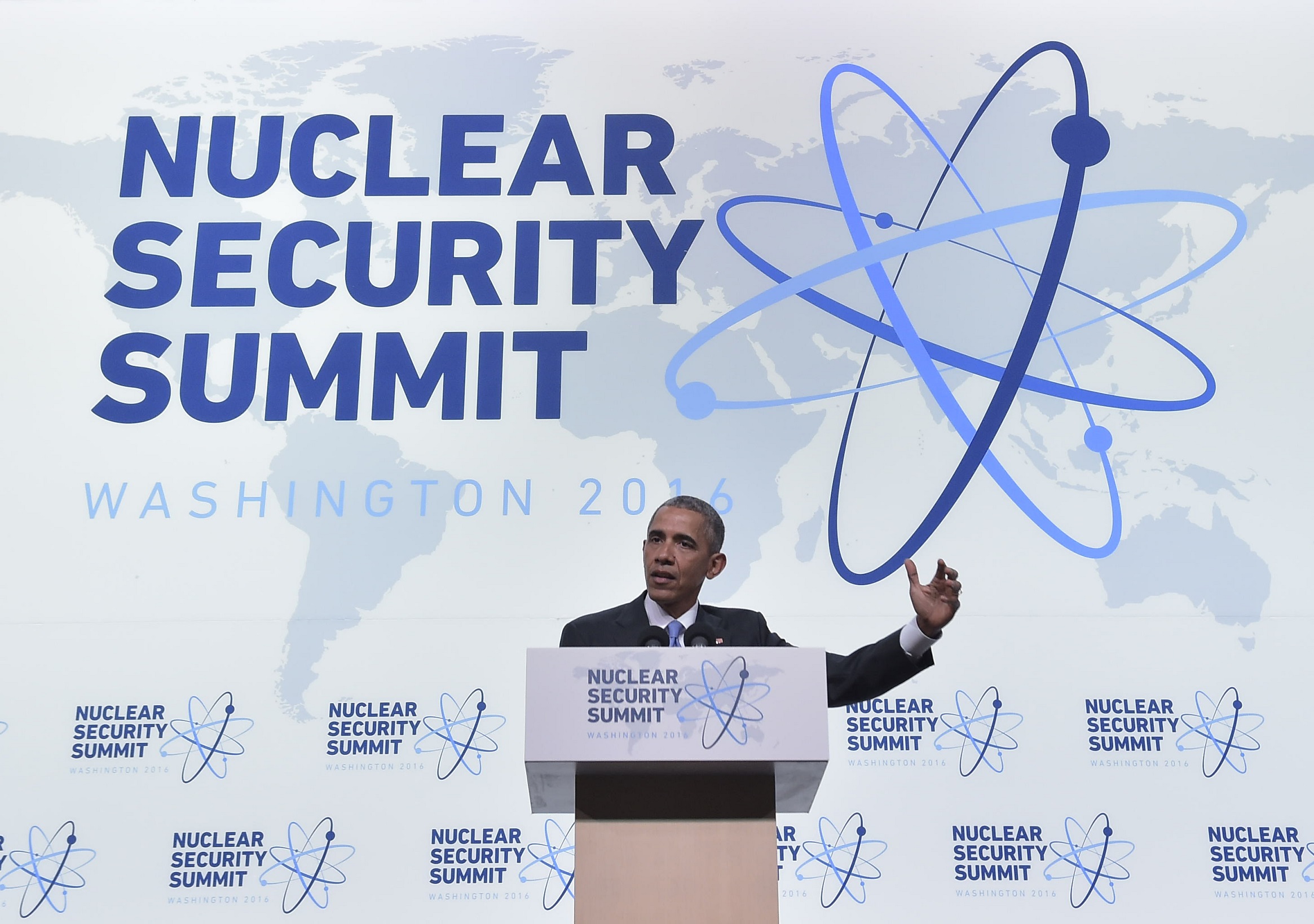
President Barack Obama at the conclusion of the Nuclear Security Summit, Washington, April 1, 2016. Photo: Mandel Ngan / AFP
The recent attempts in Brussels by members of the Islamic State to sabotage and gain access to material and know-how in the nuclear realm highlight the urgency of the threat of nuclear terrorism, and underscore that the international community must do its utmost at the national, regional, and global levels to deny the terrorists that possibility. Against the backdrop of the highly unstable situation in the Middle East, and the fact that the Islamic State has supporters in most Arab countries, there is reason to be concerned about the safety and security of nuclear material in this region, first and foremost regarding new nuclear power reactors. Initiatives that are currently being considered, such as phasing out the use of highly enriched uranium in civil commerce, gaining control of uranium enrichment production, and improving nuclear security are but a few initiatives that should be given the highest priority when discussing ways to deal with the looming threat of nuclear terrorism.

When Shultz, Perry, Kissinger, and Nunn published their op-eds on a world free of nuclear weapons in 2007 and 2008, the primary motivating factor for their new and surprising joint agenda was the fear that the world’s most dangerous weapons, materials, and know-how would fall into the hands of the most dangerous entities, namely, terrorists. When Barack Obama became president in 2009 he adopted this agenda, advocating a plan to reduce nuclear weapons worldwide – to create “a world without nuclear weapons." One component of his disarmament agenda was to carve out a plan to secure nuclear materials in all states, a goal that the administration began to advance with its inaugural Nuclear Security Summit held in Washington, DC in 2010. Thereafter, follow-up summits were held in 2012 (Seoul) and 2014 (The Hague), with the final two-day summit held on March 31-April 1, 2016, once again in Washington DC.

The threat that sparked these international efforts has become somewhat more concrete with the latest reports indicating that the recent terror attacks in Brussels possibly included a nuclear dimension. In the wake of the Brussels attacks, and ahead of the recent Nuclear Security Summit, IAEA Director-General Yukiya Amano issued a warning that "terrorism is spreading and the possibility of using nuclear material cannot be excluded." At the summit itself, the risk of nuclear terror was highlighted and participants took part in an exercise that simulated a radiological attack over Western cities.

To be sure, the threat of nuclear terrorism is not new. Warnings were issued against the backdrop of concerns of nuclear leakage following the breakup of the Soviet Union, and al-Qaeda made no secret of its desire to acquire and use weapons of mass destruction. But events surrounding the Brussels attacks raise the possibility of intent being joined by capability, if Islamic State terrorists are able to exploit the security vulnerabilities of nuclear facilities – as manifested in Belgium, a Western state – either to attack these sites or steal materials from within. A radiological attack could occur through dispersion of radioactive materials from a drone, as was simulated in the exercise, or by an attack on a nuclear facility that released these materials. (The risk of a terror organization getting its hands on an actual nuclear weapon is still very low.) In November 2015, footage tracking the comings and goings of a top official who worked at the Nuclear Research Center at Mol in northern Belgium (which produces radioisotopes) was found in an apartment of the terrorists who perpetrated the Brussels attacks. The surveillance might have been part of preparations to kidnap him. Two days after the Brussels attacks, a security guard at a nuclear plant was murdered and his pass stolen. These findings have raised concern that the Islamic State "is seeking to attack, infiltrate or sabotage nuclear installations or obtain nuclear or radioactive material" (New York Times, March 25, 2016).

Before the advent of the Islamic State, the prospect of nuclear terrorism, though on the agenda, was not considered likely, notwithstanding the al-Qaeda threats. Attaining weapons of mass destruction (WMD) is not a simple matter, and terrorists have been able to achieve their goals with conventional means. In addition, handling WMD can be dangerous for the terrorists themselves, and crossing the WMD threshold could even alienate their constituencies.

But the atrocities committed by the Islamic State raise the concern that there are no normative boundaries that will not be crossed in its quest to kill infidels, and in the most sensational manner. In fact, and perhaps following the example set by Assad, the Islamic State has already crossed the WMD threshold in the chemical realm. Chemical weapons were reportedly used on the battlefield; it seems that the organization is producing its own chemical agents, and some may have been found in Syria. Moreover, the relatively loose organizational structure for the terrorists operating in Europe – with cells given some degree of autonomy – suggests that there could be somewhat weaker organizational constraints on these attacks. If this is the case – and evidence regarding the degree of centralization in the organizational structure of ISIS is not conclusive – the perpetrators could be less prone to considering factors beyond the very strength of the damage that they can cause. Therefore, the concrete indications of attempts to gain access to nuclear plants or figures must today be taken seriously.

In 2007 Shultz, Perry, Kissinger, and Nunn stated that “the steps that we are taking now to address these threats are not adequate to the danger.” Since 2007, steps have been taken to address the threat, culminating in Obama’s nuclear security initiative. The summits have carved out concrete proposals to address the threat at the highest level, and some nuclear materials have been secured. But the process that Obama launched is a long term one, and success will likely be measured more in terms of reducing the threat than eliminating it. It is also not clear whether Obama’s successor will even place the issue high on his or her agenda.

The recent attempts in Brussels by members of the Islamic State to sabotage and gain access to material and know-how in the nuclear realm highlight the urgency, and underscore that the international community must do its utmost at the national, regional, and global levels to deny the terrorists that possibility. Against the backdrop of the highly unstable situation in the Middle East, and the fact that the Islamic State has supporters in most Arab countries, there is reason to be concerned about the safety and security of nuclear material in this region, first and foremost regarding new nuclear power reactors. Initiatives that are currently being considered, such as phasing out the use of highly enriched uranium in civil commerce, gaining control of uranium enrichment production, and improving nuclear security are but a few initiatives that should be given the highest priority when discussing ways to deal with the looming threat of nuclear terrorism.

What might be Israel's contribution to these international efforts? Israel has been a part of Obama's nuclear security initiative from the start, and has actively participated in all of the summits with high level delegations. Israel attributes great importance to the issue, especially in light of the increase in nuclear programs throughout the Middle East. Regarding the recent summit, Israel noted that it is prepared for the scenario of a radiological attack; moreover, it is prepared to help other states in the region prevent the smuggling of radioactive materials into their territory. Indeed, this is an issue that could be discussed in a regional framework, if a regional security dialogue were to be initiated in the Middle East. However, due to the seriousness of the matter, and until this can be discussed in a regional framework, the IAEA should take the lead and try to help regional member states who have a clear interest in confronting this threat.

The opinions expressed in INSS publications are the authors’ alone.
Publication Series INSS Insight
TopicsTerrorism and Low Intensity Conflict
עברית

Events

All events
Israel’s National Security Conference
27 July, 2026
10:00 - 14:00

Related Publications

All publications
Iran’s Involvement in the International Terrorism Arena
Over the past five years, Iran’s activity in the arena of international terrorism has significantly intensified, spreading across vast geographic regions and incorporating criminal organizations in the execution of terrorist operations. Although most Iranian terrorism attempts have been thwarted, there is no guarantee that this success will persist in the future. It is therefore necessary to examine the characteristics of Iran’s use of terrorism in order to improve the chances of countering it. This memorandum examines Iran’s policy regarding its use of terrorism in the international arena over the past five years, the trends that have characterized it, and its modes of operation-placing these elements within the broader historical context of Iran’s employment of terrorism. An analysis of Iran’s terrorism policy reveals a troubling trend, illustrating that Iran remains committed to employing international terrorism and is even amplifying its efforts in this regard, demonstrating a willingness to risk friction with numerous states in order to pursue its policy. This trend requires close attention, both in its own right and because it signals Iran’s growing audacity and confidence in violating international norms and the sovereignty of states-behaviors that may also manifest in other contexts.
07/07/25
Shutterstock
Iranian Terrorism on the International Stage—Possible Revenge Against Israel
In light of the delayed Iranian response to the assassination of Haniyeh, it is possible that Iran is planning to exact a price from Israel in the international arena. How should we prepare for the challenge?
09/09/24
Strategic Analysis for Israel 2023
Read the INSS Strategic Analysis for 2023
23/02/23

Stay up to date

Registration was successful! Thanks.
  • Research

    • Topics
      • Israel and the Global Powers
      • Israel-United States Relations
      • Glazer Israel-China Policy Center
      • Russia
      • Europe
      • Antisemitism and Delegitimization
      • Iran and the Shi'ite Axis
      • The Campaign Against Iran and the Shiite Axis
      • Iran
      • Lebanon and Hezbollah
      • Syria
      • Yemen and the Houthi Movement
      • Iraq and the Iraqi Shiite Militias
      • Conflict to Agreements
      • Israeli-Palestinian Relations
      • Hamas and the Gaza Strip
      • Peace Agreements and Normalization in the Middle East
      • Saudi Arabia and the Gulf States
      • Turkey
      • Egypt
      • Jordan
      • Israel’s National Security Policy
      • Military and Strategic Affairs
      • Israel's Security Strategy
      • Societal Resilience and the Israeli Society
      • Jewish-Arab Relations in Israel
      • Climate, Infrastructure and Energy
      • Terrorism and Low Intensity Conflict
      • Cross-Arena Research
      • Data Analytics Center
      • Law and National Security
      • Advanced Technologies and National Security
      • Foreign Information Manipulation and Interference
      • Economics and National Security
    • Projects
      • Preventing the Slide into a One-State Reality
      • India-Middle East-Europe Economic Corridor (IMEC)
  • Publications

    • All Publications
    • INSS Insight
    • Policy Research and Papers
    • Special Publication
    • Strategic Assessment
    • Technology Platform
    • Memoranda
    • Database
    • Posts
    • Books
    • Archive
  • About

    • Vision and Mission
    • History
    • Research Disciplines
    • Chairman of the Board
    • Board of Directors
    • Fellowship and Prizes
    • Internships
    • Annual Reports
    • Support
    • Privacy Policy and Terms of Use
  • Media

    • Communications
    • Video Gallery
    • Press Release
    • Podcast
  • Home

  • Events

  • Database

  • Team

  • Contact

  • Newsletter

  • עברית

INSS logo The Institute for National Security Studies, Strategic, Innovative, Policy-Oriented Research, go to the home page
40 Haim Levanon St. Tel Aviv, 6997556 Israel | Tel 03-640-0400 | Fax 03-744-7590 |
Developed by Daat ,Yael Group.
Accessibility Statement
This site is protected by reCAPTCHA and the Google Privacy Policy and Terms of Service apply.