


Publications
Despite Imam Omar Suleiman's harsh anti-Israel rhetoric, why is Israel's decision to label him an antisemite a strategic mistake?
INSS Insight No. 2212, November 10, 2026
Follow us on GoogleThe Ministry of Diaspora Affairs and Combating Antisemitism’s 2025 report included American Imam Omar Suleiman, one of the most prominent Muslim voices in the United States, on its list of the ten leading influencers spreading antisemitism. This article argues that although Suleiman promotes harsh anti-Zionist rhetoric within the delegitimization campaign against Israel, including him on the list as an antisemite is a strategic mistake. A broader examination of his activity reveals a more complex picture: despite the escalation in anti-Israel discourse following October 7, Suleiman has been careful to distinguish between anti-Zionism and antisemitism, has condemned attacks on the Jewish community, and has engaged in interfaith dialogue and collaboration with Jewish leaders over the years. The concern is that branding him an antisemite may actually strengthen his standing among his supporters, blur the boundary between anti-Zionism and hatred of Jews, harm dialogue with Muslim figures who oppose antisemitism, and weaken the moral weight of the term itself. Rather than focus on labeling him personally, Israel should challenge and refute the delegitimizing messages Suleiman promotes. At the same time, it should engage Muslim audiences directly by presenting the Israeli narrative and the historical Jewish connection to the land, while recognizing the Palestinian connection and drawing a more careful distinction between anti-Zionism and antisemitism.
The events of October 7, which intensified the delegitimization campaign against Israel in the West in general and in the United States in particular, were reflected in a rise in anti-Zionist discourse that spilled over into explicitly antisemitic statements and actions. These included hate crimes and efforts to blame Jews for the actions of the State of Israel. The Ministry of Diaspora Affairs and Combating Antisemitism report, published in early 2026 as part of the effort to combat this phenomenon, included a list of the "Top 10 Influencers Spreading Antisemitism in 2025." Alongside well-known figures such as Tucker Carlson and Greta Thunberg, the report also named Imam Omar Suleiman, one of the most prominent religious leaders in the United States.
Despite the report's importance in identifying influential figures as antisemitic, labeling anti-Zionist figures such as Suleiman as antisemites constitutes a strategic mistake in the effort to counter the delegitimization campaign against Israel in general, and the worsening phenomenon of antisemitism in the West in particular. The concern is that when anti-Zionism and support for Palestinians become the sole criteria for designating public figures as antisemitic, blurring the boundary between antisemitism and fierce political opposition to Israel risks carrying consequences that extend beyond the conceptual debate. It undermines the credibility of the fight against antisemitism, may fuel skepticism regarding overt manifestations of Jew-hatred, and may even reinforce the widespread claim that accusations of antisemitism are used as a tool to silence criticism of Israel.
Before examining Suleiman's views in depth, it is necessary to clarify the conceptual framework used to assess the relationship between anti-Zionism and antisemitism. The article's starting point is the IHRA Working Definition of Antisemitism, which has been adopted by many countries and institutions and serves as a key framework for identifying antisemitic expression. At the same time, the article also references the "Jerusalem Declaration on Antisemitism" (JDA), which offers an alternative approach and emphasizes the need to distinguish opposition to Israel and Zionism from hostility toward Jews. Referencing both definitions is intended to allow for a more objective examination of Suleiman's views, recognizing that the boundary between anti-Zionism and antisemitism is a subject of scholarly and public debate and is not always clear-cut. Therefore, although the IHRA definition serves as a central basis for the analysis, the article does not rely on a rigid application of a single definition. Instead, it examines Suleiman's statements and activities within a broader ideological context.
Omar Suleiman's Profile and Public Influence
Imam Dr. Omar Suleiman is considered one of the most influential imams in the United States. Born in New Orleans in 1986 to Palestinian immigrants, he is among the founders of the Yaqeen Institute in Texas, an Islamic research institute that examines challenges and issues affecting Muslims in the West in general, and in the United States in particular. In recent years, Suleiman completed his doctoral studies at the International Islamic University Malaysia. His research focused on the interpretation of jihad and how it has been shaped by historical context in Muslim thought, without reference to Israel or the Palestinian struggle. Suleiman emerged as a prominent Muslim figure in the United States in the post-9/11 era, alongside other well-known Muslim leaders such as Hamza Yusuf, Yasir Qadhi, and Nouman Ali Khan.
During that period, these imams focused mainly on public outreach and advocacy work to counter the negative image of Islam in the wake of the attacks, reinforce their sense of national belonging, and guide Muslims toward a "modern, Western" Islam aligned with American values. Suleiman can be categorized under "soft Islamism"—a current that rejects Islamic extremism and terrorism while strengthening the mutual responsibility of the global Muslim community (Ummah), working to enhance the public visibility of Islam and incorporate it as an integral part of American society.
Early in his career, Suleiman became known for his interfaith work and the community assistance he provided in the aftermath of Hurricane Katrina in the southeastern United States. He later gained prominence in Muslim-American influential circles through his extensive advocacy for Palestinians and his strong social media presence: he has 3 million followers on Facebook, nearly 1 million on X (formerly Twitter), and almost 2.5 million subscribers on YouTube.
Distinguishing Between Antisemitism and Anti-Zionism
Suleiman is considered the most prominent imam in America in terms of his explicit support for the Palestinian struggle and his opposition to Zionism. Like other Muslim spokespersons in the United States and the West, he seeks to advance the view that anti-Zionism and antisemitism are clearly distinct.
Suleiman rejected the Ministry of Diaspora Affairs' accusations, which labeled him an antisemite, arguing that his statements target Zionism and the occupation, rather than Jews. He framed the move as a sign of Israeli "panic" attempting to broaden the definition of antisemitism to include anti-Zionism, as a tool to silence criticism. Suleiman even described his inclusion on the list as a "badge of honor" and as evidence of the failure of Israeli public diplomacy (Hasbara), mocking several examples cited in the report that, in his view, contained no hate speech or incitement. He urged his millions of followers not to be deterred by the label but to continue voicing sharp criticism of Israel.
Rather than isolating Suleiman, his inclusion in the report appears to have given him a golden opportunity to reinforce his message among his supporters and portray himself as a kind of "martyr," targeted for his steadfast advocacy for Palestinians. The video he posted in response attracted unusually high attention: within a few months, it garnered over 650,000 views and many supportive comments, suggesting that his image may have been strengthened and his reach extended to new audiences. In doing so, the video illustrates how Israel's label became a media asset that served his own messaging.
Suleiman has repeatedly emphasized that anti-Zionism is a political stance distinct from antisemitism—a phenomenon involving hostility, prejudice, or discrimination against Jews because of their Jewish identity. The two should therefore not necessarily be conflated or treated as equivalent. In his view, pro-Israel entities deliberately promote this comparison, and policies such as the adoption of the IHRA definition harm both the fight against antisemitism and freedom of expression. In his view, these measures ignore the diversity within the American Jewish community, some of whose members do not support Zionism and contribute to a negative image of it. Yet polls indicate that only 7–10 percent of American Jews explicitly identify as anti-Zionist, making them a small segment of the broader Jewish community.
To further reinforce the distinction between antisemitism and anti-Zionism, Suleiman considered it important to highlight the prominent presence of progressive American Jewish groups at pro-Gaza demonstrations. He cited organizations such as Jewish Voice for Peace, IfNotNow, and other anti-Zionist Jewish groups that oppose what they describe as "genocide and occupation." In this context, Suleiman also referred to Israeli organizations that oppose the occupation and support Palestinian rights, favorably noting the activity of B'Tselem.
During the war in Gaza, Suleiman also voiced clear positions condemning antisemitism, while acknowledging that it has been on the rise in the United States since October 7:
"Antisemitism is always to be condemned. It's wrong. As a Muslim community and as people of conscience, we have always taken a stand against it. Jewish people should not be attacked for being Jewish here or anywhere else, and if a person is attacked for being Jewish, we will be the first to go and stand with them and reject that attack on them. The Muslim community has been at the forefront of condemning antisemitism. We have stood in front of synagogues, we have stood with the Jewish community when the Jewish community is attacked."
Suleiman did not clarify whether this position also applies to attacks motivated by support for Israel. The lack of a public condemnation from Suleiman of the murders of Israeli embassy staff in Washington and the deadly 2025 attack on a rally for the hostages held by Hamas in Boulder, Colorado, may indicate that he distinguishes between harm inflicted on Jews because they are Jewish and harm associated with Israel or Zionism. Nevertheless, in remarks at a 2025 conference in Doha, Suleiman emphasized that he would continue to condemn attacks on houses of worship and stand with communities that had been attacked, regardless of their political views or their position on the Palestinians.
Participation in Interfaith Dialogue and Condemnation of Terrorism Against Jews
Suleiman’s views have also been reflected in his public activities over the years. Before October 7, and despite his opposition to Israel, Suleiman called on Muslims in the United States not to rule out collaboration with pro-Israel Republican members of Congress, arguing that it is vital to cooperate with anyone capable of advancing the American Muslim community's core interests.
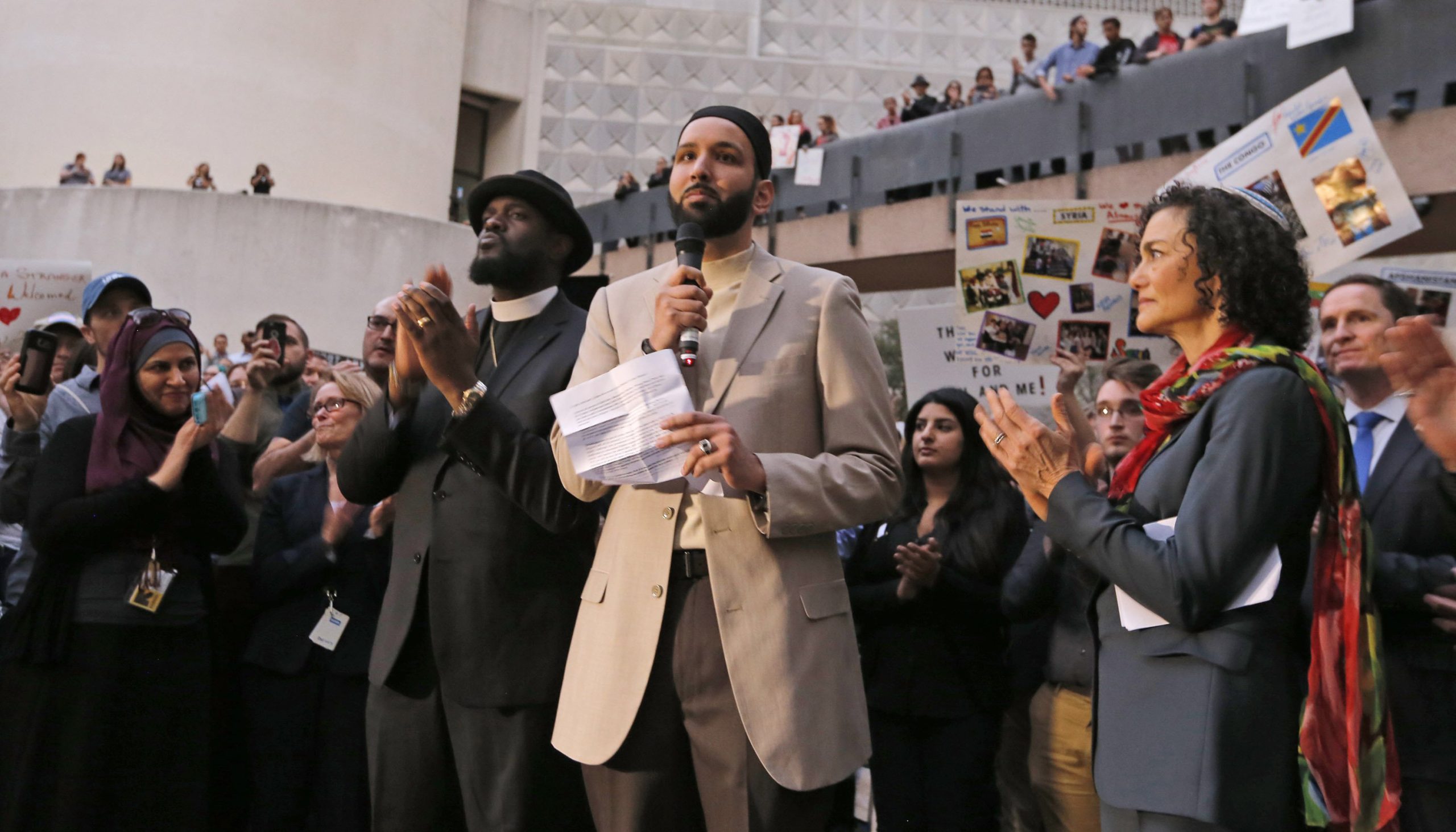
Suleiman has also taken part in interfaith panels with Jewish and Christian leaders—dialogues that have reached wide audiences on social media. In 2018, for example, Suleiman took part in an interfaith discussion with Rabbi David Stern, an avowed Zionist rabbi of the Reform Temple Emanu-El in Texas, and the Rev. Dr. Christopher Girata, Rector of Saint Michael and All Angels Episcopal Church in Dallas, Texas. The dialogue went viral online, reaching 14 million views. As part of his efforts to strengthen interfaith ties between Islam and Judaism, Suleiman also discussed the similarities between halal and kosher food and emphasized that he could join rabbis for shared meals, creating opportunities for closeness and interfaith dialogue.
Suleiman has also had a friendly relationship and public interactions with Rabbi David Stern, and the two have been seen together at various events and demonstrations, including a 2017 protest against President Donald Trump's executive order barring entry to Muslims from seven countries. In a follow-up interfaith panel in Texas in 2019, alongside Christopher Girata and Reform Rabbi Nancy Kasten, who works to promote interfaith dialogue in Dallas, Suleiman spoke about the notable similarities between Islam and Judaism as a basis for potential cooperation between the two religions.
Suleiman has also sought to highlight Jewish-Muslim solidarity by publicly condemning terrorist attacks against synagogues in the United States. When an antisemitic Christian attempted to bomb Temple Emanuel in Colorado in 2019, Suleiman expressed solidarity with the Jewish community. He described it as an antisemitic attempted terrorist attack and presented the threat as part of the danger that the far right poses to both Jews and Muslims. Suleiman issued a similar condemnation following the 2022 hostage-taking at Congregation Beth Israel in Colleyville, Texas, where an armed Muslim man held four worshippers, including the congregation’s rabbi, captive. Suleiman visited the synagogue after the attack, reflecting his commitment to condemning violence against Jews.
Following October 7 and the Escalation in Anti-Zionist Rhetoric
Although the events of October 7 hardened and intensified Suleiman’s stance toward Israel, a comprehensive review of his public messaging reveals a more complex picture, fraught with contradictions. Suleiman has always been a fierce opponent of Israel, a position reflected in some especially extreme statements. These included his call for a third intifada during Operation "Protective Edge," his comparison of IDF soldiers to Nazis, and his wish for the "death" of Zionism. However, these specific expressions by Suleiman became more moderate after 2015, and in one of his articles, he even issued a general apology for some of them.
Before October 7, Suleiman’s consistent anti-Zionist discourse focused more on universal messages such as “justice for Palestinians” and “equal rights.” The escalation prompted by the war in Gaza has also been reflected in controversial remarks about Jewish members of Congress and Israeli politicians. Suleiman sharply attacked Republican Congressman Randy Fine after he was photographed with Minister Bezalel Smotrich, writing that “their members of Congress are best friends with sanctioned terrorists.” He also sharply criticized House Speaker Mike Johnson, who spoke at Ariel University alongside an Israeli flag, describing him as "drenched in the flags of a nation committing genocide."
Suleiman has made similar remarks about prominent Americans who have strongly supported Israel. Following the assassination of conservative activist Charlie Kirk, Suleiman tweeted that while he opposed the act, he would not mourn Kirk's death. In a similar tweet following the passing of Senator Lindsey Graham, Suleiman expressed no sorrow; he cited Graham's staunch support for Israel along with several of his controversial remarks, including the claim that "Israel needs to take Gaza down like we did in Tokyo, Berlin."
At the same time, unlike other prominent imams in the United States, Suleiman condemned the killings and rapes committed during the October 7 attacks in the Gaza envelope, but did so in softened terms and without explicitly mentioning Hamas. His messaging was characterized by an asymmetry of empathy favoring the Palestinians, as several of his critics have pointed out. When asked directly about Israel, Suleiman avoided answering whether it has the right to defend itself, stressing instead that Israel's primary obligation is to protect those living under its occupation.
Despite his opposition to the Abraham Accords, Suleiman expressed full support for potential future regional agreements, provided they also address the Palestinian issue, without rejecting the very existence of a Jewish state. However, the prolonged war in Gaza and the expansion of settlements appear to have led Suleiman to question the feasibility of a two-state solution, and he hinted at support for a "state of all its citizens." In theory, he would likely support a two-state solution if it were a genuine possibility.
Regarding the heated pro-Palestinian campus demonstrations across America, Suleiman tended to agree that some had crossed the line and did not represent the true goals of the protest, but emphasized that they should not be judged by exceptional incidents. Following the mass shooting at a Chabad Hanukkah event in Sydney's Bondi Beach, Suleiman condemned the attack, expressing solidarity with the victims and praising the heroics of Ahmed Al-Ahmed, who tackled the gunman and prevented him from continuing his killing spree. Suleiman focused on Al-Ahmed's bravery as refuting the Islamophobic agenda that portrays Muslims in a negative light.
The deterioration in Jewish-Muslim relations following October 7 also affected Suleiman’s interfaith work to some degree, rendering dialogue "complicated," as he described it. Suleiman said he was disappointed by several of his Jewish and Christian dialogue partners who had refrained from publicly declaring that the war in Gaza constitutes "genocide." In addition, Suleiman emphasized that the issue was not simply the tension affecting Jewish-Muslim interfaith dialogue. He also pointed to Christian Zionism as one of the main factors behind the United States’ unconditional commitment to Israel. In light of this, Suleiman called for the "decolonization" of interfaith work in response to the events of October 7, aiming to free it from frameworks that, in his view, perpetuate power imbalances and injustice, while making the Palestinian issue and criticism of Zionism an integral part of Jewish-Muslim dialogue.
Overall, an examination of Suleiman’s anti-Zionist messaging shows that, despite its escalation during the war in Gaza, he has continued to condemn antisemitic incidents and to keep his activities and statements within the bounds of discourse that does not constitute explicit antisemitism. At the same time, as a prominent and charismatic Muslim leader with a broad public following, Suleiman could, if he chose, play a far more significant and active role in combating antisemitism instead of focusing solely on the Palestinian tragedy.
Suleiman's View: Between Israeli Policy and Jewish Communities
Suleiman’s messaging also sheds light on a broader debate between Israeli policymakers, whose negative view of him was reflected in the report, and some voices and organizations in the American Jewish community. In 2019, Rabbi Nancy Kasten, who took part in the widely publicized dialogue with Suleiman, described him as a trustworthy and important partner in interfaith dialogue, demonstrating a consistent commitment to Jewish-Muslim cooperation, solidarity with the Jewish community, and relationships built on trust and mutual respect. At an interfaith solidarity rally held the day after the 2016 murder of police officers in Dallas, Rabbi Stern also described Suleiman as “my teacher and friend.”
In terms of public standing and influence, Stern and Kasten are far less prominent than Suleiman, but they remain important voices in American Reform Jewish discourse. Stern has served as a congregational rabbi since 1996 and holds a prominent institutional position in Dallas, as well as influence in the national Reform movement, having served as president of the Central Conference of American Rabbis (CCAR). Kasten’s influence is more local and focused, but is especially evident in interfaith dialogue, social activism, and building ties between communities, as well as in her work with J Street. Unlike visits by senior American Jewish figures to Qatar and meetings between Satmar rabbis and Mamdani, Stern and Kasten’s dialogue with Suleiman appears to have been sincere and genuine, rather than an effort to whitewash his problematic image regarding Israel.
Although there is no clear public evidence of this, the events of October 7 likely put these relationships to a serious test and created tensions and divides between Suleiman and Jewish community leaders such as Stern and Kasten. Suleiman himself acknowledged that the war had plunged these relationships into crisis, and that his ties with some of the religious leaders with whom he had previously worked had been severed or seriously damaged.
Alongside the views of Stern and Kasten, and likely those of other Reform voices, Suleiman is viewed unfavorably by the broader American Jewish community, with a range of voices expressing sharp criticism. Jewish journalist Ron Kampeas, for example, discussed some of Suleiman’s inflammatory rhetoric from before October 7, including his comparison of IDF soldiers to Nazis, which he believes casts the imam in an extremely negative light.
Tensions surrounding Suleiman have also surfaced in the political sphere. In 2019, when he was invited to deliver the opening prayer in the U.S. House of Representatives at the invitation of Congresswoman Eddie Bernice Johnson, Jewish Congressman Lee Zeldin called the invitation a "terribly bad call," framing Suleiman as a negative and extreme figure. Sharp criticism of Suleiman has naturally echoed across various mainstream pro-Israel American Zionist circles. Nevertheless, according to Suleiman, the Dallas Jewish community itself would be the first to attest that he is not antisemitic—contrary to how he is perceived in other Jewish communities across the United States, and even more so in Israel.
Summary and Policy Recommendations
Omar Suleiman is currently considered one of the most prominent Muslim leaders in the United States and the most influential anti-Israel imam in America. However, it would be a mistake to ignore that he has denounced antisemitism, condemned terrorism against Jewish communities, and actively participated in interfaith dialogues with Jewish leaders. On the one hand, including Suleiman in the Diaspora Ministry's report serves Israel’s efforts to combat the delegitimization campaign, as some of his statements—such as comparing IDF soldiers to Nazis—are considered antisemitic under the IHRA definition. On the other hand, according to the Jerusalem Declaration on Antisemitism (JDA), his hostility toward Zionism does not in itself make him an antisemite. These two definitions are not necessarily mutually exclusive; in Suleiman’s case, they may complement one another. While some of his rhetoric fits the IHRA criteria for antisemitism, he may also be considered a partner in the fight against antisemitism. Beyond the fact that labeling him an “antisemite” is contested, doing so carries negative consequences that could harm Israeli interests in several respects:
- Rather than damage Suleiman’s public legitimacy, the label allowed him to cultivate an image as a political target, singled out by Israel for his consistent support of the Palestinians. It also turned the condemnation of him into a source of legitimacy and solidarity among his supporters. This appears to have strengthened his motivation to continue the campaign to delegitimize Israel and encourage others to join it, and may even have helped expand his support base.
- Labeling Suleiman an antisemite, despite his efforts to direct his sharpest messages against Israel rather than Jews, could have the opposite effect among many Muslims in America and the West. If a position that seeks to preserve this distinction is itself perceived as antisemitic regardless, then the motivation to maintain the boundary between anti-Zionism and antisemitism may weaken. This could increase the risk of more extreme rhetoric toward Jews, particularly among young people prone to binary thinking who have remained on edge since the war in Gaza.
- This situation further deepens the polarization that has grown since October 7 between Israel and the American Jewish community. It not only highlights the gap between the interests of Israeli officials and those of some Jewish communities in the diaspora, but also makes it harder for Jewish leaders to work with Muslim partners to combat antisemitism and promote interfaith relations. Israeli policy intended to protect diaspora Jews could therefore alienate potential partners in the fight against Jew-hatred, undermine Jewish-Muslim cooperation, and deepen the isolation of Jewish communities, thereby weakening their local resilience.
- Despite their hostile rhetoric toward Zionism, imams such as Suleiman continue to draw a clear red line against classical antisemitism directed at Jews and Jewish communities, thereby opposing radical Islamist organizations and far-right movements. The concern is that labeling them antisemites will not only erode the boundary they themselves draw between anti-Zionism and antisemitism, but also bring them closer to the views of more radical Islamist preachers. One indication of this can be seen in recent sharp criticism by Salafi figures of Dr. Abdul El-Sayed, the Democratic Senate candidate in Michigan, on the grounds that he is not “anti-Zionist enough.”
The effort to combat the delegitimization campaign led by Suleiman, particularly since October 7, should focus on intellectually challenging his ideas, refuting false claims, and exposing rhetoric that crosses the line from sharp political criticism into delegitimization. Among other things, he can be criticized for failing to explicitly and unequivocally condemn the October 7 massacre, and for not leveraging his influence to lead a significant campaign against antisemitism, despite his repeated condemnations of the phenomenon. In this context, Israel can adopt a carrot-and-stick approach: challenge Suleiman’s messaging while recognizing his interfaith efforts and his condemnations of antisemitism and terror. This distinction does not weaken Israeli criticism; rather, it makes it more precise and strengthens its credibility.
At the same time, Israel should develop English-language social media content tailored for Western Muslim audiences that presents the Jewish-Israeli narrative, while acknowledging Palestinian suffering and avoiding the conflation of support for Palestinians with hostility toward Israel or Jews. It should emphasize the Jewish people's historical and religious connection to the Holy Land without denying the Palestinian connection or being drawn into a competition over ownership. This would offer an alternative to the narrative promoted by Suleiman and others, rather than focusing on a personal campaign against them.
Israeli officials should also avoid treating anti-Zionist discourse as uniformly antisemitic. Including Suleiman in the report while overlooking his positive messages toward the Jewish community risks blurring the distinction between opposition to Israel and hatred of Jews. Overly broad labeling could weaken deterrence against antisemitism, erode the moral weight of the term, and undermine its ability to identify clear expressions of hatred toward Jews.
At the same time, it is important to recognize that this approach, which stops short of fully condemning Suleiman, also carries costs. It could normalize a figure who contributes to the delegitimization campaign against Israel, blurring the severity of his statements, and undermining the struggle against what is termed in public discourse as "the new antisemitism."
The recommendation to refrain from an absolute condemnation of Suleiman is not based on taking his views lightly, but rather on a sober assessment of the alternatives. Sweeping condemnation of him risks pushing an influential Muslim leader outside the spaces of dialogue and limiting the possibility of influencing the discourse he shapes. Israel’s approach to him should therefore be critical yet accommodating: it should oppose his anti-Zionist statements while preserving the possibility of clarifying boundaries, recognizing the distinction between opposition to Israel and hostility toward Jews, and maintaining a channel of influence with one of the most influential Muslim figures in the United States.