


Publications
INSS Insight No. 790, January 31, 2016
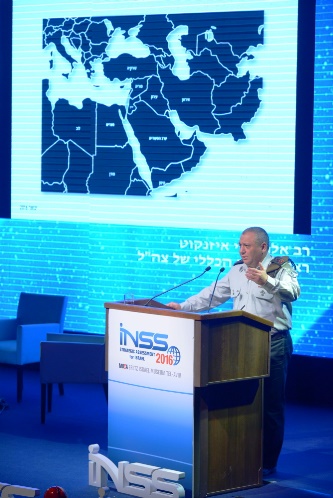
On January 17-19, 2016, the Institute for National Security Studies (INSS) held the latest conference in the INSS annual conference series, “Security Challenges of the 21st Century.” The conference raised a host of internal, regional, and global strategic issues that lie at the top of the agenda of decision makers in Israel and around the world. In the course of the conference, individuals with different, challenging approaches and various interpretations of the current situation engaged in far ranging discussions on a wide variety of subjects directly linked to Israel’s national security. The aim of this article is to bring together the key insights from the conference in a complete and coherent picture and use them as a basis for outlining policy recommendations to help the Israeli government contend with the challenges before it.
“Strategic Confusion”
The remarks of the experts and public figures who took part in the conference reflected fundamentally different perceptions regarding the main strategic challenge currently facing Israel. All the experts who commented on the state of affairs foresaw the continued disintegration of the old state order in the Middle East, though with no definitive direction for future development. They also emphasized that Israel has no leverage to shape a new order that could provide greater stability, reduce the influence of radical forces, and endow responsible actors with greater power and influence in the region. It was also widely estimated that this process would continue for an extended period and will therefore demand patience, flexibility, and the ability to adjust quickly to new situations.
Several experts from Israel and from abroad pointed to the Islamic State (Daesh) as the major strategic challenge facing not only Israel but the world as a whole and the Middle East in particular. This assessment is based on a broader view of the globalization of al-Salafiya al-jihadiya (the Salafi jihadist movement), which to some speakers amounts to World War III. Israeli President Reuven Rivlin himself specified Daesh as the major challenge, and emphasized that in addition to its activity on Israel’s borders, Daesh already has a presence in Israel stemming from its impact and inspiration among the margins of Arab society in the country. For this reason, maintained Rivlin, the primary task facing the State of Israel is investment in its Arab population in order to prevent the widening margins from being lured to embrace the Daesh destructive ideology. Rivlin also emphasized Israel’s responsibility for preventing the phenomenon’s expansion and for refraining from pointing accusing fingers at others.
In contrast, Israeli Defense Minister Moshe Ya’alon identified Iran as Israel’s major challenge and declared his preference for the Islamic State in the Golan Heights over Iran and its proxies – the Assad regime, Hezbollah, and the Iranian Quds Force. In this context, most experts who took part in the conference held that the nuclear agreement with Iran would not stop Tehran from extending support to terrorist elements, waging its subversive activity throughout the Middle East, or continuing its efforts to achieve regional hegemony. Moreover, Ya’alon emphasized, the nuclear agreement in practice provides Iran with a seal of approval for involvement in regional conflicts and supplies it with resources to support insurgent and rogue elements.
In contrast, Chief of Staff Lt. Gen. Gadi Eisenkot identified Hezbollah as the major military challenge currently facing Israel, following the recent buildup of its forces with tens of thousands of missiles, rockets, and unmanned aerial vehicles, which pose a threat to the Israeli home front. Eisenkot also maintained that Hezbollah has acquired extensive operational experience during its fighting in Syria alongside the forces of the Assad regime.
At the same time, a number of speakers singled out the Palestinian issue as the main strategic challenge currently facing Israel. This view is shared by a large portion of the Israeli public, as reflected in a public opinion poll recently conducted by INSS. According to this view, the status quo, chosen de facto by the State of Israel as its preferred current option, is not maintained in practice – as reflected in the recent outburst of terrorist attacks launched by individuals (which are extremely difficult to identify in advance and thereby foil) and fueled by radicalization in Palestinian society inspired by Daesh. This has also had a negative impact on Israeli society by harming Israelis’ sense of personal security and by increasing internal radicalization and polarization. In the context of Israeli society, Israeli author David Grossman sounded warning bells when he warned of the collapse of the “Israeli home” as a result of Israel’s action – or to be more precise, inaction.
According to the situation assessment of Israeli policymakers, the current dangers stemming from the options that deviate from the status quo outweigh the opportunities they present. However, the lack of an agreed upon definition of the major strategic challenge facing Israel, the ensuing differences in prioritization of the threats, and the failure to identify opportunities constitute a state of “strategic confusion.” In sharper terms, the chaos currently characterizing Israel’s strategic environment has resulted in intellectual chaos and the perception of the status quo as the best possible option. Alternative options require initiative and proactive measures aimed at shaping a different reality, even though they involve a high level of uncertainty.
Prominent Trends
The conference proceedings highlighted three primary trends that are currently interwoven in most developments in the Middle East.
From a distinct state-based structure to the emergence of non-state forces: The weakening of states in the region has created a vacuum of governance that has been penetrated by other actors and, in parallel, has strengthened ethnic, religious, cultural, and community elements at the expense of state-based identities. This phenomenon has been particularly prominent in the violence-ridden countries of Syria, Iraq, Libya, and Yemen, and is also present in lower intensity in more stable countries such as Saudi Arabia, Jordan, and Lebanon, and sub-state entities such as the Palestinian Authority and the Hamas regime in the Gaza Strip. State identity has been most effectively preserved in countries with historical roots and traditions that go back centuries if not longer, such as Iran, Turkey, and Egypt. Despite the efforts of the countries of the West, first and foremost the United States, to re-impose the old order in failing states in the region, moving back appears to be impossible, and preparations must be made for the emergence of a new order and new structures in the region.
Increasingly shaky infrastructure for commitments, alliances, and long term cooperative efforts: As a result of the regional chaos, all parties have been forced to rely on short term overlapping interests, which can change instantaneously. In Syria, for example, the local actors shift their allegiances frequently in accordance with developments on the ground and external support. This dynamic is also visible on the interstate level. Indeed, as a result of the difficulty of generating long term commitments, it is currently difficult to imagine the signing of an agreement to end the wars in Syria or Iraq. The same is also true of the global level, as reflected in the limitation of the nuclear agreement between Iran and the world powers to just 15 years. That being the case, it is necessary to move to awareness of action based not on the long term but rather on short increments of time.
Consciousness as a means of achieving strategic aims in the region and beyond: If recent decades have witnessed a transition on the battlefield from warfare between regular armies to asymmetric warfare against hybrid enemies and the rise of terrorism, the current period is characterized by the prominence of consciousness-related components. Israel has also been drawn into warfare aimed at achieving an image of victory at the expense of the achievement of clear results on the battlefield that would enable it to bring about a better future. The most prominent example of such image-oriented warfare, however, has been the Islamic State, with its skilled usage of social media to sow fear and disseminate its ideas throughout the world. The Palestinian Authority is also engaged in an image-based campaign of consciousness against Israel in the international arena, aimed at debilitating Israel’s legitimacy as a member of the family of nations.
Strategic Reality
The three trends discussed above interweave within Israel’s strategic environment and are distinctly manifested within the following four mutually linked spheres:
The world powers: The essence of this sphere is competition between the United States and Russia for dominance in the region and influence over the prominent actors operating in it. Of all the major issues of contention between the world powers, Israel must remain particularly cognizant of two. The first is the extent of US and Russian involvement in solving the crises in the Middle East in general and Syria in particular as a barometer of their intentions and the depth of their commitment to their allies in the region. The second is the status of the United States as the power supporting Israel and the strength of this alliance, particularly in light of the many glitches that have been weathered along the way and Israel’s improving relations with Russia, primarily in terms of the coordination and the understandings between the two countries regarding the war in Syria.
The regional sphere: This sphere has been influenced by the sharpening divisiveness in the Middle East. The Sunni-Shiite religious rivalry has reemerged as a leading motif in the struggle for regional power, with Iran at the helm of the Shiite camp and Saudi Arabia leading the Sunni-Arab camp. These two countries are currently grappling with one another in an effort to achieve regional hegemony, and their struggle plays a central role in shaping the field on which the involved actors are operating. The spheres of struggle are diverse and characterized by different levels of intensity – from Syria, to Lebanon, to Yemen. Israel’s political-security position in this context is clear: based on its words and actions, Iran constitutes a primary threat to Israeli interests, whereas Saudi Arabia and its partners share common interests, including the struggle against the Islamic State and al-Qaeda.
The struggle within the Sunni camp sphere: Another struggle currently underway within the Sunni camp is between the Salafi jihadist idea, led by the Islamic State and al-Qaeda, and political Islam, led by Turkey and Qatar, which has been significantly weakened since 2013. The Salafi jihadist camp, which embodies a unique phenomenon with regional and global impact that currently is at the heart of international discourse, constitutes the core of this sphere. In the current decade, after a number of decades of formation and development, this camp has matured into a concrete threat to the foundations of the Middle East, primarily as a result of the Islamic State phenomenon. The subversion and evolutionism of this entity have, in practice, resulted in the erasure of the border between Iraq and Syria and the rupture of the state order and its replacement by caliphates. For Israel, the threat is posed by two elements The first is Islamic State activity in close proximity to the border with Israel – in the war in Syria, its efforts to achieve influence in Lebanon, its alliance with Salafi jihadist terrorism in the Sinai Peninsula, and its effort to penetrate Jordan. The second element is efforts to amass support among the Palestinian population in the Gaza Strip and the West Bank and among the Arab citizens of Israel.
The Palestinian sphere: In contrast to the other three realms, which have direct reciprocal impact on one another, the Israeli-Palestinian conflict is relatively isolated. The decline of national identity throughout large parts of the Middle East has pushed the Palestinian issue to the margins of the agenda after years of enjoying unified consensus at the center of the Arab-Muslim stage. Although the Palestinian population is an inseparable part of the environment and therefore influenced by regional trends (the recent wave of Palestinian terrorism in Israel has in part been inspired by Daesh), it is nonetheless not a player in the game whose rules are taking shape on the killing fields of Syria, Iraq, Libya, and Yemen. The Palestinian sphere highlights the gaps in Israeli society with regard to Israel’s character as democratic, Jewish, and secure state, as well as the implications of the lack of a political solution for Israel’s standing around the world. Although the advancement of Palestinian interests is not the top priority of the leading actors in the region, the issue paradoxically still holds great potential to change Israel’s regional status and the regional balance of power, which is a positive development depending largely on the actions of Israel.
Strategic Platforms
The most significant challenge facing Israel today is the need to identify elements that will provide it with maximal “strategic advantage” in shaping new political-security options. Careful consideration of the regional trends and strategic spheres outlined above suggests that Israel actually has a number of springboards that can serve as platforms for diverse initiatives to improve its standing and promote an agenda that serves its interests vis-à-vis its allies and enemies alike.
Strategic Platform #1 – The internal Israeli arena: The top priority in this context should be a reduction in the disparities between Israel’s Arab and Jewish populations. The cultivation of a deep and well established partnership that is not based on narrow interests has the potential to improve the national resilience of Israeli society and to moderate the expanding polarization between its various sectors. The current state of the Arab population in Israel invites negative impacts such as those of the Islamic State. Only true partnership, manifested in equal economic opportunity, will enable Israel to contend with its current challenges at home.
Strategic Platform #2 – The Palestinian issue: Changing the situation in the arena of the Israeli-Palestinian conflict is likely to constitute a game changer for Israel. The wave of Palestinian violence that erupted in the autumn of 2015 once again illustrated just how critical it is to advance a plan for changing the realities on the ground. However, aside from proposals for improving the Palestinians’ economic situation and fabric of life, Israel has no far reaching political vision. In light of the ongoing deadlock, a multi-track political plan in the Palestinian arena could lay a foundation for improving many aspects of Israel’s situation. Such a plan would be based on the track where there is most agreement: creating the conditions on the ground necessary for advancing a political settlement, alongside the accelerated development of infrastructure for a future Palestinian state (including in the Gaza Strip). A positive dialogue between Israel and the Palestinians could serve to fortify Israel’s strategic relations with Egypt and Jordan, with which it already has peace treaties, and serve as a platform that is of critical importance in its capacity as a precondition for the third platform.
Strategic Platform #3 – Advancing cooperation between Israel and Arab states: In light of Israel’s shared interests with the Sunni Arab countries – such as weakening Iran, fighting the Salafi jihadist camp, and strengthening responsible actors in Syria – Israel can help advance civil-economic programs in fields such as technology, water, agriculture, and energy. For their part, these said countries can assist in developing the infrastructure for a functioning Palestinian state, while promoting their shared and overlapping interests in the region. Later, by means of what can perhaps be considered another partial strategic platform, Israel can consider identifying partners (including temporary partners) – on the local level and among other actors, including non-state actors, along its border and deep within the Arab world – who have the capacity to become important forces in the contest for power in the region and with whom relations would serve to reduce uncertainty in the future.
Strategic Platform #4 – On the level of the world powers: The most urgent priority is restoring Israel’s special relationship with the United States. Despite close security relations, the political disagreements between the two countries have caused severe damage to Israel’s horizon in the region. It is therefore necessary to restore mutual trust and to move in the direction of full cooperation with the United States. In addition, Russia’s entry into the regional equation, through its intervention in Syria, has created a new situation for Israel. The maintenance of good relations and coordination with Russia gives Israel a unique advantage as a country simultaneously on good terms with both powers, which will enable it to take actions on which these two major powers agree. At the same time, it is important not to ignore China’s increased activity in the region, especially in the economic realm, as China can assist Israel in advancing economic and infrastructure projects within the territory of the Palestinian Authority. Maintaining balanced relations with the world powers, with clear precedence for the United States, can provide Israel with valuable strategic advantages.
As was emphasized in the conference discussions, in light of the developing trends in the Middle East, Israel has nothing to gain from sitting on the fence. The dynamic currently taking shape in the region presents Israel not only with new threats but also, and sometimes simultaneously, with new opportunities. That being the case, the challenge is to identify the directions in which Israel can take action to enhance opportunities that will provide it with a positive strategic horizon and not hesitate to take action. Taking the initiative is no longer a matter of choice: it is a matter of necessity.