Future Israeli Strikes in Syria: Shifting Dynamics? As Reflected in Syrian Discourse on the Social Media | INSS
go to header go to content go to footer go to search
INSS logo The Institute for National Security Studies, Strategic, Innovative, Policy-Oriented Research, go to the home page
INSS
Tel Aviv University logo - beyond an external website, opens on a new page
  • Campus
  • Contact
  • עברית
  • Support Us
  • Research
    • Topics
      • Israel and the Global Powers
        • Israel-United States Relations
        • Glazer Israel-China Policy Center
        • Russia
        • Europe
        • Antisemitism and Delegitimization
      • Iran and the Shi'ite Axis
        • Operation Roaring Lion
        • Iran
        • Lebanon and Hezbollah
        • Syria
        • Yemen and the Houthi Movement
        • Iraq and the Iraqi Shiite Militias
      • Conflict to Agreements
        • Israeli-Palestinian Relations
        • Hamas and the Gaza Strip
        • Peace Agreements and Normalization in the Middle East
        • Saudi Arabia and the Gulf States
        • Turkey
        • Egypt
        • Jordan
      • Israel’s National Security Policy
        • Military and Strategic Affairs
        • Societal Resilience and the Israeli Society
        • Jewish-Arab Relations in Israel
        • Climate, Infrastructure and Energy
        • Terrorism and Low Intensity Conflict
      • Cross-Arena Research
        • Data Analytics Center
        • Law and National Security
        • Advanced Technologies and National Security
        • Foreign Information Manipulation and Interference
        • Economics and National Security
    • Projects
      • Preventing the Slide into a One-State Reality
  • Publications
    • -
      • All Publications
      • INSS Insight
      • Policy Papers
      • Special Publication
      • Strategic Assessment
      • Technology Platform
      • Memoranda
      • Posts
      • Books
      • Archive
  • Database
    • Surveys
    • Spotlight
    • Maps
    • Dashboards
  • Events
  • Team
  • About
    • Vision and Mission
    • History
    • Research Disciplines
    • Chairman of the Board
    • Board of Directors
    • Fellowship and Prizes
    • Internships
  • Media
    • Communications
    • Video gallery
    • Press Releases
  • Podcast
  • Newsletter
  • Campus
Search in site
  • Research
    • Topics
    • Israel and the Global Powers
    • Israel-United States Relations
    • Glazer Israel-China Policy Center
    • Russia
    • Europe
    • Antisemitism and Delegitimization
    • Iran and the Shi'ite Axis
    • Operation Roaring Lion
    • Iran
    • Lebanon and Hezbollah
    • Syria
    • Yemen and the Houthi Movement
    • Iraq and the Iraqi Shiite Militias
    • Conflict to Agreements
    • Israeli-Palestinian Relations
    • Hamas and the Gaza Strip
    • Peace Agreements and Normalization in the Middle East
    • Saudi Arabia and the Gulf States
    • Turkey
    • Egypt
    • Jordan
    • Israel’s National Security Policy
    • Military and Strategic Affairs
    • Societal Resilience and the Israeli Society
    • Jewish-Arab Relations in Israel
    • Climate, Infrastructure and Energy
    • Terrorism and Low Intensity Conflict
    • Cross-Arena Research
    • Data Analytics Center
    • Law and National Security
    • Advanced Technologies and National Security
    • Foreign Information Manipulation and Interference
    • Economics and National Security
    • Projects
    • Preventing the Slide into a One-State Reality
  • Publications
    • All Publications
    • INSS Insight
    • Policy Papers
    • Special Publication
    • Strategic Assessment
    • Technology Platform
    • Memoranda
    • Posts
    • Books
    • Archive
  • Database
    • Surveys
    • Spotlight
    • Maps
    • Dashboards
  • Events
  • Team
  • About
    • Vision and Mission
    • History
    • Research Disciplines
    • Chairman of the Board
    • Board of Directors
    • Fellowship and Prizes
    • Internships
    • Privacy Policy and Terms of Use
  • Media
    • Communications
    • Video gallery
    • Press Releases
  • Podcast
  • Newsletter
  • Campus
  • Contact
  • עברית
  • Support Us
bool(false)

Publications

Home Publications INSS Insight Future Israeli Strikes in Syria: Shifting Dynamics? As Reflected in Syrian Discourse on the Social Media

Future Israeli Strikes in Syria: Shifting Dynamics? As Reflected in Syrian Discourse on the Social Media

INSS Insight No. 644, December 21, 2014

עברית
Udi Dekel
Orit Perlov
As presented in the Syrian social media, public opinion holds that damage to the US interest in Syria will lead to a conflict of interests between the US and Israel, and an American red light regarding Israeli action against targets belonging to the Assad regime within Syria – as long as the war against the Islamic State continues. It is believed that this strategy, which urges a strong response against the rebel organizations in Syria in response to Israeli attacks in Syria, will restore deterrence against Israel, because even if Israel is not worried about a military response from Syria or Hizbollah, it will take the American interest into consideration and avoid a confrontation with the US administration. This logic, however, should be assessed critically, as the coordination and strategic understandings with the US give Israel some leeway. The American administration understands Israel’s essential need to defend itself, and it is therefore difficult to believe that it would prevent Israel from taking action aimed at preventing a significant strategic arms buildup by Hizbollah.

According to a report from official Syrian sources, on December 7, 2014, Israel once again attacked targets near the Damascus International Airport and the Syria-Lebanon border. After the attack, the Syrian army announced that the attack was designed to boost the rebels' morale, following important victories by the regime in Deir ez-Zor, Aleppo, and other areas. Reporters who visited the area of the attacked sites relayed that a shipment of ground-to-ground missiles and advanced unmanned aerial vehicles (UAVs) systems had been hit. Serious damage to the military section of the Damascus International Airport, which serves as the gateway for arms and military aid – mostly from Iran and Russia – was also reported.

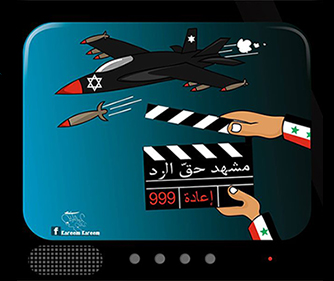
Following the attack, Israel’s alleged military operation sparked an extensive debate on the social networks in Syria; some 30 percent of the Syrian population are active social media users. A recurrent narrative was that from the beginning of the uprising against the Bashar al-Assad regime, Israel concluded that the regime, backed by Hizbollah and Iran, was focused on domestic challenges, and would therefore refrain from opening another front, i.e., against Israel. Furthermore, in the first stages of the civil war, the idea of retaliatory action against Israel seemingly had little legitimacy among the public. However, over time, the Syrian and Lebanese populations began to feel contempt toward the Assad regime and Hizbollah, due to their failure to respond to the attacks and their inability to translate the slogan "the right to respond" [in the right place at the right time] into action, leading Israel to believe that it enjoyed much freedom of action in attacking Syria.

At the same time, online discourse suggests that the window of opportunity that allegedly enabled Israel to act freely on Syrian territory against arms shipments and other targets without any response from the Assad regime and Hizbollah is closing. In February, an attack in the Beqaa Valley near the border between Syria and Lebanon was attributed to Israel. According to Voice of Lebanon radio, the attack targeted Hizbollah convoys transporting advanced rockets from Syria to Hizbollah stockpiles in the Beqaa Valley. Though not claiming responsibility, Hizbollah responded with three attacks in the Golan Heights and Har Dov, and over the next 10 months Israel reportedly refrained from attacking targets in Syria. Presumably Israel prefers to attack in Syrian territory in order to avoid provoking Hizbollah, which has recently bolstered its status as “defender of Lebanon” and gained self-confidence, following its proven capability (superior to that of the Lebanese army) in combating Sunni radical jihadist groups, primarily the Islamic State organization (IS) and Jabhat al-Nusra.

Discussion on the social networks suggests that Iran, Syria, and Hizbollah understand that their deterrence against Israel has weakened and that they must therefore devise a new strategy that demonstrates that the price Israel will pay for aerial attacks in Syria will be greater than the benefit derived from them.

At the same time, the online discourse among the leadership of the rebel groups in Syria reflects a sense of resentment over the price that they have paid for the Israeli attacks. The assumption is that the regime has chosen to respond to Israeli attacks by targeting the rebel groups Free Syrian Army (FSA) and Islamic Front (IF) and their supporting constituencies with a decisive blow. Online discussions also suggested that given the need to coordinate with Iran against IS, the United States was focusing its attacks on IS targets while refraining from attacks against Assad regime targets. At the same time, in the framework of strategic coordination with Israel, the US allows Israel to strike targets of the Assad regime and Hizbollah in Syria.

Posited, therefore, is that Iran has formulated a new strategy, based on a forceful response by the Assad regime and Hizbollah to any Israeli attack against regime or Hizbollah targets in Syria. According to this strategy, the regime’s response will be reflected in attacks against the leaders and infrastructure of the rebel organizations that are among the allies of the Western and Arab coalition – the Islamic Front, the Free Syrian Army, and the supporting civilian infrastructure. A comment posted on the internet by Jaysh al-Islam (part of the Islamic Front) leader Zahran Alloush about an hour after the December 7 attack in the Damascus area supports this theory. Alloush blamed Israel for the fact that “every time [Israel]…strikes Assad and Hizbollah targets, it gives Assad legitimacy to take revenge against the rebels.” According to this suggested analysis, this will counter American interests, weaken the “moderate rebel groups,” and strengthen the extremist organizations – Islamic State and Jabhat al-Nusra.

Assessment

The analysis of the discourse on the social networks reflects public opinion among the groups opposing the Assad regime, and leads to : (1) An attack by Israel against the assets of Assad/Hizbollah (2) prompts an attack in response by the Assad regime against the rebel groups (FSA and IF) and the population; (3) consequently, the opposition is weakened and ISIS is strengthened, (4) which undermines the efforts of the US in the war against the Islamic State, (5) and as a result, the US will demand that Israel now refrain from attacks in Syria.

The logic driving the Iranian strategy, as presented in the Syrian social media, is that damage to the US interest in Syria will lead to a conflict of interests between the US and Israel and an American red light regarding Israeli action against targets belonging to the Assad regime within Syria, as long as the war against the Islamic State continues. It is believed that this strategy, which urges a strong response against the rebel organizations in Syria in response to Israeli attacks in Syria, will restore deterrence against Israel, because even if Israel is not worried about a military response from Syria or Hizbollah, it will take the American interest into consideration and avoid a confrontation with the US administration. This logic, however, should be assessed critically, as the coordination and strategic understandings with the US give Israel some leeway. The American administration understands Israel’s essential need to defend itself, and it is therefore difficult to believe that it would prevent Israel from taking action aimed at preventing a significant strategic arms buildup by Hizbollah.

To date, Israel’s policy has been to avoid involvement in events in Syria and Lebanon while strengthening defense, mainly along the border and against high trajectory weapons. At the same time, Israel has reportedly taken action against immediate threats, including the transfer of weapons from Syria to Lebanon that threaten to detract from its military advantage. Israel has kept a low profile and has not confirmed reports about the attacks, in part in order not to harm Assad’s dignity and force him to respond. In the past, it has been the US that has revealed that attacks were carried out by Israel; the administration may have been eager to disavow responsibility for the attacks. However, in contrast to previous incidents, the administration did not respond to the most recent attack and did not make any announcement, official or unofficial, that the attack had a negative impact on the US struggle against the Islamic State.

Since the formation of the Western and Arab coalition against IS, rumors have been circulating that some of the coalition members regard the Assad regime as a partner in the war against the Islamic State, and as part of the future solution in Syria. Iran’s status in the region has also greatly improved, following its efforts against the Islamic State on the side of and in coordination with the coalition. Iran has made its contribution to the war against the Islamic State and the utilization of the its Quds force and Shiite militias conditional on the coalition not taking action against the Assad regime. Iran may therefore attempt to drive a wedge between Israel and the US by delivering a message that Israeli attacks damage the joint effort against the Islamic State. If no related development ensues, Iran may encourage action by Hizbollah and possibly also by Assad’s forces in response to an Israeli attack, in order to illustrate that a change has occurred in the balance of power and the rules of the game in the region.
The opinions expressed in INSS publications are the authors’ alone.
Publication Series INSS Insight
TopicsLebanon and HezbollahSyria
עברית

Events

All events
Iran, US, Israel, and the Global Jewish Community
10 March, 2026
12:00 - 13:00
Shutterstock

Related Publications

All publications
Stringer/dpa via Reuters Connect
“The Roaring Lion”—Hezbollah’s War for Survival
Why did the weakened organization decide to open a front against Israel following its strike in Iran, how does this campaign differ from previous campaigns in the north, and how should Israel respond?
24/03/26
REUTERS
The Lebanese Army—The Challenge for Israel Given the Gap Between Vision and Reality
The Lebanese Army is the weak link on the path to realizing the vision of Lebanon’s new leadership, which seeks to repair and rehabilitate the state. A central aspect of implementing this vision is the collection of all weapons held by the militias, primarily Hezbollah, and their transfer to the Lebanese Army. This goal aligns with Israel’s interest in seeing Lebanon become a sovereign and functioning state, with a responsible central authority, whom Israel can address, that holds a monopoly on weapons through a strong army representing all elements loyal to the state. Hence, Israel and Lebanon share a common interest in strengthening the Lebanese Army so that it can implement government decisions while taking advantage of the growing weakness of both Hezbollah and Iran after the end of Operation Roaring Lion. The significant gap between the vision of Lebanon’s leadership, as reflected in its decisions against Hezbollah thus far, and its inability to realize that vision constitutes a challenge for Israel. This document presents the failures in the functioning of the Lebanese Army and concludes with recommendations for Israeli policy considering the current campaign, even though this document was written during the war and there is no certainty as to how it will end. Its importance also stems from the need to prepare for the international conference in Paris, which will focus on strengthening the Lebanese Army and whose date has been postponed until early April.  
15/03/26
Ammar Awad/REUTERS
The Campaign in Lebanon in the Eyes of the Israeli Public
A comprehensive analysis of public perceptions of security and trust in light of developments in the northern arena since October 7, 2023
23/12/25

Stay up to date

Registration was successful! Thanks.
  • Research

    • Topics
      • Israel and the Global Powers
      • Israel-United States Relations
      • Glazer Israel-China Policy Center
      • Russia
      • Europe
      • Antisemitism and Delegitimization
      • Iran and the Shi'ite Axis
      • Operation Roaring Lion
      • Iran
      • Lebanon and Hezbollah
      • Syria
      • Yemen and the Houthi Movement
      • Iraq and the Iraqi Shiite Militias
      • Conflict to Agreements
      • Israeli-Palestinian Relations
      • Hamas and the Gaza Strip
      • Peace Agreements and Normalization in the Middle East
      • Saudi Arabia and the Gulf States
      • Turkey
      • Egypt
      • Jordan
      • Israel’s National Security Policy
      • Military and Strategic Affairs
      • Societal Resilience and the Israeli Society
      • Jewish-Arab Relations in Israel
      • Climate, Infrastructure and Energy
      • Terrorism and Low Intensity Conflict
      • Cross-Arena Research
      • Data Analytics Center
      • Law and National Security
      • Advanced Technologies and National Security
      • Foreign Information Manipulation and Interference
      • Economics and National Security
    • Projects
      • Preventing the Slide into a One-State Reality
  • Publications

    • All Publications
    • INSS Insight
    • Policy Papers
    • Special Publication
    • Strategic Assessment
    • Technology Platform
    • Memoranda
    • Database
    • Posts
    • Books
    • Archive
  • About

    • Vision and Mission
    • History
    • Research Disciplines
    • Chairman of the Board
    • Board of Directors
    • Fellowship and Prizes
    • Internships
    • Support
    • Privacy Policy and Terms of Use
  • Media

    • Communications
    • Video Gallery
    • Press Release
    • Podcast
  • Home

  • Events

  • Database

  • Team

  • Contact

  • Newsletter

  • עברית

INSS logo The Institute for National Security Studies, Strategic, Innovative, Policy-Oriented Research, go to the home page
40 Haim Levanon St. Tel Aviv, 6997556 Israel | Tel: 03-640-0400 | Fax: 03-744-7590 | Email: info@inss.org.il
Developed by Daat ,Yael Group.
Accessibility Statement
This site is protected by reCAPTCHA and the Google Privacy Policy and Terms of Service apply.